
The top patio awnings right now are motorized retractable systems from brands like Markilux, SunSetter, and Stobag for most homeowners who want flexibility and durability, but the right pick depends heavily on your climate, your wall structure, and how much you want to spend. A mid-range motorized retractable with a quality acrylic fabric like Sunbrella will cover most situations and last 10 to 15 years with proper care. If you are in a high-wind area or want a permanent structure, a louvered pergola awning or a fixed system is the smarter long-term investment. This guide walks through every type, every major decision point, and every cost so you can stop guessing and start shopping. For a curated selection of quality awnings and patios, see our recommended products and local installers.
Top Patio Awnings Buyer's Guide: Types, Costs & Tips

Who this guide is for and what it covers
Whether you are a DIYer planning to spend a weekend with a drill and a ladder or a homeowner ready to hire a local awning company, this buyer's guide covers the full picture. You will find decision checklists, material comparisons, realistic cost ranges for both U.S. and UK buyers, and a section on vetting contractors so you do not end up with a poorly mounted system that rips off the wall at the first summer storm. I have pulled together manufacturer specs, EN 13561 wind-class data, ASCE 7 structural guidance, and real-world pricing so the advice is grounded rather than generic. If you are also weighing umbrella options, louvered roof systems, or accessories like misting fans and outdoor speakers, those are covered too.
Quick decision checklist before you shop
Answer these questions before you even look at product pages. They will narrow your options fast and prevent you from buying the wrong type of system entirely.
- What is the primary goal: shade, rain protection, or both?
- How wide and how deep is the area you need to cover? (Measure width and projection before anything else.)
- What is the wall or structural support you are mounting to: masonry, timber studs, steel header, or fascia board?
- What is your local climate like? High UV, frequent rain, regular winds above 20 mph, coastal salt air, or heavy snow loads?
- Do you want manual operation, motorized with a remote, or full smart-home integration?
- Is this a rental, a short-term home, or a long-term residence? (This affects how much you should invest.)
- Are you in a HOA community or a listed/historic building in the UK? Both can restrict awning types and colors.
- What is your realistic budget, installed, including any electrical work?
Patio awning types explained
There are five main categories you will encounter, and they behave very differently in use. Knowing the difference saves you from a refund conversation two months after install.
Retractable folding-arm awnings
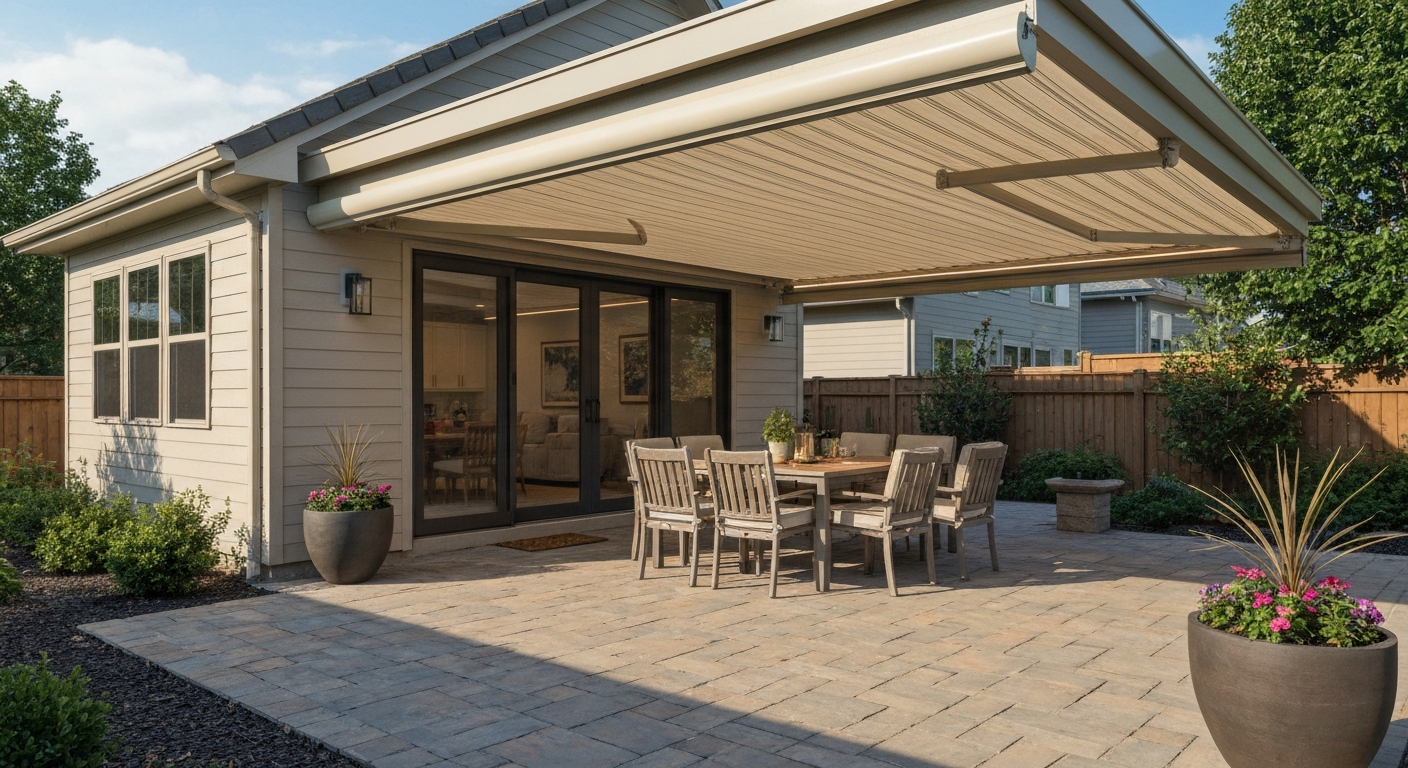
These are the most popular residential choice. The fabric and articulated arms fold back against the wall when not in use, protecting the fabric from prolonged UV exposure and preventing wind damage. They project anywhere from about 8 feet to 16 feet from the wall and span widths of 10 to 40 feet on residential-grade systems. Markilux, for example, rates its folding-arm models at wind-resistance class 2 to 3 under EN 13561, which corresponds roughly to 28 to 48 km/h (17 to 30 mph) depending on model and span. Above the manufacturer's declared wind limit, retraction is required, either manually or automatically via a wind sensor. This is not optional advice: EN 13561 normatively requires that retractable systems be retracted when site wind speed exceeds the declared limit. Motorized versions add a Somfy or equivalent motor (the Somfy Sonesse 40 family, for example, offers 3, 6, and 9 Nm torque options with RTS and io-homecontrol protocols) and can integrate wind and sun sensors for fully automatic operation.
Fixed (non-retractable) awnings
Fixed awnings are permanently extended and typically use a rigid frame covered with fabric or polycarbonate sheeting. They provide constant shade and rain protection with no moving parts to maintain. The tradeoff is that they take the full brunt of wind and snow loading year-round, which means structural attachment is critical. Fixed systems are generally better suited to mild or moderate climates and covered porches where the structural wall can handle the continuous load. In high-wind or heavy-snow regions, fixed awnings need to be engineered to local ASCE 7 wind speed and exposure category requirements.
Louvered roof and pergola awnings
Louvered roofs use motorized aluminum slats that rotate to control shade, airflow, and rain runoff. They sit on their own freestanding frame or attach to the house and can handle wind loads that would destroy a fabric retractable. Premium louvered systems (brands like Brustor, Weinor, and Renson) integrate LED lighting, heating elements, and motorized side screens into a single structure. The fabric pergola awning is a softer version: a tensioned or pleated fabric panel that extends across an overhead structure. Both types cost significantly more than fabric retractables and generally require professional installation with footings or wall brackets rated for the structural load.
Cassette and semi-cassette awnings
A cassette awning fully encloses the fabric and arms inside a protective housing when retracted. This dramatically extends fabric life because the material is never exposed to UV, bird droppings, or moisture while stored. Semi-cassette systems cover only the roller and leave the arms slightly exposed. If you are spending real money on a quality awning, the cassette option is worth the extra cost just in fabric longevity alone.
Motorized vs. manual systems
Manual crank systems are simpler, cheaper, and completely independent of electricity, which makes them a solid choice for smaller spans (under about 14 feet wide) and properties without nearby power. Motorized systems become genuinely worth the cost above that width because cranking a large awning repeatedly is tedious and discourages use. Motorized systems also allow wind and sun sensor integration, which is the single biggest factor in awning longevity: an awning that automatically retracts in a storm will outlast one that relies on a homeowner noticing the wind picked up.
| Awning Type | Best For | Wind Handling | Rain Protection | DIY Friendly | Typical Lifespan |
|---|---|---|---|---|---|
| Retractable folding-arm (manual) | Moderate climates, smaller spans | Retract below ~20 mph | Partial (slope-dependent) | Yes, for studs/masonry | 8–12 years |
| Retractable folding-arm (motorized) | Most residential patios | Sensor-auto retract | Partial (slope-dependent) | Possible, electrical needed | 10–15 years |
| Fixed / stationary | Covered porches, mild climates | Engineered to site loads | Good with proper pitch | Moderate difficulty | 10–20 years |
| Cassette awning (full) | Areas with prolonged storage needs | Retract below stated limit | Partial | Challenging; pro recommended | 12–18 years |
| Louvered roof / pergola | Premium, year-round outdoor rooms | High (aluminum structure) | Excellent (adjustable) | No; requires structural install | 20–30 years |
| Pergola fabric awning | Aesthetic shade, freestanding | Moderate | Moderate | Moderate difficulty | 8–15 years |
Umbrella options for patios
Umbrellas are the budget-friendly and flexible end of the patio shade market. They are not as capable as awnings for large-area coverage, but they are portable, require no installation, and can be repositioned as the sun moves. Here are the main types worth knowing.
Center-post (market) umbrellas
The classic design, with a central pole running through the middle of a table. They are affordable (often $80 to $350), widely available, and easy to set up. The drawback is obvious: the center pole sits in your table, which limits furniture arrangements and requires a hole-equipped table. Wind resistance is limited; most should be closed above 20 to 25 mph.
Cantilever (offset) patio umbrellas
An offset patio umbrella, also called a cantilever umbrella, positions its support pole to the side rather than through the center. The canopy hangs over the seating area from a lateral arm, which means no obstruction under the shade and full flexibility to position furniture any way you like. The base sits beside the seating area and typically uses a weighted base or sandbag ballast. Cantilever umbrellas range from about 9 feet to 13 feet in diameter and cost $200 to $1,200 depending on frame material and canopy quality. They are more susceptible to wind leverage than center-post models because of the extended arm, so closing them in winds above 15 to 20 mph is even more important.
Tilting and crank-lift umbrellas
Most mid-range and premium umbrellas now include a tilt mechanism that lets you angle the canopy toward lower sun angles in the morning or late afternoon. Combined with a crank-lift rather than a push-up mechanism, these are a significant usability upgrade over basic models and add only $50 to $150 to the price.
| Umbrella Type | Ideal Use Case | Space Required | Approximate Price Range | Wind Tolerance |
|---|---|---|---|---|
| Center-post / market | Small tables, tight spaces | Hole-equipped table needed | $80–$350 | Low; close above ~20 mph |
| Cantilever / offset | Open seating, loungers, no central obstruction | Large weighted base beside area | $200–$1,200 | Very low; close above ~15 mph |
| Tilting crank-lift | Angled afternoon shade | Same as center-post | $120–$500 | Low |
| Commercial patio (large market) | Restaurants, large decks | In-ground or heavy base | $500–$3,000+ | Moderate with locking collar |
Materials, fabrics, and waterproofing: what actually holds up
Fabric choice is where awning longevity is made or lost. The four materials you will encounter most are solution-dyed acrylic, PVC-coated polyester, open-weave mesh, and coated polyester. Each has a different performance profile on UV resistance, waterproofing, airflow, and weight.
Solution-dyed acrylic (e.g., Sunbrella)
This is the gold standard for residential awning fabric. The pigment is embedded in the fiber during manufacturing rather than dyed afterward, which is why Sunbrella offers a 10-year limited warranty against fade, mold, and mildew on its shade and marine fabrics. Sunbrella acrylic is water-resistant rather than fully waterproof: water beads on the surface and runs off at typical awning pitch angles, but the fabric breathes and will not form a watertight seal under sustained heavy rain. Hydrostatic head values for acrylic fabrics typically fall in the 350 to 700 mm range (tested per AATCC TM127 / ISO 811), compared to 1,000 to 1,500 mm or more for coated fabrics. If your patio needs to stay genuinely dry in heavy rain, you need a PVC or coated product. For a quick FAQ on that topic, see our guide section titled are patio awnings waterproof. For UV resistance, look for fabrics tested under ASTM G154 / ISO 4892 with published tensile-strength retention values, not just marketing colorfast claims.
PVC-coated polyester
PVC-coated fabric is fully waterproof, heavy, and durable. Hydrostatic head values commonly exceed 1,500 mm and can reach 3,000 mm or higher on commercial grades. The tradeoffs are weight (which stresses the awning mechanism), heat retention (PVC absorbs and traps heat under the canopy), and eventually surface cracking as the plasticizers age out in UV-heavy environments. It is the right choice for a fixed rain canopy over an entry or a carport-style structure, less so for a daily-use patio retractable in a hot sunny climate.
Open-weave mesh / shade cloth
Mesh fabrics are designed for shade, not rain protection. They allow airflow, which lowers the temperature under the canopy by reducing heat buildup, and they handle UV exposure well. Shade factor ratings typically run from 70 to 95 percent blockage. If you live in a hot, low-humidity climate like Arizona or inland Texas, a mesh awning or shade sail may actually be more comfortable than a solid acrylic canopy because of the airflow.
Coated polyester (mid-range)
Many mass-market awnings in the $200 to $1,000 range use coated polyester rather than solution-dyed acrylic. It is cheaper to produce, offers reasonable waterproof performance, but fades faster and degrades more quickly under sustained UV. If you are buying a lower-budget system, expect a 5 to 7 year fabric lifespan in a sunny climate versus 10 to 15 years for quality acrylic. Warranty terms often reflect this: budget brands typically offer 1-year coverage compared to Sunbrella's 10-year fabric warranty.
| Fabric Type | Waterproof Rating | UV Resistance | Breathability | Typical Warranty | Best Climate Use |
|---|---|---|---|---|---|
| Solution-dyed acrylic (e.g., Sunbrella) | Water-resistant (350–700 mm) | Excellent (10-yr fade warranty) | Good | 5–10 years | Hot/sunny, moderate rain |
| PVC-coated polyester | Fully waterproof (1,500–3,000+ mm) | Moderate (degrades over time) | Poor | 1–3 years (fabric) | High-rain, fixed canopy use |
| Open-weave mesh / shade cloth | Not waterproof | Good to excellent | Excellent | 1–5 years | Hot, dry, high-sun climates |
| Coated polyester (budget) | Water-resistant (500–1,000 mm) | Fair to moderate | Fair | 1 year typical | Mild climates, budget builds |
One more factor worth flagging, especially if you are in the UK or Europe near commercial spaces: fire classification. European building regulations reference EN 13501-1 for reaction-to-fire testing, and many commercial-grade awning fabrics are tested and declared at Euroclass B-s1,d0 or similar. In the U.S., NFPA 701 is the relevant test standard for flame propagation in textile awnings and membrane structures. Most residential installations never require tested fire-rated fabric, but if you are putting an awning over an exit, near a property line, or on a commercial-adjacent structure, it is worth checking local building codes.
Wind, sun, and rain: what works where
One of the biggest mistakes I see homeowners make is buying a system spec'd for California and installing it in coastal South Carolina or the Scottish Highlands. Climate drives almost every meaningful product decision, so here is a practical breakdown by condition type.
High-sun, low-rain climates (Southwest U.S., inland Texas, Southern California)
UV degradation is the primary enemy here. Prioritize solution-dyed acrylic or high-quality mesh fabrics with tested UV retention data (ASTM G154). Pale or white fabrics reflect more heat but show soiling faster; darker colors absorb more but disguise dirt. Frame finish matters too: powder-coated or anodized aluminum holds up to high-UV environments far better than painted steel. A retractable system with full cassette housing is worth the cost because the fabric is only exposed when you want it to be.
High-wind regions (Plains states, coastal New England, mountain West)
Map your local basic wind speed using the ASCE 7 wind speed maps (NOAA and the ICC also publish these) before specifying any awning. Use the Global Wind Atlas (DTU / World Bank) – high-resolution wind climatology to access site‑level wind speed maps for mapping awning suitability against ASCE/EN wind classes. If your site wind speed regularly exceeds 30 mph, a standard folding-arm retractable is only safe with an automatic wind sensor installed. A wind sensor tied to a Somfy or equivalent motor system will retract the awning the moment wind exceeds the threshold, which is exactly what the EN 13561 standard requires. For genuinely high-wind sites, a louvered aluminum roof system or a well-engineered fixed canopy is a more honest solution than a retractable you have to worry about every afternoon.
High-rainfall climates (Pacific Northwest, Southeast U.S., UK)
Rain protection depends on two things: fabric hydrostatic head (measured in mm per AATCC TM127/ISO 811) and awning pitch. A retractable awning needs at least a 5- to 15-degree pitch to shed water rather than pool it. Standing water on a fabric awning accelerates fabric breakdown and increases arm load. For genuine rain protection in the Pacific Northwest or the UK, a closed cassette with a sealed lower edge, or a fixed canopy with adequate pitch and guttering, is more reliable than an open retractable. PVC-coated polyester or laminated acrylic gives you the hydrostatic head numbers you need.
Coastal environments
Salt air accelerates corrosion on everything: frames, fasteners, springs, and motor housings. Within roughly 1 to 3 miles of surf, specify anodized aluminum frames (architectural anodize per AAMA/AA-class guidance), AAMA 2605 fluoropolymer powder coatings, and 316 stainless steel fasteners rather than standard zinc-plated hardware. Salt-fog testing to ASTM B117 or ISO 9227 is the standard used to validate coatings and fasteners for these environments, and premium awning manufacturers publish these test results. Budget systems with untreated steel components will rust significantly within two to three seasons in coastal conditions.
Cold-winter and snow-load climates (Midwest, Mountain states, Northern UK/Scotland)
Retractable awnings should always be retracted and preferably removed or fully cassette-enclosed before the first hard freeze. Snow accumulation on an extended fabric awning will collapse the arms. Fixed canopies in these regions need to be structurally engineered for snow loads per local code. PVC fabrics become brittle in sustained subfreezing temperatures; acrylic handles cold better.
Realistic cost ranges and budgeting guidance
Let me give you real numbers. The price ranges below are based on current market data and cover both U.S. and UK buyers. These are installed costs unless noted as DIY/supply-only. For specific pricing on motorized options, see how much are electric patio awnings.
U.S. cost ranges
- Basic DIY manual retractable (mass-market, coated polyester, 10–12 ft wide): $200–$700 supply only. Brands like ALEKO sold through Home Depot or Amazon. Short warranty terms (typically 1 year) and modest wind ratings (Beaufort 4, roughly 20–30 mph) are standard at this price point.
- Mid-range motorized retractable (quality acrylic fabric, Somfy motor, installed, 12–16 ft wide): $1,200–$3,500 installed. This is the sweet spot for most homeowners.
- Premium motorized with full cassette and wind/sun sensors (16–20 ft, Markilux / Stobag / SunSetter Pro tier): $3,500–$7,000 installed.
- Louvered pergola roof system (freestanding or wall-mounted, aluminum, motorized, 12x16 ft footprint): $8,000–$20,000+ installed, depending on size, accessories, and site conditions.
- Fixed canopy with custom fabrication and structural attachment: $1,500–$6,000 installed depending on size and substrate.
UK cost ranges
- Small manual awning (DIY, mass-market from B&Q or Outsunny/Primrose, 2–3 m wide): £120–£700 supply only.
- Professionally fitted domestic retractable (3–4 m wide, standard fabric, basic cassette): from around £1,000 installed.
- Mid-range motorized with cassette (4–5 m wide, quality acrylic, Somfy motor): £2,500–£5,000 installed.
- Premium bespoke motorized system (large span, full cassette, sensors, Markilux or equivalent): £5,000–£12,000+ installed.
- Louvered roof / bioclimatic pergola (professional installation, mid-size): £8,000–£18,000+ installed.
A few budgeting notes worth spelling out: electrical work for a motorized system adds $150 to $600 in the U.S. or £100 to £400 in the UK if a new circuit or outdoor outlet is needed. For a detailed breakdown of typical UK installed prices and what drives them, see how much are patio awnings UK. Permit fees vary by municipality and can add $50 to $300. Factor these in from the start. Also, do not use electric-system pricing without confirming whether the quote includes the motor, sensor, remote, and receiver as a package or as separate line items. Those add-ons can push a $2,500 quote to $3,500 quickly.
Installation, permits, and regulations checklist
Permits are the part that catches most homeowners off guard. Whether you need one depends on your municipality and the type of structure you are installing.
When permits are likely required
- Any fixed structure attached to the house that adds covered square footage (this varies but is common above 100–200 sq ft in many U.S. jurisdictions).
- Louvered pergola or freestanding roofed structure with footings.
- Electrical work beyond connecting to an existing outlet (new circuit, underground conduit, panel work).
- Properties in HOA communities (HOA approval is separate from and in addition to municipal permits).
- Historic districts or listed buildings in the UK (permitted development rights may not apply; planning permission may be needed).
- UK: Structures exceeding certain height or projection thresholds under permitted development rules.
Structural and electrical considerations
- Verify wall substrate before purchasing: masonry walls can use anchor bolts into mortar joints or through the block; timber-framed walls require mounting into studs or a structural header, not just sheathing.
- Manufacturer installation manuals (Markilux IO-1 and others) specify minimum fastener types, anchor sizes, and spacing. Large-span or high-load systems may require engineer-stamped calculations.
- Mounting height matters: arms need clearance to extend without obstruction; typical minimum mounting height is 7.5 to 8 feet above finished floor.
- Motorized systems need a dedicated weatherproof outdoor outlet within reach of the motor drive, or hard-wired connection by a licensed electrician.
- In the UK, any electrical work in a garden or external location must comply with Part P of the Building Regulations and is likely to require notification or sign-off from a registered electrician.
Measurement checklist: how to measure your patio correctly
This is the step people rush, and it costs them. Measure these dimensions before requesting any quote or placing any order.
- Mount width: Measure the clear, unobstructed horizontal distance on the wall where the mounting bar will attach. Note any obstacles: light fixtures, window frames, downspouts, outlets. The awning's physical bracket width will equal or slightly exceed the fabric width.
- Projection depth: Measure from the wall face out to where you want shade coverage to end. Standard residential retractables project 8 to 16 feet. Deeper projections require more arm length and structural capacity at the wall.
- Mounting height: Measure from the finished floor to the underside of the proposed mounting point. You need at least 7.5 to 8 feet of clearance for arms to articulate without hitting the floor or decking.
- Wall construction: Note the material (brick, stud-frame, poured concrete, EIFS stucco) and locate any structural headers above the target mounting area.
- Overhead clearances: Check for soffits, fascia overhangs, gutters, and roof pitch that might prevent the awning fabric from lying flat when extended.
- Load point spacing: Identify stud centers or masonry anchor points at the required bracket spacing specified in your chosen product's installation manual.
- Sun angle: Note which direction the patio faces (south-facing patios need maximum projection; east- and west-facing need tilt-adjustable or angled pitch to block low-angle sun).
- Electrical access point: Locate the nearest outdoor outlet or panel circuit access if you are planning a motorized system.
Accessories that genuinely upgrade your patio setup
An awning is a shade structure, not a complete outdoor living environment on its own. The accessories below are the ones that actually change how often and how comfortably you use the space.
Misting systems
A high-pressure misting system (800 to 1,000 PSI) running along the awning's leading edge or perimeter can drop the ambient temperature under the canopy by 15 to 25 degrees Fahrenheit in dry-heat climates. Low-pressure systems (line pressure, 40 to 80 PSI) work in hot-and-dry but create more moisture and can wet furniture in humid climates. Misting systems pair best with retractable awnings in the Southwest and Texas hill country. They are not a good fit for the Pacific Northwest, Florida, or the Gulf Coast, where humidity is already high.
Outdoor ceiling fans
A wet-rated ceiling fan mounted to a pergola or fixed structure keeps air moving and makes 85 degrees feel like 75. For louvered pergola systems, fans with integrated lighting are a clean solution. For retractable awnings, a freestanding oscillating fan is more practical because ceiling mounting is not an option when the structure is not permanent.
Outdoor speakers
Flush-mounted or bracket-mounted weatherproof speakers integrated into a pergola structure are unobtrusive and durable. For retractable awnings, wireless Bluetooth or Wi-Fi speakers on side walls or in planters are the practical choice since the awning itself has no fixed overhead structure to mount to.
Lighting
LED strip lighting along the awning valance or cassette housing provides ambient light and extends usable evening hours significantly. Louvered pergola systems from Weinor, Brustor, and similar brands offer integrated LED channels in the aluminum slat profiles. For retractable awnings, outdoor string lights or wall-mounted sconces are more practical since the awning does not stay in position permanently.
Patio heaters
Electric infrared heaters work well under fixed or louvered pergola structures. They mount overhead and heat people and objects directly rather than warming the air, which means they work even when it is breezy. Under a fabric retractable, keep heaters at a safe clearance distance (check manufacturer specs, typically a minimum of 3 to 4 feet from fabric) and never position a gas patio heater directly under a fabric canopy.
Smart controls and automation
Somfy's io-homecontrol and RTS ecosystems, as well as competing platforms from Nice and Gaposa, allow integration with smart home systems including Apple HomeKit, Google Home, and Amazon Alexa. A wind sensor is the most important single automation investment: it protects the awning automatically rather than relying on the homeowner to notice a change in weather. Sun sensors automate extension on bright days. Timer-based programming handles routine daily schedules.
Maintenance schedule and warranty checklist
Seasonal maintenance tasks
- Spring opening: Inspect fabric for mold, mildew, or winter damage. Clean with mild soap and water (not solvent-based cleaners on acrylic fabric). Check arm pivot points and joints for corrosion. Lubricate moving parts per manufacturer guidance (silicone spray on pivot pins; avoid oil-based lubricants on fabric contact points).
- Summer: Check that wind sensor is functioning before peak storm season. Remove debris accumulation on fabric immediately after storms. Do not leave the awning extended during thunderstorm warnings.
- Fall: Deep-clean fabric before storage season. Inspect cassette seals and drainage channels. Check electrical connections and motor housing for moisture intrusion.
- Winter (retractable systems): Retract and store or leave retracted. In freeze-prone areas, disconnect water from any integrated misting lines. Cover cassette housing with a breathable weatherproof cover if the system cannot be removed.
What to check in warranties
- Fabric warranty: Is it 5 or 10 years? Does it cover fade, mold, and mildew or only manufacturing defects?
- Frame/structure warranty: Is aluminum covered separately from fabric? 10 to 15 years is reasonable for quality frames.
- Motor warranty: Motor-component warranties are often separate from the awning warranty (Somfy motors typically carry a 5-year warranty; verify with the specific model).
- Labor and on-site service: Does the manufacturer or installer include on-site service calls or just parts replacement?
- What voids it: Most warranties are voided by wind damage if the awning was left extended above its rated wind class, improper installation on an unsuitable substrate, or use of unapproved cleaning products.
Quality indicators and what separates a good awning from a cheap one
After looking at a lot of awnings, there are a handful of physical signs that separate a product that will last from one that will frustrate you within three years.
- Arm pivot quality: Look for zinc-die-cast or stainless-steel pivots, not plastic or thin stamped steel. The pivot is the highest-stress point in the arm mechanism.
- Roller tube diameter: Larger diameter tubes (typically 60–80 mm for quality systems) reduce fabric stress during winding compared to thin 40–50 mm tubes on budget systems.
- Cassette construction: A full cassette with a fitted bottom rail seal prevents moisture and UV from reaching the stored fabric. Partial cassette or open-rafter systems offer much less protection.
- Fabric join quality: Fabric panels should be sewn or welded with double-stitched or heat-welded seams. Raw edges or single-stitched seams unravel faster under cyclic stress.
- Frame finish: AAMA 2605 fluoropolymer powder coat or architectural anodize is the quality benchmark for aluminum. Ask the retailer or installer which specification the finish meets.
- Motor sizing: The motor's nominal torque should be selected with at least a 20 percent safety margin over the calculated fabric-plus-arm load. An undersized motor will stall and overheat under normal use.
- EN 13561 wind class declaration: A quality manufacturer will declare the product's wind-resistance class under EN 13561. If a product has no declared class or vague claims, treat it as unrated.
DIY vs. hiring a professional
I am a genuine advocate for DIY when the conditions are right. But awning installation is one of those jobs where the conditions need to actually be right, not just approximately right.
When DIY works well
- Manual retractable awning, 10 to 14 feet wide, mounting into clearly identified timber studs or solid masonry.
- You have two people, a drill with proper masonry or wood bits, and a level.
- The wall is accessible from a standard stepladder without scaffolding or roof access.
- You are comfortable reading an installation manual in detail and following fastener torque specs.
- The system is under 60 lbs (most residential manual retractables) and does not require electrical work.
When you should hire a professional
- Motorized systems that require new electrical circuits or hard-wired connections.
- Mounting spans over 16 feet wide where the bracket load and structural verification matters.
- EIFS/stucco, cladding, or composite wall surfaces where waterproofing penetrations must be sealed correctly.
- Any louvered pergola or freestanding structure that requires footings, post bases, or engineer-stamped calculations.
- High-wind or coastal sites where the structural attachment must meet local building codes.
- Whenever the manufacturer's warranty is conditional on professional installation (this is common for premium brands).
How to vet and hire a local awning contractor
Finding a competent local installer matters more than many homeowners realize. A poorly installed awning on an unsuitable wall is a liability, not a feature. Here is the process I recommend. Manufacturer installation manuals require installers to verify mounting substrate suitability (masonry, structural timber studs, steel headers), list allowable fastener types/anchor sizes and minimum mounting heights; large‑span or high‑load systems frequently require site‑specific structural verification or engineer‑stamped calculations Manufacturer installation manuals (for example, markilux IO‑1 remote & installation safety / warranty / installation notes (manual)) require installers to verify mounting substrate suitability, list allowable fastener types and minimum mounting heights, and state when site‑specific structural verification or engineer‑stamped calculations are required..
How to find candidates
Start with manufacturer dealer locators: Markilux, SunSetter, Weinor, and Somfy all maintain lists of trained/certified dealers. If you are in Portland, consider local dealers such as May Awning and Patio (Portland) as an example of a manufacturer-listed installer with experience on residential retractable and fixed systems. This is more reliable than a general contractor search because these installers have been trained on specific product lines. Local searches for established awning businesses, including regional operators in the style of May Awning and Patio (a long-running regional awning company model with decades of local installation experience) or similar firms in your metro area, often turn up specialists who understand local climate conditions and building codes better than a general home improvement contractor. Check Google Business, Angi, and Houzz reviews, but also look up the company name directly in state contractor licensing databases.
Questions to ask every contractor before you hire
- Are you licensed as a contractor in this state/county? Can you provide your license number?
- Do you carry general liability insurance and workers' compensation? Can you provide a certificate of insurance?
- Have you installed this specific product or product family before? How many installs?
- Will you pull the permit if one is required, or is that the homeowner's responsibility?
- What is included in the installation warranty, and how long is it? Is it separate from the product warranty?
- Will you provide a written quote with itemized labor, materials, hardware, and any electrical sub-contracting costs?
- Who is responsible for the structural assessment of the mounting wall?
- Do you have recent local references in my neighborhood I can contact?
Red flags to walk away from
- No written quote or a quote with only a lump total and no line items.
- Pressure to pay in full before any work begins.
- Cannot provide proof of insurance or a license number on request.
- Dismisses permit requirements for a job that clearly needs one.
- No physical business address and no verifiable history of installations.
Practical next steps: from measurements to install day
- Complete the measurement checklist: record mount width, projection needed, mounting height, wall construction, and electrical access.
- Identify your climate priorities: is this primarily a sun, rain, or wind challenge? That determines awning type and fabric choice.
- Set your realistic budget inclusive of installation, electrical work, and permits.
- Choose your awning type from the comparison table in this guide based on your measurements, climate, and budget.
- Select fabric: solution-dyed acrylic for most situations, PVC-coated for full waterproofing, mesh for dry-heat climates.
- Decide on motorized vs. manual: motorized if the span is over 14 feet or if you want sensor automation.
- If hiring: gather three quotes from vetted installers using the checklist above. Verify licenses and insurance before accepting any quote.
- Confirm permit requirements with your local building department before scheduling installation.
- Plan accessory integration (misting, lighting, fans, heaters) before installation so conduit and connection points can be incorporated during the install rather than added later.
- Schedule installation in mild weather: extreme heat warps aluminum during installation and extreme cold makes fabric handling difficult.
Image and layout suggestions for this guide
The following visual assets would make this guide significantly more useful and scannable for readers.
- Hero image: A motorized retractable awning fully extended over a furnished outdoor patio, showing both the fabric canopy and the shaded seating area below. Mid-afternoon light from a side angle works best to show depth.
- Type comparison diagram: A side-by-side illustration of a folding-arm retractable, a fixed canopy, a louvered pergola roof, and a cassette awning, each labeled with key features (arms, cassette housing, louver slats).
- Measurement diagram: An overhead and elevation view of a patio wall showing the eight measurement points from the checklist, with dimension lines and callouts.
- Fabric close-up shots: Macro photos of solution-dyed acrylic, PVC-coated polyester, and open-weave mesh side by side to show texture and weave differences.
- Wind sensor and motor installation photo: A Somfy motor drive and wind sensor mounted on a cassette awning, showing the wiring and bracket positioning.
- Contractor vetting checklist graphic: A formatted two-column visual checklist of questions to ask contractors and red flags, suitable for saving or printing.
- Climate map graphic: A simplified U.S. map (and UK inset) color-coded by primary climate challenge (high UV, high wind, high rain, coastal) with recommended awning type overlaid.
- Before-and-after patio transformation: A split photo showing an uncovered patio and the same patio after awning installation, ideally with accessory lighting or misting visible.
FAQ
What exact product data and technical specifications must be gathered for each awning type (retractable, fixed, louvered, pergola, umbrella, motorized/manual)?
For each SKU or model gather: manufacturer and model number; type (retractable/fixed/louvered/pergola/umbrella/offset); dimensions (width, projection, clearance, roof pitch if applicable); fabric specification (material, construction, weight g/m², solution‑dyed or coated, hydrostatic head in mm or AATCC/ISO/EN test reference); frame materials and finishes (aluminum grade, anodize spec, powder coat specification e.g., AAMA 2605); connection and fastener specs (recommended anchor types, embedment depths, fastener grades, recommended substrate); wind‑resistance class (EN 13561 class or manufacturer-declared Beaufort / mph / km/h limit) and test method; motor/drive specs (motor family, nominal torque Nm, speed rpm or retraction/extension time, control protocols RTS/io/homecontrol/Z‑wave, internal brake, thermal protection); electrical requirements (voltage, current, isolator, conduit, conduit entry locations, surge protection/earth‑fault notes); safety and sensors (wind sensor type and trip thresholds, sun sensors, rain sensors, tilt stops, manual override); accessory interfaces (lighting bars, LED strips watts/m, speaker line‑outs, misting port, heater/fan mounting points); warranty breakdown (fabric, frame, motor, electronics — duration and conditions); tested fire classification where applicable (EN 13501‑1 / NFPA 701); installation manual reference and downloadable link; maintenance intervals and recommended procedures; declared useful life or expected longevity guidance; country/region of sale and any region‑specific model variants.
Which international and national standards are essential to cite or reference in a buyer’s guide and why?
Cite these core standards and explain their role: EN 13561 (external blinds/awnings) — wind‑resistance classes, performance tests, retraction directives (Europe); ASCE 7 — U.S. basic wind speed maps and design wind loads for anchorage and structural checks; AATCC TM127 / ISO 811 / EN 20811 — hydrostatic head / water column test for waterproofing claims; ASTM G154 / ISO 4892 — accelerated UV aging protocols for textile colorfastness and tensile retention; NFPA 701 and EN 13501‑1 — textile flame performance for public/commercial use and building‑regulation compliance; ASTM B117 / ISO 9227 — salt‑fog testing guidance for coastal corrosion resistance of fasteners and finishes; relevant electrical codes (UK: BS 7671 IET Wiring Regs; US: NEC) for motorized awnings; local building code references for required permits or load tests. Linking these standards lets readers map manufacturer claims to verifiable tests and local regulatory responsibilities.
What climate and site performance metrics should be provided to guide homeowners in choosing an awning for sun, rain, wind, and coastal conditions?
Provide site metrics: local design basic wind speed (ASCE 7 or local map) and typical gust statistics; mean annual solar radiation / UV index range and expected hours of direct sun; precipitation intensity and typical events (mm/hr or mm/day) and whether underdrainage or run‑off is needed; coastal exposure (distance to surf, salt spray classification) and recommendation for 316 stainless or architectural anodize/AAMA 2605 finishes; temperature extremes (min/max °C or °F) for material thermal performance; snow-load risk (rare for most awnings but required for fixed/pergola roofs); recommended hydrostatic head (mm) for waterproof fabrics by rainfall severity (e.g., >1,000 mm water column for heavy rain/wet roofing; 300–800 mm for light showers/water‑resistant); wind class mapping (map local wind speeds to EN 13561 classes or manufacturer speed thresholds and advise retraction triggers).
What realistic cost ranges and budgeting guidance should be included (separate notes for US and UK buyers and for DIY vs. professional installation)?
Provide tiered cost bands: DIY/basic (small umbrellas, DIY roll awnings, basic manual retractables): US <$200–$1,000; UK £120–£700. Mid‑range installed (domestic retractable with motor): US $1,200–$5,000 installed; UK ~£1,000–£4,000 fitted. Premium engineered systems (large pergola awnings, louvered roofs, integrated lighting/heating/misting, custom spans): US $5,000–$15,000+; UK £4,000–£20,000+. Motor adders: typical Somfy motor variants add US$200–$900 depending on torque/control; installation labor varies by site complexity and region (allow extra for electrical work). Accessory cost examples: LED lighting bars $150–$800, integrated speakers $200–$1,000, misting system $300–$1,500, infrared heaters $200–$1,200. Include contingency 10–25% for site remediation, structural reinforcement, or planning/permits. Note typical warranty scope affects value (longer motor/fabric warranties justify premium).
Which manufacturer specifications are critical when selecting motorized components and how should torque be sized?
Key motor specs: nominal torque (Nm), speed (s/turn or rpm), duty cycle, control protocol (RTS/io-homecontrol/Hardwired), integrated brake, thermal protection, IP rating for outdoor exposure, dimensions and mounting options, surge and lightning protection recommendations. Sizing rule of thumb: pick motor nominal torque with ≥20% safety margin above calculated required torque that includes fabric drag, arm friction and dynamic loads. Use manufacturer torque charts with given awning width/projection and fabric weight. Verify compatibility with cassette and gear ratios; confirm local electrician can supply required circuit and control wiring or choose wirefree with battery/solar if wiring is impractical.
What regulatory, permitting, and installation verification steps should homeowners expect to check?
Checklist: confirm whether planning permission or building‑control notification is required locally (UK: local planning authority if external appearance or highways/ listed building; US: check municipal building permits for structural additions); verify load path and substrate suitability per manufacturer manual — require engineer sign‑off for large spans or where mounting penetrates party walls/roof structure; electrical permitting for motorized awnings (UK: Part P / qualified electrician; US: local electrical permit and licensed electrician); fire and escape route considerations for fabrics near exits in multi‑unit or commercial installations; coastal/local conservation area restrictions and listed building consents. Keep installation documentation and manufacturer installation manual on file to validate warranty.