
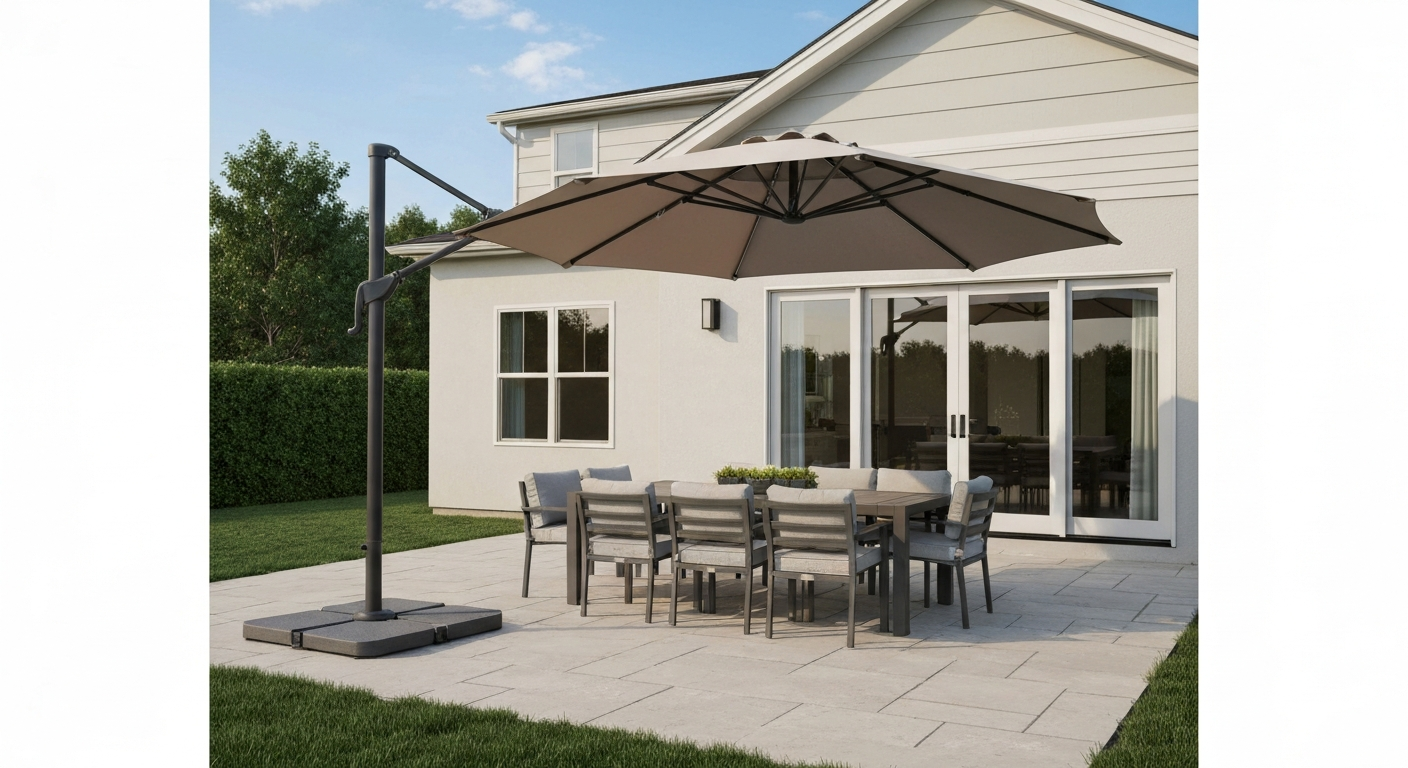
An offset patio umbrella (also called a cantilever or side-post umbrella) is a canopy supported by a vertical post positioned to one side of the shaded area rather than through the center of it. A horizontal arm extends from the top of that post and suspends the canopy overhead, leaving the space underneath completely clear. No pole in the middle of your table. No awkward placement around a fire pit. Just clean, unobstructed shade exactly where you need it.
What Is an Offset Patio Umbrella: Choosing, Sizing & Care

Elise Prescott
16 Jul 2026
What this guide covers and who it's for
If you've been staring at your patio trying to figure out how to get real shade without rearranging everything around a center pole, this guide is for you. Whether you're a homeowner doing weekend research, a DIYer ready to shop and install solo, or someone planning to call a contractor for a permanent mount, this article walks through everything you need to make a confident decision. I'll cover how offset umbrellas actually work, what sizes make sense for different spaces, which materials hold up in real weather, how they compare to center-pole umbrellas and patio awnings, what installation looks like depending on your setup, and realistic cost ranges from entry-level to premium. There's also a buying checklist and a basic maintenance plan so you know what you're signing up for long-term.
The clearest definition of an offset umbrella
The defining feature is geometry. On a traditional center-pole umbrella, the support mast runs straight up through the middle of the canopy. On an offset cantilever umbrella, the mast stands off to the side and a boom arm reaches out horizontally (or at an angle) to hold the canopy over an open area. That cantilevered arm is the engineering key: it transfers the canopy's weight and wind load back to the base through the post, so the shaded footprint can remain obstacle-free. Think of it like a crane. The hook hangs out over open air, but all the structural work happens behind it.
All the names you'll see in stores and catalogs
The same product gets called different things depending on the brand. Treasure Garden, Frankford, TUUCI, Wayfair, and Home Depot all label essentially the same style as 'offset,' 'cantilever,' or 'side-post' interchangeably across their catalogs and product pages. You'll occasionally see 'suspended umbrella' or 'parasol' in higher-end or European-influenced listings. For practical shopping purposes, treat all of these as the same category. When you search any of those terms, you're looking at the same type of product.
- Offset umbrella: the most common consumer term in the US, used heavily by big-box retailers
- Cantilever umbrella: favored by mid-range and premium manufacturers; emphasizes the structural arm
- Side-post umbrella: a descriptive name pointing to where the pole sits relative to the canopy
- Suspended umbrella or suspended parasol: used mainly in premium/architectural and European contexts
- Cantilever parasol: common in UK product listings and catalogs
Who actually gets the most out of an offset umbrella
Honestly, almost any patio setup benefits from removing the center obstruction, but a few situations make offset umbrellas the obvious choice. If you have a dining table where a center pole would block seating arrangements or be a constant nuisance, an offset solves that immediately. Hot tubs and swim spas are another perfect use case: nobody wants a pole to navigate around in the water. Outdoor sofas and sectionals in an L or U-shape also benefit because you can position the post at a corner and arc the canopy over the whole seating area.
For homeowners in sun-intense regions like Texas, Arizona, or Southern California, the ability to rotate and tilt the canopy to track the sun throughout the day is genuinely useful in a way that a fixed center-pole never manages. DIYers who want a weekend installation without cutting their deck appreciate that most mid-range offset umbrellas come with freestanding weighted bases. Designers and contractors working on hospitality projects or high-end residential patios lean toward commercial cantilever systems from manufacturers like Frankford or TUUCI precisely because those allow permanent concrete or in-deck mounts that look intentional and architectural rather than temporary.
How an offset umbrella actually works
Walk up to one and you'll see the same basic anatomy regardless of price point. The vertical post (sometimes called the mast) anchors into a base or mounting point and carries the full structural load. A horizontal or angled cantilever arm extends from the top of that post, and the canopy hangs from a hub at the end of the arm. What separates a $200 unit from a $2,000 one is mostly in the quality of the mechanical systems connecting those parts.
Core components
- Mast/post: the vertical support column, typically aluminum or steel; thickness and wall gauge matter for wind resistance
- Cantilever arm/boom: the horizontal member extending from the mast top; longer arms create more offset and more leverage on the base
- Canopy: the fabric shade panel stretched over a rib frame; attached to the hub at the end of the arm
- Hub and rib frame: the internal skeleton of the canopy; aluminum or fiberglass ribs determine canopy shape and resilience
- Base: either a heavy freestanding weighted base (often accepting paver stones), an in-deck sleeve, or a concrete/in-ground anchor
- Tilt mechanism: allows the canopy angle to change so you can track the sun; most mid-range models offer infinite tilt
- Rotation system: a 360-degree rotation hub lets you pivot the canopy direction without moving the base
- Lift/crank system: consumer models use a hand crank or worm gear; premium commercial models like the TUUCI Ocean Master MAX use a specialized gearbox or lead-screw lift, and some offer motorized/automated versions
The cantilever arm creates a moment force on the base, meaning the longer the arm and the bigger the canopy, the more downward and outward force gets applied to whatever the post is anchored to. This is exactly why base weight and mounting method are not optional afterthoughts: they're load-bearing decisions. A 200-pound paver base might be perfectly stable for a 9-foot residential umbrella in calm conditions, but a 13-foot commercial cantilever in a coastal environment needs a concrete footing or a 500-plus-pound paver frame.
Sizing, canopy shapes and how to plan your footprint
Consumer offset umbrellas are commonly sold in round, hexagonal, octagonal, square, and rectangular canopies ranging from about 8 to 13 feet in diameter or width. Commercial and architectural models from manufacturers like Frankford extend to 11 to 16 feet and beyond with custom configurations. The right size depends on what you're shading and where the post can actually go.
Sizing rules of thumb
- For a standard 4-person dining table (roughly 36 x 60 inches): a 9- to 10-foot round or square canopy typically provides full coverage with the post offset about 2 to 3 feet to one side
- For a 6- to 8-person outdoor dining set: a 10- to 13-foot canopy is a better fit; look at rectangular canopies if your table is elongated
- For a sectional sofa or L-shape seating arrangement: a 10- to 13-foot canopy positioned at the inner or outer corner of the L gives the cleanest coverage
- For a hot tub: measure the tub's longest dimension and add 2 feet on each side; a 10-foot canopy covers most residential hot tubs when the post is positioned at the back corner
- Clearance underneath: plan for at least 7 feet of clearance from the ground to the underside of the canopy ribs; most offset umbrellas hang the canopy at 7 to 9 feet when opened
Don't forget the base footprint. A freestanding weighted base for a 10-foot offset umbrella can take up 2 to 4 square feet on its own, and you'll want clearance around it so people aren't tripping over the frame. In tight spaces, an in-deck sleeve or concrete in-ground mount is worth the extra installation work because it eliminates the base footprint entirely. Placement planning also has to account for the direction the arm extends: the post will sit on one side of the shaded area, and you need to make sure that position is actually accessible and structurally usable in your space.
Materials and finishes: what actually holds up over time
This is where the real quality differences show up, and where I think a lot of buyers end up disappointed when they go too budget-focused. An offset umbrella takes a beating: constant UV exposure, wind loading, moisture cycling, and in coastal areas, salt air. The materials you choose determine whether you're replacing it in two years or still using it in ten.
Frame materials
| Material | Common Use | Durability | Weight | Notes |
|---|---|---|---|---|
| Powder-coated aluminum | Mid-range and premium residential | Very good with intact coating | Light to medium | Most common frame choice; coating can chip at connection points over time |
| Anodized aluminum | Premium and commercial | Excellent; no surface coating to fail | Light to medium | More corrosion-resistant than powder coat; used by TUUCI and premium brands |
| Fiberglass ribs | Premium canopy frames | Excellent flex resistance | Light | Used in high-wind and commercial models; flexes rather than breaking under load |
| Steel (powder-coated) | Entry-level consumer | Adequate in dry climates; rust risk in humid/coastal | Heavy | Lower cost; avoid in coastal or high-humidity environments |
| 316 stainless hardware | Marine-grade commercial | Excellent in coastal/saltwater | Medium | Used for fasteners and joints on marine-grade models like TUUCI Ocean Master MAX |
Canopy fabrics
Solution-dyed acrylic, marketed most prominently under the Sunbrella brand, is the industry benchmark for outdoor canopy fabric. The dye is worked into the fiber during manufacturing rather than applied to the surface, which means color doesn't fade off the top layer: it resists UV degradation uniformly through the fiber. Sunbrella's technical datasheets list the fabric as 100% solution-dyed acrylic and include UV transmittance data tested to AATCC Test Method 183 (UV transmittance through fabrics) and ASTM D6544 (textile preparation for UV testing). blank" rel="noopener noreferrer">Sunbrella technical data sheet (product specification PDF) confirms many product TDS details including composition as 100% solution‑dyed acrylic, typical weight, recommended uses such as umbrella/canopy, and cleaning/finish notes. For practical purposes, a quality solution-dyed acrylic canopy in good condition typically provides a UPF rating of 50 or higher.
Solution-dyed polyester and olefin fabrics are less expensive alternatives and perform adequately in moderate climates, but they fade faster under intense UV exposure and typically have shorter usable lifespans in sun-heavy regions like the Southwest or Florida. If you're in a climate where the umbrella goes up in April and comes down in October, polyester may be fine. If it's out most of the year in full sun, the premium for solution-dyed acrylic is worth it.
| Fabric Type | UV/Fade Resistance | Water Resistance | Typical Lifespan | Cost Level |
|---|---|---|---|---|
| Solution-dyed acrylic (e.g., Sunbrella) | Excellent; color-stable for 5-10+ years | Water-repellent (not fully waterproof); sheds light rain | 7-10+ years with care | Premium |
| Solution-dyed polyester | Good; fades faster than acrylic in intense sun | Water-repellent | 3-6 years | Mid-range |
| Olefin/polypropylene | Fair; UV inhibitors added but not as stable long-term | Water-repellent | 2-4 years | Budget |
| Coated polyester (laminated) | Fair; coating can degrade and peel | Better initial water resistance; degrades over time | 2-4 years | Budget to mid |
One important clarification on water resistance: most offset umbrella canopies are water-repellent, not truly waterproof. They shed light rain and drizzle well, but a sustained downpour will eventually get through the weave and seams. If you need fully waterproof overhead coverage, a fixed or retractable awning with a solid or sealed fabric is a better fit for that specific need. If you want a deeper answer on whether patio awnings are waterproof, see our guide titled 'are patio awnings waterproof' for details on materials, sealing, and maintenance. Patio awnings, including retractable options, are designed with waterproofing in mind in a way that umbrella canopies generally are not. For comparisons and buying recommendations on top patio awnings, see our guide to top patio awnings.
Weather performance and climate: what to expect and what to watch
Wind is the big variable with offset umbrellas, and manufacturers are pretty consistent on one point: close your umbrella when the wind picks up. TUUCI's operations manuals specifically recommend closing shade equipment when winds exceed about 25 mph, and they exclude damage above their stated operating guidance from warranty coverage. Frankford and Treasure Garden manuals give similar guidance, with most consumer and commercial products citing a 'close' threshold somewhere in the 25-to-30 mph range.
Published wind ratings vary significantly across the market. Consumer-grade models often cite operating ratings of 15 to 30 mph. Some commercial systems claim operating capacity of 35 to 60-plus mph when properly anchored with concrete footings or heavy paver bases, but that's very much a 'mounted correctly' qualifier. To put those numbers in context using the Beaufort scale: Beaufort Force 5 corresponds to roughly 19 to 24 mph (a fresh breeze that moves small trees), and Force 6 is 25 to 31 mph (a strong breeze where large branches move and umbrellas begin to fail if they're not properly secured or closed). The Beaufort Wind Scale (NOAA) maps wind speeds to Beaufort forces, for example, Force 5 is about 19–24 mph. For anyone in a coastal, plains, or mountain region where sustained winds regularly hit those levels, the mounting method and base weight become critical decisions, not optional upgrades.
Climate-specific considerations
- Hot and sunny climates (Texas, Arizona, Southern California): UV resistance is the priority; solution-dyed acrylic canopy and anodized or powder-coated aluminum frame are the right choices; rotation and tilt features add real daily value
- Coastal and humid climates (Florida, Gulf Coast, Pacific Northwest): salt air and moisture accelerate corrosion on steel and low-grade coatings; anodized aluminum and marine-grade stainless hardware are worth the premium; bring the umbrella in or close it during tropical weather events
- High-wind regions (Great Plains, mountain West): base weight and mount type are critical; oversized canopies in these areas need concrete or in-ground mounts and higher-rated commercial frames; freestanding bases are marginal in frequent high-wind situations
- Cold-weather climates (Minnesota, Colorado, Northeast): seasonal storage is non-negotiable; bring the canopy inside before first freeze; aluminum frames tolerate cold well but fabric and hub mechanisms benefit from dry indoor storage
- UK and Northern Europe: waterproof performance matters more than in most US climates; look for canopies with tighter weaves and DWR (durable water repellent) finishes; retractable awnings may outperform umbrellas for year-round UK use given sustained rain
Mounting and installation: portable base, in-deck, or concrete
How you anchor an offset umbrella affects its stability, its appearance, its portability, and your installation cost. There are three realistic options for most homeowners and contractors, each with genuine tradeoffs.
Freestanding weighted base
This is the most common consumer setup: the umbrella post slots into a base frame that accepts paver stones or sandbags to add weight. No drilling, no permits, fully portable. The tradeoff is footprint (the base frame itself takes up floor space) and practical weight limits. A 9-foot residential umbrella can be reasonably stable on a base loaded to 100 to 150 pounds in calm-to-moderate conditions. For anything larger or in windier locations, commercial-grade paver frames weigh 200 to over 800 pounds fully loaded. Frankford and Shadescapes publish paver base options that include frames listed at over 300 pounds, which gives a sense of what serious freestanding anchoring looks like.
In-deck sleeve
A sleeve or flange is embedded in a wood or composite deck during construction or retrofitted with some careful cutting and reinforcement. The post slides in and locks, eliminating the surface base entirely. Treasure Garden and other manufacturers offer compatible mount kits for this. It's a cleaner look and a more stable installation than a surface base, but it commits the post location and requires some carpentry competence for a retrofit. If you're building a new deck, planning the sleeve location upfront is a straightforward DIY step.
Concrete in-ground or footing mount
For permanent installations, commercial applications, or high-wind environments, a concrete anchor is the right answer. Treasure Garden, Frankford, and TUUCI all offer dedicated concrete mount kits sized to their product lines. This is typically a contractor job unless you're comfortable with footing work: you're digging a hole, setting a sleeve or anchor bolt pattern in concrete, and waiting for cure time before the umbrella goes up. The stability gain is significant, and it's the installation method that unlocks the upper end of commercial wind ratings. The tradeoff is permanence: relocating a concrete-mounted umbrella means breaking concrete.
DIY vs. calling a pro
A freestanding offset umbrella with a pre-weighted base is well within DIY range for most homeowners. Assembly typically takes one to two people and one to two hours. An in-deck sleeve retrofit is DIY-possible if you're comfortable cutting into your deck and understand deck framing well enough to add blocking where needed. Concrete in-ground mounts, anything involving a large commercial frame, or installations on rooftop decks or elevated patios are situations where I'd recommend at minimum a consultation with a contractor who does outdoor structures. Getting anchoring wrong on a large cantilever in a windy area is a real safety issue, not just an aesthetic one.
Offset umbrella vs. center-pole umbrella vs. patio awning
These are the three shade options most homeowners compare. Each makes sense in specific situations, and knowing the honest tradeoffs saves a lot of buyer's remorse.
| Feature | Offset/Cantilever Umbrella | Center-Pole Umbrella | Fixed or Retractable Awning |
|---|---|---|---|
| Pole obstruction | None under canopy | Pole runs through center of space | None; attaches to wall |
| Flexibility/portability | High with freestanding base; fixed with mount | High with portable base | Low; semi-permanent or permanent |
| Waterproof coverage | Water-repellent; not reliably waterproof | Water-repellent; not reliably waterproof | Can be fully waterproof depending on fabric and slope |
| Tilt and rotation | Most models offer both | Tilt available on many; rotation limited | Fixed pitch; retractable models open/close |
| Wind resistance | Moderate; close at 25-30 mph | Moderate; close at 25-30 mph | Higher with quality awning; retractables need wind sensor or manual close |
| Installation complexity | Low (base) to high (concrete) | Low to moderate | Moderate to high; wall attachment required |
| Typical cost range (US) | $150 to $16,000+ | $50 to $2,000+ | $500 to $10,000+ installed |
| Best for | Open seating areas, hot tubs, flexible coverage | Single table or bistro setup with center access | Covered patio extension, wall-attached, weather protection priority |
If waterproof overhead coverage is your primary need, a patio awning is the stronger solution. If you want pricing specifics for motorized options, look up how much are electric patio awnings to see typical cost ranges for entry-level retractable units through premium motorized systems. For local installation and custom awning options, consider contacting May Awning and Patio for professional advice and quotes. Quality awnings, including retractable options with motorized operation, are purpose-built for weather protection in a way offset umbrellas aren't. For more on waterproof, fixed or retractable awning options and installation guidance, see manual patio awnings uk. If you need waterproof overhead solutions, look into quality awnings and patios for retractable, motorized, and fixed options. Local examples include May Awning and Patio in Portland, which offers retractable and fixed patio awnings and installation services. On the other hand, if you want flexible, repositionable shade that doesn't require a wall attachment or a building permit, an offset umbrella gives you much more placement freedom. The center-pole umbrella wins only on simplicity and lowest entry price; once your space gets beyond a basic bistro table, the pole-in-the-middle problem makes it less practical than an offset.
Realistic cost ranges and what drives the price
The offset umbrella market spans an extraordinary price range, and understanding what you actually get at each level prevents sticker shock in both directions.
| Tier | Typical Price Range (US) | What You Get | Best For |
|---|---|---|---|
| Entry-level | Under $200 | Steel or thin aluminum frame, olefin or polyester canopy, basic crank, small base | Occasional use, renters, low-sun climates, short-term solution |
| Mid-range residential | $300 to $1,200 | Aluminum frame with powder coat, solution-dyed polyester or acrylic canopy, infinite tilt, 360° rotation, weighted base included | Most homeowners; daily use in moderate climates |
| Upper residential / light commercial | $1,200 to $3,500 | Heavier aluminum or anodized frame, Sunbrella-grade fabric, gearbox lift, concrete or deck mount kits available | Frequent use, sun-intense regions, design-forward installs |
| Premium commercial / architectural | $3,500 to $16,000+ | Marine-grade stainless hardware, anodized aluminum or fiberglass, premium fabric, motorized options, long warranties, design-assist support | Hospitality, high-end residential, coastal/commercial environments |
The Home Depot mid-range market gives a useful anchor point: a 10-foot commercial aluminum cantilever lists at around $899. At the premium end, a TUUCI Ocean Master MAX configured for a large residential or commercial patio has appeared at retail for around $16,295. Neither price is wrong for what it delivers; they're just solving different problems. For most homeowners with a standard residential patio and a real budget, the $400 to $1,200 range delivers reliable quality. UK shoppers should expect similar tiers with prices in GBP roughly equivalent to the US dollar amounts, with premium brands like Frankford and TUUCI available through European distributors. For specific local pricing and retailer comparisons, see our UK guide on how much are patio awnings UK to get typical costs and options in GBP.
Buying checklist: what to verify before you purchase
- Wind rating: confirm the published operating wind speed and the manufacturer's recommendation for when to close; for anything above a freestanding base in a low-wind area, verify what mount method is required to achieve that rating
- Canopy fabric: confirm whether it's solution-dyed acrylic, polyester, or olefin; for high-UV or coastal use, solution-dyed acrylic (Sunbrella or equivalent) is the minimum you should accept
- Frame material and finish: powder-coated aluminum is acceptable for most residential use; anodized aluminum or marine-grade stainless hardware is worth the cost in coastal or commercial settings
- Base or mount compatibility: confirm the base weight or mount type included and whether it's appropriate for your canopy size and local wind conditions
- Tilt and rotation capability: verify whether the model offers infinite tilt and 360-degree rotation if sun tracking matters for your orientation
- Lift mechanism: hand crank is fine for most residential use; gearbox or motorized lift is worth considering for large or frequently adjusted canopies
- Warranty terms: read what wind conditions void the warranty; reputable manufacturers like TUUCI are explicit about this
- Accessories available: check whether the manufacturer offers replacement canopies, LED lighting kits, valances, or side curtains that fit the specific model
- Replacement canopy availability: confirm you can buy a replacement canopy for that specific rib frame size in the future
Maintenance and seasonal care: a basic plan
An offset umbrella kept clean and stored properly will outlast one that's neglected by years. The maintenance isn't complex, but it has to be consistent.
Regular season maintenance
- Brush off dry debris (leaves, pollen, bird droppings) weekly; letting organic material sit on the canopy traps moisture and degrades fabric
- Clean the canopy monthly during heavy-use season with mild soap and water (Sunbrella recommends diluted dish soap and a soft brush); rinse thoroughly and let dry fully before closing
- Inspect the crank mechanism, rotation hub, and tilt joints each season opening; apply a light silicone or PTFE spray lubricant to moving parts as needed
- Check all fasteners at the base and arm connection points at the start of each season; retighten any that have loosened from use and vibration
- Close the umbrella whenever winds approach 25 mph; don't leave it open during thunderstorms or any weather event with gusts
End-of-season and winter storage
- Clean and fully dry the canopy before storage; storing damp fabric causes mildew even on acrylic
- Remove the canopy if possible and store it in a breathable bag in a dry indoor space; at minimum, use a fitted protective cover
- For climates with freezing temperatures, bring the entire umbrella inside or into a covered garage; aluminum tolerates cold but hub mechanisms and fabric can be damaged by ice and freeze-thaw cycling
- Inspect for any canopy tears, bent ribs, or frame cracking before storage; address repairs before spring so you're not discovering issues on the first warm day of the season
- For concrete or in-deck mounted systems, cap the sleeve opening over winter to prevent water from entering and freezing in the mount
When to hire a professional
A freestanding offset umbrella assembly is a reasonable weekend DIY project for most people. But there are specific situations where I'd push you toward calling a contractor or working with a manufacturer's design-assist team. Any installation involving a concrete in-ground footing, structural deck modification, or a rooftop application should be handled by someone who understands the structural loads involved. If you're specifying a large commercial system for a hospitality setting or a complex multi-unit residential project, manufacturers like Frankford and TUUCI offer design-assist and specification support specifically for that purpose. If you're comparing permanent shade solutions for a full patio renovation, a contractor familiar with outdoor structures can help you weigh whether an offset umbrella, a pergola with a retractable awning, or a fully engineered shade structure makes the most sense for your space, climate, and budget.
FAQ
What is an offset (cantilever/side‑post) patio umbrella?
An offset (also called cantilever or side‑post) patio umbrella is a freestanding shade canopy whose vertical support is positioned to one side instead of through the canopy center. A horizontal cantilever arm or boom holds the canopy over the desired footprint so seating or a table is unobstructed beneath. Manufacturers use the three terms interchangeably.
How does an offset umbrella work and what are its main parts?
Core components are: a vertical mast or post mounted to a weighted base or in‑ground footing; a cantilever arm/boom that projects the canopy; the canopy itself (various shapes and sizes); lift and adjustment mechanisms (crank, gearbox, worm‑drive, pulley or telescoping mast); rotation/tilt hubs for sun positioning; and a base or mount (portable paver/base, deck mount, in‑ground concrete footing). The cantilever arm transfers canopy load to the side post, allowing open space beneath.
What sizes and canopy shapes are available and how do I plan the umbrella footprint?
Common canopy shapes include round, square, rectangular, hexagon and octagon. Typical consumer sizes are roughly 8–13 ft across for round or equivalent rectangular footprints; commercial/custom units are larger (11–16+ ft or bespoke). Sizing rules: measure the area to shade, add 2–3 ft of overhang around primary seating/table for full coverage, and choose an umbrella canopy that covers that diameter or rectangular area. For table layouts, ensure the cantilever arm and base location permit the canopy center to clear furniture and circulation paths.
What materials and canopy fabrics should I choose for durability and climate?
Frame materials: powder‑coated or anodized aluminum and fiberglass ribs are common; premium commercial units use marine‑grade hardware (316 stainless) and corrosion‑resistant finishes. Fabrics: solution‑dyed acrylic (e.g., Sunbrella or equivalents) is the preferred premium choice for fade resistance, UV protection and coastal durability. Solution‑dyed polyester and olefin are lower‑cost options with shorter lifespans in intense sun. For wet climates, look for water‑repellent coatings and sealed seams if you need waterproofing (note: many canopies are water‑resistant but not fully waterproof). Choose finishes and hardware rated for local salt, humidity and freeze conditions.
How do lift, tilt and rotation mechanisms differ and why does that matter?
Entry models use simple hand cranks or pulley systems; better consumer and commercial models use worm‑gear/gearbox lifts or lead‑screw mechanisms for easier, safer operation under load. Tilt and 360° rotation hubs let you track sun without moving the base. Mechanism choice affects ease of use, longevity and maintenance—geared systems and sealed bearings are more durable for frequent adjustment and larger canopies.
What mounting and installation options are available and when is a pro recommended?
Three common mounting options: 1) Portable weighted bases or paver frames — best for renter/seasonal use or where drilling is not possible; require substantial ballast (often hundreds of pounds for larger canopies). 2) Deck/wood mounting kits — bolt into structural framing or engineered blocking; suitable for DIY when you can access framing and follow manufacturer specs. 3) In‑ground concrete footings — concrete pier or sleeve cast below frost line for permanent, high‑wind installations. Hire a pro when: local building codes or frost‑depth footing are required; you need structural/deck reinforcement; the umbrella is large/premium and requires specified anchoring; you want integrated electrical (lighting/heater/motorization) or custom hardscaping bases; or you are unsure about wind loads and anchor sizing.