
Most patio awnings are water-resistant, not fully waterproof. The difference matters a lot in real weather. A quality acrylic or polyester awning will shed light-to-moderate rain well, keep you reasonably dry, and bounce back fine afterward. But leave it pitched too flat, hit it with a heavy downpour, or let water pool on the fabric, and you will find its limits fast. Fully waterproof awnings do exist, typically built from vinyl/PVC or coated polyester membranes, and those genuinely stop water rather than just slowing it down. The right answer for your patio depends on the material, the slope it is installed at, and how serious your local rainfall gets.
Are Patio Awnings Waterproof? Materials, Types & Buying Tips

Elise Prescott
12 Aug 2026
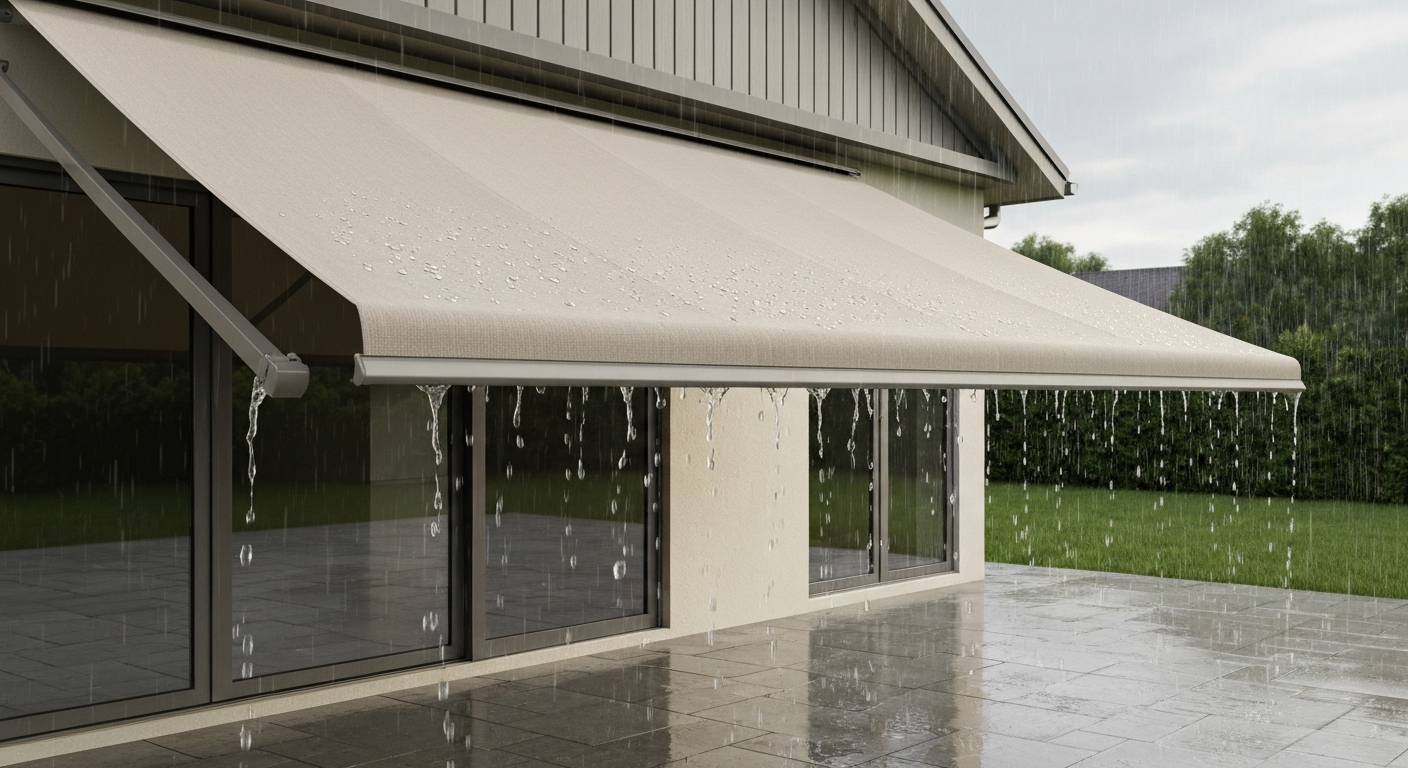
How different awning types hold up in rain
The structural type of your awning changes its rain performance almost as much as the fabric does. A fixed awning bolted permanently to the wall at a proper pitch will handle rain better than a retractable one you have left extended during a storm, because it is designed to drain continuously. Here is how the main types break down.
Fixed awnings
Fixed awnings are your best bet for consistent rain protection. Because they stay in one position, installers can set them at a deliberate slope (more on the right angle below) and add drip edges or gutters along the front. A well-installed fixed awning over a doorway or seating area does a genuinely good job of keeping rain off. The trade-off is that the fabric takes every bit of weather, year-round, so material quality matters more here than anywhere else.
Retractable awnings: open-roller vs. cassette
Retractable awnings split into two main forms. Open-roller systems expose the rolled fabric and mechanism to the elements all the time. Cassette (or closed-box) systems enclose the rolled fabric in a housing when retracted, which protects the fabric and hardware from sun and moisture when not in use. That protection matters for longevity, but neither system is designed to stay extended in heavy rain. EN 13561, the European standard that governs retractable awnings, is explicit about this: retractable awnings should be pulled in during heavy precipitation to prevent water pocketing and mechanical stress. If you want genuine rain coverage without having to monitor the weather constantly, a fixed structure or a motorised awning with a rain sensor is the more practical setup. Electric patio awnings with auto-retract sensors address this directly, and if you are comparing manual versus electric options or thinking about typical price ranges, that is worth a separate look.
Material-by-material rain performance
Fabric choice is where the waterproof question really gets answered. These are the materials you will encounter most often when shopping for awnings.
| Material | Water Performance | Hydrostatic Head (approx.) | Best For | Watch Out For |
|---|---|---|---|---|
| Solution-dyed acrylic (e.g., Sunbrella) | Water-resistant | ~400–450 mm | UV resistance, colour retention, mildew resistance | Not waterproof under sustained pressure; needs good slope |
| Solution-dyed polyester | Water-resistant to moderate | 400–800 mm (varies by coating) | Budget-friendly, good colour life | Degrades faster than acrylic without UV coating |
| Vinyl/PVC (solid) | Fully waterproof | 1,000–10,000+ mm | Maximum rain protection, easy to wipe clean | Heavier, less breathable, can crack in cold climates |
| Vinyl-coated polyester | Fully waterproof | 1,000–5,000+ mm | Rain protection with more flexibility than solid vinyl | Seam quality is critical; welded seams required |
| Aluminum (solid panel) | Fully waterproof | N/A (rigid panel) | Permanent structures, maximum durability | No fabric flexibility; more expensive to install |
| Polycarbonate (panel) | Fully waterproof | N/A (rigid panel) | Pergola-style roofs, allows light through | Can be noisy in heavy rain; yellows over time without UV protection |
Solution-dyed acrylic
Acrylic is probably the most widely sold awning fabric in North America and the UK, and it is genuinely excellent in many ways. It resists UV fading better than almost anything else in its price range, it fights mildew well, and it feels more like a premium canvas than a tarp. But I want to be straight with you: solution-dyed acrylic, including well-known brands in the marine and awning space, tests at around 400 to 450 mm hydrostatic head under AATCC TM127. That is well below the roughly 1,300 to 1,500 mm threshold that textile engineers commonly use as the practical dividing line between water-resistant and genuinely waterproof. In a steady downpour, especially on a flat or low-pitch install, water will eventually seep through. Keep the pitch steep enough, keep the fabric clean and re-proofed, and it will serve you well for years. But do not expect it to function like a PVC tarp.
Solution-dyed polyester
Polyester awning fabrics sit in a wide range depending on how heavily they are coated or laminated. Uncoated or lightly coated polyester performs similarly to acrylic in rain. Add a PU or PVC coating and the numbers climb meaningfully. If you are buying a budget awning and the spec sheet mentions a coated polyester fabric, ask specifically for the hydrostatic head rating before assuming it is waterproof.
Vinyl/PVC and vinyl-coated polyester
These are the genuinely waterproof options in the fabric awning world. PVC-coated polyester membranes, including the high-end architectural types used in tensile structures, commonly achieve hydrostatic head ratings from 1,000 mm up to well over 10,000 mm depending on weight and finish. Some premium products carry blank" rel="noopener noreferrer">PVDF fluoropolymer topcoats that extend UV resistance and outdoor service life significantly beyond plain PVC. The critical caveat with these materials is seam construction. A vinyl panel is only as waterproof as its weakest seam, and stitched seams with needle holes are leakage points unless they are sealed with heat-welded tape or hot-air welded entirely. Technical trade guidance and manufacturing references note that blank" rel="noopener noreferrer">high‑frequency (HF) or hot‑air welding (and compatible adhesive tapes/films) produce leak‑tight seams in PVC/TPU laminates, whereas stitched seams require seam‑taping, hot‑melt sealants or secondary welding to prevent needle‑hole leakage.
Aluminum and polycarbonate
Rigid panel systems sidestep the fabric debate entirely. Aluminum louvred or solid-panel awnings and polycarbonate sheet roofing are fully waterproof by nature. Polycarbonate has the advantage of letting diffused light through, which keeps a covered space from feeling like a cave, though it amplifies rain noise noticeably and cheaper grades yellow within a few years. If you are comparing these options to a fabric awning or thinking about pergola-style covers, they are worth serious consideration for anything that needs to function as a proper roof.
Water-resistant vs. waterproof: what those terms actually mean
These two terms get used interchangeably in marketing, which causes real confusion. Water-resistant means the fabric repels water under light contact and will not instantly absorb or pass moisture, but it will eventually wet through under sustained pressure or pooling. Waterproof means the material maintains a barrier under continuous hydrostatic pressure. The way this is measured is by the hydrostatic head test (ISO 811 in Europe, AATCC TM127 in North America), which applies increasing water column pressure to a fabric until water penetrates. The result in millimetres of water column tells you exactly how much pressure the fabric resists.
In practical awning terms: a fabric rated at 400 to 800 mm will handle a light shower and keep you reasonably dry, but a sustained heavy rain will eventually push through, especially at seams. Fabrics above roughly 1,300 to 1,500 mm are generally treated as waterproof in European textile guidance. Heavy-duty coated membranes used in commercial or permanent installations often exceed 3,000 mm. When you are reading product listings and a seller simply says 'weatherproof' without giving a number, that vagueness is itself a signal worth noting.
Seams, welds, and coatings: the details that stop leaks
The fabric's rating only tells part of the story. In real-world testing and in peer-reviewed research on coated textiles, seam construction is consistently the most common failure point. A stitched seam creates hundreds of tiny needle holes in a waterproof membrane. That is fine on a water-resistant acrylic, where the fabric itself is not trying to be a membrane, but on a vinyl or PVC-coated polyester awning claiming full waterproofness, those needle holes will leak.
What to look for in a genuinely waterproof fabric awning:
- High-frequency (HF) welded seams or hot-air welded seams: these fuse the PVC layers together without puncturing them
- Taped seams: a heat-seal tape bonded over stitched seams to seal needle holes, common in outdoor gear and quality awning panels
- Ultrasonic welding: used in some manufacturing for consistent seam strength in multi-layer coated textiles
- PVDF or fluoropolymer topcoats: extend UV resistance and reduce surface degradation, meaning the waterproof layer lasts longer before breaking down
- Factory-applied DWR (durable water repellent) finishes: help shed water from the surface but degrade with UV and cleaning over time and need periodic re-treatment
For acrylic or lightly coated polyester awnings where full waterproofing is not the goal, re-proofing sprays and wash-in treatments can restore surface repellency every few years. This is normal maintenance, not a sign of a bad product. What it does mean is that an acrylic awning that was performing fine in year two might start wetting through by year four or five if you have never re-treated it.
Slope, drainage, and design features that make a real difference
Even a fully waterproof fabric becomes a problem if it sags and pools water. Structural and installation decisions matter here just as much as material specs.
Pitch and slope
EN 13561, the European standard for external awnings, references a slope of around 14 degrees (approximately 25%) as a target incline for avoiding water pockets in retractable fabric awnings. In practice, most installers aim for at least 10 to 15 degrees on a fixed awning to ensure runoff. Flatter installations look sleeker but accumulate water, put stress on the fabric and frame, and push the fabric's water-resistance limits. If your site has constraints that force a low pitch, upgrading to a fully waterproof membrane rather than an acrylic becomes more important.
Front gutters and drip edges
A lot of awnings dump water off the front edge directly onto the patio or onto people walking underneath. A drip edge or integrated front gutter channels that runoff to the sides and away. On fixed awnings over doorways or seating areas, this is worth specifying upfront rather than retrofitting later.
Cassette designs and fabric protection
Cassette awnings enclose the rolled fabric in a box when retracted. This protects the fabric from UV and moisture when not in use, which helps preserve waterproof coatings and DWR treatments over time. It does not make the awning waterproof when extended, but it does extend the lifespan of whatever waterproofing properties the fabric has. If you are in a climate with frequent unexpected showers, a cassette system paired with a rain sensor makes considerably more sense than an open-roller setup.
Tension
A properly tensioned awning sheds water because the surface stays taut and angled. A loose or improperly installed fabric sags, creating low spots where water pools. Over time, that pooling stresses the seams, strains the frame, and overwhelms even a high-hydrostatic-head fabric. Tension is as much a waterproofing feature as the fabric itself.
How to read waterproof specs when you are shopping
When you are looking at awning product pages, here is what the technical language actually means in practice. If price is a key factor, check guides on how much are patio awnings UK to compare typical costs and the main factors that affect pricing.
| Specification | What It Means | Practical Implication |
|---|---|---|
| Hydrostatic head / water column (mm) | How much water pressure the fabric resists before leaking (tested per ISO 811 or AATCC TM127) | Below ~800 mm: water-resistant only. 1,300–1,500 mm+: practically waterproof for most conditions. 3,000 mm+: heavy-duty waterproof |
| DWR finish | Durable water repellent surface treatment applied to the fabric | Helps bead water off the surface but degrades over time; needs periodic re-treatment |
| PVDF topcoat | Fluoropolymer coating layer over PVC or polyester base | Significantly improves UV and weathering resistance; longer-lasting than plain PVC coatings |
| Welded seams | Seams fused by heat or high-frequency process rather than stitched | Critical for waterproof membranes; eliminates needle-hole leakage points |
| Taped seams | Sealing tape applied over stitched seams | Restores waterproof integrity at stitched joins; look for this on any awning claiming full waterproofness |
| Water-resistant label (no HH number given) | Marketing term without measurable claim | Ask for the actual hydrostatic head rating before purchasing |
If a product listing describes an awning as 'weatherproof' or 'water-resistant' without quoting a hydrostatic head number, that is not necessarily dishonest, but it leaves you with no way to compare it against alternatives. Reputable manufacturers and quality awning suppliers will provide the test standard and the number. For local suppliers and installation services, consider May Awning and Patio Portland as a nearby option. For example, May Awning and Patio provides hydrostatic head ratings and detailed specs on its product pages. For any awning you expect to handle regular or heavy rainfall, I would always ask for that figure before buying. For curated recommendations and models that meet high waterproofing standards, see top patio awnings.
When an awning will not be enough
Even the best awning has real limits, and knowing them upfront saves a lot of frustration and wasted money.
Heavy and sustained rain
A water-resistant acrylic awning in a genuinely heavy rainstorm is going to wet through eventually, particularly at seams and any low spots. Even waterproof vinyl awnings face the problem of volume: large amounts of fast-falling rain can overwhelm gutters and run off the edges in sheets rather than channelling away cleanly. If you live somewhere with regular heavy rainfall, a fabric awning is a partial shelter, not a roof replacement.
Standing water and pooling
Standing water is the fastest way to destroy any fabric awning, regardless of its waterproof rating. The weight alone stresses frames and attachment points dangerously, and sustained contact pressure eventually defeats even high-hydrostatic-head membranes. If your installation has any tendency to pool water due to a low pitch or sagging, that needs to be corrected structurally, not compensated for with a better fabric.
Wind-driven rain
Rain coming in at an angle under the awning is a different problem than rain falling straight down. No standard awning fully addresses horizontal or wind-driven rain without side screens or curtains added to the structure. This is especially relevant in coastal regions or open sites with consistent wind exposure.
Snow load
Snow accumulation is a structural risk more than a waterproofing issue. Most retractable fabric awnings should be retracted before snowfall. Fixed awnings need to be rated for snow load if you are in a region that gets meaningful accumulation. This is a conversation to have directly with your installer using local building codes as the baseline, not something to assess from a product spec sheet alone.
When to consider alternatives
If your rain exposure is serious enough that a fabric awning keeps failing your needs, a step up to a rigid structure is worth pricing out. Aluminum panel awnings, polycarbonate-roofed pergolas, and full patio covers provide rain performance that fabric simply cannot match. An offset patio umbrella is on the opposite end of the spectrum: convenient and flexible, but genuinely only useful in light rain. For buyers in the UK looking specifically for non-motorised options, manual patio awnings UK remain a popular and cost-effective choice. For the middle ground, a high-quality fixed awning with a waterproof PVC-coated fabric, proper slope, and integrated gutters comes closer to a true roof than most homeowners expect. For another relevant comparison, see what is an offset patio umbrella.
Maintenance, re-proofing, and keeping waterproofing intact
Buying a quality awning is only half the job. DWR and PU coatings degrade with UV exposure, abrasion, and repeated washing. For acrylic and lightly coated polyester awnings, re-proofing every two to three years is a reasonable baseline, though you may need to do it sooner if the fabric starts absorbing rather than beading water. Use a re-proofing spray or wash-in treatment compatible with your specific fabric type, applied to a clean, dry surface. For vinyl and PVC-coated awnings, the coating itself is more durable, especially with a PVDF topcoat, but it still benefits from regular cleaning to prevent mildew and surface degradation. Mildew is worth taking seriously: once it gets into an acrylic fabric, it can be very difficult to fully remove, and it degrades both the appearance and the fabric's water repellency. Clean regularly with a mild solution and let the fabric dry fully before rolling or folding.
Warranties, lifespan, and what to expect
Quality awning fabrics from established brands typically carry warranties of five to ten years against fading and deterioration. For local options on quality awnings and patios, consult reputable suppliers who provide hydrostatic head ratings and clear installation guarantees. The hardware, frame, and mechanisms often carry separate warranties, and these matter just as much for a retractable system. Cassette mechanisms and motors have more failure points than fixed structures, so look carefully at what the warranty actually covers. In terms of real-world lifespan: a quality fixed acrylic awning in a moderate climate, maintained properly, can last ten to fifteen years. A retractable system used daily in a harsher climate might need fabric replacement in seven to ten years. Vinyl and coated membrane fabrics used on permanent structures can exceed fifteen years, especially with a PVDF or fluoropolymer topcoat. Regional climate makes a significant difference here; what holds up a decade in the UK may degrade faster in Texas sun or Florida humidity.
Practical checklist before you buy
Before committing to an awning for rain protection, work through these questions honestly:
- How heavy and frequent is your typical rainfall? Light showers versus regular heavy rain changes the material spec you need
- What pitch can your installation realistically achieve? Aim for at least 10 to 15 degrees; if that is not possible, move to a waterproof membrane fabric
- Is this a fixed or retractable setup? If retractable, do you want a rain sensor to auto-retract, or are you comfortable managing it manually?
- Will you be in a cassette or open-roller retractable system? Cassette protects the fabric and coatings when retracted
- What hydrostatic head rating does the fabric carry? Ask for an ISO 811 or AATCC TM127 figure if rain performance matters to you
- Are seams welded, taped, or simply stitched? For any awning claiming waterproofness, seams should be welded or taped
- Does the awning include a front gutter or drip edge, or will you need to add one?
- What is the snow load rating if you are in a region with winter accumulation?
- What does the warranty cover specifically: fabric, hardware, mechanism, and installation?
- Have you got a quote from a local contractor who knows your regional weather and building code requirements?
Getting these answers before you buy will save you from the most common mistake homeowners make, which is choosing an awning based on looks and price alone, then being frustrated when it does not perform in real weather. A well-specified awning matched to your climate is a genuinely useful outdoor investment. One that is mismatched to your conditions is a recurring maintenance headache.
FAQ
Core question: Are patio awnings waterproof?
Short answer: It depends. Some awnings (PVC/PVC‑coated polyester and welded membrane systems) are designed to be fully waterproof; most common fabric awnings made from solution‑dyed acrylic or uncoated polyester are water‑resistant (shed ordinary rain) but not fully waterproof. Whether an installed awning stays dry also depends on seams, slope, tension, drainage and how it’s used (retractable units should usually be closed in heavy rain).
How do common awning materials perform in rain?
Acrylic (Sunbrella style): highly UV and mildew resistant but typically water‑resistant only (low hydrostatic head). Solution‑dyed polyester: similar to acrylic unless factory coated. Vinyl/PVC and PVC‑coated polyester: can be fully waterproof; ratings vary by weight/coating. Vinyl‑coated polyester with weldable seams and high hydrostatic head give true waterproofing. Aluminum and polycarbonate (hard roofs): fully waterproof as rigid roof systems, not fabric.
What is water‑resistant vs fully waterproof for fabrics?
Water‑resistant fabrics resist light rain and spray but will leak under sustained pressure, pooling or heavy wind‑driven rain. Fully waterproof fabrics have a high hydrostatic head (typically well over ~1,300–1,500 mm) and leak‑tight seams or welded joins so water cannot penetrate under expected loads.
What is hydrostatic head and why does it matter?
Hydrostatic head (water‑column) is a laboratory measure (mm H2O) of how much water pressure a fabric can withstand before leaking. Higher numbers = better waterproofing. Practical thresholds: ~1,300–1,500 mm is often used as a boundary for 'waterproof' in textile applications; coated/vinyl membranes can reach thousands of mm.
How do seams affect waterproofing?
Seams are the most common leakage point. Welded seams (hot‑air, HF, ultrasonic) or factory heat‑sealed joins in coated membranes can be leak‑tight. Stitched seams require seam‑tape, weldable hems or seam‑sealing to prevent needle‑hole leaks. For waterproof performance, check how the manufacturer constructs and seals seams.
Do retractable awnings offer waterproofing?
Most retractable fabric awnings are not intended to be left out in heavy rain; even water‑resistant fabrics can sag and collect water. Some retractable systems use waterproof fabrics and cassettes that protect the fabric when stowed, but standards and manufacturers commonly advise retracting in sustained/heavy precipitation to avoid pooling and damage.