
The best patio for Colorado Springs outdoor dining is a covered, hardscape space oriented to avoid west-facing afternoon sun, built from concrete, pavers, or composite decking, and equipped with at least one shade structure and a ceiling fan or misting system. That combination handles the real challenges here: intense UV, afternoon heat, surprise hail, spring wind gusts, and freeze-thaw cycles that destroy lesser materials over time. If you get those fundamentals right, the rest is personal taste and budget.
Best Patio Colorado Springs: Dining, Materials, Costs

Elise Prescott
21 May 2026
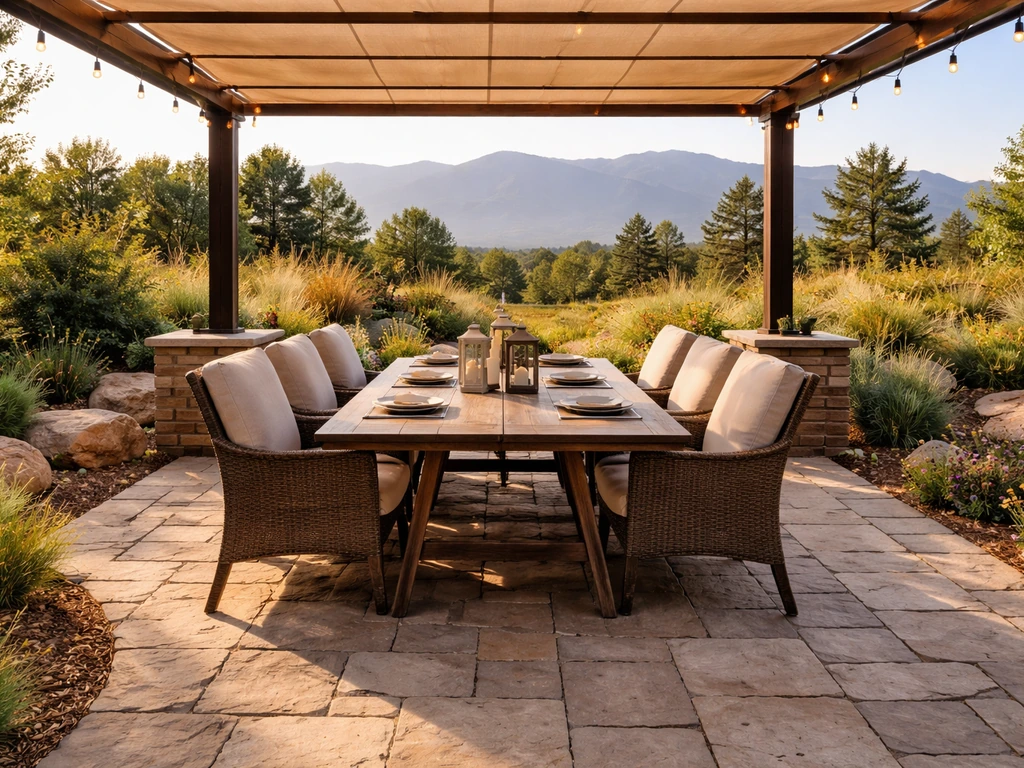
How to choose the best patio for Colorado Springs
Colorado Springs sits at roughly 6,000 feet, which changes the math on almost every patio decision. UV intensity is significantly higher than at sea level, so colors fade faster, plastics degrade quicker, and unshaded surfaces get brutally hot. You also get strong spring winds (April is the windiest month, averaging around 8 mph but with regular gusts well above that), afternoon thunderstorms in July and August, hail, and hard freezes from October through April. A patio that ignores any one of those factors will need repairs or replacement within a few seasons.
Start by answering three questions before you look at a single product or contractor: Which direction does your yard face? How much of the day do you actually use the space? And what's your primary use (dining, lounging, entertaining large groups)? Orientation is the biggest one. A west-facing patio will bake in afternoon and evening sun, which is exactly when most people want to eat outside. East-facing patios get pleasant morning light but shade out by midday. South-facing is generally the most manageable because the sun is higher and easier to block with a pergola or awning. If you're locked into a west-facing yard, plan for substantial shade from the start rather than adding it as an afterthought.
Size matters more than most people expect. For a dining setup, 12x16 feet is a comfortable minimum for a six-person table with chairs pushed back and a clear traffic lane around the perimeter. If you want to add a grill station, a bar cart, or a fire pit zone, budget for at least 16x20 feet or plan a two-zone layout with the dining area separate from the lounge or cooking area. Measure your space before you talk to a contractor, and mark it out with spray paint or rope to see how it actually feels.
Top patio ideas for Colorado Springs (layout and dining setups)
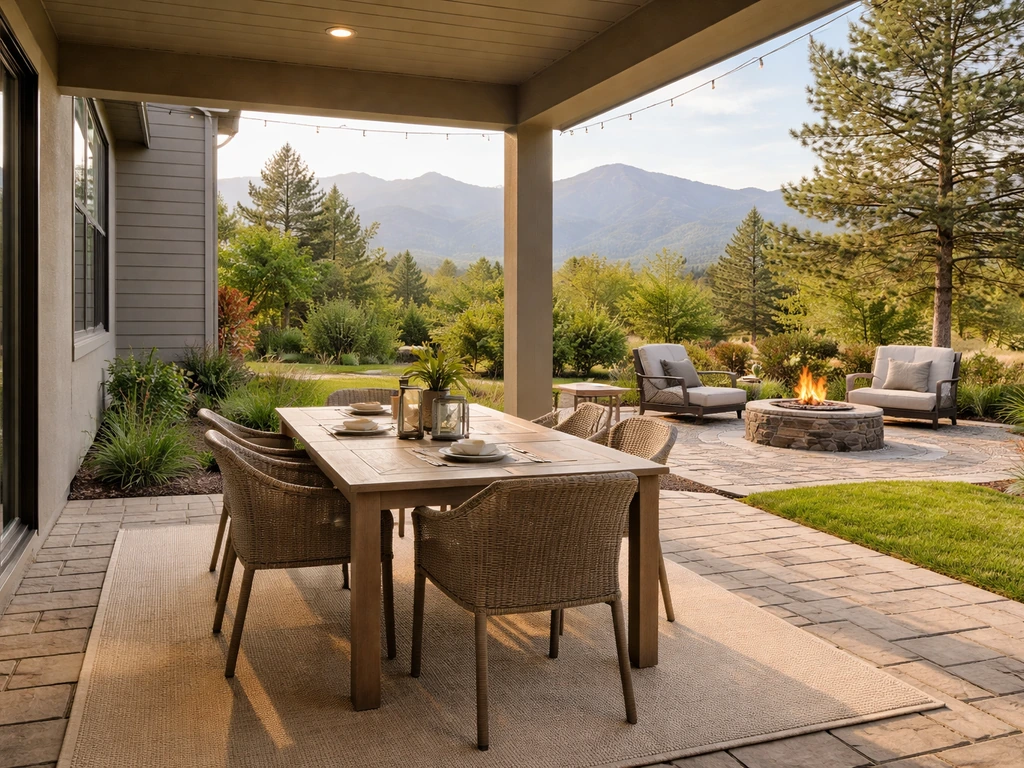
The most practical layout for Colorado Springs dining is a partially covered main patio attached to the house, with an optional open-air secondary zone for fire pit use or lounging. Attaching the covered section to the house gives you access to interior utilities (power, lighting, gas lines) without expensive trenching, and it lets the roof overhang double as partial weather protection.
Place your dining table under the primary shade structure, ideally centered so chairs can pull back from all sides. Keep the grill or outdoor kitchen off to one side, slightly downwind of the dining zone so smoke doesn't drift across your guests. If your yard slopes, a split-level design with the dining section on a raised platform keeps sight lines open and makes the space feel intentional rather than crammed against the house.
For entertaining larger groups, a wraparound or L-shaped layout works well. One wing handles dining, the other handles seating or a fire feature. The key in Colorado Springs is leaving a clear wind buffer on at least one side, either through a privacy wall, landscaping, or a partial lattice panel. Spring evenings can go from calm to breezy fast, and that makes candles pointless and napkins airborne.
- Attached covered dining patio (12x16 ft minimum): best for everyday use, easiest utility access, highest ROI
- Detached pergola with dining zone: good for yards where the house orientation is unfavorable, creates a destination feel
- Two-zone layout (covered dining + open lounge/fire pit): best for entertaining, requires 16x24 ft or more
- Wraparound or L-shaped deck: maximizes square footage on corner lots or homes with multiple door access points
- Raised platform dining area: ideal for sloped lots, adds visual interest and keeps drainage simple
Best patio materials for local weather
Material choice is where Colorado Springs patios succeed or fail. The freeze-thaw cycle alone eliminates several popular options from serious consideration. Here's how the main materials hold up locally.
| Material | Freeze-Thaw Performance | UV/Hail Resistance | Maintenance | Typical Cost (Installed) | Recommendation |
|---|---|---|---|---|---|
| Concrete (broom finish or stamped) | Good if properly sealed; stamped can crack without control joints | Good; UV affects sealers not slab | Seal every 2-3 years | $8-$18/sq ft | Best all-around value |
| Concrete Pavers | Excellent; individual units flex and can be reset | Excellent; individual replacement easy after hail damage | Re-sand joints every few years | $12-$22/sq ft | Top pick for longevity |
| Natural Stone (flagstone, travertine) | Good for flagstone; travertine can pit if porous | Excellent UV resistance | Seal porous stone annually | $18-$35/sq ft | Premium look, higher maintenance |
| Composite Decking | Good if gapped for expansion | Moderate; UV can fade without capped composite | Low; occasional wash | $25-$40/sq ft | Best for elevated/deck applications |
| Pressure-Treated Wood | Fair; needs annual sealing in freeze-thaw climates | Poor to fair; fades and checks without maintenance | High; annual sand/seal | $15-$28/sq ft | Budget option, higher upkeep |
| Brick | Good with proper base; can heave if base settles | Excellent | Repoint mortar every 10-15 years | $14-$24/sq ft | Good but limited DIY-reset flexibility |
Concrete pavers are the practical winner for most Colorado Springs homeowners. If a hailstorm chips one, you pull and replace that unit instead of patching an entire slab. They drain well, they can be reset if frost heave shifts the base, and the range of styles and colors is enormous. Stamped concrete is a close second if you want a lower upfront cost with a specific look, but insist on proper control joints every 8-10 feet and plan to reseal it every two to three years. At altitude, UV breaks down concrete sealers faster than the manufacturer's label suggests.
If you're doing a raised deck rather than a ground-level patio, go with capped composite over pressure-treated wood. The UV and moisture resistance of capped composite justifies the higher cost in Colorado's climate, and you won't be sanding and staining every spring. Speaking of finishes, if you're painting or refinishing any part of your patio surface, the product you choose matters a lot at altitude. If you need to repaint a pool patio surface, focus on the best pool patio paint formulated for UV exposure and moisture so it holds up through Colorado’s freeze-thaw cycles. If you are choosing the best paint color for an outdoor patio, prioritize fade-resistant exterior formulas and tones that hide dirt and heat best paint color for outdoor patio. If you are ready to refresh your surface, look for the right match for where to buy patio paint in Colorado Springs. Choosing the best patio deck paint for Colorado Springs helps your surface resist UV, moisture, and peeling through freeze-thaw cycles. Picking the right paint also matters at altitude, because patio finishes need to handle intense UV and heat in Colorado Springs painting or refinishing any part of your patio surface. The same logic applies to patio colors: lighter tones reflect heat better than dark ones, which is a real comfort difference when surface temps can exceed 140°F on a dark Colorado summer afternoon.
Best patio covers, shade, and climate control options
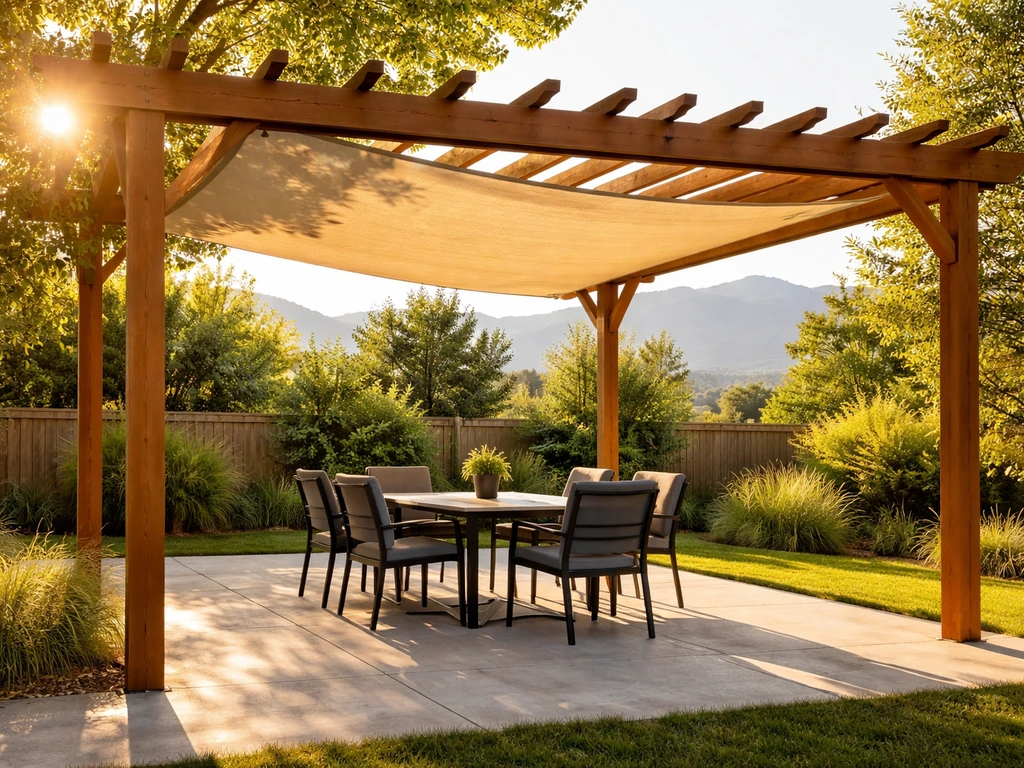
A shade structure is not optional for comfortable Colorado Springs dining. It's the single upgrade that turns a patio from a place you avoid between noon and 7 p.m. into one you actually use. The debate is usually between pergolas, retractable awnings, and solid patio covers, and each has a real trade-off in this climate.
Pergolas
A traditional open-beam pergola filters light but doesn't block it, which means you still get a lot of UV and radiant heat in a Colorado summer. The fix is adding a shade sail, motorized canopy, or polycarbonate roof panels to the frame. Aluminum pergolas outperform wood in Colorado's climate because they don't crack, warp, or check through freeze-thaw cycles, and they don't degrade from UV the way wood does without regular maintenance. A motorized louvered pergola, where the roof slats open and close, is the premium option: you control airflow and shade on the fly, and the louvers close to protect against sudden afternoon hailstorms.
Retractable awnings
Retractable awnings are great for east and south-facing patios where you want flexibility: open for morning sun, extended for afternoon shade. They're a poor match for west-facing patios because you'd have them out during the windiest and stormiest part of the day. Most motorized retractable awnings have a wind sensor that retracts them automatically when gusts hit a set threshold, which is a smart feature in Colorado Springs. Budget for a quality fabric like Sunbrella that resists UV fading; cheaper fabrics go dull and start to mildew within two Colorado summers.
Solid patio covers and room additions
A solid insulated roof cover, either a patio cover kit or a full aluminum or wood structure tied into your roofline, gives you year-round usability and the best weather protection. This is the right call if you want to use the space from April through October consistently or if you're adding lighting, fans, or speakers overhead. The downside is cost (typically $8,000-$25,000+ professionally installed depending on size and materials) and the need for a building permit in Colorado Springs. Tie it to your roofline correctly or you risk water intrusion at the connection point, which is a common and expensive mistake on DIY installations.
East and west-facing sun is harder to block than south-facing sun because the sun is lower in the sky at those angles, meaning a standard overhead structure provides less effective shade. If your patio faces east or west, consider adding vertical shade panels or privacy screens on the sun-side perimeter in addition to your overhead cover. A pergola alone won't cut it for a west-facing dining setup in July.
Must-have upgrades for patio dining (lighting, speakers, fans, and misters)
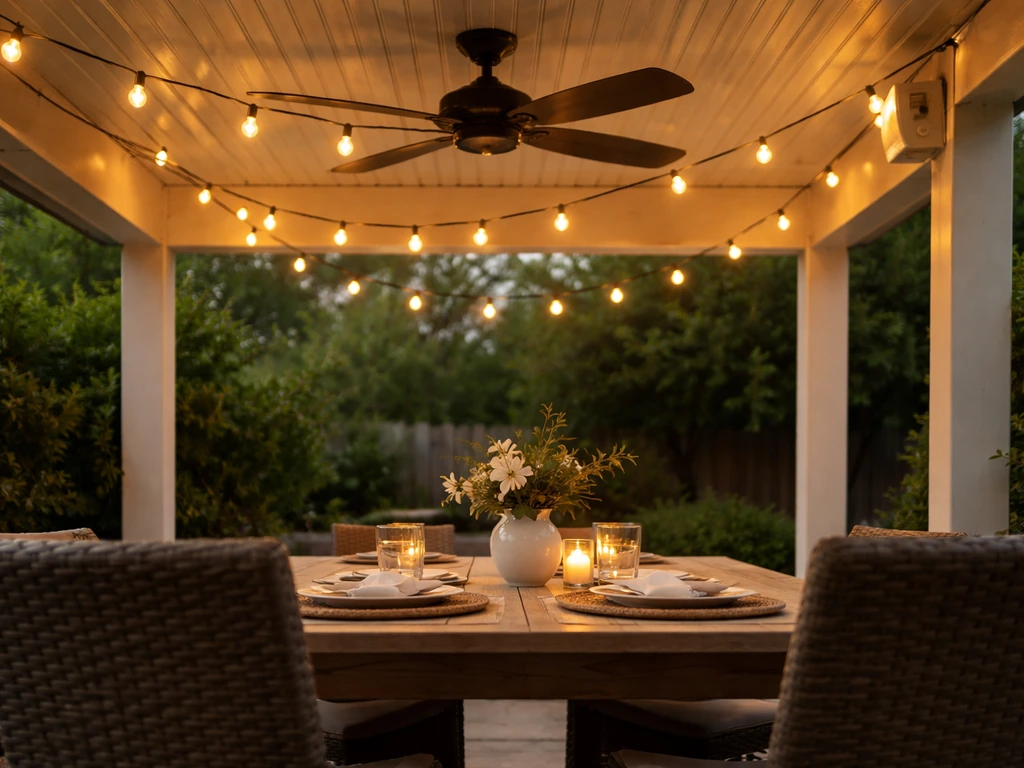
Once the structure and shade are sorted, these are the upgrades that determine whether your patio becomes the place people want to spend time or just somewhere you occasionally drag chairs outside.
Lighting
Overhead string lights or recessed LED fixtures under a covered patio extend usability into evenings, which in Colorado Springs start cooling off nicely by 8-9 p.m. most of summer. Go with 2700K-3000K color temperature LEDs for a warm, inviting dining ambiance. If you're adding a pergola or solid cover, rough in electrical during construction, because retrofitting it later costs two to three times as much. Pathway lighting and step lighting are safety basics, not luxuries, especially on multi-level patios.
Outdoor speakers
In-ceiling or in-wall outdoor speakers mounted under a covered patio give you clean sound without the cable clutter of portable Bluetooth speakers. Look for IP65 or higher rated speakers built for outdoor temperature swings. Brands like Sonance, Polk Audio, and Klipsch have well-regarded outdoor lines. Wire them during the cover installation if at all possible. Wireless rock or landscape speakers are a lower-cost option if you already have a patio and can't add wiring easily.
Ceiling fans and misting systems
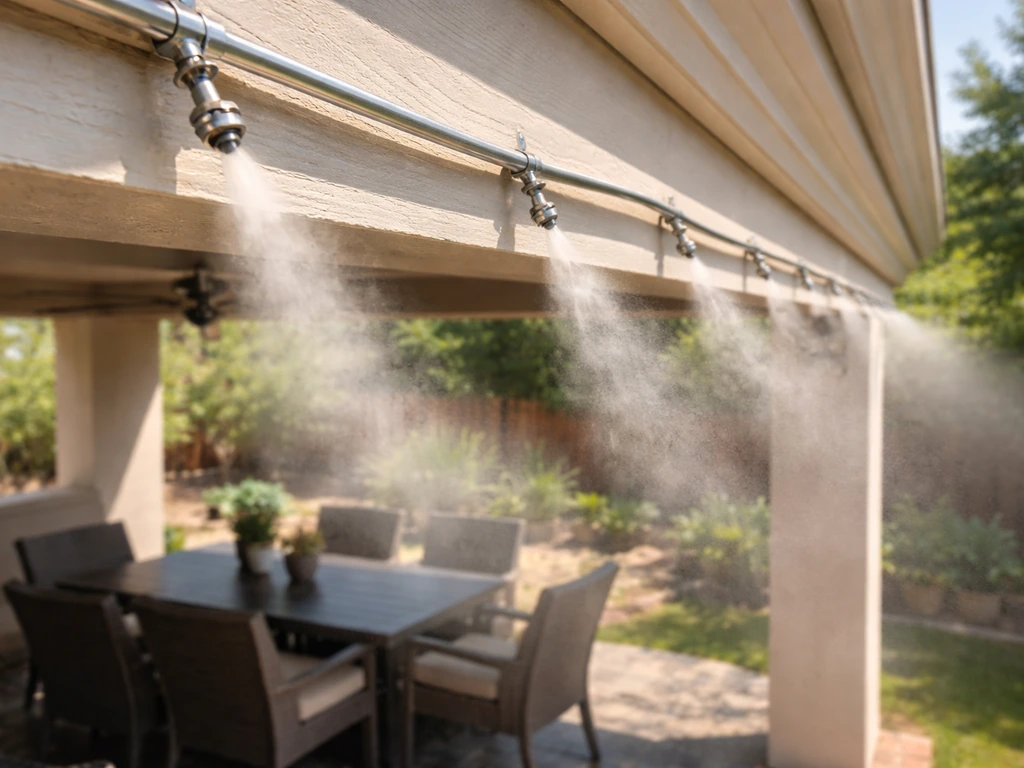
Colorado Springs sits at altitude with relatively low humidity, which makes evaporative cooling (misters) surprisingly effective here. A mid-pressure misting system running along the perimeter of a covered patio can drop the perceived temperature by 10-20 degrees on a dry afternoon. Pair a misting system with a ceiling fan under your covered structure and the combination works better than either alone. For ceiling fans, use a damp- or wet-rated outdoor fan (UL wet-rated if any rain can reach it). Sixty-inch blade span or larger for a 12x16+ space; smaller fans just push hot air around. Hunter, Big Ass Fans, and Minka-Aire all make quality outdoor models that hold up well in temperature-variable climates.
Budget tiers and what you get at each price point
Here's an honest breakdown of what your money actually buys in Colorado Springs today. Labor and material costs in the Front Range are higher than national averages, so use these as realistic local benchmarks rather than big-box store estimates.
| Budget Tier | Typical Spend | What You Get | Best For |
|---|---|---|---|
| Entry-level DIY | $2,000-$6,000 | Concrete patio slab or paver patio (12x12 to 12x16), shade sail or basic 10x10 pergola kit, string lights, portable fan | Renters or short-term owners wanting a functional outdoor space on a tight budget |
| Mid-range (DIY or partial pro) | $6,000-$15,000 | Paver or stamped concrete patio (16x20+), aluminum pergola or retractable awning, ceiling fan, basic lighting circuit, misting kit | Homeowners wanting a quality space without a full custom build |
| Upper mid-range (professional) | $15,000-$30,000 | Custom paver or natural stone patio, motorized louvered pergola or attached solid cover with permits, recessed lighting, outdoor speakers, misting system, ceiling fan | Homeowners planning to stay 5+ years and entertain regularly |
| Premium custom build | $30,000-$60,000+ | Full outdoor living room: custom stonework, attached insulated patio room or louvered pergola, outdoor kitchen/bar, full A/V system, professional landscape integration, permit-pulled and engineered | Serious outdoor entertainers, high-end remodels, homes with resale value focus |
The biggest value jump happens between entry-level and mid-range. Spending $8,000-$12,000 on a properly built paver patio with a decent pergola and ceiling fan gets you something that will last 20+ years with minimal maintenance, whereas a $3,000 concrete slab with a shade sail often needs repairs or upgrades within three to five Colorado winters. If you're on a tight budget, prioritize the surface material quality and the cover structure first, then add lighting and audio as money allows.
Finding and vetting local Colorado Springs patio contractors
Colorado Springs has a solid base of hardscape and outdoor living contractors, but the quality range is wide. Here's how to find good ones and filter out the rest quickly.
Where to find contractors

- Houzz and Angi (formerly Angie's List): filter by Colorado Springs, look for contractors with 10+ reviews and photos of local work specifically
- National Concrete Masonry Association (NCMA) and Interlocking Concrete Pavement Institute (ICPI): both maintain contractor directories; ICPI certification matters for paver installation quality
- Local lumber yards and tile suppliers: ask who their best repeat commercial customers are; trade reps know who does quality work
- Nextdoor and neighborhood Facebook groups: real neighbor referrals in Colorado Springs zip codes are often the most reliable leads
- Home Depot and Lowe's pro desks: they sometimes have contractor referral boards, though vet these independently
How to vet them
Ask every contractor you're considering these questions before you let them quote: Are you licensed and insured in Colorado (general liability and workers' comp)? Do you pull permits for covered structures? Can you show me three local projects in Colorado Springs from the last 18 months? What base preparation do you use for pavers or concrete slabs in freeze-thaw conditions? That last question is a filter. A contractor who installs a 4-inch base in Colorado Springs instead of a 6-8 inch compacted gravel base is cutting corners that will show up as heaving and cracking within a few years.
Get at least three quotes and make sure they're comparing the same scope. A quote that's 30% cheaper is often cheaper because it omits base preparation, uses thinner materials, or skips the permit. Ask each contractor to break out labor, materials, and any subcontracted work line by line. Permit fees in Colorado Springs vary by project size but plan for $300-$800 for a covered structure; any contractor who suggests skipping the permit to save money is a red flag.
Questions to ask before signing
- What is your timeline from deposit to completion, and what are the payment milestones?
- Who handles the permit application and inspections?
- What base depth and compaction method do you use for this soil type?
- What is your warranty on labor and materials?
- Will you provide a detailed written contract before any work begins?
- Do you use subcontractors, and if so, are they also insured?
- Can I contact two or three recent Colorado Springs clients as references?
Once you've picked a contractor, don't skip the design review step. Walk the yard together, confirm measurements, mark utility lines (call 811 before any digging), and agree in writing on material brands and grades, not just categories. 'Concrete pavers' can mean anything from $1.50 per square foot builder-grade units to $8.00 premium architectural pieces. Nail down the spec before you sign, and you'll avoid the most common source of post-project disputes.
If you're taking the DIY route for any portion of the project, be honest about where the line is. Laying pavers on a properly prepared base is achievable for a motivated DIYer. Tying a covered structure into your home's roofline, running electrical, or installing a gas line for an outdoor kitchen are all jobs where hiring a licensed pro protects your home and your insurance coverage. The material and finish choices, like patio surface color and paint or stain for any wood elements, are where personal creativity pays off and where you can save money doing it yourself regardless of your overall approach.
FAQ
What’s the best patio choice in Colorado Springs if I’m worried about hail damage?
Plan for hail with materials and edges that can be individually serviced. Paver patios let you replace chipped units without redoing the whole slab, and you should also choose a shade cover system that can be serviced or swapped (for example, polycarbonate or a replaceable canopy panel) rather than a fixed, hard-to-repair roof.
How do I choose shade if my patio faces west, and I still want to use it after 3 p.m.?
If you want frequent afternoon use, treat it as a shading-first project. For west-facing yards, aim for shade that covers the dining zone plus vertical coverage on the sun side (privacy panels, lattice, or a shade sail extension), and avoid assuming a small side umbrella will solve the late-day heat.
Can I connect a patio directly to my house without causing water problems?
Yes, but only if you handle moisture and drainage correctly at the transitions. Use a slight slope and keep water moving away from the house, then leave an expansion gap where the patio meets structures. Poor detailing at door thresholds and roof-to-patio connections is a common cause of standing water and early surface failure.
What are common reasons a patio starts failing sooner than expected in Colorado Springs?
Expect them to be shorter on the first few storm seasons if your setup is missing a wind and drainage strategy. In Colorado Springs, wind gusts can lift lightweight items and push debris into openings, so use wind-resistant hardware, weatherproof covers rated for outdoor UV, and install a real pathway lighting plan on steps and changes in elevation.
What exact questions should I ask about base prep and installation so I don’t get a “cheap” foundation?
For pavers, compacted base thickness is the biggest variable, then jointing material choice. Ask what they use for the bedding sand, whether they compact in lifts, and how they stabilize joints for freeze-thaw. For concrete slabs, ask about control-joint placement and sealing schedule, and confirm they account for altitude UV on any sealer.
Are retractable awnings worth it for Colorado Springs, and what wind features should I require?
Don’t rely only on a shade structure rating, check how the system handles dynamic wind, not just static wind. If your design is retractable or canopy-based, verify whether the model has an automatic wind sensor threshold and what happens to fabric when it retracts during gusts.
Should I rough-in electrical and speakers before the patio roof goes up?
Plan wiring before the cover is installed, and choose fixtures and fans rated for outdoor wet or damp conditions. Also confirm circuit placement and weatherproofing method, for example, in-use covers on exterior outlets and proper sealing around penetrations, because retrofits usually require opening finished surfaces.
How effective are misters in Colorado Springs, and where should they be installed?
Yes, but aim for the right target and placement. Mist systems work best along a covered perimeter with adequate airflow, and they perform differently in dry versus muggy weather. Pairing with a ceiling fan improves comfort because it increases perceived cooling, but you still need proper runoff control to prevent slippery surfaces.
What patio color and finish choices hold up best at 6,000 feet?
Look for materials that can handle freeze-thaw and for color choices that reduce heat buildup. Lighter exterior tones typically stay cooler, and if you’re painting or staining wood, use products formulated for UV and temperature cycling, then confirm recoat intervals for altitude exposure.
How should I plan the timeline and schedule around Colorado Springs weather and permits?
Set expectations on timeline and living-space planning. Even if materials are in stock, permitting, inspections, and weather windows can push the schedule, so ask contractors for a dated construction plan and inspection milestones, plus what happens if hail or freezes delay curing or installation.
Where is the DIY line for the “best patio Colorado Springs” results?
DIY is most realistic for surface and layout steps, like laying pavers over a properly built base, provided you can meet compaction and levelness tolerances. Stop DIY if the job requires roof tie-in, gas line installation, or new electrical runs, because those affect safety, permitting, and insurance coverage.