
The Polk Patio 200 and the Polk Atrium series are so closely related that a Best Buy Q&A response from Polk's own team flat-out says the Patio 200 and Atrium 5 are the same speaker with slightly different grilles. For a focused comparison, see the Polk Patio 200 vs Atrium guide for side-by-side specs and buying advice. That tells you most of what you need to know right away: if you're comparing the Patio 200 to the Atrium 4, you're choosing between a larger, fuller-sounding speaker and a more compact entry-level one. See a focused comparison of Polk Patio 200 vs Atrium 4 for specs, listening impressions, and mounting advice in the dedicated guide titled "Polk Patio 200 vs Atrium 4.". If you're comparing it to the Atrium 6, you're deciding whether deeper bass and Polk's PowerPort venting are worth the step up in price. And if you're sitting on a discontinued Patio 200 listing you found on a deal site, the Atrium 5 is essentially its current retail replacement.
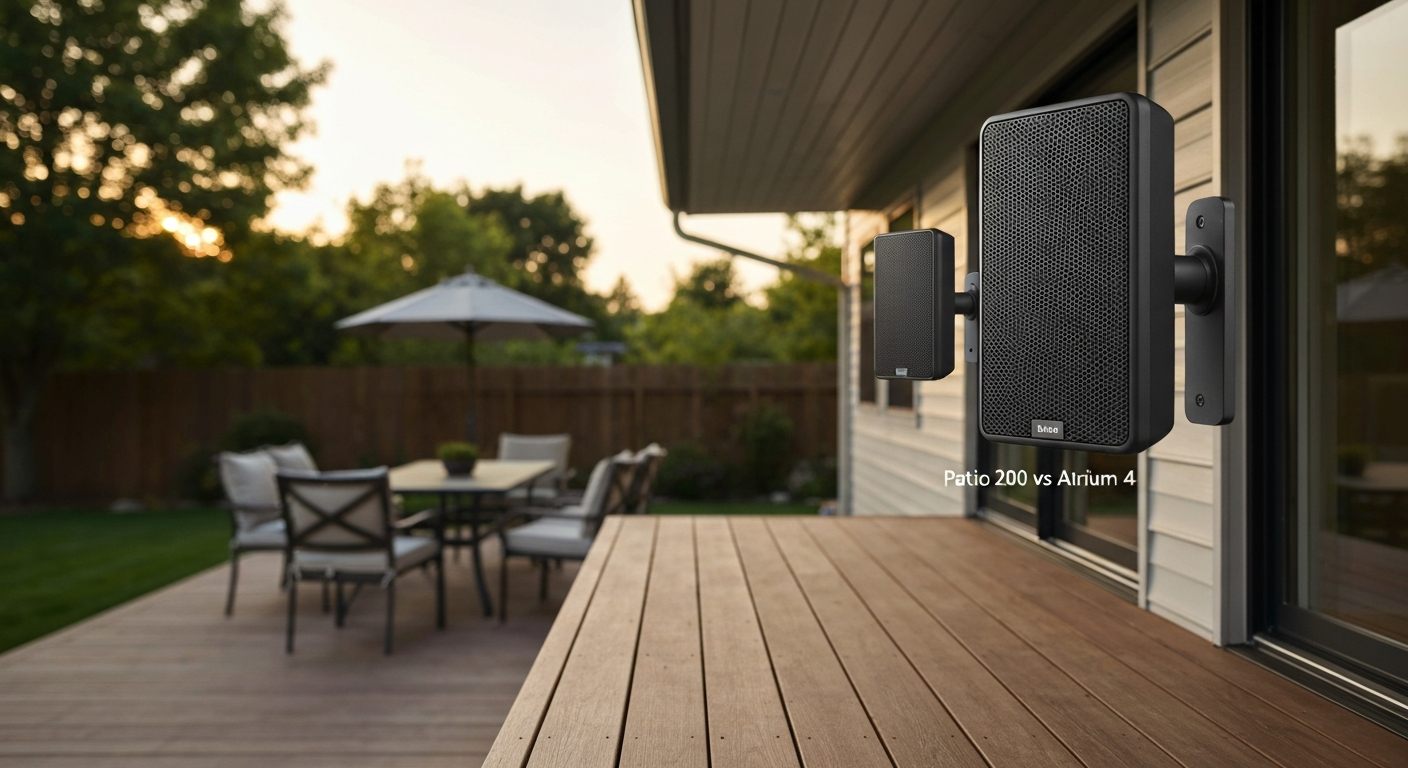
Polk Patio 200 vs Atrium 4: Outdoor Speaker Comparison Guide

Quick snapshot: Patio 200 vs the Atrium lineup
Polk's outdoor speaker lineup has evolved over the years, but the underlying formula hasn't changed much: Dynamic Balance polypropylene woofers, anodized aluminum dome tweeters, weather-sealed enclosures, and Speed-Lock wall mounting. The Patio 200 fits squarely in the middle of that family tree. At 5 inches, sealed enclosure, 90 dB sensitivity, and 50 W RMS power handling, it matches the Atrium 5 spec-for-spec. The Atrium 4 sits below it with a smaller 4.5-inch woofer and a narrower 75 Hz lower limit. The Atrium 6 steps above with a 5.25-inch woofer, PowerPort bass venting, and Polk's most rigorous weather certifications across the Atrium line.
The buying signal here is fairly clear. If you're finding the Patio 200 on clearance or as a used pair, grab it without hesitation because it's essentially a current Atrium 5. If you're buying new today, the Atrium series is the active product line. Choose the Atrium 4 if you have a small covered porch or tight budget, the Atrium 5 (or its Patio 200 equivalent) for a standard deck or mid-size patio, and the Atrium 6 if you want more bass presence and you're covering a larger open-air space or running a party-level system.
Model-by-model: Patio 200 vs Atrium 4
This is the most meaningful step-down comparison in the Atrium family. The Atrium 4 uses a 4.5-inch woofer and rolls off at 75 Hz, which in practice means noticeably less low-end body compared to the Patio 200's 5-inch driver and 60 Hz extension. If you're playing anything with a bass line, whether it's classic rock, hip-hop, or just background music during a cookout, the Patio 200 sounds fuller and more balanced without a subwoofer in the mix. The Atrium 4 also comes in smaller physically at 8.625 inches tall versus the Patio 200's roughly 10.3 inches, which matters if you have a tight eave or a smaller bracket situation. Sensitivity drops one dB to 89 dB on the Atrium 4, and the recommended power ceiling is 80 W versus 100 W peak on the Patio 200. Neither difference is dramatic in isolation, but combined with the smaller woofer you'll notice the Atrium 4 runs out of headroom sooner at higher volumes. For a small covered porch where you just want background conversation-level audio, the Atrium 4 is perfectly capable and costs around $100 less per pair at MSRP ($249 vs $349 for the Atrium 5 equivalent). For anything bigger, the Patio 200 or Atrium 5 wins cleanly.
Model-by-model: Patio 200 vs Atrium 5
This comparison is almost a non-comparison. The Patio 200 and Atrium 5 share a 5-inch Dynamic Balance woofer, a 3/4-inch anodized aluminum dome tweeter, 8-ohm impedance, 90 dB sensitivity, 60 Hz to 25 kHz frequency response, and 100 W peak power handling. The enclosure designs differ slightly (the Patio 200 uses a sealed box while the Atrium 5 is ported/bass-reflex), which gives the Atrium 5 a marginally punchier low end and slightly more efficiency in the bass registers. In a blind listen at moderate volume, most people won't hear a difference. The practical distinction is availability: the Patio 200 is discontinued and showing up on clearance or used markets, while the Atrium 5 is current retail at $349/pair MSRP. If you own Patio 200s and want to add more speakers to a multi-zone setup, Atrium 5s will match seamlessly in terms of impedance, sensitivity, and tonal character.
Model-by-model: Patio 200 vs Atrium 6
The Atrium 6 is where the Patio 200 starts to feel like the budget option. Polk bumps the woofer to 5.25 inches, adds PowerPort water-resistant bass venting (a patented port design that smooths airflow and reduces turbulence compared to a conventional port opening), and puts the Atrium 6 through Polk's most rigorous environmental testing including ASTM D5894 UV salt fog cycles and MIL-STD immersion and corrosion protocols. In real-world listening, independent reviewers consistently describe the Atrium 6 as noticeably bassier and louder than mid-range Polk outdoor models, with headroom to fill a 600 to 1,000 square foot open patio at party volumes. The Patio 200 can hold its own for background and moderate listening, but if you're trying to project audio across a large deck with wind and ambient noise fighting you, the Atrium 6's extra driver area and porting make a real audible difference. The tradeoff is price: the Atrium 6 runs $449/pair at MSRP, which is $100 more than an equivalent Atrium 5 or Patio 200 replacement. For large patios, coastal installs, or anyone who wants genuine party-level outdoor audio without a subwoofer, that premium is worth it.
What each lineup is actually built for
The Atrium line as a whole targets homeowners who want set-it-and-forget-it outdoor audio. Polk designed these speakers to survive UV exposure, salt air, freeze-thaw cycles, and occasional hose-down without requiring annual maintenance or covers. The Patio 200 came from the same philosophy but was marketed as an indoor/outdoor hybrid, which is why you'll see it described as suitable for garages, sunrooms, and covered patios in addition to exposed exterior installs. That dual positioning made it popular for enclosed or semi-enclosed patio rooms where you're not dealing with direct rain but want a speaker that won't suffer from humidity.
If you're in a humid southern climate (think Gulf Coast Texas, coastal Georgia, or South Florida), the full Atrium certification matters more than it does in a dry Phoenix patio install. The Atrium 6's ASTM D5894 salt fog certification is particularly relevant if you're within a mile or two of the ocean. For a covered suburban deck in the Midwest or Mountain West, a Patio 200 or Atrium 4 will likely last just as long in practice. The point is: know your environment before you choose, and don't over-spec for conditions you don't actually have.
Detailed spec comparison
| Spec | Patio 200 | Atrium 4 | Atrium 5 | Atrium 6 |
|---|---|---|---|---|
| Woofer size | 5" Dynamic Balance poly | 4.5" Dynamic Balance poly | 5" mid-woofer poly | 5.25" Dynamic Balance poly |
| Tweeter | 3/4" anodized aluminum dome | 3/4" anodized aluminum dome | 3/4" anodized aluminum dome | 1" anodized aluminum dome |
| Frequency response | 60 Hz – 25 kHz | 75 Hz – 25 kHz | 60 Hz – 25 kHz | Below 60 Hz – 25 kHz (PowerPort aided) |
| Sensitivity (1W/1m) | 90 dB | 89 dB | ~90 dB | ~90 dB |
| Nominal impedance | 8 Ω | 8 Ω | 8 Ω | 8 Ω |
| Recommended amp power | 10–100 W peak | 10–80 W | 10–100 W | Up to ~150 W peak |
| RMS power handling | 50 W | ~40 W | ~50 W | ~65 W |
| Enclosure type | Sealed, weather-resistant | Sealed | Bass-reflex (ported) | Bass-reflex with PowerPort |
| Dimensions (H×W×D) | 10.31" × 6.75" × 6.69" | 8.625" × 5.688" × 6.688" | ~10.3" × 6.75" × 6.69" | ~11.5" × 7.5" × 7.3" |
| Weight per speaker | ~4.6 lb | 3.6 lb | ~4.6 lb | ~5.5 lb |
| Weather/IP rating | Weather-resistant (indoor/outdoor) | All-Weather (Polk certified) | All-Weather (Polk certified) | All-Weather Certified (ASTM D5894, MIL-STD) |
| Mounting system | Keyhole/bracket | Speed-Lock | Speed-Lock | Speed-Lock |
| Binding posts | 5-way gold-plated | 5-way gold-plated | 5-way gold-plated | 5-way gold-plated |
| Paintable grille | No (fixed) | Yes | Yes | Yes |
| MSRP (pair) | Discontinued (~$299 orig.) | $249 | $349 | $449 |
How they actually sound
Polk's outdoor speakers have a house sound that's pretty consistent across the lineup: warm mids, a slightly bright top end from those aluminum dome tweeters, and bass that punches above what you'd expect from a small box. The Atrium 4 is the thinnest-sounding of the group. It handles voice and acoustic guitar well but starts to sound lean on anything with a kick drum or bass guitar. At cocktail-party volumes under a covered porch, it's more than adequate. Push it past about two-thirds volume on a typical 50-watt receiver channel and you'll notice compression creeping in.
The Patio 200 and Atrium 5 sound nearly identical to my ear. They're the sweet spot of the lineup: full enough to enjoy music as music rather than just background noise, clear enough for speech intelligibility when you're watching a game on an outdoor TV, and sensitive enough that a modest 50-watt-per-channel receiver drives them to outdoor-party levels without strain. The sealed enclosure on the Patio 200 gives it a tighter, slightly drier bass character compared to the ported Atrium 5, which has a small bass bloom around its port tuning frequency. Neither is objectively better; it's a matter of preference and room (or rather, outdoor space) acoustics.
The Atrium 6 is a clear step up in bass extension and loudness. The PowerPort design noticeably smooths out the ported bass response compared to a standard reflex port. Multiple hands-on reviewers have called it bassy and loud in a way that feels appropriate for a large open patio rather than boomy or exaggerated. The 1-inch tweeter (versus 3/4-inch on the others) also gives it slightly more high-frequency headroom and dispersion, which matters when you're mounting speakers on a wall at one end of a 30-foot patio and want the sound to reach people near the house and out by the fire pit. Vocal clarity is strong across all four models; Polk's Dynamic Balance driver tech genuinely reduces distortion at the kinds of moderate-to-high SPLs you're running at a backyard gathering.
Matching these speakers to your listening scenarios
Background music and ambient audio
For low-to-moderate background listening (think dinner conversation, weekend morning coffee, or ambient music while gardening), the Atrium 4 is genuinely enough. It's also the right pick for a small covered porch, a screened-in lanai, or a garage workshop where the listening area is compact and you're not competing with wind. The Patio 200 or Atrium 5 is the better background speaker for a standard 200 to 400 square foot deck because the extra woofer area lets you run lower volume levels while still filling the space with sound.
Outdoor TV, sports, and speech intelligibility
All four models handle speech well thanks to the aluminum tweeter and Polk's crossover tuning. For dedicated outdoor TV audio (a mounted screen on a covered patio or pavilion), the Patio 200 or Atrium 5 is the practical choice: clear dialogue, reasonable low-end for action sequences, and enough sensitivity that you're not running your receiver at full tilt. The Atrium 4 works too but can sound a little thin during movie soundtracks. The Atrium 6 is honestly overkill for solo TV watching but fantastic if you're hosting game-day crowds on a large patio where ambient noise is a real factor.
Party and higher-volume outdoor audio
If you're regularly running music at party volumes for 20 or more people on a large open patio, the Atrium 6 is the right answer from this lineup. Its combination of larger woofer, PowerPort bass venting, and higher power handling gives you genuine headroom for outdoor party levels without distortion. Two pairs of Atrium 6 speakers run in a multi-zone configuration with a 100-watt-per-channel outdoor receiver can realistically cover a 1,000 square foot patio. The Patio 200 and Atrium 5 can do party duty too, but you'll hit their limits sooner in a large open space. The Atrium 4 is not the right speaker for regular high-volume outdoor parties; it wasn't designed for that use case.
Music styles and source material
- Acoustic, jazz, classical, podcasts: Atrium 4 or Patio 200 are both excellent; the aluminum tweeter handles detail and air well at low volumes.
- Pop, rock, country: Patio 200 or Atrium 5 is the sweet spot; the 5-inch driver handles the full frequency range of most mainstream music without needing an outboard sub.
- Hip-hop, EDM, bass-heavy playlists: Atrium 6 is the clear winner; its PowerPort bass extension and larger woofer handle sub-bass content better than the sealed Patio 200 can.
- Live sports and TV outdoors: Patio 200 or Atrium 5 for speech clarity and dialogue; Atrium 6 if you want cinematic impact for a large crowd.
- Multi-room background audio across multiple zones: match sensitivities (all are 89-90 dB) and impedances (all 8 Ω) for easy multi-zone wiring without level-matching complications.
Mounting, installation, and wiring
All Atrium models use Polk's Speed-Lock bracket system, which genuinely makes solo installation manageable. The bracket slides onto two screws protruding from the wall (you'll want those screw heads sticking out about 1/8 to 1/4 inch), locks in place, and then a hand-tightenable knob lets you aim the speaker up or down without tools. Polk's manual recommends #10 screws into studs or #10 wall anchors if you're hitting drywall or stucco between studs. For exterior installs, I'd always prefer a stud when possible; the speakers are only 3.6 to 5.5 pounds each but outdoor wind load and vibration over years of use can work anchors loose. The Patio 200 uses a similar keyhole-slot mounting approach, so the process is the same.
Mount under eaves whenever the layout allows. Polk's own manual says this and the advice is sound: a covered mounting location dramatically extends speaker life by shielding drivers and grilles from direct UV and rain impact. If your patio has no overhang, the Atrium 6's certified all-weather rating (ASTM/MIL-STD) gives you the most confidence for fully exposed installs. For fully exposed mounting in harsh coastal or high-UV environments, also consider adding paintable grilles (Atrium models have them; paint them to match your siding if aesthetics matter to you).
For wiring, all four models accept bare wire, banana plugs, spade connectors, or pin connectors through their gold-plated 5-way binding posts. Polk's Atrium product page lists a pair of gold‑plated 5‑way binding posts on the speaker rear to accept bare wire, pins, spades, or banana plugs. For outdoor runs, use CL3-rated direct-burial speaker cable if you're running wire through conduit or underground to remote mounting locations. 16-gauge wire is adequate for runs under 50 feet; go to 14-gauge for longer runs to avoid resistance-related power loss. All models are 8 Ω nominal, so standard stereo receivers and outdoor A/V receivers wire directly without impedance complications. If you're running multiple pairs in parallel (for multi-zone coverage), each pair you add halves the impedance load seen by the amp; make sure your receiver is rated for 4 Ω loads or use an impedance-matching volume control at each speaker location.
Placement and coverage by patio size
| Patio size | Recommended model | Placement guidance | Amplifier suggestion |
|---|---|---|---|
| Small porch / screened lanai (under 150 sq ft) | Atrium 4 (one pair) | Mount 8–10 ft high at one end, angled down 15–20° | Any stereo receiver, 30–50 W/ch |
| Standard deck (150–400 sq ft) | Patio 200 or Atrium 5 (one pair) | Mount at corners or center eave, aim toward listening area | Outdoor receiver, 50–80 W/ch |
| Large patio (400–800 sq ft) | Atrium 5 (two pairs) or Atrium 6 (one pair) | Stereo pair at each end OR one Atrium 6 pair mounted high and centered | Outdoor receiver, 80–100 W/ch, or multi-zone amp |
| Large open yard / party space (800+ sq ft) | Atrium 6 (two pairs) | Distribute pairs 20–25 ft apart; keep height consistent at 8–10 ft | Multi-zone outdoor amp, 100+ W/ch, with impedance matching |
A common mistake I see on large patios is mounting speakers too high and angling them too steeply downward. At 12 or 14 feet up on a tall exterior wall, even an Atrium 6 sounds thin and directional because you're pointing it at the ground rather than projecting it across the listening area. Keep mounting height between 8 and 10 feet for the best balance of coverage and tonal performance. On wide patios with a long narrow footprint, consider two pairs of Atrium 5s wired to separate zone outputs rather than one pair of Atrium 6s; distributed audio almost always covers space more evenly than a single powerful pair at one end.
Weatherproofing, durability, and long-term care
Polk's All-Weather Certified claim on the Atrium line is backed by actual test standards (ASTM D5894 for UV and salt fog resistance, MIL-STD testing for immersion and corrosion), not just marketing language. The Patio 200's designation as indoor/outdoor is more modest: sealed construction and stainless hardware, but without the same formal certifications. In practice, owners in moderate climates report both lasting 8 to 12 years without significant issues. In harsh environments (coastal, desert UV, severe freeze-thaw), the Atrium series formal certifications matter and the Atrium 6 sits at the top of that durability hierarchy.
The most common failure mode across all these models, based on long-term user feedback, is grille degradation before driver failure. The painted grille mesh can rust or become brittle in high-UV environments after 5 to 7 years. The woofer surrounds (polypropylene on all models) are inherently UV-resistant and rarely fail first. If you notice grille corrosion starting, replacement grilles are available through Polk and third-party accessory suppliers and are worth swapping before rust stains your mounting surface or works its way to the driver basket.
All current Atrium speakers carry a 5-year limited warranty to the original purchaser. The Patio 200 is discontinued, so warranty support on new-old-stock units may be limited depending on purchase date and retailer. If you're buying a Patio 200 from a third-party marketplace today, treat it as a warranty-free purchase and price it accordingly.
Amplifier matching: what receiver or amp to pair with each model
All four speakers are 8 Ω and share sensitivity ratings between 89 and 90 dB, which makes them easy to drive. A basic 50-watt-per-channel stereo receiver will drive the Atrium 4 and Patio 200 to very loud outdoor levels. For the Atrium 6, you'll get the best performance with 80 to 100 watts per channel because its larger woofer and PowerPort design benefit from having clean headroom. Don't be fooled by the 10 W minimum rating on the Atrium specs: running any of these speakers on a low-power amp works, but you lose dynamic impact and can actually push small amps into clipping (which damages tweeters) when you crank the volume on a busy patio.
For fully outdoor installations where the receiver or amplifier is exposed to weather, consider a purpose-built outdoor A/V receiver or a weatherproof mini-amp in a sealed enclosure. Sonance, Russound, and SpeakerCraft make outdoor-rated distribution amps that pair well with the Atrium lineup for multi-zone setups. For a simple one-zone patio, an entry-level Yamaha or Denon stereo receiver in a covered equipment cabinet works perfectly.
Accessories to complete your install
- CL3 or CL2-rated outdoor speaker cable (14 or 16 gauge depending on run length)
- Banana plug connectors for clean, removable connections at the binding posts
- Conduit and weatherproof junction boxes for in-wall or underground cable runs
- Impedance-matching volume controls (if running multiple pairs from a single amp zone)
- Paintable replacement grilles (for long-term cosmetic maintenance or color matching)
- Stainless steel or zinc-plated mounting screws (avoid bare steel outdoors — it will rust into your wall)
- Outdoor speaker wire covers or cable conduit for surface-mounted runs on siding or stucco
- Equipment enclosure or outdoor-rated cabinet if your amp or receiver is not rated for outdoor use
Pros, cons, and price-to-value summary
| Model | Pros | Cons | Best value pick for |
|---|---|---|---|
| Patio 200 | Excellent build quality, strong all-around sonics, pairs with Atrium 5 seamlessly, often available at discount | Discontinued (no warranty on clearance stock), sealed enclosure limits bass vs ported Atrium 5 | Bargain hunters, semi-enclosed patios, indoor/outdoor installs |
| Atrium 4 | Compact size, lowest price ($249/pair), adequate for small spaces, Speed-Lock mounting, 5-year warranty | Least bass extension (75 Hz), lowest power ceiling (80 W), not ideal for large or open patios | Small covered porches, tight budgets, secondary zones |
| Atrium 5 | Best overall value, near-identical to Patio 200 but current production, ported enclosure adds bass punch, paintable grille | Mid-range price ($349/pair), no meaningful upgrade over Patio 200 if you already own those | Most homeowners, standard decks, primary patio zone |
| Atrium 6 | Deepest bass, highest power handling, PowerPort venting, strongest weather certifications, 1" tweeter for wider dispersion | Most expensive ($449/pair), physically largest, overkill for small covered patios | Large open patios, party audio, coastal environments, high-UV climates |
When to hire a pro instead of doing it yourself
Mounting a single pair of Atrium speakers on an exterior wall under an existing eave is a legitimate DIY job. You need a drill, a level, a stud finder, and about an hour. Where I recommend calling a vetted local contractor is when the job involves running speaker wire through exterior walls or conduit, installing a multi-zone distribution system, wiring into a dedicated outdoor A/V cabinet, or integrating with a home automation or whole-home audio system. Those runs involve working with wall cavities, potentially cutting exterior siding, and making sure your wire terminations are weatherproofed properly. A poorly installed outdoor wire run that traps moisture is a much bigger headache than the cost of a half-day professional installation. If you're planning a large patio audio system with multiple zones, a subwoofer, and landscape speakers in addition to wall mounts, a professional audio installer who specializes in outdoor systems will save you troubleshooting time and get your impedance matching right the first time.
Buying checklist before you order
- Measure your patio square footage and identify your primary listening zone to size the right model.
- Check your mounting surface: stud locations, eave availability, and height (target 8–10 feet).
- Confirm your amplifier or receiver's power output and impedance rating (all models are 8 Ω).
- Calculate wire run distance from your amp to each speaker location to choose the right gauge.
- Decide on connection type (banana plugs, bare wire, spades) before running cable.
- Check local climate: coastal or high-UV zones warrant Atrium 5 minimum; Atrium 6 for harsh conditions.
- Buy stainless or zinc mounting hardware separately if you're not near a stud and need anchors.
- If mixing Patio 200 with Atrium 5 in a multi-zone setup, confirm matched sensitivity and impedance (they match).
- Check Polk's current warranty terms if purchasing from a third-party marketplace (discontinued models may not qualify).
- Budget for accessories: cable, connectors, conduit, and an outdoor equipment enclosure if needed.
The bottom line on which one to buy
For most homeowners upgrading or building out a patio audio system today, the Atrium 5 is the right starting point. It's the current production equivalent of the Patio 200, it's actively supported with a 5-year warranty, and it delivers the right balance of bass, clarity, and outdoor durability for a standard deck or patio. If you find a Patio 200 at a meaningful discount (roughly $150 or less per pair), buy it; it's the same speaker. Step up to the Atrium 6 if you have a large open space, you're in a tough coastal or high-UV climate, or you simply want the loudest, bassiest outdoor speaker in this family without adding a subwoofer. Step down to the Atrium 4 only if you have a genuinely small covered space or you're adding supplemental coverage to secondary zones where high volume is never the goal. The comparisons between the Patio 200 and the other Atrium variants (including the Atrium 5 and Atrium 6 separately) are worth reviewing in more detail if you're still deciding between those specific pairings. For a direct features-and-specs breakdown, see our polar patio standard vs premium comparison for another way to frame budget versus performance choices.
FAQ
Quick snapshot — what are the main differences between the Polk Patio 200 and the Polk Atrium series (Atrium 4, 5, 6)?
Snapshot: The Patio 200 is an archived Polk 5" indoor/outdoor model that matches the Atrium 5 in core driver size and measured specs; many retailer notes say Patio 200 and Atrium 5 are effectively the same speaker with different grilles. The Atrium line offers three contemporary outdoor‑ready sizes: Atrium 4 (4.5" woofer) for smaller spaces, Atrium 5 (5" woofer — similar to Patio 200) as a mid‑range all‑weather option, and Atrium 6 (5.25" woofer with larger motor and PowerPort® venting) for higher output and stronger bass. Atrium models carry Polk’s All‑Weather certification and modern Speed‑Lock mounting; Atrium warranty is 5 years.
Detailed spec comparison (power handling, sensitivity, impedance, frequency response, drivers, enclosure/finish, IP/weather rating) — can you summarize in one place?
Spec snapshot (typical manufacturer values): - Patio 200 (archived): Drivers: 5" Dynamic Balance® woofer + 3/4" anodized aluminum tweeter; Frequency: ~60 Hz–25 kHz; Sensitivity: ~90 dB; Impedance: 8 Ω; Power: RMS ~50 W / peak ~100 W; Enclosure: sealed weather‑resistant, stainless hardware; Weather: designed for outdoor use but not modern Atrium certifications; Dimensions: ~10.3" H × 6.75" W × 6.69" D. - Atrium 4: Drivers: 4.5" woofer + 3/4" aluminum dome tweeter; Freq: 75 Hz–25 kHz; Sensitivity: 89 dB; Impedance: 8 Ω; Recommended amp: 10–80 W; Enclosure: UV‑resistant, paintable grille; Weather: Polk All‑Weather (exceeds ASTM D5894 / MIL‑STD tests); Mount: Speed‑Lock bracket; Size: 8.625" H × 5.688" W × 6.688" D; Weight ~3.6 lb. - Atrium 5: Drivers: 5" woofer + 3/4" tweeter (very similar to Patio 200); Freq: ~60 Hz–25 kHz; Sensitivity: ~90 dB; Impedance: 8 Ω; Recommended amp: 10–100 W; Enclosure: ported/paintable grille on some listings; Weather: All‑Weather certified; MSRP historically ~$349/pair. - Atrium 6: Drivers: 5.25" Dynamic Balance woofer + 1" aluminum dome tweeter; Freq: extended low end (approx down to 50–60 Hz depending on placement); Sensitivity: ~90 dB+; Impedance: 8 Ω; Recommended amp: higher headroom 20–150 W; Enclosure: larger ported with PowerPort® water‑resistant bass venting; Weather: All‑Weather certified (ASTM/MIL tests); MSRP historically ~$449/pair. Note: exact numbers vary slightly by published product page and retailer; consult current Polk product pages for final specs.
How do they sound — audible performance and use‑case differences?
Audible differences: - Atrium 4: smaller woofer = tighter midrange, less bass weight — good for background music, terraces, and voice clarity at moderate volumes. - Atrium 5 / Patio 200: balanced midbass and clear highs; better low‑end presence than Atrium 4 — versatile for small‑to‑medium patios, background-to-party levels. - Atrium 6: strongest bass and highest output — better for larger patios, pool parties, and when you want more impact without a subwoofer. All Atrium models use anodized aluminum tweeters for crisp highs; Atrium 6’s PowerPort and larger motor yield fuller, harder‑hitting bass. For music fidelity at conversational levels, Atrium 4 or 5 is usually enough; for loud entertaining or larger spaces, choose Atrium 6.
Mounting and installation guidance for exterior walls and eaves (DIY tips)
Mounting basics and tips: - Use the included Speed‑Lock bracket (Atrium) per manual: mount bracket with two #10 screws into studs or heavy‑duty anchors if no stud. - Recommended screw head gap: leave ~1/8"–1/4" protruding for keyhole engagement, then slide on and tighten aiming knobs. - For Patio 200 (archived sealed box) follow similar two‑screw mounting pattern; use stainless exterior screws/anchors. - Locate under eaves where possible to minimize direct weather exposure and extend lifetime. - Angle speakers toward listening area (aim down 10°–20° for wall mounts). - Seal all wall penetrations with outdoor silicone; use grommets for cable entries. - Run speaker cable inside conduit or rated outdoor CL2/CL3‑UV cable if exposed. - Use two people for higher installations; test polarity/balance before final tightening. Follow weight/clearance specs and local building codes.
Weatherproofing and durability — how rugged are these models and what to expect long‑term?
Durability notes: - Atrium series: Polk advertises All‑Weather certification (ASTM D5894 / MIL‑STD immersion/corrosion tests) — built for UV, salt, humidity, and temperature cycling. Expect strong longevity when mounted under eaves or protected locations. - Atrium hardware uses stainless/galvanized fasteners and corrosion‑resistant materials. - Patio 200: sealed enclosure and stainless hardware provide good protection but it’s an older/archived product; long‑term support may be limited. - Real‑world user reports: generally high satisfaction with weather resistance; isolated failures exist where speakers were exposed to direct immersion, constant salt spray, or improper installation. - Recommendation: place under overhangs, avoid direct spray, keep ports and tweeter hoods clear of debris; inspect annually for grille and seal integrity.
Amplifier matching and wiring recommendations — what amp power, wiring and connectors should I use?
Amp matching and wiring: - Impedance: all models nominally 8 Ω — match with 8 Ω stable outputs or use multi‑zone receivers designed for 8 Ω loads. - Power: Atrium 4: 10–80 W recommended; Atrium 5/Patio 200: ~10–100 W recommended; Atrium 6: higher headroom recommended (20–150 W) for clean bass at high SPLs. Choose an amp that can deliver clean RMS power in the recommended range per speaker with 20–30% headroom for peaks. - Wiring: use 14 AWG CL2/CL3 or outdoor‑rated 12 AWG for runs over 50 ft or longer runs/low impedance; 16 AWG acceptable for short runs (<25 ft) and Atrium 4/5 at moderate volume. - Connectors: Atrium models have 5‑way binding posts (accept bare wire, pins, spades, banana plugs) — use spades/pins for solid wall mounting, bananas for easy disconnects. - Multi‑zone: use an amp per zone sized for that zone’s speaker count; parallel‑wired speakers reduce impedance — ensure amp can handle total load or use 70/100V transformers for many speakers.