
If you are comparing the Polk Patio 200 against the Polk Atrium family, here is the short version: the Patio 200 is a discontinued model that still shows up used and refurbished, and any current Atrium model (4, 5, or 6) beats it on documented weatherproofing, warranty support, and mounting flexibility. For most homeowners buying new today, the Atrium 4 is the right starting point for small patios and tight budgets, the Atrium 5 covers mid-size decks comfortably, and the Atrium 6 is the pick for larger entertaining spaces where you want real low-end presence without a subwoofer.
Polk Patio 200 vs Atrium: Best Outdoor Speaker for Patio Setups

Elise Prescott
24 Jul 2026
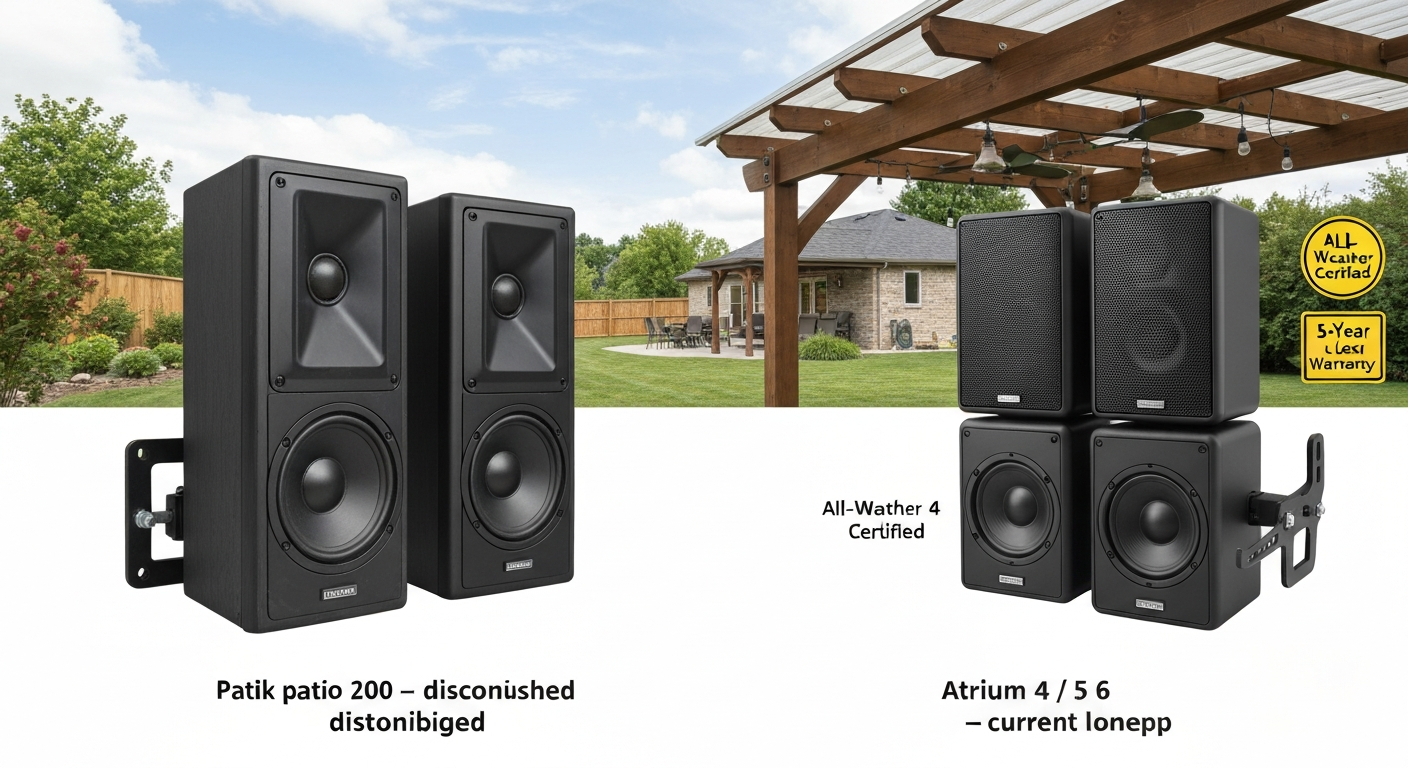
Which one should you actually buy?
The Patio 200 was a solid speaker in its day, built around a 5-inch mineral-filled polymer woofer and a 3/4-inch anodized-aluminum dome tweeter. The Algopix product listing Best Deal for Polk Audio Patio 200 Indoor/Outdoor Speaker (Algopix product listing) notes a 5" mineral-filled polymer woofer and a 3/4" anodized‑aluminum dome tweeter with approximately 60 Hz–25 kHz frequency response and about 90 dB sensitivity. Third-party data aggregators consistently report roughly 60 Hz to 25 kHz response and 90 dB sensitivity at 8 ohms, which are respectable numbers. The problem is it is no longer sold new by Polk, it lacks a current dedicated product page, and the warranty story is murky if you buy a used unit. If you find one secondhand for under $60 and just want background music on a covered porch, it can still do the job. But if you are spending any real money or putting speakers somewhere exposed to sun, rain, salt air, or freeze-thaw cycles, buy an Atrium. The current lineup is actively supported, certified to published environmental standards, and priced competitively.
| Spec | Patio 200 | Atrium 4 | Atrium 5 | Atrium 6 |
|---|---|---|---|---|
| Woofer size | 5" mineral-filled polymer | 4.5" Dynamic Balance® polypropylene | 5" Dynamic Balance® polypropylene | 5.25" Dynamic Balance® polypropylene |
| Tweeter | 3/4" anodized-aluminum dome | Not officially detailed | Not officially detailed | 1" tweeter |
| Frequency response | ~60 Hz–25 kHz | 75 Hz–25 kHz | 60 Hz–25 kHz | 50 Hz–27 kHz |
| Sensitivity (1W/1m) | ~90 dB | 89 dB | 90 dB | 90 dB |
| Impedance | 8 Ω | 8 Ω | 8 Ω | 8 Ω |
| Recommended amp power | Not officially confirmed | 10–80 W | 10–100 W | 10–100 W |
| Cabinet dims (H×W×D) | Not officially confirmed | 8.625" × 5.688" × 6.688" | Not officially confirmed | 11.688" × 7.688" × 8.75" |
| Weight (each) | Not officially confirmed | Not officially confirmed | Not officially confirmed | 5.4 lb |
| Mounting | Bracket (older style) | 180° Speed-Lock | 180° Speed-Lock | 180° Speed-Lock |
| Weather rating | Basic outdoor rating | All-Weather Certified | All-Weather Certified | All-Weather Certified |
| Current production | Discontinued | Active | Active | Active |
| Approx. street price (pair) | $40–$80 used | ~$199 | ~$279 | ~$359–$449 |
| Warranty | Limited/unclear used | 5-year limited | 5-year limited | 5-year limited |
What each speaker line is actually designed for
The Patio 200 was Polk's mid-tier entry into the indoor-outdoor speaker market during an earlier product generation. It was designed for covered patios and screened porches rather than fully exposed installations, and that heritage shows in its construction: decent weatherproofing for calm environments, but not built to the documented military-style environmental testing standards Polk now applies to the Atrium line. It paired well with an AV receiver or a simple stereo amp and was popular for background listening in modest outdoor setups.
The Atrium family is Polk's current, purpose-built outdoor speaker line. Every Atrium model is engineered from the ground up for full exposure to elements, not as an adaptation of an indoor design. The lineup scales up by woofer size: the Atrium 4 uses a 4.5-inch woofer, the Atrium 5 a 5-inch woofer, and the Atrium 6 a 5.25-inch woofer. Each step up adds meaningful low-frequency extension, slightly more cabinet volume, and broader headroom before distortion sets in. The Atrium 8 SDI sits above these three as a high-performance commercial-adjacent model with a 6.5-inch driver, 91 dB sensitivity, and a 45 Hz to 27 kHz response, relevant if you are wiring a whole-property distributed system. For a residential patio, the 4, 5, and 6 cover nearly every realistic scenario.
How the tech actually differs: drivers, power, sensitivity and frequency response
The most meaningful differences between the Patio 200 and any Atrium model come down to driver maturity and low-frequency extension. The Patio 200's 5-inch mineral-filled polymer cone and aluminum dome tweeter were competent, but Polk's current Dynamic Balance woofer technology refines cone geometry and material damping in ways that reduce coloration at moderate outdoor listening levels. The practical result is that an Atrium 5 with its identical 5-inch woofer size sounds cleaner under a wider range of conditions.
Sensitivity matters more outdoors than it does in a living room because you are fighting ambient noise constantly: traffic, wind, HVAC units running, pool pumps cycling. All three active Atrium models land at 89 to 90 dB sensitivity, which is actually the same ballpark as the Patio 200's reported 90 dB. That means your amp sizing logic does not change dramatically. What does change is low-frequency reach. The Atrium 6's 50 Hz floor beats the Atrium 5 (60 Hz) and Atrium 4 (75 Hz) meaningfully. In a real listening environment outdoors, bass frequencies below 80 Hz bleed into the yard and dissipate quickly, so that 50 Hz spec on the Atrium 6 gives you a noticeably fuller sound without a separate sub, which matters a lot at a backyard party.
All Atrium models and the Patio 200 run at 8 ohms nominal impedance, so they are universally compatible with standard stereo receivers, AV receivers, and dedicated multi-zone amplifiers without any impedance-matching complications when running single pairs. Impedance matching transformers only become relevant when you start daisy-chaining multiple pairs from one amplifier channel, which is covered in the distributed audio section below.
Size, enclosure and weatherproofing: where the Atrium family pulls clearly ahead
This is the category where the comparison is least competitive. The Patio 200 was designed for covered installations and does not carry the environmental certifications of the current Atrium line. Polk's Atrium speakers are marketed as All-Weather Certified and the product pages reference testing against ASTM D5894 (UV and salt fog), as well as military-standard immersion and corrosion protocols. The cabinets are mineral-filled polypropylene, the grilles are powder-coated aluminum, and the hardware is stainless or brass. Binding post inputs are gold-plated 5-way terminals on the Atrium 6. These are not marketing buzzwords; they are material choices that actually matter when a speaker sits under a pergola in coastal Florida or a Pacific Northwest drip zone for five years straight.
The Atrium 6 is the largest of the three main residential models at 11.688 inches tall, 7.688 inches wide, and 8.75 inches deep, weighing 5.4 pounds each. The Atrium 4 is significantly more compact at 8.625 by 5.688 by 6.688 inches, which matters when you are working with smaller soffits or tight pergola rafters. All three Atrium models use Polk's 180-degree Speed-Lock mounting bracket, which lets you rotate and lock the speaker orientation without tools during final positioning. That is a real installation convenience the Patio 200's older bracket system does not match. The Patio 200's bracket is a simpler fixed-angle design, which means you need to plan your mounting point more precisely before drilling.
What these speakers actually sound like outdoors
For background music, meaning you want something playing while people are cooking, having drinks, or relaxing at a conversational volume, both the Patio 200 and any Atrium model perform fine. At 70 to 80 dB of output, which is roughly the level of a normal conversation, the differences between a 5-inch and a 5.25-inch woofer are barely audible. The tonal balance from all of these speakers at background levels is pleasant: clear mids, non-fatiguing highs, and enough bass for acoustic, jazz, vocal, or pop content.
For parties, meaning you want music to fill a 400 to 800 square foot deck at social volumes, the Atrium 6 is the meaningful upgrade. Independent hands-on testing describes the Atrium 6 as having a bassy presentation with good loudness headroom for its woofer size, which aligns with the 50 Hz floor and 90 dB sensitivity spec. Pushing an Atrium 4 hard to fill a large space introduces audible compression and thinning of the bass faster than the Atrium 6. The Patio 200 falls roughly where you would expect a 5-inch speaker of its generation: fine at moderate volumes, less satisfying when pushed.
Voice clarity is consistently good across all these speakers. The 25 kHz tweeter extension on the Atrium models means speech intelligibility is not a concern for patio TV audio or podcast playback. Low-end limitations are the honest caveat for all small-to-mid format outdoor speakers: no 4.5- or 5.25-inch woofer in a compact sealed cabinet is going to give you the chest-thumping bass of a proper subwoofer. If deep bass is a priority, budget for an outdoor sub like Polk's own Atrium Sub100 alongside whichever satellite speaker you choose.
Model-by-model matchups: Atrium 4, 5, and 6 vs Patio 200
Atrium 4 vs Patio 200
The Atrium 4 has a smaller 4.5-inch woofer and a narrower frequency floor of 75 Hz compared to the Patio 200's reported 60 Hz. On paper the Patio 200 should reach lower, and in a controlled indoor environment it probably does. Outdoors, that difference is largely irrelevant because bass dissipates so quickly. What the Atrium 4 offers instead is superior weatherproofing, an active 5-year warranty, the Speed-Lock mount, and current retailer support. See our Polk Patio 200 vs Atrium 4 comparison for a side-by-side spec and performance rundown. Tom's Guide included the Atrium 4 in its best outdoor speakers roundup for mid-2026, recognizing it as a strong performer for small-to-medium patios. At roughly $199 per pair, it is the right buy for a compact covered patio or a secondary zone off a larger yard. Detailed specs for this matchup are covered in more depth in a dedicated Atrium 4 vs Patio 200 comparison.
Atrium 5 vs Patio 200
This is the closest comparison on paper because both speakers use a 5-inch woofer and both report roughly 60 Hz to 25 kHz response at 90 dB sensitivity. The Atrium 5 wins on the same grounds as the rest of the Atrium lineup: better-certified weatherproofing, cleaner industrial design, easier mounting, and an active warranty. For a side-by-side spec and buying guide, see polk patio 200 vs atrium 5. If you found a Patio 200 for $40 used and just need something for a covered porch this season, it would work. But buying a used Patio 200 at any price above $50 when the Atrium 5 is available new at $279 does not make practical sense. A full breakdown of this matchup, including specific driver material comparisons and sensitivity testing context, lives in the dedicated Atrium 5 vs Patio 200 article.
Atrium 6 vs Patio 200
The Atrium 6 is the clearest upgrade over the Patio 200 in real-world use. See the polk patio 200 vs atrium 6 comparison for side-by-side specs and real-world testing notes. The extra 0.25-inch of woofer diameter matters less than the lower 50 Hz frequency floor and the larger cabinet volume, which together produce a noticeably fuller sound at party volumes. The 10 to 100 watt power handling range also gives the Atrium 6 more amplifier flexibility than anything the Patio 200 officially documents. For open-air patios, decks exposed to full weather, or entertaining setups where low-end warmth matters, the Atrium 6 is the speaker. There is a complete Atrium 6 vs Patio 200 comparison available if you want to go deeper on the sonic and installation differences.
How Atrium 4, 5, and 6 compare to each other
Within the Atrium family, the progression is logical and honest. Each step up costs roughly $80 more per pair and delivers a larger woofer, lower bass extension, and a larger cabinet. The Atrium 4 is the right choice when you have a tight installation space, a smaller budget, or a secondary zone where you just need background music. The Atrium 5 is the sweet spot for most homeowners: enough bass to be satisfying, compact enough to mount almost anywhere, and priced in the middle of the range. The Atrium 6 is for people who want the best single-speaker sound from Polk's residential outdoor line without going commercial or adding a subwoofer. For anyone considering specific model pairings in detail, separate comparisons of the Atrium 4 vs Atrium 5, and the Atrium 5 vs Atrium 6, provide model-level driver and placement analysis.
Standard vs premium outdoor speaker lines: what the price tiers actually get you
The Patio 200 represented Polk's entry-to-mid tier in an older product generation. For a focused breakdown of how entry-level and higher-tier outdoor speakers differ, see our polar patio standard vs premium comparison. The Atrium line spans what you could call standard (Atrium 4) through mid-premium (Atrium 6) in the current residential outdoor category. What changes as you move up tiers is not just driver size. Higher-tier outdoor speakers tend to offer better enclosure sealing and longer-term UV resistance from more refined cabinet compounds, heavier-gauge and more corrosion-resistant hardware, more robust tweeter protection against moisture ingress, and better-documented test certifications that give you real confidence about installing in exposed climates. Polk's Atrium 8 SDI and Atrium All-Weather System bundles represent the step into performance/commercial territory, with 91 dB sensitivity and a 45 Hz floor. At that level, Polk bundles the system with a Denon AVR and the Atrium Sub100 subwoofer, acknowledging that the application has moved from background patio music to a proper outdoor entertainment system.
Amplification, volume and wiring guidance
All three Atrium models are 8-ohm speakers, so any standard stereo receiver, AV receiver, or dedicated multi-zone amplifier will drive them without special configuration. Polk's stated ranges are 10 to 80 watts for the Atrium 4 and 10 to 100 watts for both the Atrium 5 and Atrium 6. In practice, for a single pair of outdoor speakers, a receiver putting out 50 to 80 watts per channel is more than adequate. You do not need to push these speakers hard to fill a normal patio; outdoor ambient noise is the limiting factor long before the speakers run out of headroom.
For multi-speaker setups covering a larger yard, the important principle is impedance management. Running two pairs of 8-ohm speakers in parallel on a single amplifier channel drops the load to 4 ohms, which some receivers handle well and others do not. Check your amplifier's minimum stable impedance rating before wiring two pairs in parallel. If your amp is not rated for 4-ohm loads, wire pairs in series (combined 16 ohms, lower volume) or use a dedicated multi-zone amplifier with individual channel outputs per zone. A product like a Sonos Amp, Denon HEOS Amp, or any quality two-channel outdoor-rated zone amplifier handles this cleanly.
For gain staging, start with your amplifier's gain at about 70 percent and control volume from your source or zone controller. Cranking a receiver's volume knob to maximum to get loud output stresses the output stage and can introduce clipping distortion that damages tweeters over time, even at levels the speaker should theoretically handle. Keep headroom in your amp.
Distributed audio and 70V systems: when they make sense for patios
If you are wiring more than four or five speaker pairs across a large property (think a full backyard, pool deck, covered outdoor kitchen, and side yard all on the same system), a 70-volt distributed audio system is worth serious consideration. In a 70V system, each speaker uses an internal transformer to tap a small amount of power from a high-voltage low-current audio line, which means you can run many speakers from a single amplifier over long wire runs without significant impedance or voltage-drop problems.
The Atrium line does not natively support 70V operation, but external 70V transformers (such as those from Speco or Atlas Sound) can be added at each speaker location. This is a configuration more commonly done by professional installers than DIYers. For a standard residential patio with two to four speakers, a conventional 8-ohm stereo or multi-zone setup is simpler, cheaper, and easier to troubleshoot. Reserve the 70V conversation for whole-property commercial-adjacent installs or very long cable runs exceeding 100 feet where line resistance would otherwise cause noticeable volume loss.
Mounting and placement tips for coverage and aesthetics
The Speed-Lock bracket on all Atrium models is genuinely useful. It mounts to a single point (wall, soffit, pergola rafter) and lets you swing and lock the speaker across a 180-degree arc without a screwdriver. This means you can rough-mount the bracket, run your wire, then fine-tune the speaker aim after the fact. Position speakers so the tweeter axis points toward the primary listening area at roughly ear height when seated, typically aiming downward at a 15 to 30 degree angle from a mounting height of 8 to 10 feet.
For a typical rectangular patio up to about 300 square feet, two speakers mounted at opposite corners aimed inward provide good stereo coverage without hot spots or dead zones. For larger spaces or L-shaped layouts, consider a four-speaker setup in stereo pairs, or go to a multi-zone distributed approach. Avoid mounting speakers directly aimed at a neighboring property fence or window to minimize noise complaints and stay friendly with your neighbors.
From a design-integration standpoint, the Atrium line comes in both white and black finishes. White blends with painted soffits and light-colored pergola lumber; black reads as a hardware accent and pairs well with dark metal pergola systems or stained wood. Both finishes are powder-coated aluminum grilles over the polypropylene cabinet, so either holds up outdoors. If your patio has a misting system, ceiling fans, or recessed lighting already installed, plan speaker placement early to avoid conflicts with conduit, fan mounting brackets, and mist line routing. In climate-intensive regions like the Gulf Coast or Desert Southwest, orienting speakers away from prevailing wind and direct afternoon sun extends grille and cabinet life even on fully-rated outdoor units.
Accessories and parts list
- Mounting hardware: Polk Speed-Lock bracket is included with all Atrium models; for non-standard surfaces (hollow brick, stucco, composite pergola beams), keep appropriate anchor hardware on hand before installation day
- Speaker wire: 16-gauge oxygen-free copper (OFC) wire for runs up to 50 feet, 14-gauge for runs of 50 to 100 feet, 12-gauge for runs over 100 feet
- Connectors: banana plugs or spade connectors for gold-plated 5-way binding posts (Atrium 6); bare wire strip works fine for Atrium 4 and 5 spring-clip or binding-post terminals
- Weatherproof conduit or wire channel: direct-burial rated CL3 or CL2 cable if running wire through walls or underground; outdoor-rated UV-resistant conduit for exposed surface runs
- Replacement grilles: Polk offers grilles as accessories; keep a spare pair if you are in a high-UV coastal environment where grille oxidation is common after several years
- Weather seals: self-fusing silicone tape around exterior wall penetrations where speaker wire passes through; prevents moisture intrusion into wall cavities
- 70V transformers: only needed for distributed audio setups; 8-ohm line-matching transformers (Speco, Atlas, or equivalent) rated to at least the speaker's maximum power handling
- Outdoor subwoofer: Polk Atrium Sub100 or equivalent if extended bass is a priority for entertaining setups
- Multi-zone amplifier: Sonos Amp, Denon HEOS Amp, or similar for whole-home audio integration or multi-room zone control
Price, value and long-term ownership costs
At roughly $199 to $449 per pair across the Atrium 4, 5, and 6 lineup, these speakers are not the cheapest outdoor option on the market, but they represent solid value when you account for the five-year warranty, documented weatherproofing certification, and the fact that well-maintained Atrium speakers routinely last eight to twelve years in residential installations. The Patio 200, bought used at $40 to $80, looks like a bargain until you factor in zero warranty coverage, uncertain weatherproofing history from the previous owner, and the likelihood of replacing it within a few seasons if it lives in an exposed location.
Crutchfield lists the Atrium 6 at $449 per pair, versus Polk's own website listing of approximately $359 on sale. Shopping between Polk direct and authorized dealers like Crutchfield during sale periods is a reasonable strategy; Crutchfield includes free speaker wire and installation guides that add practical value. The total ownership cost for a two-speaker outdoor setup, including wire, connectors, and a decent zone amplifier, typically lands between $400 and $700 for an Atrium 4-based system and $600 to $900 for an Atrium 6-based system. That is a one-time investment for a decade of use if you maintain the speakers correctly.
Warranty, longevity and seasonal maintenance
Polk backs every current Atrium model with a five-year limited warranty to the original retail purchaser. That warranty covers manufacturing defects but not physical damage, misuse, or improper installation. Keep your purchase receipt and register your product on Polk's website at the time of purchase. Community forum threads from Polk's official forum show that warranty service on Atrium units is generally straightforward when claims are submitted with proof of purchase. Polk community forum threads document recurring installer notes, such as grille removal tips, and warranty-claim experiences for Atrium and older Patio models, providing real-world context beyond official product pages.
For longevity, the biggest variables are UV exposure, freeze-thaw cycling, and salt air. In Sun Belt climates (Texas, Arizona, Florida), UV is the primary enemy: direct sun breaks down even outdoor-rated polymers over time. Mounting speakers in shaded or soffit-sheltered positions meaningfully extends cabinet and grille life. In freeze-thaw climates (Minnesota, Colorado, the upper Midwest), check that no water is pooling inside the enclosure each spring: a speaker that survived its first winter with water-damaged voice coils will fail its second. In coastal and marine environments, rinse the grilles with fresh water once or twice per season to remove salt deposits, even on all-weather-certified units. For seasonal shutdown in extreme climates, removing speakers from exposed mounting positions and storing them in a garage or shed during winter is not required but does extend life noticeably.
Hiring and installation checklist for contractors
If you are hiring a low-voltage or AV installation contractor to wire and mount your outdoor speakers, here is what to discuss before they start work.
- Confirm the contractor is familiar with outdoor-rated low-voltage wiring codes in your jurisdiction; some states require licensed low-voltage contractors for in-wall or buried wire runs
- Provide the contractor with the exact speaker model spec sheet (downloadable from Polk's product pages), including the power handling range, impedance, and mounting dimensions
- Ask the contractor to sketch a wiring topology diagram before installation, showing how speakers are wired to the amplifier and what impedance loads result from the configuration
- Confirm wire gauge and type used: specify 14-gauge CL3-rated oxygen-free copper as a minimum for outdoor runs
- Ask about penetration sealing: all exterior wall penetrations for speaker wire should be sealed with weatherproof caulk or self-fusing silicone tape
- Request that the contractor test each speaker pair with a tone signal and multimeter continuity check before closing walls or finalizing mounts
- Confirm mounting hardware: Speed-Lock brackets included with Atrium speakers should be used with appropriately rated anchors for the mounting surface material
- Define the post-install testing procedure: walk through the system with the contractor at completion, verify full-range audio at low and moderate volumes from each speaker position
- Ask for a written as-built diagram showing wire routing, amplifier connections, and zone assignments for future reference and service
- Confirm the contractor will register the warranty on your behalf or provide documentation for you to complete registration with Polk directly
Decision matrix: pick your speaker by scenario
| Scenario | Recommended speaker | Notes |
|---|---|---|
| Small covered porch, background music only, tight budget | Atrium 4 | Compact mount, 75 Hz floor fine for vocals and acoustic music |
| Mid-size open deck, mixed music and occasional entertaining | Atrium 5 | Sweet spot of size, bass extension, and price |
| Large patio or open yard, parties and loud entertaining | Atrium 6 | 50 Hz floor, larger cabinet, best headroom in residential Atrium lineup |
| Multiple zones across large property | Atrium 6 per zone + multi-zone amp | Consider 70V transformers for runs over 100 feet |
| Patio in coastal/salt-air environment | Any Atrium model (not Patio 200) | All-Weather Certified vs unclear rating on used Patio 200 |
| Freeze-thaw climate (Minnesota, Colorado) | Atrium 5 or 6 under eave cover | Sheltered mounting plus seasonal checkup for water ingress |
| Found a used Patio 200 for under $50 | Patio 200 acceptable for covered porch | No warranty, verify condition first, do not install in exposed position |
| Commercial restaurant patio or hospitality venue | Atrium 8 SDI or commercial speaker | Residential Atrium lineup not designed for commercial duty cycles |
Final summary and buying checklist
The Patio 200 is not a bad speaker, it is just an old one without the warranty, weatherproofing documentation, or retail support the current Atrium line provides. Unless you are buying it used for almost nothing and installing it in a gentle environment, any current Atrium model is the better choice for new outdoor speaker purchases. Match your Atrium model to your space: Atrium 4 for compact covered areas, Atrium 5 for mid-size decks, Atrium 6 for larger entertaining spaces. Use 14-gauge or heavier wire, manage impedance carefully in multi-speaker setups, keep your receipt for warranty registration, and protect speakers from direct sustained UV and standing water regardless of how good their outdoor rating is.
- Choose Atrium 4 for patios under 150 square feet or secondary background-music zones
- Choose Atrium 5 for decks of 150 to 400 square feet with mixed-use listening
- Choose Atrium 6 for spaces over 400 square feet or where bass presence matters without a subwoofer
- Use 14-gauge CL3-rated OFC wire for all outdoor runs; 12-gauge for runs over 100 feet
- Keep amp output between 30 and 80 watts per channel for single pairs; do not parallel-wire more than two pairs per channel without checking amp impedance rating
- Register your warranty with Polk at purchase; keep the original receipt
- Inspect grilles and cabinet seams each spring if you are in a freeze-thaw or coastal climate
- Hire a licensed low-voltage contractor for in-wall or buried wire runs; get a written as-built diagram at completion
- Only consider a used Patio 200 if the price is under $50 and it will live on a sheltered, covered porch
FAQ
Which Polk model should I pick for my patio: Patio 200 or an Atrium (4, 5, 6)?
Short recommendation by patio size/use: - Small patios/compact decks (up to ~150 sq ft) or primarily background music: Atrium 4 — smaller footprint, lower bass, adequate sensitivity, good value. - Medium patios (150–350 sq ft) or mixed use (background music + occasional gatherings): Atrium 5 — 5" woofer gives noticeably better mid/bass than Atrium 4 and handles higher SPLs. - Large patios (350+ sq ft), louder parties, or voice/foreground use: Atrium 6 — 5.25" woofer, higher headroom and better low-frequency extension. - Budget or replacement for an older/discontinued line: Patio 200 is comparable in driver size to the Atrium 5/6 (reported ~5" woofer and ~60 Hz–25 kHz response) but is an older model with limited current support; choose Atrium models for newer warranty, mounts, and documented all‑weather certification. These recommendations prioritize practical sizing, matching Polk’s published recommended amplifier power (Atrium 4: 10–80 W; Atrium 5: 10–100 W; Atrium 6: 10–100 W) and sensitivity ~89–90 dB for planning headroom.
What are the key spec differences at a glance (drivers, freq response, impedance, sensitivity, power, size)?
Spec-at-a-glance (representative, see manufacturer pages for exact numbers): - Atrium 4: 4.5" woofer, 75 Hz–25 kHz, 8 Ω, 89 dB sensitivity, 10–80 W recommended, compact dimensions. - Atrium 5: 5" woofer, 60 Hz–25 kHz, 8 Ω, 90 dB sensitivity, 10–100 W recommended. - Atrium 6: 5.25" woofer, 50 Hz–27 kHz, 8 Ω, 90 dB sensitivity, 10–100 W recommended, larger cabinet/weight. - Patio 200 (legacy listings): ~5" mineral‑filled polymer woofer, 3/4" anodized‑aluminum dome tweeter, ~60 Hz–25 kHz, ~8 Ω, ~90 dB sensitivity; unit is older/discontinued so Polk product page may not be available. Sources: Polk product pages for Atrium models and retailer/manual listings for Patio 200.
How do Atrium and Patio speakers compare in weatherproofing and durability?
Atrium series: marketed as All‑Weather Certified with mineral‑filled polypropylene cabinets, powder‑coated aluminum grilles/brackets and corrosion‑resistant hardware; Polk documents environmental testing and provides installation manuals. Patio 200: marketed as indoor/outdoor and uses mineral‑filled polymer woofer and aluminum tweeter materials per retailer data, but the model appears older/discontinued and lacks current Polk warranty/product page details. For long-term exposure, Atrium models offer clearer modern certification, replacement parts, and documented corrosion resistance — prefer Atrium for harsh climates and contractor installs.
What is the sound character and real‑world use cases for each model?
Sound character (practical summary): - Atrium 4: clear mids and highs, limited low-end — best for unobtrusive background music, patios with nearby neighbors, and voice/announcements at moderate SPL. - Atrium 5: fuller mid-bass and better clarity for music playback at medium volumes — good for mixed use (background + casual gatherings). - Atrium 6: strongest bass response, better headroom — suited for louder parties, music with bass content, and larger areas where low-end projection matters. - Patio 200 (historical): reports and specs place it between Atrium 5/6 in driver size; expect similar mid-bass to Atrium 5 but fewer modern mounting/installation conveniences. None of these small-to-mid outdoor speakers will match a dedicated powered subwoofer for deep bass; if low-frequency extension is important, add a weatherproof sub.
How should I match amplifiers and plan wiring (including multi‑speaker and 70V considerations)?
Amp/wiring guidance: - Match nominal impedance: models are 8 Ω, recommended amp power ranges noted on Polk pages (Atrium 4: 10–80 W; Atrium 5/6: 10–100 W). Allow 3–6 dB of headroom above typical listening levels when choosing amp wattage per speaker. - Parallel wiring of two 8 Ω speakers on a single amp channel halves impedance to 4 Ω — ensure amp can drive that load or wire across separate channels. - For systems with many speakers (four or more), use multi‑zone amps or distributed 70V systems with step‑down transformers. Polk Atrium SDI/commercial variants and Polk bundles show examples of system pairings; Atrium consumer models are 8 Ω but Polk offers commercial variants or external 70V transformers if you need distributed audio. - Speaker wire gauge: 16 AWG for runs <50 ft, 14 AWG for 50–100 ft, 12 AWG for runs >100 ft or higher power levels. - Keep polarity and wiring maps documented for installers; use weatherproof junctions and conduit where exposed. - Use binding‑post or spring terminals per model; convert to waterproof terminal enclosures if required for exposed installations.
What about mounting and placement for best coverage and aesthetics?
Mounting/placement tips: - Position speakers to aim inward and slightly down toward listening zones; use height of 6–8 ft for even coverage without harsh directivity. - For even coverage on rectangular patios: use two speakers for small patios, three or four for larger/irregular areas; angle them to overlap coverage by ~30–60°. - Use Polk Speed‑Lock or equivalent brackets (Atrium series uses Speed‑Lock) to allow quick aiming without visible hardware. - Avoid placing speakers directly above seating where tweeter axis points at ears; tilt for a balanced soundfield. - Conceal wiring in soffits, posts or conduit for aesthetics and protection. - For discreet integration, choose speaker color (white/black) and mount behind thin shrubs or under eaves; ensure grills and hardware are accessible for maintenance as Polk manuals advise.