
The Polk Patio 200 and the Atrium 5 are, for all practical purposes, the same speaker. The Patio 200 was a retailer-limited release built on the Atrium 5 platform, sharing the same 5-inch Dynamic Balance woofer, 3/4-inch anodized aluminum dome tweeter, 8-ohm impedance, 90 dB sensitivity, and 60 Hz to 25 kHz frequency response. If you are trying to choose between those two specifically, the decision usually comes down to price and availability, not performance. For a focused comparison of Polk Patio 200 vs Atrium 4, see the model-by-model breakdown for differences in bass extension, power handling, and suitable patio sizes. Where things get genuinely interesting is when you step back and look at the full Atrium family: the Atrium 4, Atrium 5, and Atrium 6 each target a different patio size, budget, and bass expectation, and choosing the wrong model for your space is the most common mistake I see homeowners make.
Polk Patio 200 vs Atrium 5: Outdoor Speaker Comparison Guide

Who this comparison is for and what you'll learn
This article is written for homeowners planning or upgrading a wired outdoor audio system, DIYers who want to run their own wire and mount their own speakers, and contractors pricing a patio audio package for a client. Whether you are cross-shopping the Patio 200 against the Atrium 5 because you spotted one on sale, or you are trying to figure out whether the Atrium 4 is enough speaker for your covered patio or whether the Atrium 6 is worth the extra money, this guide will walk you through specs, real-world sound differences, coverage math, installation steps, amplifier pairing, and clear use-case recommendations for each model. I will also show you where the Patio 200 fits (and why it is not a mystery), and point out the spots where comparing the Atrium 4 versus the Atrium 6 is equally worth your time.
A quick look at each model: design intent and buyer positioning
Polk Patio 200
The Patio 200 was marketed as an indoor/outdoor loudspeaker, and Polk positioned it as a versatile, accessible entry point. It used the same 5-inch polypropylene woofer and aluminum dome tweeter as the Atrium 5, in a sealed enclosure rated at 50 W RMS and 100 W peak. The archived Polk product page 'Patio 200 - Indoor/Outdoor Loudspeakers with 5" Drivers | Polk Audio (Archived)' lists it as a sealed indoor/outdoor speaker with a 5" Dynamic Balance® polypropylene woofer, 3/4" anodized aluminum dome tweeter, 50 W RMS (100 W peak), 8 Ω impedance, 60 Hz–25 kHz frequency response, and 90 dB sensitivity. Because it was a retailer-exclusive (Best Buy was the primary channel), inventory is now largely clearance or used. Polk's own customer service and community forums confirm that Patio 200 units are serviced using Atrium 5 parts, which tells you everything you need to know about their relationship. If you find one at a steep discount, it is a legitimate buy. If you are starting fresh, the Atrium 5 is the current equivalent and carries full warranty support.
Polk Atrium 4
The Atrium 4 is Polk's entry point into the current Atrium line. It uses a 4.5-inch woofer and sits at roughly $199 per pair, making it the most budget-friendly option here. Polk rates it at 75 Hz to 25 kHz, so you are giving up meaningful bass extension compared to the larger models. It handles 10 to 80 W per channel, which is a slightly lower ceiling than the 5 and 6. For a small covered patio, a pergola corner, or a situation where you are placing four speakers at lower volume rather than two speakers working harder, the Atrium 4 makes a lot of sense. Tom's Guide hands-on coverage describes it as delivering wide, balanced sound for its size, which tracks with how I think about it: honest, competent, not bass-forward.
Polk Atrium 5
The Atrium 5 is the sweet spot of the line for most homeowners. It steps up to a 5-inch woofer, extends down to 60 Hz (versus the Atrium 4's 75 Hz), and handles up to 100 W per channel. At around $349 per pair, it costs $150 more than the Atrium 4 but delivers noticeably more low-end body, which matters when you are playing music outdoors without any room reinforcement. This is the model that the Patio 200 was based on, so all those user reviews and forum posts about the Patio 200's sound quality apply directly here.
Polk Atrium 6
The Atrium 6 is the largest model covered in this comparison and the one you reach for when the patio is big, the gatherings are loud, or you want the fullest possible sound from a two-speaker setup. Its 5.25-inch woofer and 1-inch aluminum dome tweeter (one step up from the 3/4-inch dome in the 4 and 5) combine for a rated response of 50 Hz to 27 kHz. That extra 10 Hz of low-end reach over the Atrium 5 is audible with bass-heavy music outdoors. At around $449 per pair, it is the premium choice in this family, and Crutchfield's overview notes that higher-numbered Atrium models are better suited to progressively larger spaces.
At a glance: Patio 200, Atrium 4, Atrium 5, and Atrium 6 side by side
| Spec | Patio 200 | Atrium 4 | Atrium 5 | Atrium 6 |
|---|---|---|---|---|
| Woofer size | 5 inch | 4.5 inch | 5 inch | 5.25 inch |
| Tweeter | 3/4" aluminum dome | 3/4" aluminum dome | 3/4" aluminum dome | 1" aluminum dome |
| Frequency response | 60 Hz – 25 kHz | 75 Hz – 25 kHz | 60 Hz – 25 kHz | 50 Hz – 27 kHz |
| Nominal impedance | 8 Ω | 8 Ω | 8 Ω | 8 Ω |
| Sensitivity (1W/1m) | 90 dB | 89–90 dB | 90 dB | 90 dB |
| Power handling (RMS / Peak) | 50 W / 100 W | 10–80 W | 10–100 W | 10–100 W |
| Weather certification | Indoor/outdoor | All-Weather Certified | All-Weather Certified | All-Weather Certified |
| Mounting system | Standard bracket | 180° Speed-Lock | 180° Speed-Lock | 180° Speed-Lock |
| Typical price (per pair) | Discontinued / clearance | ~$199 | ~$349 | ~$449 |
| Warranty | Polk service via Atrium 5 parts | 5 years (cabinet/drivers) | 5 years (cabinet/drivers) | 5 years (cabinet/drivers) |
Design, materials, and weatherproofing: what holds up and what doesn't
All three current Atrium models carry Polk's All-Weather Certified designation, which is backed by third-party environmental testing: ASTM D5894 for UV and salt fog resistance, MIL-STD 810 immersion standards, and MIL-STD 883 Method 1009.8 for salt and corrosion endurance. That is not marketing language. Those are specific test protocols, and they matter if you live anywhere with salt air (coastal areas, or even regions where roads are salted in winter) or intense UV exposure. The woofer cones are mineral-filled polypropylene, which resists moisture absorption and warping better than paper or untreated fabric. The tweeters use anodized aluminum domes, the grilles are powder-coated aluminum, and the mounting hardware is stainless or brass. When I have seen outdoor speakers fail prematurely, it is almost always because of grille corrosion or cone delamination. Polk's material choices specifically address both failure modes.
The Patio 200 carries an indoor/outdoor rating rather than All-Weather Certified. In practice, the internals are essentially identical to the Atrium 5, so the real-world durability is comparable. But if you are mounting speakers in a fully exposed location in a humid coastal climate or a region with heavy rain and freeze-thaw cycles (think Pacific Northwest, Gulf Coast, or upper Midwest), the Atrium line's formal certification gives you documented assurance the Patio 200 does not carry on paper. For a covered patio in a moderate climate, the distinction is largely academic.
One practical difference worth noting: the current Atrium models use the 180-degree Speed-Lock mounting bracket, which lets you pivot and lock the speaker orientation with one hand. The Patio 200 uses a more conventional bracket. If you are mounting speakers in a tight corner or overhead on a pergola beam where getting two hands into position is awkward, Speed-Lock saves real frustration during installation.
Drivers and acoustic design: how the hardware shapes the sound
All four speakers in this comparison use Dynamic Balance polypropylene woofers and anodized aluminum dome tweeters in a two-way configuration. Polk's Dynamic Balance process uses finite element analysis and laser interferometry during design to minimize cone resonances and breakup modes, which tends to produce cleaner midrange and smoother off-axis response compared to basic polypropylene cones. That matters outdoors because you are rarely sitting directly on-axis in front of a speaker the way you would be at a desk or in a listening room. The crossover works harder when listeners are spread across a patio at varying angles.
The step from Atrium 4 to Atrium 5 is primarily about woofer diameter: 4.5 inches versus 5 inches. A larger cone moves more air, which translates directly to more low-frequency output. The jump from Atrium 5 to Atrium 6 adds both a slightly larger woofer (5.25 inches) and a larger tweeter (1 inch versus 3/4 inch). A larger tweeter dome generally handles more power in the high frequencies before distorting and can produce slightly smoother high-frequency dispersion, though the difference in real-world listening is subtler than the woofer size difference. Polk does not publish crossover frequency points in their consumer documentation, so exact handoff information is not available, but the frequency response specifications suggest the Atrium 6's crossover is designed to take advantage of both the larger woofer's extension and the larger tweeter's headroom.
Power handling, sensitivity, and what the specs actually mean outdoors
All three Atrium models and the Patio 200 share a 90 dB sensitivity rating (the Atrium 4 is sometimes listed at 89 dB). That means with identical amplifier power, you will get essentially the same volume from any of them. The meaningful differences are in power handling ceiling and bass extension. The Atrium 4 tops out at 80 W per channel recommended versus 100 W for the Atrium 5 and 6. Outdoors, where there is no room gain and sound disperses freely in all directions, you use more amplifier headroom than indoors at the same perceived loudness. If you are running a backyard party with 20 or 30 feet of open space, getting closer to 100 W per channel is not overkill. Polk's manual specifically warns against driving any of these speakers into audible distortion (clipping), which damages tweeters faster than over-powering does.
On frequency response: the 75 Hz lower limit on the Atrium 4 versus 60 Hz on the Atrium 5 and Patio 200 versus 50 Hz on the Atrium 6 has real consequences outdoors. Kick drums, bass guitar, and the low end of vocals sit in the 60 to 100 Hz range. If your speakers roll off at 75 Hz, bass-forward genres (hip-hop, electronic, pop) will sound noticeably thinner than the same track played on an Atrium 5 or 6. For background music, conversation-level listening, or genres that are not bass-heavy (jazz, acoustic, classical), the Atrium 4's rolloff is much less bothersome. All of these speakers will benefit from a dedicated outdoor subwoofer for true low-end extension at party volumes, but the Atrium 5 and 6 get you further before that feels necessary.
How they actually sound: comparative listening expectations
The Atrium 4 sounds clean and balanced for its size. The treble is crisp without being harsh, the midrange is honest, and it handles vocals and acoustic instruments well. What you notice is what is absent: the thump and weight under bass lines that makes music feel physical. For background music at a dinner party or while working in the garden, this is a non-issue. For a cookout where people are dancing or a sports watch party with crowd noise, you will feel the limitation.
The Atrium 5 and the Patio 200 sound, in direct comparison, essentially identical. The additional woofer diameter versus the Atrium 4 adds real body to bass lines and gives the low end of male vocals and acoustic bass more presence. Independent reviews and forum listening notes consistently describe the Atrium 5 as a well-rounded performer that works across most music genres without a glaring weakness. Off-axis dispersion is solid, which means sound coverage across a patio is relatively even as you move side to side.
The Atrium 6 delivers the most complete sound of the group. The extra low-end reach (50 Hz versus 60 Hz) closes most of the gap between a dedicated outdoor speaker and adding a separate subwoofer for normal listening levels. The 1-inch tweeter also contributes a slightly more spacious, airy high-frequency character that some listeners prefer. Multiple independent reviews note the Atrium 6 as one of the better performing outdoor speakers in its price range. See OuterAudio's Polk Audio Atrium 6 Review: One of Polk’s Greatest Outdoor Speakers, OuterAudio (independent review) for an independent take noting the Atrium 6's strong low end and overall value Polk Audio Atrium 6 Review: One of Polk’s Greatest Outdoor Speakers — OuterAudio (independent review). It is the right choice for large patios, open-air environments with a lot of ambient noise, and listeners who prioritize full-range sound over keeping costs down. For TV or streaming dialogue in an outdoor living room, all three models handle midrange clearly, but the Atrium 6's extended response at both ends gives it a small edge.
Coverage, placement, and layouts for real patios
Small patios (up to about 150 square feet)
A single stereo pair (two speakers) placed at opposite corners, aimed inward and slightly downward toward the main seating area, is the standard starting point for a small covered patio or a deck off the back of the house. Mounting height of 8 to 10 feet gives you even coverage without the speakers being so high that they wash over the seating area. For this scenario, the Atrium 4 is genuinely sufficient, and its lower price makes running four speakers (two stereo pairs) affordable if you want more even coverage. The Atrium 5 or Patio 200 in a two-speaker setup gives the same footprint with more bass.
Medium patios (150 to 400 square feet)
This is where four speakers become the recommended layout. A four-speaker setup using two stereo pairs, wired in parallel (which keeps an 8-ohm nominal load per channel if you use 8-ohm speakers, though check your amplifier's minimum impedance spec) lets you spread coverage across a rectangular patio or L-shaped space without any single speaker having to work too hard. Place one pair toward the house and one pair toward the yard boundary, all aimed toward the center of the entertainment zone. For this size, I typically recommend the Atrium 5 for most buyers: you get real bass, plenty of headroom, and the four-speaker layout fills the space evenly. If budget is the priority and the space is not exposed, two pairs of Atrium 4 speakers cover the area well for background listening.
Large patios and open yards (400 square feet and above)
Six or more speakers, or a combination of the Atrium 6 plus an outdoor subwoofer, is the practical solution at this scale. For a six-speaker layout, think of three stereo pairs: one toward the house, one in the middle zone, one at the far end of the patio or yard. This distributes the load evenly and avoids the characteristic of outdoor audio where the first 10 feet from a speaker are loud and everything beyond that falls off rapidly. The Atrium 6 is the right per-speaker choice here because it handles more power per channel and extends lower, which both matter when individual speakers need to cover a larger zone.
Dealing with common obstacles: walls, pergolas, and open yards
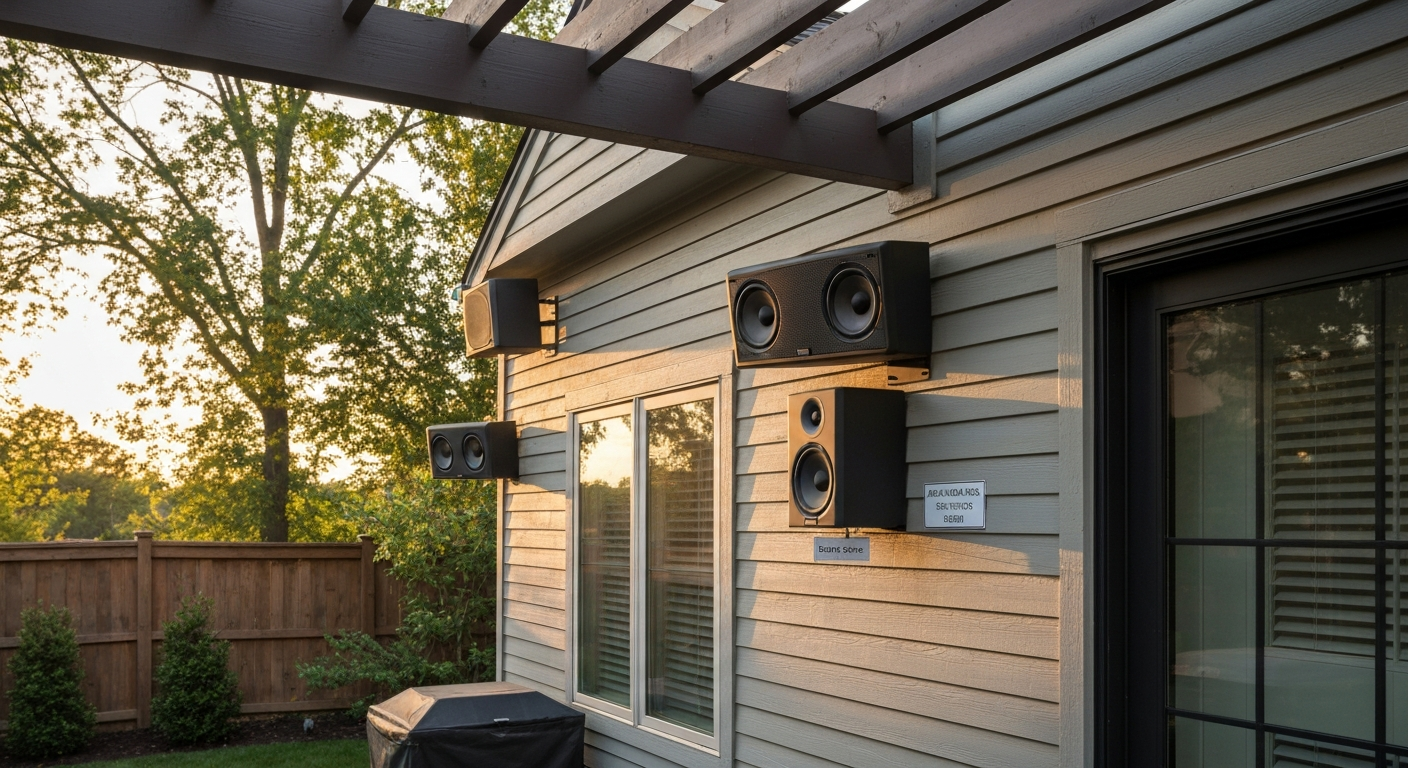
A covered pergola with a solid roof and walls on two or three sides gives you a small amount of acoustic reinforcement and lets you get away with fewer or smaller speakers than a fully open yard. Mount speakers on the covered portion aimed inward. In a fully open yard without structure, sound loss is significant in all directions, which pushes you toward the Atrium 6, more speakers, higher mounting with a downward tilt, and more amplifier power. If your patio has a masonry wall on one side (brick, concrete block, stucco), placing a speaker angled to use the wall as a partial reflective surface can extend perceived coverage without adding more speakers. Avoid mounting directly on glass surfaces: vibration transfer and limited mounting security are both problems.
- Small covered patio (under 150 sq ft): 2 speakers, Atrium 4 or Atrium 5, mounted at 8–10 ft, aimed inward
- Medium open patio (150–400 sq ft): 4 speakers, Atrium 5 recommended, spaced evenly across the space
- Large patio or open yard (400+ sq ft): 6 speakers or Atrium 6 pairs plus subwoofer, three-zone layout
- Pergola or covered structure: use the ceiling structure to mount and angle speakers downward 15–20 degrees
- Open yard with no overhead structure: aim for higher mounting points, maximum downward tilt, more amplifier headroom
Installation: mounting, wiring, and impedance guidance
DIY installation workflow
The Speed-Lock bracket on the Atrium 4, 5, and 6 makes positioning straightforward. The bracket attaches to the mounting surface (wood fascia, soffit, pergola beam), the speaker clips onto the bracket, and you pivot and lock it in one motion. Polk publishes installation instructions and speaker weights in the Atrium owner's manual, which you should check before mounting anything overhead. Use lag screws into studs or solid blocking for overhead mounts, not drywall anchors. For wire runs, 16-gauge CL2-rated (in-wall rated) outdoor speaker wire is the standard minimum. For runs over 50 feet, step up to 14-gauge to keep resistance low. All connections at the speaker terminal should be sealed with self-fusing silicone tape after you make them, especially in humid or coastal climates.
Amplifier pairing and impedance
All four speakers are 8-ohm nominal, which means any standard stereo amplifier, AV receiver, or outdoor-rated amplifier with a minimum 8-ohm load will work. If you wire two pairs of 8-ohm speakers in parallel per channel (a common four-speaker setup), the amplifier sees a 4-ohm load per channel. Verify your amplifier is stable at 4 ohms before doing this. Many AV receivers are, but some entry-level models are not, and running a 4-ohm load into an 8-ohm-only amp will cause thermal shutdown or damage over time. For a six-speaker layout, consult an impedance matching selector or distribute channels differently (two amplifier channels each driving three speakers in a series-parallel configuration).
Contractor checklist
- Confirm mounting surface material and load-bearing capacity before selecting hardware
- Map all wire runs before purchasing cable; measure actual paths including bends around corners
- Specify wire gauge based on run length (16 AWG under 50 ft, 14 AWG over 50 ft)
- Check amplifier impedance rating before planning parallel wiring of multiple speaker pairs
- Use weatherproof speaker connectors or self-fusing tape at all exterior terminations
- Confirm speaker model and pair count with homeowner before ordering (Atrium 4/5/6 are not interchangeable physically in terms of enclosure size)
- Review Polk's Atrium owner's manual for mounting torque specs and weight ratings before overhead installation
- Register speakers on Polk's warranty portal for the homeowner at project close
Price, warranty, and value positioning
Polk lists the Atrium 4 at approximately $199 per pair, the Atrium 5 at $349, and the Atrium 6 at $449. Each current Atrium model carries a five-year warranty on cabinet and drivers for the original purchaser. The Patio 200, as a discontinued retailer-exclusive, does not carry a current new-unit warranty from most sellers, but Polk's community and service history shows they service these units using Atrium 5 parts, which is reassuring if you are buying used or clearance. The value calculation for most buyers is straightforward: if you can hear the difference the Atrium 5's extra bass makes for your listening habits and patio size, the $150 premium over the Atrium 4 is well spent. If you are outfitting a large outdoor space with four or six speakers and budget is the driver, four Atrium 4 pairs at $199 each will outperform two Atrium 6 pairs at $449 each in terms of coverage evenness, even if the Atrium 6 sounds better in isolation.
Use-case recommendations and buyer decision matrix
| Use case / priority | Best model | Why |
|---|---|---|
| Budget-first, small covered patio | Atrium 4 | Lowest cost, honest sound, 5-year warranty, adequate for background music |
| Best all-around value for most patios | Atrium 5 | More bass than Atrium 4, full power handling, same sensitivity, works for most music genres |
| Patio 200 owner upgrading or replacing | Atrium 5 | Identical internals, full current warranty, Speed-Lock bracket upgrade |
| Large open yard or high-volume parties | Atrium 6 | Deepest bass (50 Hz), largest drivers, most headroom, best for open-air and noisy environments |
| Four-speaker budget setup for medium patio | Atrium 4 x2 pairs | Cost-effective coverage, spread four speakers evenly instead of two Atrium 6s |
| TV/outdoor living room, dialogue focus | Atrium 5 or 6 | Clear midrange from Dynamic Balance drivers, low enough extension for full program audio |
| Background music, dinner party, low volume | Atrium 4 | Sensitivity is equal, smaller driver is not a limitation at conversation-level volumes |
| Coastal or high-UV climate, max durability | Atrium 5 or 6 (Atrium-certified) | All-Weather Certified with third-party environmental testing; avoid Patio 200 in exposed locations |
The bottom line on Patio 200 vs Atrium 5, and where the other models fit
If you are comparing the Patio 200 and the Atrium 5 directly, buy the Atrium 5 unless the Patio 200 is significantly cheaper and you are mounting in a protected location. For a direct head-to-head on larger patios, see our Polk Patio 200 vs Atrium 6 comparison to understand how the Atrium 6's extra low-end and power handling change real-world performance. For a focused polk audio patio 200 vs atrium 6 comparison, see the dedicated comparison in this guide. They are the same speaker in meaningful ways, and the Atrium 5 carries the better warranty coverage and current parts availability. If you are deciding between the full Atrium family, let patio size and listening habits make the call: Atrium 4 for small spaces and budget builds, Atrium 5 for most homeowners and most patios, Atrium 6 for large or demanding outdoor spaces where the extra low-end reach and power handling actually get used. For a focused comparison, see our Polk Audio Patio 200 vs Atrium 4 head‑to‑head guide for side‑by‑side specs and listening notes. The comparisons between Atrium 4, 5, and 6 across different use cases are worth exploring in more depth if you are still working through the right configuration for your space. For a focused comparison, see our Polk Patio 200 vs Atrium guide Polk Patio 200 vs Atrium comparison. For comparisons with other outdoor speaker lines, see the polar patio standard vs premium guide for a focused breakdown of feature and durability differences.
FAQ
Quick at-a-glance: How do Polk Patio 200 and Polk Atrium 4/5/6 compare in one line each?
Patio 200: archived 5" woofer/3/4" tweeter outdoor-capable model (90 dB, 60 Hz–25 kHz, 8 Ω, ~50 W RMS) similar to Atrium 5 internals; Atrium 4: compact 4.5" woofer/3/4" tweeter (≈89–90 dB, ~75 Hz–25 kHz, 8 Ω) best for small patios; Atrium 5: 5" woofer/3/4" tweeter (90 dB, 60 Hz–25 kHz, 8 Ω) good mid-size coverage and balanced bass; Atrium 6: 5.25" woofer/1" tweeter (90 dB, 50 Hz–27 kHz, 8 Ω) deepest bass and highest output for larger spaces.
What are the key driver, power and sensitivity specs that affect real-world sound?
Drivers: larger woofers yield more low end—Atrium 6 > Atrium 5/Patio 200 > Atrium 4. Tweeter types are anodized aluminum domes across the line for clarity. Nominal impedance is 8 Ω for all models, and sensitivity is ~89–90 dB (1 W/1 m) so they’re efficient. Polk lists recommended amplifier ranges (Atrium 4: 10–80 W; Atrium 5/6: 10–100 W). Frequency responses indicate bass extension: Atrium 6 (~50 Hz) gives noticeably fuller low notes; Atrium 4 (~75 Hz) will sound thinner on bass-heavy material.
How will these specs translate to real-world coverage and placement for common patio sizes?
Small patio (up to ~150 sq ft): Atrium 4 (one pair) or Patio 200/Atrium 5 (pair) for background music. Medium patio (150–400 sq ft): Atrium 5 pair provides balanced coverage; consider two pairs for even SPL. Large patio or open yard (>400 sq ft): Atrium 6 or multiple Atrium 5 pairs—Atrium 6 gives better single-pair SPL and bass for parties. Placement: mount speakers 6–10 ft apart for small areas, 8–15 ft apart for larger layouts; height 6–10 ft aimed slightly down and toward listening area. Use corner or surround placements to extend coverage, but avoid very close wall-coupling if you want clearer imaging.
Are the Patio 200 and Atrium series truly weatherproof? What materials and durability differences matter?
Atrium series: marketed as All‑Weather Certified with tested resistance to UV, salt fog and immersion benchmarks; features mineral‑filled polypropylene cones (Dynamic Balance), anodized aluminum tweeters, powder‑coated aluminum grilles/brackets and corrosion‑resistant hardware—designed for long-term outdoor exposure. Patio 200 (archived) shares similar driver materials and construction (reports and community evidence show it was effectively based on Atrium hardware). In short: Atrium models are built for continuous outdoor exposure; Patio 200 behaves similarly but being archived may have limited direct warranty/parts differences—practical durability is essentially the same when maintained.
What mounting and installation tips should DIYers and contractors follow?
Use the Atrium Speed‑Lock bracket for quick aiming—mount on solid surfaces with corrosion‑resistant fasteners sized per wall substrate. For DIY: pre-run speaker cable (18–14 AWG—14 AWG for runs >50 ft or higher power), use silicone or gasketed cable entries to keep moisture out, and aim speakers down ~10–20° toward listening area. For pro installs: plan conduit or junction boxes, use in‑wall rated cable to the first outdoor junction, terminate with outdoor terminal blocks or waterproof connectors, and torque hardware per manual. Follow safety guidance for weight/fastener selection; seal all penetrations and keep transformers (if using 70V) in protected locations.
How should I pair amplifiers and wire these speakers (impedance, power, wiring gauge)?
All models are nominal 8 Ω. Use an amp that can deliver within Polk’s recommended range (10 W minimum; up to 80–100 W peak per channel depending on model). For clean headroom avoid driving into audible distortion. Wiring: 14 AWG for runs over 50 ft or higher-power setups; 16–18 AWG acceptable for short runs (<25–50 ft) at normal listening levels. If combining multiple speakers per amp channel, calculate final impedance: two 8 Ω speakers parallel = 4 Ω (ensure amp can drive 4 Ω), or wire in series for 16 Ω if needed but expect lower SPL. For distributed installs where many speakers are needed, favor 70/100 V transformer-capable solutions (use Atrium models with appropriate inline transformers or external transformers) to simplify wiring and avoid low-impedance amp loading.