
The best patio air cooler for most homeowners in a hot, dry climate is a quality evaporative cooler (swamp cooler) in the 1500 to 3000 CFM range, positioned upwind of your seating area with good cross-ventilation around it. If you're in a humid climate like the Gulf Coast or Southeast, skip the evaporative route entirely and look at a portable chilled-air unit or a well-designed misting fan combo instead. The right answer really does depend on where you live and how your patio is built, so let's work through it.
Best Patio Air Cooler: Buyer Guide, Setup, and Top Picks

Elise Prescott
29 Apr 2026
What a patio air cooler actually is (and what it isn't)
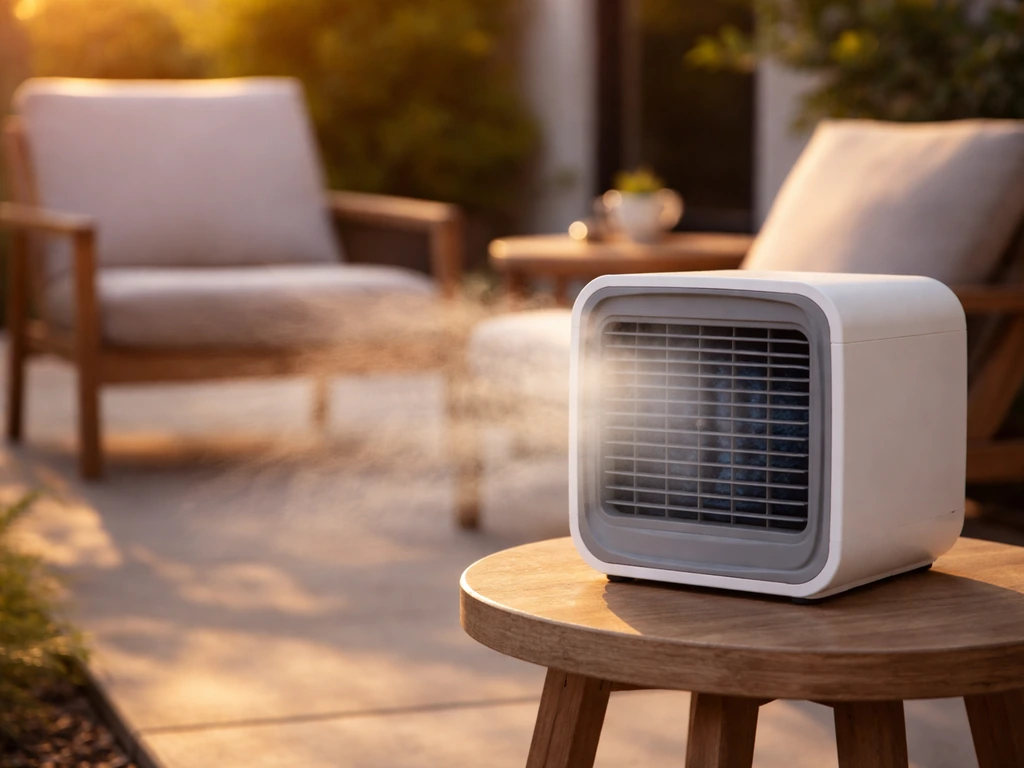
The term 'patio air cooler' gets used loosely, and that's where a lot of buyers go wrong. In most product listings, it refers to an evaporative cooler, sometimes called a swamp cooler. These units draw hot outdoor air through water-saturated cooling pads. As water evaporates from those pads, it absorbs heat from the air passing through, dropping the temperature before a built-in fan pushes it toward you. The physics is real and it works well, but only when the incoming air is dry enough to absorb more moisture.
That's the fundamental difference from the other cooling options you'll see marketed alongside these units. A basic patio fan moves air without cooling it at all. An outdoor misting system adds fine water droplets to the air around you, cooling you through evaporation at skin level. A portable air conditioner uses refrigerant to actively remove heat and humidity from the air, which is more powerful but also more expensive to run and harder to set up outdoors. A patio air cooler sits in between: it's more effective than a fan alone, cheaper and simpler to run than a portable AC, but it depends on low humidity to do its job.
The U.S. Department of Energy is direct about this: evaporative coolers are designed for low-humidity climates and should not be used in humid ones, because they add moisture to the air. In a humid environment, that extra humidity makes you feel hotter and stickier, not cooler. So before you buy anything, your first question is whether your climate is actually a good fit.
The three main types and which one fits your patio
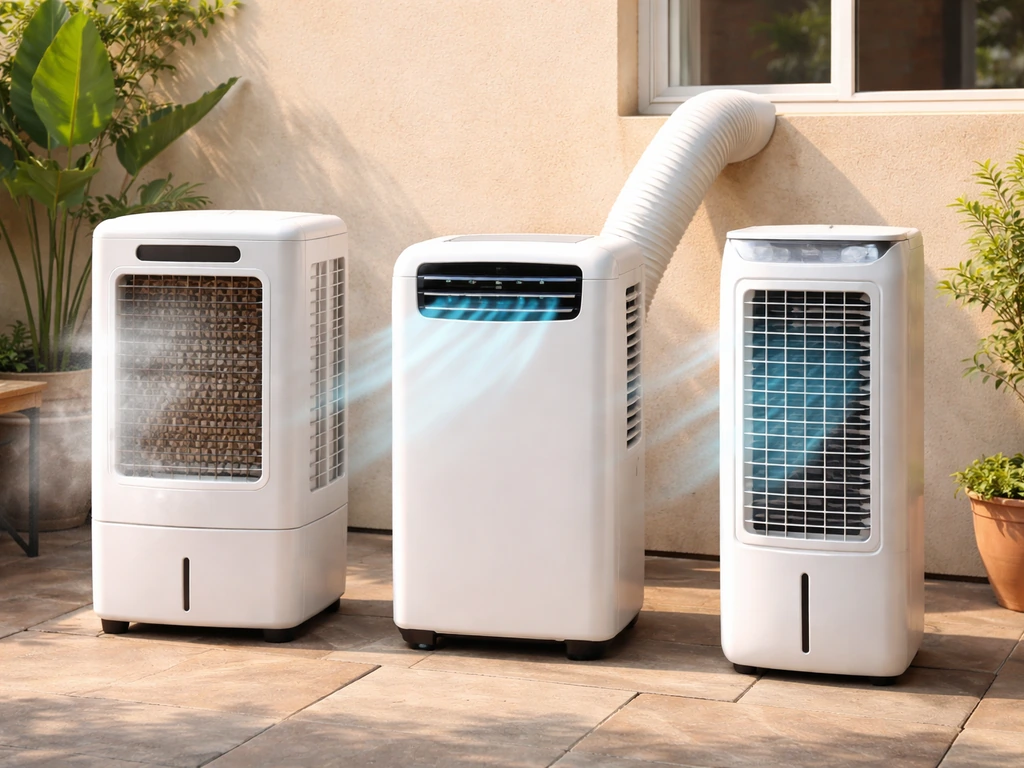
Once you know your climate situation, you can match the cooler type to your patio. There are really three categories worth knowing about.
Evaporative patio coolers
These are the most popular option and the ones most people mean when they search for a patio air cooler. They pull hot air through wet pads and push cool air out, consuming 1 to 2 liters of water per hour (based on units like the Cajun Kooling CK3000-S). They're affordable to run, relatively easy to set up, and capable of covering 300 to 500 square feet of patio space at the high end. The DOE recommends sizing for 20 to 40 air changes per hour depending on your climate, which is why CFM ratings matter so much when comparing models. These work best in the dry American West and Southwest: think Arizona, Nevada, New Mexico, Colorado, parts of California, and Texas away from the coast.
Portable air conditioners for patios
Portable AC units use refrigeration to cool air and remove humidity at the same time. They work in any climate because they don't rely on dry air to function. The catch outdoors is that they need to exhaust hot air somewhere, and most require a 120V or 240V outlet close by. They cost more to run and typically need a covered, semi-enclosed patio to work efficiently, since you can't really air-condition the open sky. If you have a screened porch or a tightly covered patio enclosure, a portable AC can be genuinely effective. If you are shopping for the best portable air conditioner for patio comfort, focus on venting options and how enclosed your space is so the unit can cool effectively. For an open pergola or uncovered slab, you're fighting physics.
Chilled-air tower and hybrid coolers
A newer category sometimes called 'chilled air coolers' or personal cooling towers uses ice water or refrigerated coils combined with a fan. Units like the Dreo IceWind 712S fall into this range, offering features like a 6-liter tank, noise levels as low as 33 dB, and wind speeds up to 25 ft/s. These are best as personal or close-range coolers, not whole-patio solutions. Think of them as a souped-up desk fan with a cooling boost, useful for a single seating area or a small covered balcony, but not for covering a 400-square-foot deck.
Features that actually matter when you're shopping
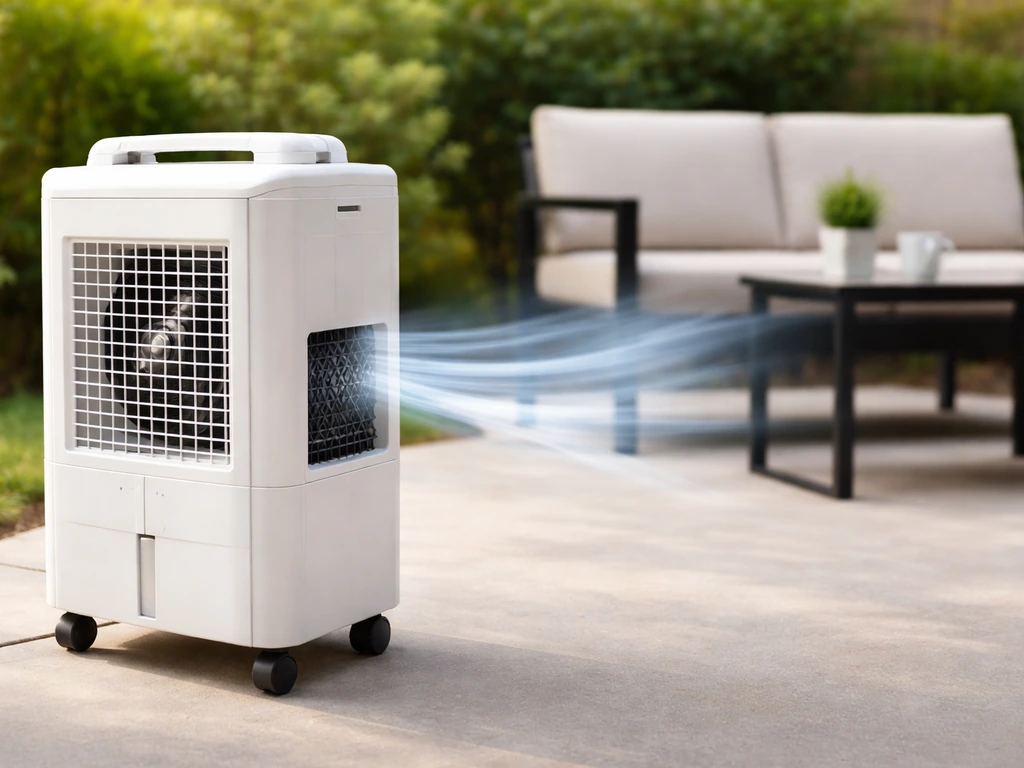
Marketing copy on cooler boxes can be misleading. Here's what to actually look at before you buy.
- CFM (cubic feet per minute): This tells you how much air the unit moves. For a 300 to 500 sq ft open patio, look for at least 1500 CFM. The Honeywell CO60PM puts out 1540 CFM; the Cajun Kooling CK3000-S claims 3000 CFM with airflow reaching up to 20 feet.
- Water tank size: Larger tanks mean less frequent refilling. The Honeywell CO60PM has a 15.9-gallon (60L) tank, which at 1 to 2 liters per hour gives you a long run before refilling. Smaller personal units like the Dreo 712S carry only 6 liters, fine for a few hours of use.
- Coverage area: Treat manufacturer claims as optimistic. A '500 sq ft' rating assumes dry air, good airflow, and no direct sun on the unit. Real-world coverage is usually 20 to 30 percent less in typical conditions.
- Controls and remote: Outdoor use is much better with a remote or app control so you're not walking back to the unit. A timer is useful for pre-cooling the patio before you head outside.
- Oscillation: Side-to-side oscillation dramatically improves airflow distribution across a seating area. Don't skip this feature if you're covering more than one or two people.
- Weather resistance and IP rating: Look for an IPX4 or higher rating if the unit will be exposed to splashing or light rain. Most evaporative coolers are not fully weatherproof and should be moved under cover during storms.
- GFCI compatibility: The Honeywell CO60PM manual explicitly requires a GFCI-protected outlet for outdoor use. Critically, the Cajun Kooling CK3000-S manual states it cannot be connected to a GFCI outlet, which is an important safety and installation consideration.
- Safety features: Look for overheat protection, tip-over cutoffs, and cord length adequate for your outlet placement. Units should always be placed on a flat, level surface with casters locked if applicable.
- Filtration and recirculation: Some units recirculate water through a pump to keep pads wet evenly; better filtration keeps mineral buildup and odors under control longer between cleanings.
Which cooler works best in your climate and patio layout
This is the section that will save you the most money and frustration. The 'best patio air cooler' is genuinely different depending on where you live. If you want to compare options across different climates and patio sizes, use a dedicated guide to find the best cooler for patio comfort. Choosing the best outdoor patio cooling system also means balancing climate, coverage area, and the setup you can realistically maintain year-round best patio air cooler.
| Climate / Region | Best Cooler Type | Why It Works | What to Avoid |
|---|---|---|---|
| Hot and dry (AZ, NV, NM, inland CA, CO, UT) | Evaporative cooler, 1500+ CFM | Low humidity means maximum wet-bulb depression; temps can drop 15 to 25°F | Portable AC (overkill cost/complexity for open patios) |
| Hot and humid (Gulf Coast, FL, SE U.S.) | Portable AC or misting fan with good airflow | Evaporative coolers add moisture and make humid conditions worse | Evaporative coolers entirely |
| Hot with variable humidity (TX coast, mid-Atlantic, Pacific Northwest summers) | Hybrid chilled-air cooler or portable AC for enclosed patios; misting fan for open patios | Humidity swings make evaporative performance unpredictable | Relying on evaporative cooler alone |
| Mild but warm (mountain West, northern states in summer) | Smaller evaporative cooler or chilled tower unit | Lower peak temps mean less cooling demand; oversizing wastes money | Large commercial-grade units |
| Covered/screened porch or patio enclosure (any climate) | Portable AC most effective; evaporative works if dry climate | Enclosed spaces benefit most from refrigerant cooling since cool air stays contained | Evaporative in humid enclosed spaces (mold risk) |
| Large open pergola or uncovered deck (dry climate) | High-CFM evaporative cooler (3000 CFM range) | Open airflow is ideal for evaporative; high CFM compensates for open-air loss | Small personal coolers (inadequate coverage) |
Open patios are where evaporative coolers shine in dry climates, precisely because the open air provides fresh dry intake air continuously. The evaporative process can, in ideal conditions, bring supply air temperature down to the incoming wet-bulb temperature, meaning you can realistically see 15 to 20°F drops on a dry Arizona afternoon. On the other hand, if you're in Houston in July and your humidity is running at 75 to 85 percent, even the best evaporative cooler will struggle to drop temperatures more than 2 to 5°F, if that. USGS similarly notes that evaporative coolers work best in dry areas, while humid conditions in the eastern U.S. are where normal air conditioners are typically used instead if you're in Houston in July and your humidity is running at 75 to 85 percent. In that case, your money is better spent on a covered patio with a quality misting system or an enclosed porch with a portable AC.
Installation and setup: what's a DIY job and what needs a pro
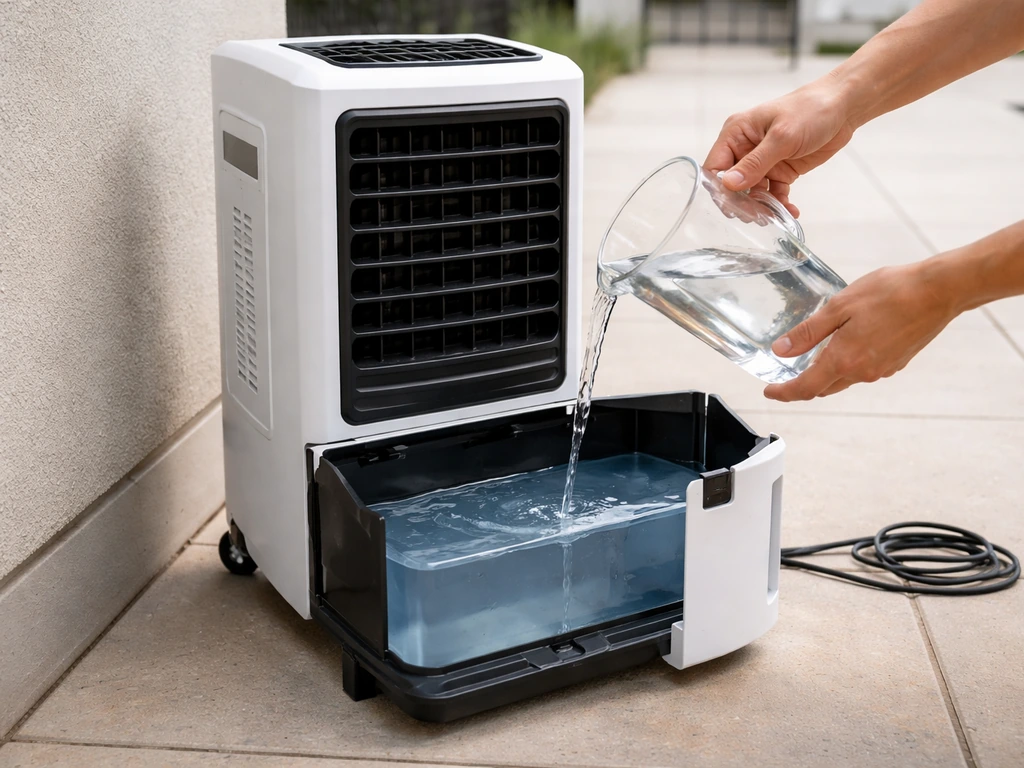
Most portable patio air coolers are genuinely plug-and-play. You pull them out of the box, fill the tank, plug them in, and turn them on. That's true for units like the Honeywell CO60PM and the Cajun Kooling CK3000-S. No installation credentials needed. But a few situations do call for a professional.
What you can handle yourself
- Unboxing, assembling, and positioning any portable evaporative cooler or chilled-tower unit
- Filling the water tank and setting speed, oscillation, and timer settings
- Connecting to an existing outdoor GFCI outlet (always verify the outlet type matches the unit's requirements before plugging in)
- Routing a garden hose to a unit with a continuous-fill port, if it has one
- Seasonal cleaning, pad rinsing, and tank draining before storage
When it's worth calling a pro
- Adding a new outdoor electrical circuit or GFCI outlet: This requires a licensed electrician and a permit in most jurisdictions. Don't skip this; an improperly wired outdoor outlet is a real fire and shock hazard.
- Mounting a wall-mounted or ceiling-mounted evaporative cooler on a covered patio: Structural fastening into posts, beams, or masonry walls should be handled by someone who knows the load requirements.
- Integrating an evaporative cooler with a patio misting system or ducted airflow: Combining systems for maximum efficiency is a job for an HVAC contractor or an experienced outdoor living contractor.
- Running a dedicated water line for continuous-fill operation: A plumber can tap into your irrigation or household supply cleanly; DIY connections at the wrong point can cause pressure problems or leaks.
- Installing a whole-house or built-in evaporative cooling system that serves the patio and indoor spaces: Always hire a licensed HVAC professional for this.
If you're unsure about your outdoor electrical situation, have a licensed electrician check it before you run a high-CFM cooler on an old or unprotected circuit. The Honeywell CO60PM specifically calls for a GFCI-protected outlet, and for good reason: water and electricity share the same unit, and outdoor environments add weather and moisture exposure to the equation.
Power, water, maintenance, and what it costs to run
Running costs
Evaporative patio coolers are cheap to run compared to portable air conditioners. Most residential-grade units draw 150 to 400 watts, versus 1000 to 1500 watts for a portable AC. At the national average electricity rate of around $0.16 per kWh, a 300W evaporative cooler running 6 hours a day costs about $0.29 per day. Water consumption is roughly 1 to 2 liters per hour, so a full 6-hour session uses 6 to 12 liters. Over a summer, that's a minor water bill addition, not a major one.
Cleaning and descaling
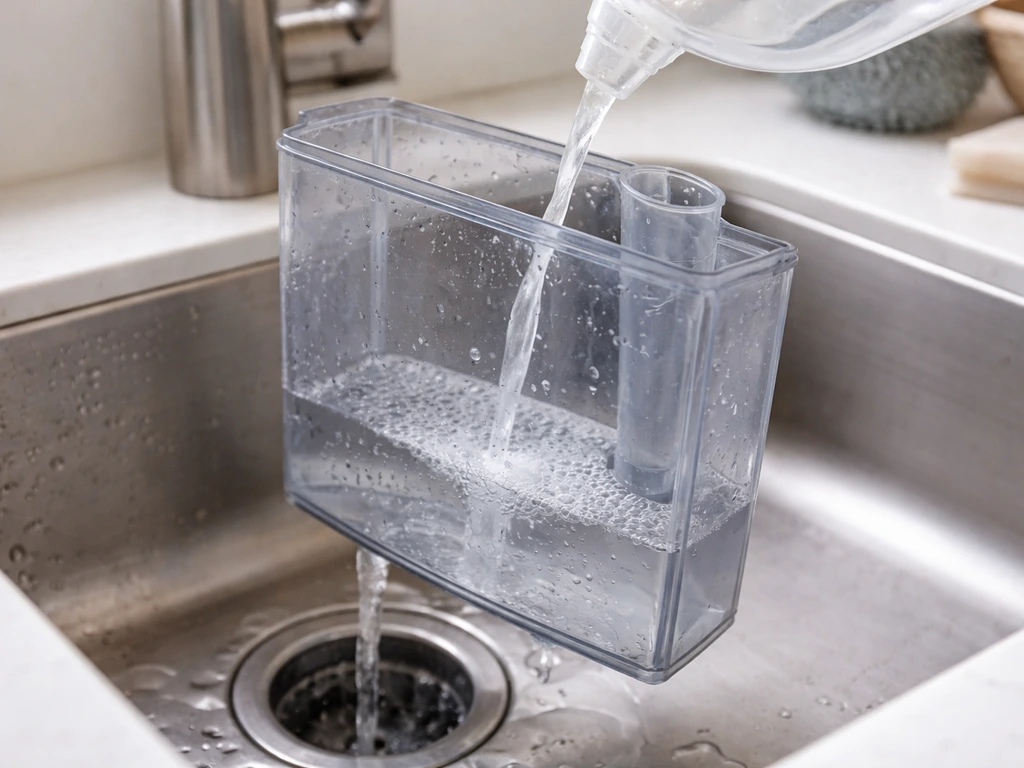
This is the maintenance step most people skip, and it's why coolers start smelling musty or cooling less effectively by mid-summer. Dreo recommends cleaning the water tank with citric acid every two weeks to prevent mold growth, and rinsing the cooling pad once a month to prevent dust buildup. That schedule is realistic and worth following. Mineral deposits from hard water will clog pads and reduce airflow over time, so if you're in a hard-water area, descaling monthly is smarter. Don't add foaming or soap-based cleaners to the reservoir while the pump is running; the Cajun Kooling manual specifically warns against this because foaming can overflow and damage the unit.
Filter and pad replacement
Cooling pads typically need replacement once per season, or more often if you're running the unit daily in a dusty environment. The Honeywell CO60PM manual includes detailed pad replacement instructions. Budget roughly $15 to $40 per pad set depending on the unit size. Some units use washable pads that last multiple seasons with proper care.
Winterizing and storage
Before you store any evaporative cooler for the off-season, drain the tank completely. Cajun Kooling's manual is explicit: drain out all water during long periods of non-use. Standing water in a cooler over winter is a mold and mineral-buildup problem that will greet you badly in spring. The MasterCool MCP44C manual includes a dedicated winterization section covering flushing the reservoir, drying the pads, and protecting any exposed fittings. That's the right approach: drain, dry, and store in a covered or indoor space if possible.
Where to put it and how to get the most out of it
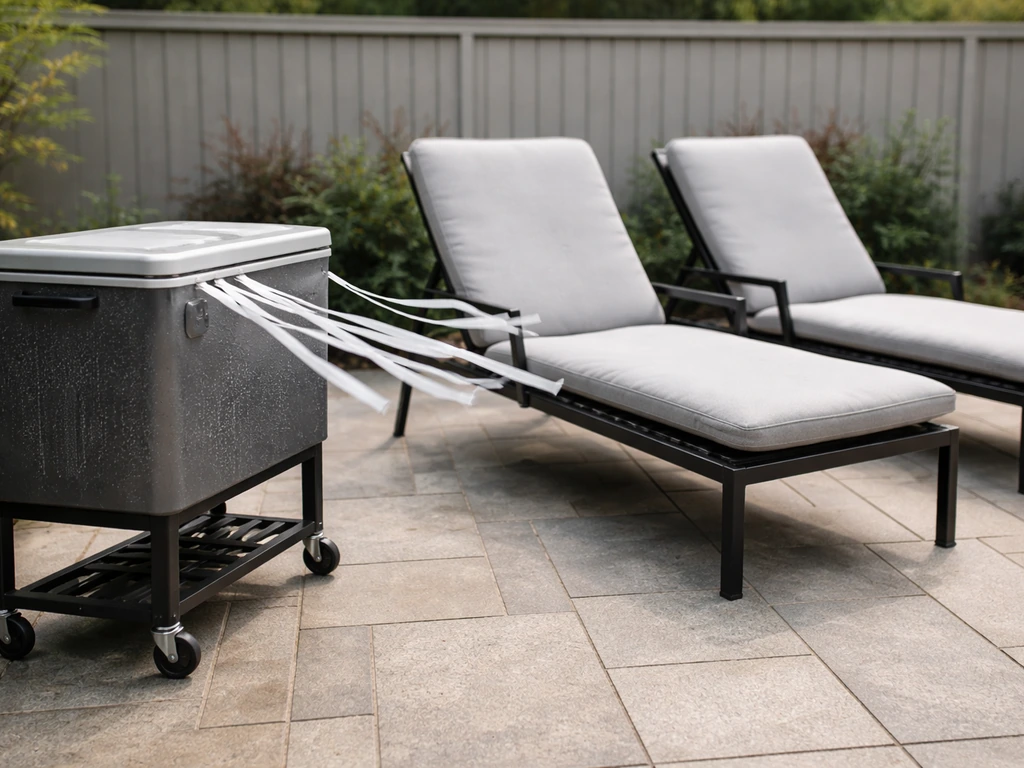
Placement makes a surprisingly large difference in how well a patio cooler performs. I've seen people place a unit in the corner of a patio pointing at a wall and wonder why it doesn't work. Here's what actually matters.
- Position the cooler upwind of your seating area. You want to be in the path of the cooled air stream, not beside it. On a patio with prevailing afternoon winds, place the unit on the windward side so natural airflow and the cooler's output work together.
- Keep at least 3 feet of clearance behind and on the sides of the unit so it can draw fresh air freely. Blocking the intake with furniture or walls will reduce cooling output significantly.
- Avoid placing the unit in direct sun. Direct solar radiation heats the unit's housing and the water in the tank, reducing cooling effectiveness. If possible, position it in shade or under a patio cover.
- Aim the airflow across your seating area, not directly at one person's face. With oscillation enabled, you'll get more even coverage. For larger patios, aim slightly above seated head height so the cooled air descends naturally.
- Pair with shade first. A good patio cover or shade sail reduces radiant heat load dramatically before the cooler even turns on. Cooling a sun-baked concrete slab is a losing battle; cooling a shaded patio is much more achievable.
- Combine with a patio ceiling fan if you have a covered patio. The fan improves air circulation and helps distribute the cooled air further. Running both together usually gives noticeably better comfort than either alone.
- Keep doors, gates, or openings on the downwind side open to allow airflow to exit. Evaporative cooling works through ventilation; trapping the humid exhaust air in an enclosed space will eventually reduce comfort.
- Use a timer to pre-cool the patio 20 to 30 minutes before you plan to use it, especially on days over 100°F. Starting with a cooler ambient temperature gives the unit less work to do.
- On days with high humidity, switch to a high-fan-speed-only mode (no water) to use the unit as a powerful airflow fan rather than fighting the humidity with evaporation that won't help.
Top picks: how the leading options compare and how to choose
Rather than declare one unit the absolute winner, here's how the most-referenced options stack up, because the right pick depends entirely on your patio size, climate, and how much you want to spend.
| Unit | CFM / Airflow | Tank Size | Best For | Notable Caveat |
|---|---|---|---|---|
| Cajun Kooling CK3000-S | 3000 CFM / up to 20 ft reach | 10 gallons | Large open patios in dry climates; 300-500 sq ft | Cannot be used on a GFCI outlet; check your electrical setup first |
| Honeywell CO60PM | 1540 CFM | 15.9 gallons (60L) | Medium patios; indoor/outdoor use; long run time between refills | Requires GFCI outlet; bulkier unit |
| Dreo IceWind 712S | Up to 25 ft/s wind speed | 6 liters | Personal use; single seating area; covered balcony or porch | Not a whole-patio solution; limited coverage area |
| Portable AC (any brand, 8,000-12,000 BTU) | N/A (refrigerant-based) | Condensate varies | Humid climates; enclosed or screened patios | Higher running cost; needs exhaust duct; least portable option |
For a large, open, uncovered patio in a dry climate, the Cajun Kooling CK3000-S is hard to beat on raw airflow and coverage, but verify your outlet situation before you buy since its GFCI incompatibility is a real constraint. If you want a longer run time and a unit that handles both indoor and outdoor duty, the Honeywell CO60PM is a solid, well-documented choice with a big tank and clear maintenance guidance. If you want something quieter and more compact for a small seating nook or a balcony, a personal chilled tower like the Dreo 712S is worth considering, with the understanding that it's a targeted solution, not a whole-patio cooler.
For humid-climate homeowners, none of the evaporative options above will solve your problem. Your best path is either a portable AC in an enclosed patio, a quality misting fan setup, or a combination of shade, a ceiling fan, and a misting system. Those approaches are covered in detail in related guides on outdoor evaporative coolers and portable patio air conditioners, along with comparisons of full outdoor cooling systems if you want to go deeper on any one option. If you're specifically shopping for an evaporative setup for a patio, compare the best outdoor evaporative cooler for patio options that fit dry climates and your coverage needs outdoor evaporative coolers.
The quick decision path
- Check your climate first. If your summer relative humidity regularly runs above 60 percent, skip evaporative coolers and go straight to portable AC or a misting fan system.
- Measure your patio. For open patios under 200 sq ft, a mid-range evaporative cooler around 1500 CFM is sufficient. For 300 to 500 sq ft, you need 2500 to 3000 CFM.
- Check your electrical setup. Confirm whether you have an outdoor GFCI outlet or a standard outlet, and match it to the unit's requirement. If you need a new circuit, budget for an electrician.
- Decide on portability vs. capacity. Bigger tanks mean less refilling but heavier units. If you'll be moving the cooler in and out of storage regularly, a 10-gallon unit is more manageable than a 16-gallon one.
- Plan your placement before you buy. If your patio doesn't have good cross-ventilation or airflow paths, even the best cooler will underperform. Fix the airflow problem first with shade and layout adjustments.
- Budget for maintenance. Set aside $20 to $50 per season for pad replacements and citric acid cleaning supplies. That's cheap insurance against musty smells and reduced performance.
The bottom line is this: a patio air cooler is a genuinely useful tool in the right environment, and the right one for your patio is not the most expensive or the highest-rated on Amazon. If you want the simple, practical version of choosing one, this life is good patio cooler guide can help you pick the right style for your climate. It's the one that matches your climate, fits your space, runs on your electrical setup, and gets maintained properly through the season. Get those basics right and you'll be comfortable outside even on the hottest days of summer.
FAQ
How can I tell if a best patio air cooler (evaporative) will work in my exact location?
No. If your humidity is high, evaporative coolers add moisture and the air can feel hotter and stickier. A practical check is to compare your typical afternoon humidity to your expected target, if you routinely see muggy conditions, plan for a portable AC, an enclosed patio approach, or a misting fan setup instead.
What placement mistakes make a patio air cooler feel like it is not cooling?
Aim for intake airflow that is cooler and drier than the air around your seating, place the unit so it pulls fresh air from an open side and blows toward (not into) the seating area. Avoid pointing at a wall, and do not block the top exhaust path, you want cross-flow that actually carries cooled air to where people sit.
Is higher CFM always better for the best patio air cooler?
For evaporative patio air coolers, higher CFM generally improves coverage, but only if you have enough air changes and cross-ventilation. If you have a tight patio enclosure, oversized airflow can just stir warm air, prioritize correct airflow direction and unobstructed intake/exhaust over chasing the biggest number.
Can I move a patio air cooler while it is running?
Evaporative units are not designed to be moved while running and many manuals expect stable placement to prevent water sloshing and inconsistent pad saturation. Set it up, verify outlet safety, then operate it in that fixed position for the session, especially on uneven surfaces.
What extension cord or outlet setup is safest for a patio air cooler?
Many units are fine with extension cords in specific cases, but high-CFM evaporative coolers should be plugged into a properly rated outlet, using a cord that matches the unit’s amperage and outdoor rating. If the unit requires GFCI protection, the safest approach is to plug into a GFCI-protected outdoor receptacle rather than relying on adapters.
Will a portable AC or chilled-air unit work on an open pergola patio?
Look for whether the design assumes an open-air patio. Portable chilled-air or portable AC units usually need a semi-enclosed space and working exhaust, if hot air cannot vent out effectively, performance drops sharply. For open pergolas, expect minimal results from refrigerant-based portable ACs.
My patio air cooler smells musty and feels weaker, what should I troubleshoot first?
If you get a musty smell or weaker airflow, check three things first: empty and thoroughly clean the tank, rinse and inspect pads for mineral buildup, and confirm the intake is not clogged with dust. Replacing pads mid-season is often faster than deep troubleshooting when airflow is visibly reduced.
Does hard water ruin evaporative patio air coolers, and what should I do about it?
If you run the unit in hard-water areas, mineral scale can shorten pad life and reduce cooling efficiency. Descale on a schedule (often monthly), and if you can, using filtered or softened water can slow clogging and reduce maintenance intensity.
What cleaning products should I avoid in the water tank of a patio air cooler?
Do not use foaming or soap-based cleaners in the reservoir while the pump is running, foaming can overflow and interfere with operation. For routine cleaning, follow manufacturer-approved descaling, then rinse thoroughly before refilling.
How should I winterize an evaporative patio air cooler if I store it outdoors?
In winter, leaving water inside is a common cause of mold and scale. Drain completely, dry the pads, flush the reservoir if the manual calls for it, then store the unit covered and ideally indoors, to protect exposed fittings and reduce corrosion risk.
If two patio air coolers have similar CFM, how do I choose between quiet and high airflow?
Noise matters, but airflow direction and pad condition matter more for comfort. A quieter unit may cover less area, so choose based on seat distance and patio size, if you sit close to the outlet, personal chilled towers can be a better fit than a whole-patio model.
How do I evaluate performance quickly after setup to know if I chose the right type?
Use a quick comfort test: run for a short session on a typical hot day, then check whether supply air temperature drops meaningfully and whether you feel airflow at the seating. If humidity is your limiting factor, you will see little temperature improvement, then it is time to switch strategies (shade, fans, misting, or portable AC in an enclosure).