
For a dry-climate patio (think Arizona, New Mexico, West Texas, or inland California), a well-matched outdoor evaporative cooler can drop the air temperature by 15 to 30 degrees Fahrenheit and cost a fraction of running a compressor-based AC. A well-chosen best patio evaporative cooler can be a major upgrade for dry, sunny patios where evaporation cooling actually performs.
Best Outdoor Evaporative Cooler for Patio: Buyer Guide

Elise Prescott
29 Apr 2026
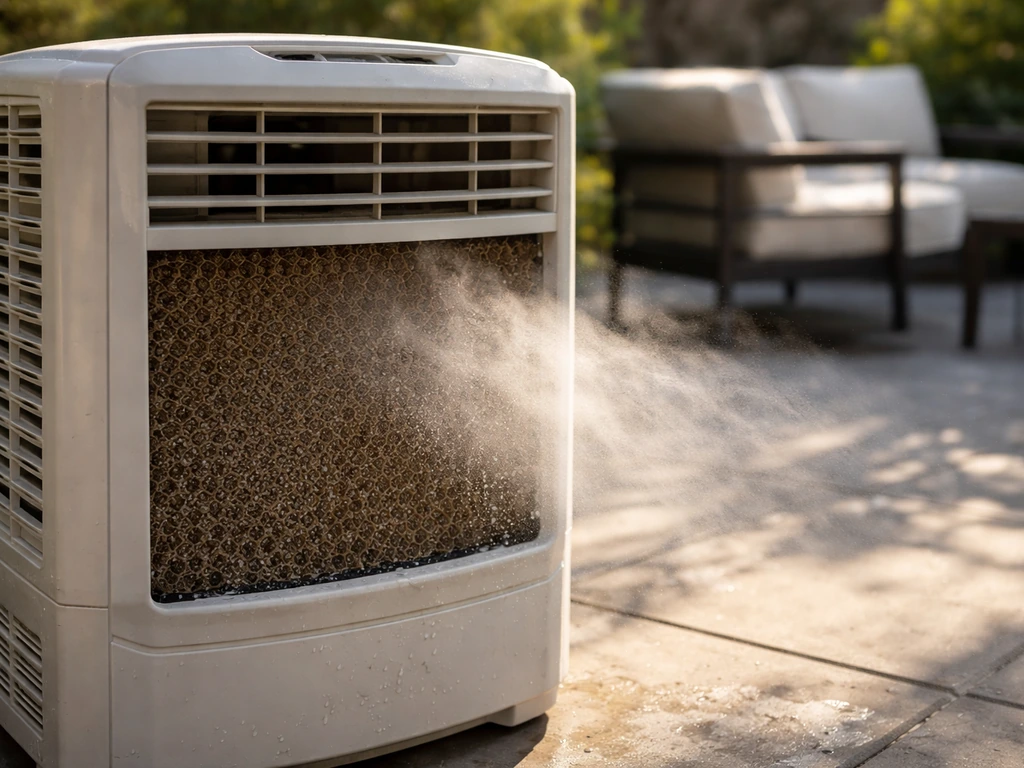
The Port-A-Cool Cyclone 3000 (3,000 CFM, 16-gallon tank) is the best overall pick for most medium-to-large patios, while the Cajun Kooling CK4500-S (4,500 CFM, 32-gallon tank, ~1,200 sq ft coverage) is the move if you have a big covered patio and want to run it for hours without refilling. If you are still trying to decide the best cooler for patio, compare these patio evaporative cooler options by CFM coverage and run-time before you buy.
If you live somewhere humid, though, an evaporative cooler is the wrong tool entirely and you'll want to keep reading before you spend a dime.
How patio evaporative coolers work (and when they actually work)
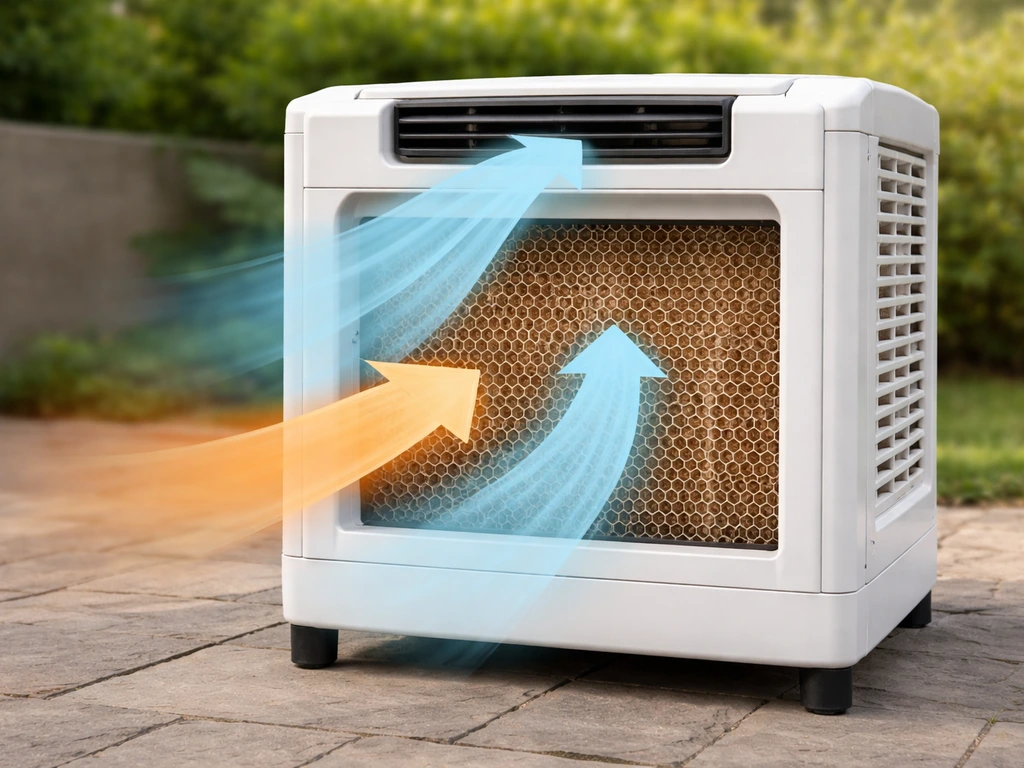
Evaporative coolers pull warm outside air through a water-soaked pad or membrane. As the water evaporates into the airstream, it absorbs heat and drops the air temperature before blowing it out toward you. The physics here are real and the cooling can be dramatic, but there's a hard ceiling: [the outgoing air temperature can never go below the outdoor wet-bulb temperature](https://handbook. ashrae.
org/Handbooks/S16/IP/s16ch41/s16ch41_ip. aspx). In practical terms, that means the drier the air, the more cooling you get. In very dry conditions, wet-bulb depression of 20 to 25°F is common, meaning you could take 100°F air and push it out at 75 to 80°F.
The air leaving the cooler is typically at 80 to 90% relative humidity, which is why exhaust matters so much outdoors.
The wet-bulb limit is also why these coolers are basically useless on a humid Gulf Coast afternoon. When the outdoor air is already 85°F and 80% humidity, there's almost no wet-bulb depression left to work with. You'll get a slight breeze and minimal cooling, and you'll actually make the air around you feel stickier. If your summer humidity regularly sits above 60%, look at the alternatives section at the bottom of this article before committing to an evaporative unit. If you're in a mixed climate (humidity varies day to day), an evaporative cooler can still work great during your dry spells, and most units let you run the fan only without the pump when it's humid.
One more thing worth understanding: evaporative coolers need airflow through and away from the space. On a completely enclosed patio or screened room, the humidity from the cooler builds up rapidly and the cooling effect collapses. A covered but open-sided patio is the sweet spot. Cross-ventilation is your friend. Position the cooler so air flows across the seating area and exits through an open side.
Measure your patio and match cooler size to coverage
CFM (cubic feet per minute) is the number that actually tells you how much air a cooler moves. Most residential and patio-grade evaporative coolers fall between 1,500 and 5,000 CFM. A general rule borrowed from greenhouse fan-and-pad engineering is that you want roughly 8 CFM per square foot of floor area for effective cooling. That means a 200 sq ft patio needs about 1,600 CFM minimum, a 400 sq ft patio needs 3,200 CFM, and a 600 sq ft covered outdoor room warrants a 4,500 CFM unit. These are minimums. On a hot day outdoors, you'll want to err toward the higher end.
For spot cooling (a single seating group, one corner of the patio), you can get away with a smaller unit in the 1,500 to 2,500 CFM range. For whole-patio coverage, especially under a solid patio cover where the air doesn't move on its own, go with a larger unit and add a ceiling fan or floor fan to help distribute the cooled air. Think of the evaporative cooler as the source of cold air and the fans as the distribution network.
| Patio Size | Minimum CFM Needed | Recommended Unit Size | Tank Size to Aim For |
|---|---|---|---|
| Up to 150 sq ft | 1,200 CFM | 1,500–2,000 CFM | 10–15 gallons |
| 150–300 sq ft | 1,600–2,400 CFM | 2,500–3,000 CFM | 15–20 gallons |
| 300–500 sq ft | 2,400–4,000 CFM | 3,500–4,500 CFM | 20–32 gallons |
| 500–1,200 sq ft | 4,000–9,600 CFM | 4,500–5,000+ CFM | 32+ gallons or plumbed |
Water use scales directly with airflow and operating conditions. A 3,000 CFM unit typically burns through 5 to 7 gallons of water per hour, while a 4,500 CFM unit can use 7 to 12 gallons per hour. A well-designed unit like the Cajun Kooling CK4500-S with its 32-gallon tank gives you 8 to 10 hours of run time before you need to refill. If you're running a large cooler and don't want to babysit the tank, look for a model with a garden hose hookup for continuous fill and an automatic low-water shutoff.
Top features to compare before you buy
Airflow and fan type
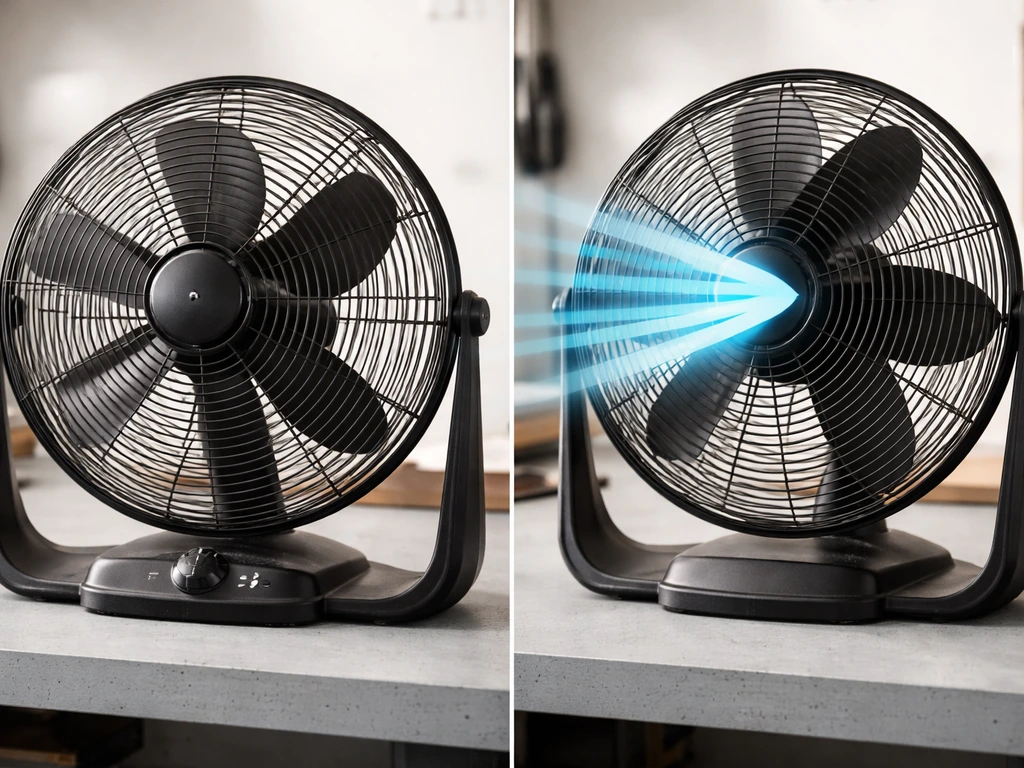
CFM at the top speed is the headline number, but check whether the unit has multiple fan speeds (3-speed is standard on quality models). Variable speed matters more outdoors than indoors because conditions change. During moderate heat, running at medium speed is fine. When temps spike, you want full blast. Direct-drive motors tend to be simpler and more durable for outdoor use. Belt-drive units are generally larger commercial-grade coolers and are overkill for a residential patio.
Pad thickness and media quality
Pad thickness directly affects cooling efficiency because thicker pads give air more contact time with the wet media. A 10-inch pad delivers meaningfully better cooling than a 4-inch pad under the same conditions. For outdoor use, look for rigid media (often called Chillcel or similar) over thin aspen pads. Rigid media lasts longer outdoors, is easier to clean, and handles UV and weather exposure better.
Controls and convenience
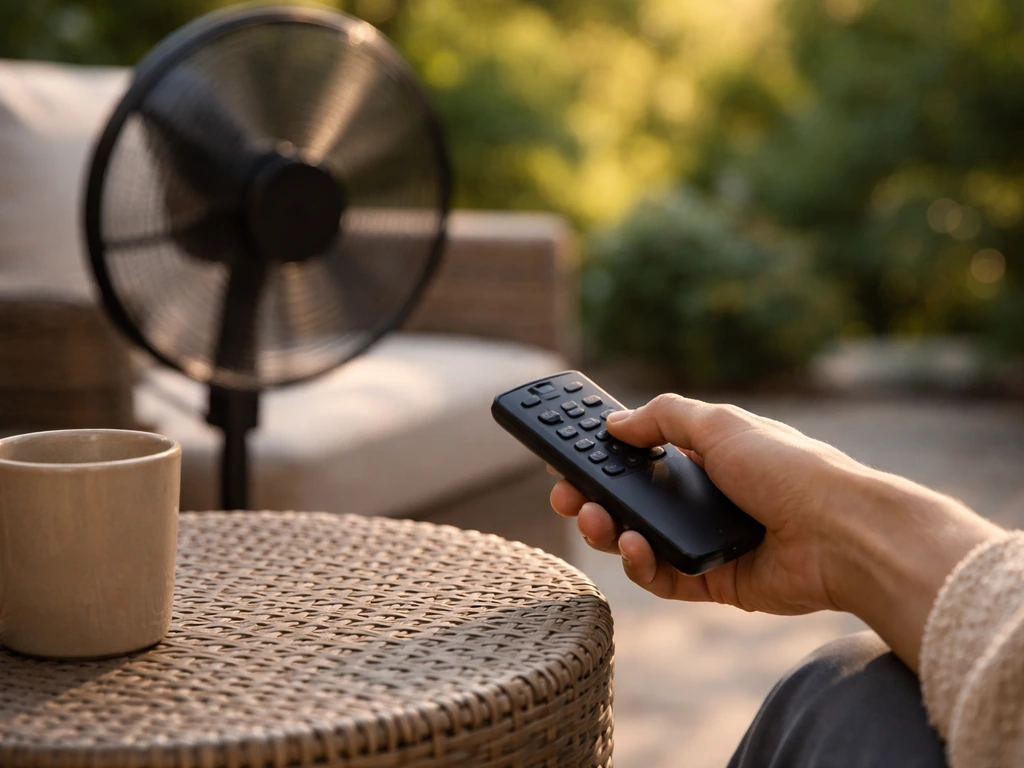
At minimum, look for a remote control since walking to the unit when you're comfortably seated is annoying. Higher-end models like Portacool's lineup offer app control through their CoolSync platform so you can adjust fan speed and run multiple units from your phone. For most backyard setups, a basic 3-speed remote is plenty. Timer functionality is useful if you want to pre-cool the patio before a gathering.
Durability for outdoor use
This is where many cheap units fail fast. Look for UV-stabilized housing (usually HDPE or similar polymer), stainless steel or coated hardware at the water contact points, and sealed bearings in the motor. Wheels and a solid base matter too if you're rolling the unit in and out of storage. Units with powder-coated metal frames tend to outlast all-plastic competitors in outdoor conditions, especially in regions with intense sun.
Water use and tank management
Evaporative coolers use roughly 3 to 15 gallons of water per hour depending on size and how hard they're working. Smaller patio units in the 1,500 to 3,000 CFM range consume 5 to 7 gallons per hour. Larger units above 4,000 CFM can push 10 to 17 gallons per hour in hot, dry conditions. A direct garden hose hookup is worth paying extra for if you plan to run the cooler for more than 3 to 4 hours at a stretch. Also look for a drain plug at the bottom of the reservoir since you'll need it for cleaning and seasonal storage.
Best picks by patio type and climate
There's no single perfect cooler for every situation, so here's how I'd break it down based on what you're actually working with. To narrow down the best patio air cooler for your space, focus on CFM coverage, pad quality, and run-time. If you are searching for a life is good patio cooler, use CFM coverage and run-time as your quick filter before comparing features.
| Use Case | Best Fit | Key Specs to Target | Notes |
|---|---|---|---|
| Best overall (medium patio, dry climate) | Port-A-Cool Cyclone 3000 | 3,000 CFM, 16-gal tank, portable | Strong brand, easy to move, widely available |
| Best for large/covered patio | Cajun Kooling CK4500-S | 4,500 CFM, 32-gal tank, ~1,200 sq ft | Long tank life, remote control, 3-speed |
| Best for small patio/spot cooling | 1,500–2,000 CFM portable unit | ~1,500 CFM, 10–15 gal tank | Many budget options work fine at this scale |
| Best for premium/tech-forward setup | Portacool with CoolSync app | 2,400–3,000 CFM, app-enabled | Worth it if you want multi-unit app control |
| Best budget pick | Any 1,500–2,000 CFM HDPE unit with remote | UV-stable housing, 3-speed | Spend money on pad quality, not brand name |
Climate matters at least as much as patio size. If you're in Phoenix, Albuquerque, Las Vegas, Fresno, or similar desert or semi-arid cities, almost any decent evaporative cooler will impress you. If you're in Dallas or Atlanta where humidity swings wildly, an evaporative cooler works well on low-humidity days (typically spring and early fall in Texas) but struggles during humid summer stretches. In those cases, having a cooler you can run in fan-only mode on humid days is a nice flexibility. If you're on the Gulf Coast or in Florida, skip evaporative cooling entirely and look at alternatives discussed below.
Covered vs open patio considerations
A covered patio with open sides is the ideal environment for an evaporative cooler. The roof keeps direct sun off you and the cooler's water supply, and the open sides provide the ventilation the unit needs to push humid exhaust air away. An open patio with no cover works too but the cooler has to fight direct solar heat gain on every surface. On a fully enclosed screened porch or sunroom, you'll need to crack a window or door to maintain enough air exchange, otherwise the space gets humid and the cooling benefit disappears within 20 to 30 minutes.
Installation and placement tips for maximum cooling
Where you put the cooler on your patio makes a bigger difference than most people expect. The goal is to push cooled air across your seating area and let warm humid exhaust escape from the other side. Place the cooler at one end or one side of the patio so the airstream travels the length of the space before exiting. Don't tuck it in a corner where it just recirculates the same air.
- Orient the cooler so air blows toward your seating area, not perpendicular to it or into a wall
- Keep at least 2 to 3 feet of clearance around the intake side so the unit draws fresh air freely
- If the prevailing wind opposes the direction you want to blow cooled air, position the cooler to work with the wind, not against it (fighting wind direction can reduce effective airflow by 10 to 15%)
- For large patios, a second smaller unit at the opposite end pointed back toward the center can help fill dead spots
- If you have a ceiling fan, run it to circulate the cooled air further across the space
- Avoid pointing the cooler directly at a wall or fence within 4 to 5 feet; reflected air loses velocity and just builds up humidity near the unit
- Shade the cooler's water reservoir from direct afternoon sun when possible; cooler water means slightly more efficient evaporation
For permanent or semi-permanent setups, some homeowners plumb the cooler directly to a garden hose bib and add a float valve to maintain a constant water level. This eliminates tank refilling entirely. If you go that route, make sure the water line can handle the flow rate your unit requires. Larger units can need 10 to 17 gallons per hour of consistent supply, and some higher-end commercial-grade evaporative systems specify even higher instantaneous flow requirements. A standard residential hose bib handles this fine in most cases, but don't rely on a shared line that's also running irrigation at the same time.
Maintenance and running costs
Evaporative coolers are cheap to run compared to compressor-based AC. The only real power draw is the fan motor and water pump, which together typically use 200 to 800 watts depending on unit size, compared to 1,200 to 3,500 watts for a similarly capable outdoor AC unit. A 3,000 CFM evaporative cooler running 6 hours a day might cost $15 to $30 per month in electricity at typical U. S.
rates. Water cost depends on your local rates and runtime, but at 5 to 10 gallons per hour for 6 hours a day, you're looking at 30 to 60 gallons daily, which is comparable to running a sprinkler system for an hour. ASHRAE notes that in evaporative cooling processes, [reservoir water temperature tends to approach the entering-air wet-bulb temperature under recirculation](https://handbook. ashrae.
org/Handbooks/A19/SI/a19ch53/a19ch53_si. aspx) conditions. For most homeowners, water cost is modest compared to electricity savings.
Regular maintenance during the season
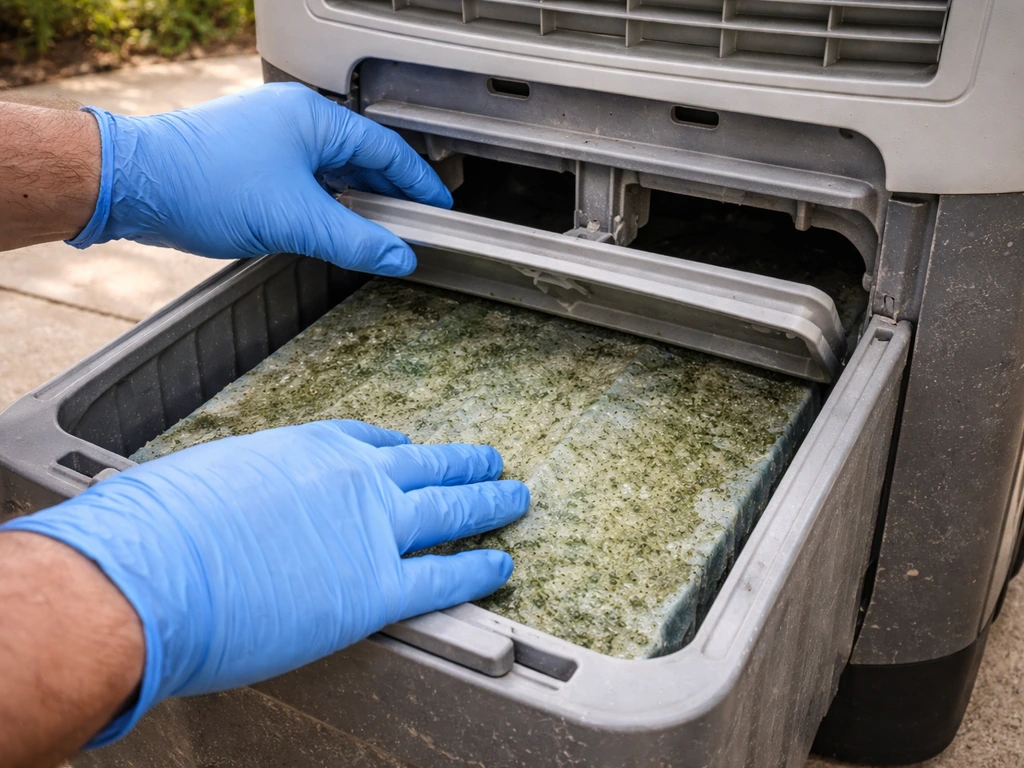
The biggest maintenance tasks are keeping the pads clean and controlling algae and mineral scale in the reservoir. If you have hard water (common in desert Southwest, which is also prime evaporative cooler country), scale will build up on the pads and inside the tank. Weekly flushing of the sump and a bleed-off rate of about 5 to 10% helps prevent mineral concentration. Add an algae-control treatment once per week or after each time you flush and refill the sump, and rinse the pads top-to-bottom when you treat them. Algae-clogged pads reduce airflow and drop your cooling effectiveness fast.
Pads should be inspected monthly during heavy use. Rigid media pads typically last 3 to 5 seasons with proper care. Aspen fiber pads usually need replacing every season. If the pads look dark, smell musty, or show visible mineral crust that won't rinse off, replace them. Replacement pads for popular models typically cost $20 to $60 depending on size.
Winterizing and end-of-season prep
At the end of the season, drain the tank completely, remove and clean the pads, and flush the pump and water lines before storage. Standing water left in the reservoir over winter grows bacteria, corrodes seals, and can freeze and crack the housing in cold climates. Disconnect any plumbed water supply, wipe the interior of the tank dry, and store the unit in a garage or shed if possible. A padded cover works for units that stay outdoors in mild climates. Doing this once at the end of the season takes 20 to 30 minutes and can add years to the unit's life.
When evaporative cooling isn't enough (alternatives and add-ons)
If your patio gets too humid for an evaporative cooler to work well, you're not out of options. If your patio gets too humid for an evaporative cooler to work well, you may still be able to find relief with the best outdoor patio cooling system strategies like shade-first setups or refrigeration-based options. The honest truth is that in high-humidity climates, the only way to meaningfully cool outdoor air is refrigeration or strategic shade and airflow management.
A compressor-based outdoor or portable air conditioner can drop temperature and remove moisture simultaneously, which is what you need when the wet-bulb is high. If you need a true portable air conditioner for your patio, look for a compressor-based model sized for your space and humidity level. If you need the best patio air conditioner, a compressor-based unit is the approach that can both cool and remove moisture in humid conditions.
The tradeoff is higher electricity cost and the need for refrigerant management, plus a condensate drain in most cases.
Misting systems are a middle-ground option that can work even in moderate humidity by flashing tiny water droplets directly into the air around you. The droplets evaporate before reaching skin and carry heat away, but unlike an evaporative cooler they don't recirculate air through a pad. High-pressure misting systems (1,000+ PSI) produce finer droplets that evaporate faster and feel less wet, making them more effective in humid conditions than low-pressure misters. They're also a great add-on to an evaporative cooler in dry climates for extreme heat days.
Ceiling fans and high-velocity floor fans don't cool the air at all, but they make people feel several degrees cooler through wind-chill and perspiration effects. Combining a quality patio fan with a shaded cover is often more cost-effective than any mechanical cooling system in mild climates, and fans work equally well regardless of humidity. If your patio gets brutally hot but has good natural airflow, a large ceiling fan under a pergola or patio cover might honestly be all you need for most of your season.
Patio covers and shade structures deserve a mention here too because they change the math on every cooling option. A solid patio roof can reduce the heat load on your space dramatically, making it possible for a smaller (or less powerful) evaporative cooler to do the job a bigger one would need to do on an uncovered slab. If you're investing in a cooling system, it's worth thinking about the patio structure itself at the same time. A well-shaded patio with even a modest evaporative cooler often outperforms an unshaded patio with a much larger unit.
To put it simply: in dry climates, start with an evaporative cooler and add fans or shade structures to extend its reach. In mixed climates, choose a cooler with a fan-only mode so you get value even on humid days. In humid climates, skip the evaporative cooler and focus on misting systems, shade, fans, or a dedicated outdoor cooling system. If you want the best patio air conditioner for hot, humid weather, you will need to consider compressor-based cooling options instead of evaporative coolers dedicated outdoor cooling system. Getting the right tool for your climate is the single most important decision in this whole buying process.
FAQ
How can I estimate the CFM I need beyond just patio square footage?
Start with the 8 CFM per sq ft minimum, then increase it if your patio has high heat gain (no shade, dark flooring, lots of afternoon sun) or if the space is deep. A good rule of thumb is to add 20 to 40% more CFM for exposed, sun-baked patios because the cooler must overcome extra heat loading.
Should I run my evaporative cooler on fan-only when it’s humid?
Yes, if your model supports it. Fan-only mode can still improve comfort by moving air across your seating, even when evaporative cooling is limited. However, comfort may drop during very humid stretches because the cooler may not create much wet-bulb depression, so treat fan-only as “air movement,” not true temperature reduction.
What wet-bulb or humidity threshold means “buy a different system”?
If your outdoor humidity is commonly above about 60% during summer, plan for poor performance and consider alternatives. The practical tell is when you see little change in feel after 20 to 30 minutes of running, that indicates the local wet-bulb depression is too small to deliver meaningful cooling.
How do I know if a unit’s CFM rating will translate well outdoors?
Look for whether the rating is tied to a specific fan speed, and confirm it has multiple speeds or a variable setting. Outdoor conditions change quickly, so a cooler that can reliably run at high speed during heat spikes usually performs better than a unit that only reaches top CFM briefly or only on a single setting.
Can I use an evaporative cooler on a screened porch without opening windows?
Usually not effectively. In semi-enclosed spaces, humidity builds up and the cooling effect fades within 20 to 30 minutes. If you try it, you need a real exhaust path, like cracking a nearby door or window on the opposite side, so moist exhaust can leave while outside air enters.
Does the cooler need to be placed in any specific orientation on the patio?
Yes. Place it so air flows across the seating and exits through an open side, ideally from one end or side of the patio. Avoid corners where air recirculates over the same people, because that prevents moist exhaust from being swept away.
How much water should I expect to use, and will it spike my utility bills?
Expect water use to track with airflow and operating effort. As a rough guide, 3,000 CFM systems commonly use about 5 to 7 gallons per hour, while 4,500 CFM units can run 7 to 12 gallons per hour. Electricity use is usually dominated by fan and pump, but water cost can still be noticeable if you run it daily for long sessions.
Is a garden hose hookup worth it if I already have a large tank?
Often yes if you run more than a few hours at a time or you want consistent performance without refilling. Continuous fill can also help reduce interruptions on party days. Just make sure your hose supply can handle the required flow rate for the unit you choose, especially for larger CFM models.
What’s the best way to prevent mineral scale and clogged pads?
Use a weekly flush and a bleed-off approach (often around 5 to 10% of the sump), and add algae-control treatment on the same cadence. If you have hard water, inspect pads regularly and rinse thoroughly after treatment, because mineral crust can restrict airflow and quickly reduce cooling output.
How often should I replace pads for outdoor use?
Rigid media pads typically last several seasons with good maintenance, while aspen fiber pads usually need replacement more frequently. Replace when pads look dark, smell musty, or you see mineral deposits that don’t rinse off, since worn or clogged pads reduce airflow contact time and weaken cooling.
What maintenance step matters most if I live in a cold climate or store the unit outdoors sometimes?
Drain completely at season end and clear water from the pump and lines before storage. Standing water can lead to bacterial growth and freeze damage that cracks housings or harms seals, so disconnect any plumbed supply and keep the inside dry.
Are thicker pads always better than thinner pads?
Thicker pads generally cool more effectively because air stays in contact with wet media longer. If choosing between two units with similar CFM, a pad system around 10 inches is usually more efficient than something closer to 4 inches, and rigid media often performs better outdoors due to UV and weather tolerance.
What should I check for if I need app control or remote operation?
Verify the control method is tied to fan speed control, timer options, and the ability to manage multiple units if you’re setting up more than one. Also confirm the remote is genuinely convenient for your layout, some units still require basic access for daily checks like water level and pad inspection.
How do I decide between a large high-CFM unit and a smaller one plus a fan?
If the patio is deep or poorly ventilated by nature, a larger unit is safer because it can push enough cooled air across the space. For spot cooling (one seating group), a smaller CFM unit can work well, but pair it with a ceiling or floor fan to distribute air and prevent the cooled plume from dying out too quickly.