
For most pool patios, a brushed or exposed-aggregate concrete finish, quality concrete pavers, or a textured stone or porcelain tile with a wet DCOF rating of at least 0. If you want the best surface for outdoor patio, prioritize a brushed or exposed-aggregate concrete finish, quality concrete pavers, or textured stone or porcelain tile with a wet DCOF rating that meets pool-deck standards. 42 (ideally 0.50 or higher for pool decks) will give you the best combination of safety, comfort, durability, and long-term value. The exact best pick depends on your climate, budget, and how much maintenance you're willing to do, but those three options cover the vast majority of homeowners well. If you want to compare options beyond concrete, tile, and pavers, alternative patio flooring can still deliver solid slip resistance when you choose materials rated for wet barefoot use. Smooth concrete, polished stone, and untextured ceramic tile are genuinely dangerous wet, and they should be off the table from the start.
Best Pool Patio Surfaces: How to Choose the Right One

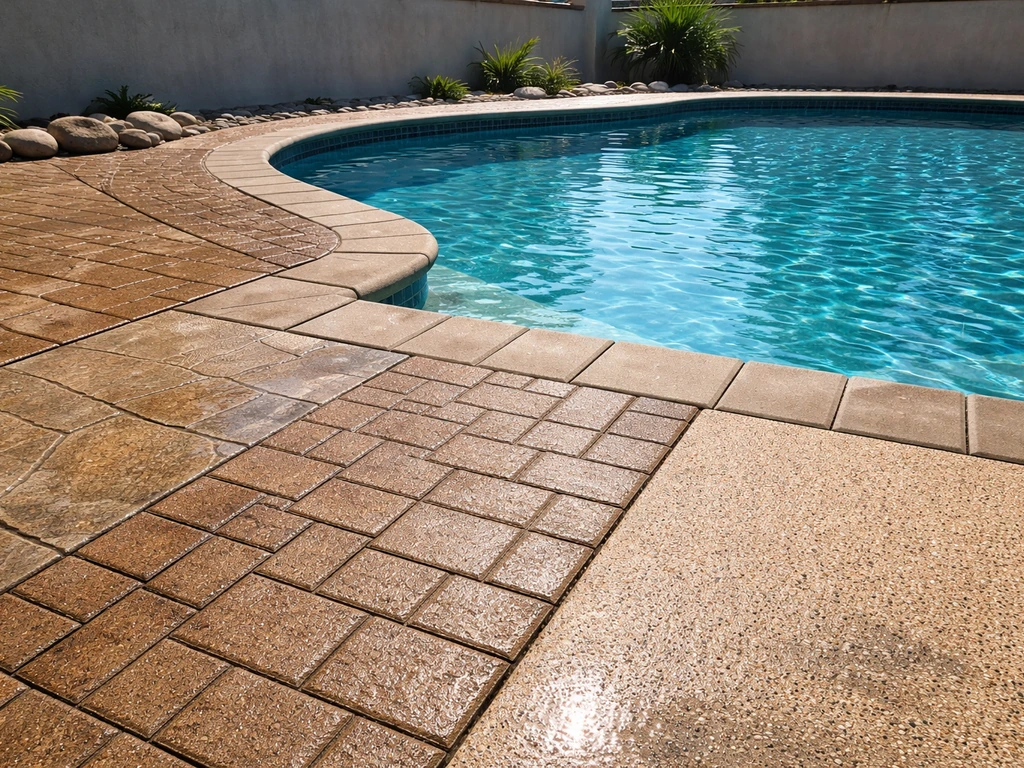
How to choose the right pool patio surface
A pool patio isn't just an outdoor floor, it gets continuously wet, baked by sun reflecting off water, and hit with chlorine splash or salt spray. It carries barefoot kids running, adults dripping, and the occasional dropped drink. That's a lot to ask of one surface, so the criteria you use to evaluate it need to match those actual conditions.
Safety is the non-negotiable first filter. A slip on a wet pool deck sends people to the ER every single day, and most of those falls happen on surfaces that looked fine when dry. Comfort is second, no one wants to walk barefoot on a surface that hits 140°F in July. Then come durability, how the surface holds up to water, freeze-thaw cycles, and pool chemicals, and finally cost, which needs to account for installation, sealing, and 10-year maintenance, not just what you spend at the beginning.
When you're weighing options, also think about how the patio connects to your broader outdoor setup. If you're running a patio cover, misting system, or overhead fans above the deck, the surface needs to dry reasonably fast between wet cycles. Misting systems and shade structures can keep the surface cooler, which opens up materials like stamped concrete that might otherwise overheat. These systems work in concert, it's worth thinking through the whole picture before you commit to a surface material.
Slip resistance and bare-foot comfort: what actually matters
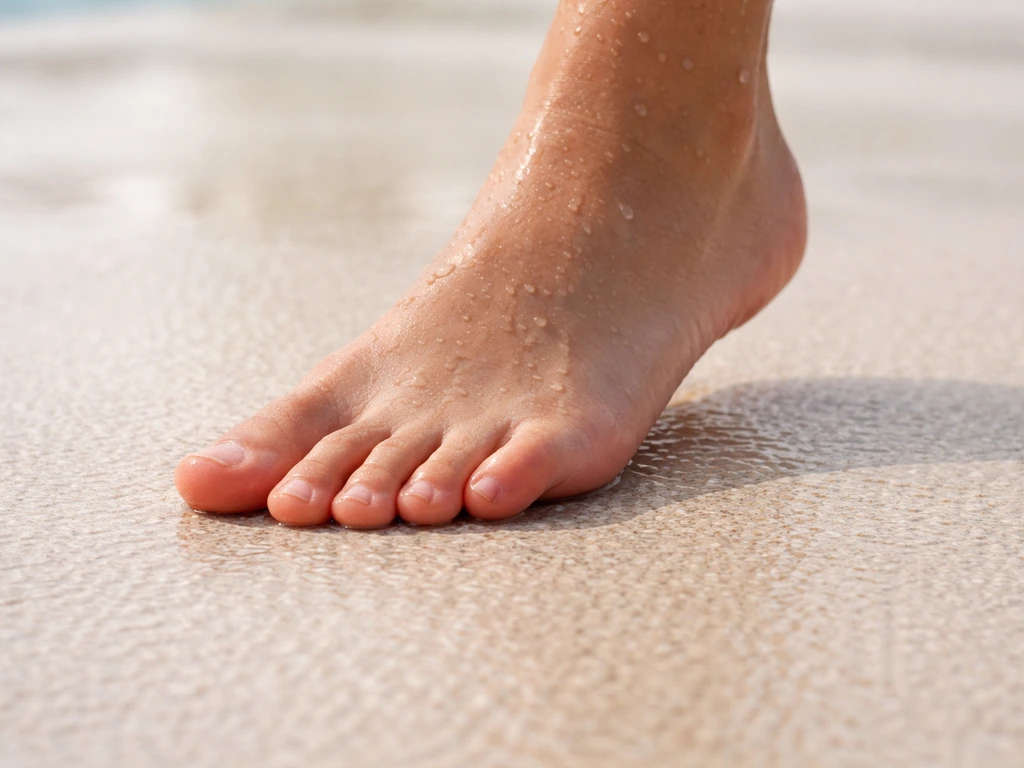
The standard you need to know is ANSI A326.3, which measures wet Dynamic Coefficient of Friction (DCOF) using a device called the BOT-3000E. The minimum threshold commonly cited is 0.42 wet DCOF, but that number comes with an important caveat blank" rel="noopener noreferrer">directly from the standard: it's not a guarantee of slip-safe performance in every application. For a pool deck, where you have wet barefoot traffic, sloped surfaces, and people who are actively running, most flooring pros recommend a minimum of 0.50, and 0.55 or higher is better for pool entry areas and steps.
The National Floor Safety Institute (NFSI) adds another layer with their B101.4 test, which specifically covers wet barefoot conditions, the exact scenario you have at a pool. Under their B101.3 traction labeling system, a wet DCOF of 0.40 to 0.59 earns a 'Moderate Traction / Slip-Resistant' label. For a pool deck, you want to be comfortably in the middle or upper end of that range, not scraping past the minimum. When you're shopping tile or pavers, ask the manufacturer directly for the wet DCOF test result from the BOT-3000E, not just a vague 'slip-resistant' marketing claim.
Bare-foot comfort is a separate issue from slip resistance. Light-colored concrete, light travertine, and lighter pavers can stay 20 to 30 degrees cooler at the surface compared to dark gray concrete or black slate on a hot summer day. In climates where afternoon sun is intense, Texas, Arizona, Florida, surface color and material thermal mass matter as much as texture. A surface that scores well on DCOF but burns bare feet by 2 PM is not a good pool patio surface in practice.
Material-by-material comparison
Here's an honest look at the most common pool patio surfaces, what they're actually like to live with, and who they're right for.
Broom-finish and exposed-aggregate concrete
Broom-finished concrete is the most common pool deck surface in the country for a reason, it's affordable, durable, and when done right, genuinely slip-resistant. A medium broom finish gives good texture without being abrasive on bare feet. Exposed aggregate (where pebbles are seeded into the surface and the cream is washed away) takes it further, giving excellent grip and a nice look. Costs typically run $6 to $12 per square foot installed for broom finish, and $10 to $18 for exposed aggregate, depending on your market.
The downside is that plain gray concrete can look dated, it's prone to cracking over time especially in freeze-thaw climates, and it needs sealing every 2 to 4 years to resist staining from sunscreen, algae, and pool chemicals. Heat absorption is a concern with dark tints or in direct full-sun exposures.
Stamped and colored concrete
Stamped concrete looks great, you can mimic stone, slate, brick, or wood plank at a fraction of the cost. But it introduces real trade-offs near a pool. Stamped surfaces are typically smoother than broom-finish, and the texture comes from the pattern, not from actual grit. This means wet DCOF scores can fall below safe thresholds unless a non-slip additive is built into the sealer or surface. Also, the integral color or surface stain that makes stamped concrete look good is the first thing to fade under UV exposure and pool chemical splash, usually within 3 to 7 years without consistent resealing. Budget $14 to $25 per square foot installed, plus plan on resealing every 2 to 3 years.
Concrete pavers
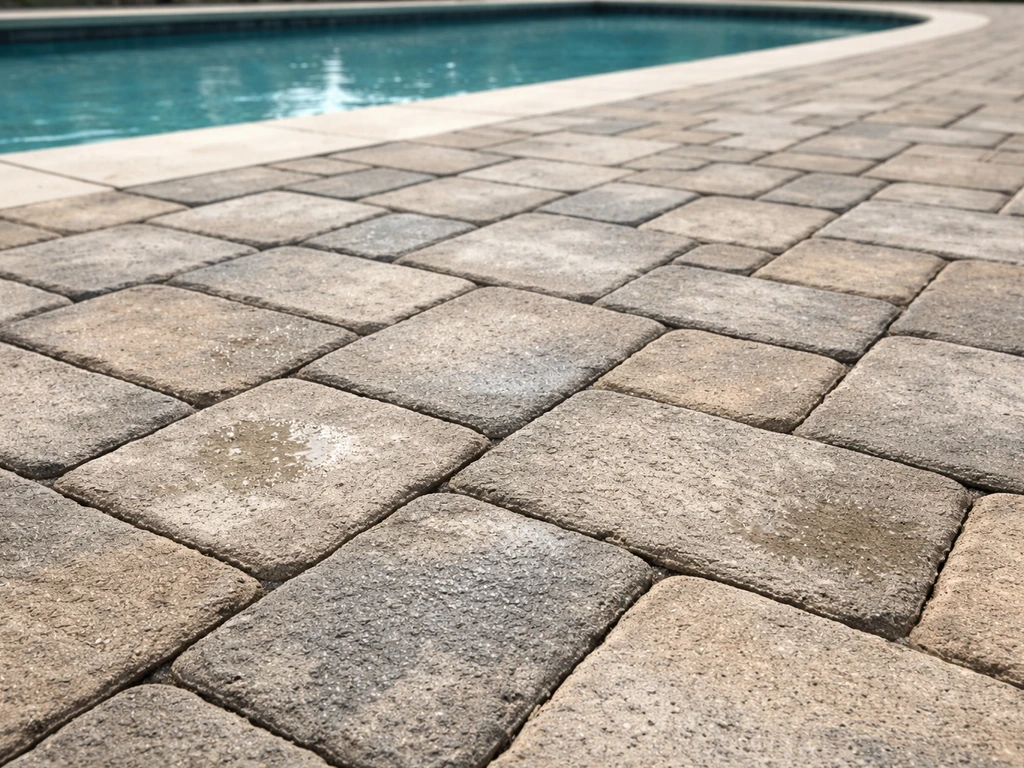
Concrete pavers are probably the most versatile option overall. They come in a huge range of colors, textures, and formats, tumbled pavers give great slip resistance and a natural stone look; smooth pavers are prettier but riskier when wet. The big structural advantage is that the joints between pavers allow for slight ground movement without cracking the entire surface, and individual damaged pavers can be replaced without tearing out the whole deck. Typical installed costs run $12 to $22 per square foot. Joint sand does need periodic maintenance, and polymeric sand is well worth the upgrade to prevent washout and weed intrusion.
Natural stone (travertine, limestone, slate, flagstone)
Travertine is probably the most popular natural stone for pool decks, and it earns that status. It's naturally porous, which means it stays cooler underfoot than dense materials, and its natural texture gives decent slip resistance. Unfilled travertine has small pits that add grip but trap debris; filled and honed travertine is easier to clean but can get slippery. Slate and flagstone offer great texture but can be uneven underfoot, which is a trip hazard issue for older adults or kids. Natural stone costs vary wildly, budget $15 to $35 per square foot installed, and it needs sealing annually to resist pool chemical staining.
Porcelain and ceramic tile
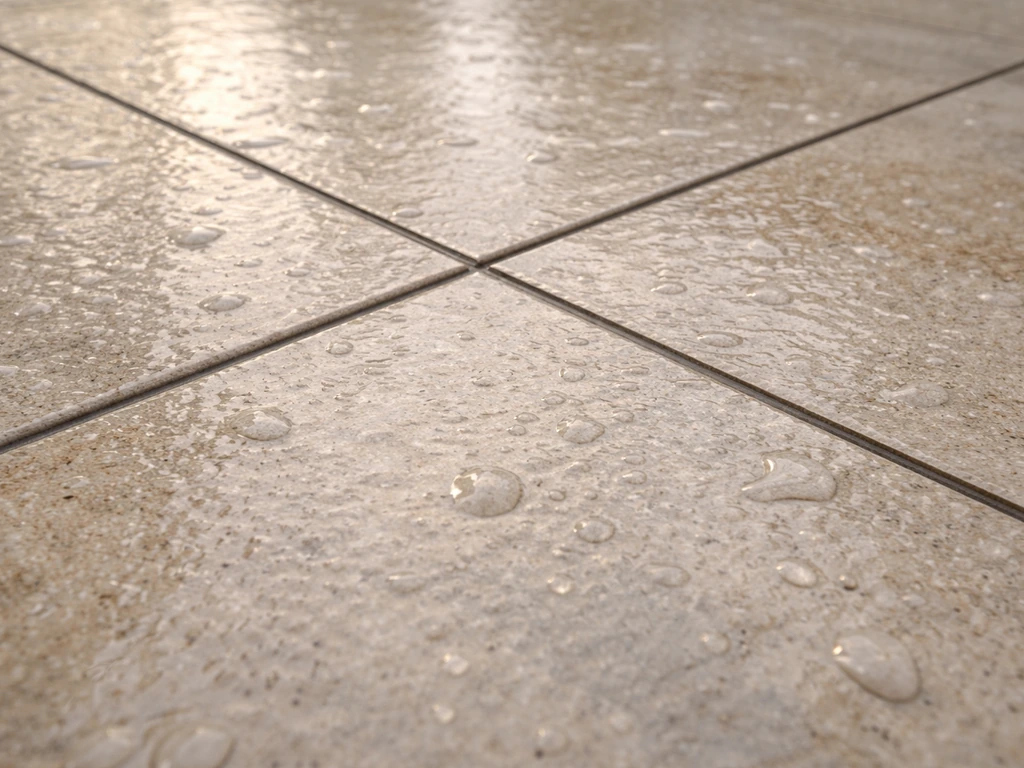
Porcelain tile designed for pool decks can be excellent, it's dense, resists chemical staining better than almost anything else, and holds its color without fading. The critical requirement is that you need tile specifically rated for wet outdoor use with a high wet DCOF rating. Many attractive tiles have ratings well below 0.42 wet, beautiful in a showroom, dangerous at a pool. Outdoor porcelain in a textured, matte finish with a wet DCOF of 0.50 or higher is your target. Crossville’s wet DCOF guidance referencing ANSI A326.3 uses 0.42 as a wet pool-deck benchmark and notes 0.50 to 0.60 as a higher-safety range blank" rel="noopener noreferrer">wet DCOF of 0.50 or higher as your target. Grout joints also need to be kept up; cracked or missing grout traps water, leads to subsurface damage, and becomes a freeze-thaw failure point. Installed costs typically run $15 to $30 per square foot.
Aggregate and specialty coatings (Kool Deck, rubber, composite)
Kool Deck and similar acrylic-based textured coatings are applied over existing concrete and are very popular in hot, dry climates like the Southwest. They reflect heat significantly, a Kool Deck surface can measure 20 to 30 degrees cooler than uncoated concrete in direct sun, and provide good slip resistance. The trade-off is that they're thin coatings and need recoating every 4 to 8 years depending on use and climate. Rubber composite deck tiles or mat systems are a DIY-friendly option for existing pool decks that need a refresh; they're soft underfoot, drain well, and replace easily. They're not as long-lived or as premium-looking as hard surfaces, but for a phased upgrade they make sense.
| Material | Typical Installed Cost/sq ft | Slip Resistance (wet) | Heat Comfort | Durability | Maintenance Level | Best Climate Fit |
|---|---|---|---|---|---|---|
| Broom-finish concrete | $6–$12 | Good (medium broom) | Moderate | High (prone to cracking) | Low–Moderate | Most climates |
| Exposed aggregate concrete | $10–$18 | Excellent | Moderate | High | Low–Moderate | Most climates |
| Stamped/colored concrete | $14–$25 | Moderate (varies by sealer) | Poor–Moderate | Moderate (needs resealing) | High | Warm/dry climates |
| Concrete pavers | $12–$22 | Good–Excellent (tumbled) | Moderate | Very High | Moderate | Most climates |
| Natural stone (travertine) | $15–$35 | Good (unfilled/textured) | Good (stays cooler) | Moderate–High | High (annual sealing) | Warm climates |
| Porcelain tile (rated outdoor) | $15–$30 | Excellent (if rated ≥0.50) | Moderate | Very High | Low–Moderate | Warm, stable climates |
| Kool Deck / acrylic coatings | $3–$8 (over existing) | Good | Excellent | Moderate (recoat cycle) | Moderate | Hot, dry climates |
| Rubber/composite tiles | $5–$15 | Excellent | Good | Moderate | Low | Any (temporary/phased) |
Climate and water exposure: matching material to your conditions
Where you live shapes the list of viable options more than almost any other factor. What works brilliantly in Phoenix can fail catastrophically in Minneapolis.
In hot, dry climates like Texas, Arizona, and Southern California, heat is the dominant problem. Light-colored surfaces, Kool Deck-style coatings, and light travertine or buff-toned pavers perform best. Dark materials and dense concrete overheat. Chlorine exposure is more concentrated here too since evaporation is fast, so materials that resist chemical etching, porcelain tile, sealed travertine, quality pavers, hold up better over time.
In freeze-thaw climates like the Midwest, Colorado, or the Northeast, water infiltration and freeze-thaw cycling are the killers. Porous materials that absorb water, certain natural stones, improperly sealed concrete, will crack, spall, and heave. Concrete pavers specifically designed for freeze-thaw use (look for ASTM C936 compliance) are often the best bet here. Porcelain tile with very low water absorption (less than 0.5% is the standard for frost-resistant tile) also performs well. Natural travertine, limestone, and some sandstones are risky in cold climates unless very carefully sealed and maintained.
In humid climates like Florida, the Gulf Coast, or the Pacific Northwest, algae and mildew are constant adversaries. You need surfaces that can be scrubbed and cleaned without losing their texture or protective coatings, and drainage slope matters more here than anywhere else. Porcelain tile and sealed pavers tend to hold up best in high-humidity environments. Natural stone and stamped concrete in humid climates need aggressive sealing schedules because algae eats protective coatings fast and then starts on the material itself.
Salt water pools add another variable. Saltwater systems don't eliminate chlorine, they generate it, and over time the corrosive effect on materials can be significant. Unsealed or poorly sealed natural stone, concrete with exposed aggregate, and metal accents all degrade faster in saltwater environments. Porcelain tile and quality sealed pavers resist salt well.
Installation essentials: base prep, drainage, slope, and cracking control
The surface material you choose is only as good as what's underneath it. This is the part where a lot of pool deck projects go wrong, especially DIY ones, and it's the first thing to ask a contractor about.
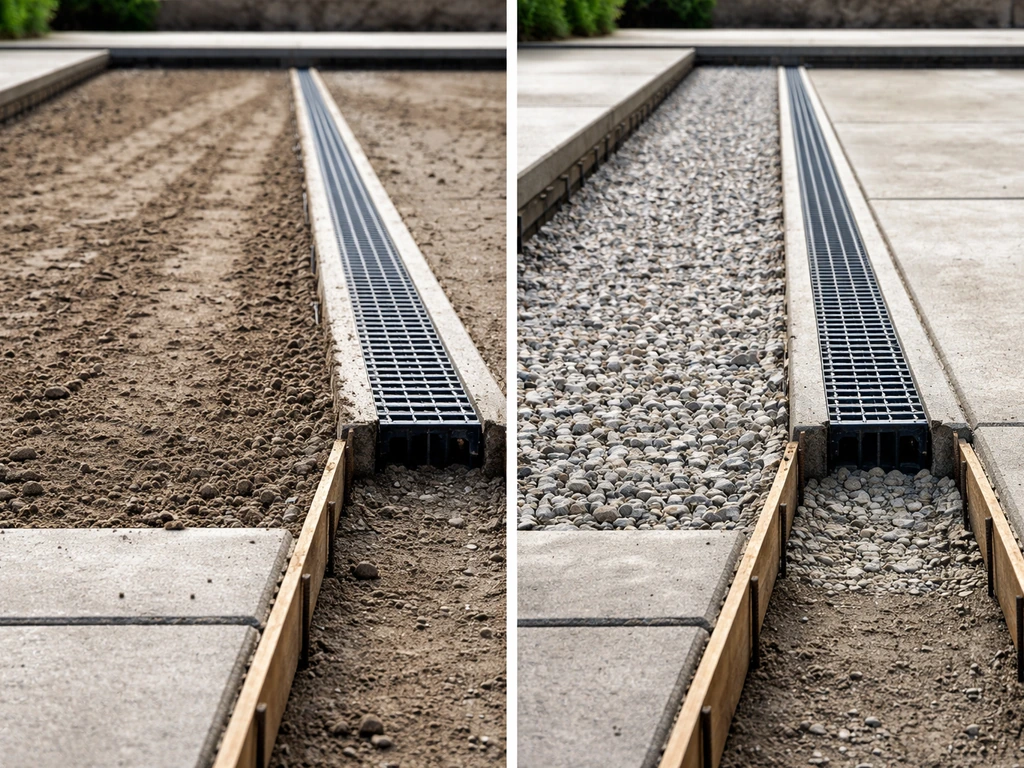
Drainage slope is critical. Pool deck surfaces should slope away from the pool at a minimum of 1/8 inch per foot, and ideally closer to 1/4 inch per foot in wet climates, to direct water away from the water's edge and toward drainage channels or landscaping. Water that ponds on a pool deck breeds algae, accelerates surface degradation, and creates slip hazards. For tiled surfaces and pavers, slope needs to be built into the base, not corrected after the fact with mortar thickness variations.
Base depth depends on material and climate. For concrete slabs, 4 inches of concrete over a compacted gravel base (minimum 4 inches, 6 to 8 inches in freeze-thaw climates) is standard. Pavers need a well-compacted aggregate base of 4 to 6 inches plus a 1-inch bedding sand layer. Tile set over concrete needs the slab to be properly cured, level, and crack-free before tile goes down. Skimping on the base is the fastest path to cracking, heaving, or uneven surfaces within a few years.
Cracking control in concrete is managed with control joints, intentional score lines or saw cuts placed every 8 to 10 feet that give the slab a predictable place to relieve stress rather than cracking randomly. Rebar or fiber reinforcement in the mix also helps. For tiled surfaces or pavers near pool coping, expansion joints filled with flexible sealant rather than grout or mortar are essential, the pool shell and the deck move independently, and rigid connections crack.
If you're adding a patio cover, pergola, or mounting overhead fans and misting lines, post footings or structural anchors may need to go in before or during the patio surface installation, not after. It's much easier to plan for these penetrations during the build than to core-drill through finished concrete or pavers later.
Maintenance, repairs, and long-term costs
The upfront cost comparison between materials can be misleading because maintenance costs over 10 years can easily flip which option is actually cheaper. Here's what to expect realistically.
Concrete of any kind, broom finish, stamped, exposed aggregate, needs a quality penetrating or film-forming sealer applied every 2 to 4 years depending on product and traffic. Budget roughly $0.50 to $1.50 per square foot for a professional resealing application. A neglected concrete pool deck will stain from sunscreen, algae, and pool chemicals, and once that happens, restoring it is significantly more work and cost than maintaining it proactively.
Pavers are relatively low-maintenance but the polymeric joint sand can wash out in high-rain areas or with aggressive hosing, requiring refilling every 2 to 5 years, a DIY-friendly task. Individual cracked or stained pavers can be swapped out without major disruption, which is a genuine long-term advantage over a poured concrete slab.
Natural stone needs annual sealing in most climates. Travertine in particular is porous and will absorb pool chemicals and organic staining quickly without it. The sealing cost is modest but it's an annual commitment. Grout joints in tiled surfaces need periodic inspection and spot regrouting, cracked grout is an entry point for water that can undermine the entire installation.
Kool Deck and acrylic coatings typically need recoating every 5 to 8 years, which runs about $2 to $5 per square foot professionally applied. The base concrete underneath is still there, so you're not losing the structural investment, you're just refreshing the top layer. This is actually a nice feature if you want to change colors or texture down the road.
For a 500-square-foot pool patio, a rough 10-year total cost estimate (including installation, sealing, and maintenance) might look like: broom-finish concrete at $7,000 to $12,000 total; pavers at $13,000 to $18,000; natural stone at $17,000 to $28,000; porcelain tile at $15,000 to $22,000. The gap between materials narrows considerably when you account for maintenance, and the higher-end options often deliver better durability and appearance over time.
DIY vs. hiring a pro: when to do it yourself and when to call someone
Some pool patio work is genuinely DIY-friendly. Rubber or composite tile systems that click or sit over existing surfaces, resealing an existing concrete deck, or replacing a handful of individual pavers are all reasonable DIY projects if you're handy and willing to prep properly. The larger the scope and the more it involves concrete work, drainage grading, or tile setting on a slab, the faster the risk of an expensive mistake climbs.
Pouring and finishing a new concrete slab is a job that rewards professional experience. Concrete has an unforgiving timeline, once it's placed, you have a narrow window to finish it correctly. Stamped and colored concrete especially requires a crew that does it regularly; the timing of stamping and the application of color hardener is a craft skill, not something you learn from a YouTube tutorial on a 400-square-foot slab.
Tile setting around a pool, particularly on sloped surfaces with expansion joints at the pool coping, is another area where hiring a pro pays for itself. A bad tile installation can fail within two to three years, with tiles cracking or popping off as the substrate shifts, which means tearing out the whole deck and starting over.
Questions to ask any contractor before signing
- What is the wet DCOF rating of the specific product or finish you're proposing, and do you have the BOT-3000E test data to support it?
- What base depth and preparation are you planning, and does it account for my climate's freeze-thaw risk?
- How are you handling the expansion joint between the pool coping and the patio surface?
- What slope are you building in, and where does the water drain to?
- What sealer or protective coating are you applying, how is it rated for pool chemical exposure, and how often will it need reapplication?
- Can I see two or three recently completed pool patio projects similar to mine that I can visit in person?
- What is your warranty on labor and materials, and what voids it?
Sample and test before you commit
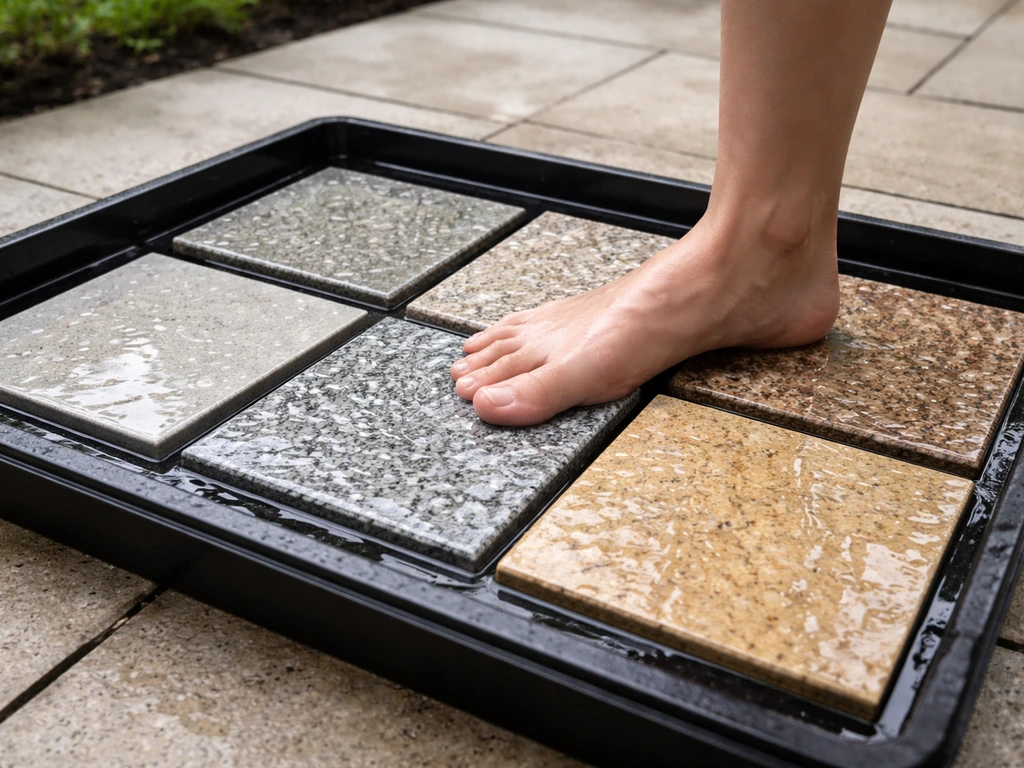
Before finalizing any surface, order physical samples and test them yourself. Wet the sample thoroughly and walk barefoot on it, does it feel grippy or does your foot slide? Set it in the sun for 30 to 60 minutes on a hot day and then step on it. If it's uncomfortably hot, that's your answer for a pool deck. Bring it near your pool and splash pool water on it, some light stones will stain or discolor immediately from mineral-heavy pool water, which tells you right away what years of exposure will do.
For an existing surface you're considering coating or overlaying, do a water absorption test first: sprinkle a few drops of water on the existing concrete and watch how fast they absorb. If the water beads up, the surface still has active sealer and may need light sanding or etching before a new coating will bond. If it absorbs within 30 seconds, you're in good shape for an overlay or coating application.
Planning a phased upgrade
If budget is a constraint right now, a phased approach works well. Start with a professional reseal and a non-slip additive applied to your existing surface this season, it buys you 3 to 5 years of safe, improved performance and gives you time to save for the full upgrade. In year two or three, add rubber composite tiles in the highest-traffic wet zones. Then do the full surface replacement when you're ready, ideally coordinating the timing with any planned patio cover, misting system, or fan installation so everything is built in together. This kind of planning connects directly to how your whole outdoor space functions, not just the floor under your feet.
The right pool patio surface is the one that matches your climate, your household's safety needs, your willingness to maintain it, and your budget over a full decade, not just the lowest price tag at installation. Once you evaluate slip resistance, comfort, and 10-year costs, you can narrow down the best outdoor patio flooring for your specific patio conditions. If you're comparing materials for a pool or wet patio area, the best patio floor covering will depend on wet DCOF, heat buildup, and maintenance needs best outdoor patio flooring. Start with the slip resistance test, narrow by climate fit, and then compare true 10-year costs. That process will get you to the right answer faster than any single 'best' recommendation ever could. If you want a single starting point, compare these options against the best outdoor patio flooring choices for your climate and safety needs.
FAQ
Can I use broom-finished concrete if I’m doing it myself to save money?
Yes, but only if the finish is intentionally textured and has a wet DCOF test tied to pool-deck use. If the product only claims “non-slip” without a BOT-3000E wet DCOF value, treat it as unverified for barefoot wet traffic.
Is it safe to coat an existing pool deck surface instead of replacing it?
Avoid overlays over badly failing concrete, especially if you see widespread scaling, active crumbling, or cracks that are still moving. If the surface is stable, do a water-absorption check first, then verify the existing sealer status, light etch/sand as needed, and confirm the new coating’s bond requirements match your substrate.
What’s the mistake people make when choosing a pool patio surface based on traction claims?
Not automatically. Materials that are “slip-resistant” when dry can still be risky when wet, and pool decks also face dynamic traffic (running, stepping on/off raised edges). Use wet DCOF values specifically, and ensure the product’s rating assumes barefoot or wet conditions similar to a pool.
If my surface has a good wet DCOF, do I still need to worry about drainage?
It depends on the drainage and base build, not just the surface. If water ponds near the pool edge or the slope is incorrect, algae and staining will build under or within grout, joints, or pores. Even a high-DCOF surface can become slick if it’s continuously contaminated by ponded water and residue.
Can porcelain tile be a better choice than pavers for a saltwater pool?
Porcelain tile often performs well, but the “system” matters. Confirm the tile is rated for wet outdoor use with a wet DCOF at or above pool-deck targets, and verify the grout and installation plan include waterproofing where needed, crack control at pool coping, and a maintenance schedule for grout joints.
Will my pool patio surface stay slip-resistant forever once installed?
No. Any surface with grout lines, natural stone pits, or unfilled pores can collect organic film and minerals that reduce traction over time. Plan for periodic cleaning that preserves texture, and re-seal or re-coat on the schedule needed for your material, climate, and chemical exposure.
Which surface types are most reliable in freeze-thaw areas?
For freeze-thaw climates, pavers and frost-rated porcelain tile are usually safer bets because they handle movement and water better when built correctly. Watch out for porous natural stones and any concrete slab that lacks proper base thickness, compaction, and crack/joint control.
Do I need different slip-resistance specs for steps and pool entry areas?
Yes, and it’s a common edge case. Steps and pool entry zones see higher wet-speed traffic and more turning, so pros typically recommend higher wet DCOF targets there than on interior patio runs, and you should verify slip ratings specifically for those areas, not just “overall deck.”
How can I avoid choosing a surface that becomes too hot for barefoot walking?
Yes, especially with coatings and tints. Darker finishes and dense materials can become uncomfortably hot even if they meet traction needs. Use the sample test under sun, and consider lighter colors, reflective coatings, or lighter stone in hot climates.
Are pavers truly low-maintenance if I live somewhere with heavy rain?
Polymeric joint sand helps pavers resist washout and weed intrusion, but it still needs monitoring in heavy rain areas. If you power-wash aggressively or don’t address drainage, joints can fail sooner. Plan for periodic inspection and gentle cleaning methods matched to paver joints.
Why do tile decks near the pool coping fail, even when the tile itself is high quality?
You should budget for expansion or movement at the pool coping and for independent deck movement. Rigid bonding at that interface is a leading cause of cracks and popped tile. Make sure the plan includes proper expansion joints filled with flexible sealant where required.
What does a water absorption test tell me, and what doesn’t it tell me?
For existing concrete you plan to overlay or re-coat, water behavior is a useful first screen, but it’s not the only check. If water soaks in unevenly or you see staining that won’t clean, bonding may be compromised. In those cases, ask about surface preparation methods and whether the substrate needs restoration before applying a new layer.
Where should I start if I’m doing a phased pool patio upgrade?
If you’re installing an upgrade in phases, start with the highest-risk wet zones first, like the entry path and areas with frequent splash. Then schedule resealing or recoating earlier than you think if you use harsher pool chemicals or have saltwater exposure that accelerates surface wear.