
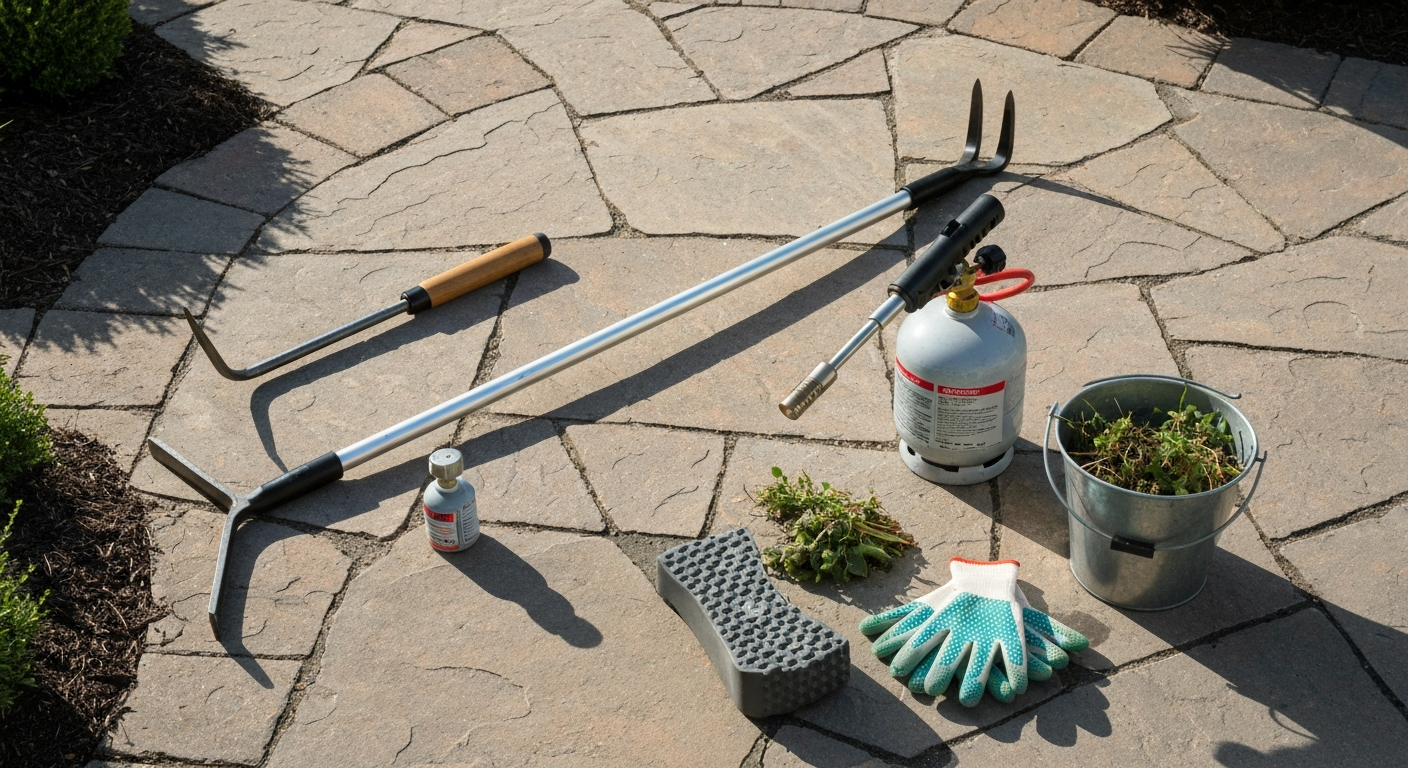
For most homeowners, the best patio weeder comes down to two tools working together: a short-handled hand weeder with a forged steel head (like the CobraHead Original at around $39) for digging into tight paver joints and pulling taproots, paired with a stand-up claw weeder (typically $40 to $90) for extracting dandelions and deep-rooted weeds without kneeling. If you have a large gravel or flagstone patio and want to skip chemicals entirely, a propane weed torch rounds out the kit. The right combination depends on your patio surface, your back, and your climate, and this guide walks through all of it.
best patio weeder: Top tools, tips & eco options, Buyer's Guide

Elise Prescott
27 Jul 2026
Top Patio Weeder Picks at a Glance
Before diving into the details, here are straightforward recommendations by category. Every pick below is based on hands-on testing data, expert editorial roundups, and real user feedback from verified purchasers.
Hand Tools (Kneeling/Close-Up Work)
A forged or tempered-steel "fingernail" style hand weeder is the gold standard for tight paver joints and gravel edges. The CobraHead Original Weeder and Cultivator is the most consistently recommended option in this category. Made in Wisconsin from forged and tempered steel, it sells for around $39 directly from the manufacturer and comes with a one-year warranty against defects. The curved head digs under roots rather than just cutting the top, which matters enormously for persistent weeds like bindweed and crabgrass. For occasional light weeding, a basic stainless-steel V-blade hand fork at $10 to $15 from any garden center does the job.
Long-Reach and Stand-Up Manual Weeders
Stand-up weeders with a claw mechanism are the right call if bending or kneeling causes you pain, or if your patio has a lot of open joints with established tap-rooted weeds. The Fiskars 4-Claw Stand-Up Weeder, which uses stainless-steel claws and an aluminum shaft, has been ranked "Best Overall" in hands-on testing by BobVila's expert team for ergonomics and rust resistance. Street price runs from about $50 to $90 depending on the retailer (Target lists it at $49.98). The "Grampa's Weeder" style (a two-claw long-handle ejector) is another widely praised option in the same price band. Both work best when the soil under your pavers is slightly moist after rain.
Motorized and Electric Tools
Cordless electric weeders and oscillating multi-tools with narrow blade attachments are useful for large patios or homeowners with limited hand strength. They work best on concrete expansion joints and wide mortar gaps rather than tight 3mm paver joints. Expect to pay $40 to $120 for a dedicated electric weeder, or use a narrow oscillating tool blade you may already own. These tools save time but require more care to avoid scratching soft pavers or limestone.
Eco and Non-Chemical Options
Propane weed torches (Weed Dragon, Flame King, and Bernzomatic are the most common brands) are fast and chemical-free for gravel paths and flagstone joints. Flame Engineering and Flame King both offer homeowner kits in the $30 to $80 range, often with a one-year limited warranty. Boiling water poured directly into joints kills small annual weeds on contact and leaves no residue. Both methods are recommended by Iowa State Extension as effective non-chemical approaches, though they do not remove root systems and work better on young weeds than established perennials.
Who This Guide Is For and How to Use It
This guide is written for homeowners who deal with weeds growing in the joints, cracks, and edges of an existing patio, whether that patio is made of concrete, pavers, gravel, flagstone, or brick. RV owners who want a portable outdoor living area can also see our guide to the best toy hauler with side patio for options that bring patio-style spaces on the road. It covers DIY approaches at every budget level, from a $10 hand fork to a $100 propane torch kit, and it honestly flags when a professional hardscaper makes more sense than a tool purchase.
If you have a small patio with occasional weeds, jump to the hand tool section and the step-by-step how-to. If low-back pain or mobility is a concern, the long-reach section and the mobility-focused model selection guide are the most relevant parts. If you live in a high-rainfall region, the climate section and the polymeric sand prevention advice will save you a lot of repeat labor. If your patio joints are crumbling or settling, read the "when to hire a pro" section before buying any tool at all.
Buyer's Checklist: What Actually Matters When Choosing a Patio Weeder
Blade and Head Type
The head geometry matters more than any other single factor. A narrow, curved or hooked blade reaches into tight joints (3mm to 10mm) without popping out pavers. A V-shaped or flat hoe blade works on wider mortar joints and gravel but does almost nothing in narrow gaps. Claw-style heads on stand-up weeders need to straddle the weed stem, so they require at least 3 to 4 inches of clear space around the weed, which makes them poor choices for very tight paver patterns.
Materials and Rust Resistance
Stainless steel is the most rust-resistant option and the right call if you leave tools outdoors or live in a humid or coastal environment. Forged carbon steel (like the CobraHead head) holds a sharper edge and is tougher under load, but requires drying and occasional oiling to prevent surface rust. Avoid tools with painted steel heads: the paint chips, and then the bare steel rusts quickly. Aluminum shafts (Fiskars uses one on their stand-up weeder) are lightweight and will not corrode. Fiberglass handles are the most durable choice for long handles; wood handles feel good but split over time if left in rain.
Ergonomics
Handle length, grip material, and weight all affect how your wrist and back feel after 20 minutes of weeding. For kneeling work, a handle between 12 and 16 inches keeps the tool close and controllable. For standing work, a 39-inch or longer shaft means you do not have to hunch. Rubber or overmolded grips reduce vibration and blistering on electric tools. If you have arthritis or grip weakness, look for wide-diameter grips and tools under 2 pounds.
Price Tiers
- Budget (under $20): Basic stainless hand forks, V-blade hoes, simple crack knives. Fine for occasional use on small patios.
- Mid-range ($20 to $60): Quality forged hand weeders (CobraHead at $39), basic stand-up claw weeders, propane torch kits. Best value for most homeowners.
- Premium ($60 to $120+): High-end stand-up weeders (Fiskars, Grampa's at the top end), cordless electric weeders, professional steam units. Worth it for large patios or frequent use.
Category Comparison: Hand vs Long-Reach vs Electric vs Eco
| Category | Best For | Pros | Cons | Pavers | Gravel | Flagstone/Stone | Concrete |
|---|---|---|---|---|---|---|---|
| Hand weeder (short handle) | Tight joints, precision root removal, small patios | Cheap, precise, no power needed, lightweight | Requires kneeling, slow on large areas, back/knee strain | Excellent | Good | Good | Good |
| Long-reach / stand-up claw | Tap-rooted weeds, low-back strain, medium-large patios | No kneeling, good root extraction, ergonomic | Needs space around weed, poor in compacted clay, plastic parts can break | Good (open joints) | Fair | Good | Good |
| Electric / motorized | Wide joints, large patios, limited hand strength | Fast, low effort, consistent cutting depth | Can scratch soft stone, costly, less precise in tight gaps | Fair | Fair | Fair | Excellent |
| Eco/non-chemical (torch, boiling water, steam) | Gravel, broad areas, chemical-free preference | No residue, fast on young weeds, no digging | Fire risk (torch), does not remove roots, regrowth likely on perennials | Good (caution) | Excellent | Good (caution) | Good |
Top Pick Profiles by Category
What to Look for in a Hand Weeder
The best hand weeders for patio work have a narrow, deeply curved or hooked head that can slip into a joint, hook under a root ball, and lever the weed out intact. A straight-bladed dandelion digger is designed for lawn work and is too wide for most paver gaps. Look for a head width of 1 inch or less for tight joints. Forged steel is the preferred construction: it will not flex or snap under the levering pressure required to pop out a deep-rooted plantain. Expect to spend $25 to $45 for a quality mid-range hand weeder, or $10 to $20 for a basic stainless option that will last several seasons with care.
What to Look for in a Long-Reach / Stand-Up Weeder
Stand-up weeders work by driving a claw mechanism into the soil around the weed's crown, then using a foot pedal to grip and a lever to eject the root. The most important quality factors are claw material (stainless steel holds up; painted mild steel rusts and blunts quickly) and the durability of the ejection mechanism. User reviews consistently flag plastic ejector components and plastic foot pedals as the first failure points on cheaper models, including some configurations of the Fiskars 4-Claw. If your patio sits over compacted fill or heavy clay, roots tend to shear instead of pulling clean, which puts extra stress on the mechanism. Look for models with metal-reinforced foot steps and stainless claws. Price range: $40 to $90.
What to Look for in an Electric or Motorized Weeder
Cordless electric weeders are essentially narrow oscillating or rotating cutters. They are best suited to wider expansion joints in concrete (10mm or more) and large gravel areas where volume matters more than precision. The key spec is blade width: most dedicated models run 10mm to 25mm blade widths, which rules them out for very tight paver joints. Battery platform compatibility matters if you already own cordless tool batteries from a particular brand. For patio use, a 20V or higher platform with a runtime of at least 30 minutes per charge is practical. Price range: $40 to $120.
What to Look for in Eco/Non-Chemical Solutions
For propane torch kits, look for a full-size vapor torch rather than a small handheld soldering-style torch. Full-size kits attach to a standard 1-pound or 20-pound propane cylinder and deliver enough heat to wilt and kill small weeds in 1 to 2 seconds of contact. Adjustable flame control and a trigger-lockout safety are worth paying extra for. For steam weeders, consumer units are available in the $80 to $200 range but tend to have short runtimes before needing a water refill. Boiling water from a kettle is free and works just as well for spot treatment on small areas.
Choosing the Right Tool for Your Specific Situation
Joint Width and Root Depth
Paver joint width is the single most constraining spec. Joints under 5mm (typical of tightly set Belgian block or tumbled brick) require a tool with a blade width of 4mm or less, which means a narrow hand weeder, a crack knife, or a thermal method. Joints 5mm to 15mm (standard concrete paver spacing) accept most hand weeders and some torch tips comfortably. Joints over 15mm (wide flagstone, random-set fieldstone, or settled patios with significant separation) can accommodate stand-up claw weeders if the paver surface is level enough to work the foot pedal.
Root depth matters because shallow-rooted annuals like hairy bittercress and annual bluegrass pull cleanly with almost any tool after rain, while deep tap-rooted perennials like dandelion, dock, and bindweed require tools that can reach 4 to 6 inches below the joint surface without breaking the root. If you break a tap root, regrowth from the root fragment is almost guaranteed. For deep roots in tight joints, a narrow curved hand weeder used with a digging and twisting motion outperforms any thermal or stand-up tool.
Patio Surface Type
Concrete is the most forgiving surface for metal tools and electric weeders. Flagstone and soft limestone scratch easily, so avoid metal blades dragging across the face of the stone and use plastic-tipped or smooth-metal tools carefully at the joint edge. Brick patios can chip at corners if you lever aggressively with a hand weeder. For gravel, thermal methods (torch or boiling water) and raking are far more practical than digging tools.
User Mobility and Low-Back Strain
If kneeling is difficult or painful, a long-handle stand-up weeder is the most important upgrade you can make. A 39-inch or longer shaft lets you work in a full upright stance. For seated users or those with limited standing endurance, a kneeler pad combined with a short-handle weeder keeps the total working time in any one position short and manageable. Electric weeders with long shafts are another option, though the vibration can be uncomfortable for users with joint issues.
How to Weed Your Patio: Step by Step
Recommended Sequence and Timing
The single most impactful timing decision is to weed when the soil is moist, ideally 24 hours after rain or irrigation. BobVila's hands-on testing confirmed that stand-up weeders fail to extract full roots in dry, compacted conditions and perform dramatically better in moist soil. For annual weeds, remove them before they set seed: one plant going to seed can produce hundreds of future weeds. For perennials, early spring removal before the root stores energy for the season gives the best results.
Using a Hand Weeder
- Choose a day after rain or water the joint area lightly and wait 30 minutes.
- Insert the blade tip at a 30 to 45 degree angle into the joint beside the weed stem, not directly through it.
- Push the blade down 2 to 3 inches, angling toward the root ball.
- Rotate and lever the handle upward while pressing the blade tip against the root to pry it loose.
- Grip the stem close to the soil surface and pull straight up with steady tension, not a jerk.
- Drop the intact root into a bucket or bag immediately so it cannot re-root.
- Refill the joint with dry polymeric sand after weeding to close the gap and prevent re-establishment.
Using a Long-Reach / Stand-Up Claw Weeder
- Position the open claw directly over the weed stem with the claws centered around it.
- Press down firmly with one foot on the foot pedal to drive the claws into the soil around the root crown.
- Keep steady downward pressure as you pull the handle upward in one smooth motion.
- Activate the ejection lever over your waste bucket to release the weed without hand contact.
- If the weed shears at the root, use a narrow hand weeder to dig out the remaining root fragment.
- Work in rows across the patio rather than randomly to track what has been done.
Using an Electric or Motorized Weeder
- Check the joint width against the blade width before starting. Do not force a blade into a joint narrower than the blade.
- Wear eye protection. Flying grit and debris are a consistent hazard with electric weeders.
- Run the tool along the joint at a slow, controlled pace. Rushing leaves root fragments behind.
- Collect loose debris with a stiff brush and dustpan after each pass.
- Recharge the battery before it is fully depleted to preserve battery lifespan.
Using Thermal and Non-Chemical Methods
- For boiling water: Boil a full kettle and pour slowly and directly into the joint, concentrating on the weed's crown. The weed will wilt within minutes. Repeat after 3 to 5 days if regrowth appears. Keep boiling water away from desirable plants.
- For a propane torch: Work outdoors on a calm, wind-free day. Hold the flame 2 to 4 inches above the weed for 1 to 2 seconds until the leaf tissue wilts and darkens. Do not hold the flame in one spot. Never use near dry mulch, wood structures, or combustible materials. Keep a garden hose ready.
- After thermal treatment: Wait 48 hours and check for regrowth. Annual weeds typically die; perennial roots may resprout and require a follow-up mechanical removal.
- To close joints after any weeding method: Sweep dry polymeric sand into the cleaned joint, compact lightly, and mist with water to activate the binding agent.
Tool Maintenance, Sharpening, and Storage
Routine Care Checklist
- After each use: Knock off soil from the blade, rinse with clean water, and dry completely before storage.
- Monthly (during season): Wipe carbon-steel blades with a light coat of mineral oil or linseed oil to prevent surface rust.
- Seasonally: Sharpen blade edges on hand weeders with a flat mill file or a honing stone. A sharp edge cuts through soil and roots with far less effort and reduces handle stress.
- Before storing for winter: Clean, dry, and lightly oil all metal parts. Store in a dry location, off the ground. Hang tools on wall hooks rather than leaning them against a damp wall.
- Propane torch kits: Inspect hose connections for cracks or brittleness each spring before first use. Replace the hose if any cracking is visible.
- Electric weeders: Clean the blade channel after each use. Check battery contacts for corrosion. Store batteries at room temperature, not in a cold garage.
Expected Lifespan and When to Replace
A well-maintained forged-steel hand weeder should last 10 years or more. The handle (wood or fiberglass) is the most likely failure point: replace a cracked handle rather than the whole tool, since most quality manufacturers sell replacement handles. Stand-up claw weeders with steel claws and aluminum shafts can last 5 to 10 years, but the plastic ejection mechanism and foot-pedal components are the weak points and may need replacement sooner under heavy use. User reviews on the Fiskars 4-Claw note that plastic components sometimes fail within 1 to 2 seasons under hard use. Electric weeders have a realistic lifespan of 3 to 7 years depending on motor quality and battery condition. Propane torch hoses should be inspected every season and replaced every 5 years as a precaution regardless of apparent condition.
Safety, PPE, and Pet-Safe Approaches
For mechanical weeding, the main risks are knee strain, back injury from repetitive bending, and cuts or punctures from sharp blades. Wear thick gardening gloves, use a kneeler pad, and take breaks every 20 to 30 minutes. Keep tools stored with blade guards or hanging out of reach of children.
For torch weeding, the risks escalate significantly. Always work on a calm, wind-free day. Never use a propane torch near wood fencing, dry plant material, fabric patio furniture, gas lines, or combustible structures. Keep a connected garden hose nearby as a precaution. Pets and children must be clear of the area during torch use and until the hardscape cools, typically 15 to 30 minutes.
If you choose to use an herbicide (such as glyphosate-based products) in patio joints, the US EPA requires that you follow label directions exactly, including PPE such as chemical-resistant gloves and eye protection. The scientific community is not fully aligned on glyphosate health risks: the US EPA has concluded that labeled use is acceptable, while the IARC classified glyphosate as "probably carcinogenic" (Group 2A). These are genuinely different conclusions drawing on overlapping but differently weighted evidence. At minimum, wear the label-specified PPE, keep pets and children off treated areas until the product is dry, avoid using near storm drains, and check your state or local municipality's rules before applying, since some jurisdictions restrict or ban herbicide use in hardscape or near water features. The EPA's Pesticide Product and Label System (PPLS) is the authoritative database for current label requirements and restrictions.
For households with pets and children, mechanical removal and boiling water are the safest choices. Boiling water leaves no chemical residue, and a mechanically weeded area is safe for children and pets as soon as it is dry. Propane-torched areas are safe for pets once the surface cools.
Eco-Friendly and Non-Chemical Control Options
Iowa State Extension and UC Cooperative Extension both recommend mechanical removal as the most reliable non-chemical approach because it physically removes the root system rather than just killing the above-ground foliage. UC ANR (UC Master Gardeners), tool care, weed management, and “pull before seeding” guidance supports mechanical removal as a primary non-chemical strategy and emphasizes pulling weeds before they set seed and keeping tools clean and dry UC ANR (UC Master Gardeners) — tool care, weed management, and “pull before seeding” guidance. The guidance is consistent: pull before seed set, work when soil is moist to avoid breaking roots, and repeat for perennials. For patio joints, this means a narrow hand weeder used correctly will always outperform thermal methods on deep-rooted perennial weeds.
When Non-Chemical Methods Work Best
- Boiling water: Effective on annual weeds, moss, and algae in joints. Apply directly and carefully. Does not affect roots deeper than 1 to 2 inches. Safe for adjacent desirable plants if poured precisely.
- Steam weeding: Similar effectiveness to boiling water but allows more controlled targeting. Consumer steam units are available but require water refills every 10 to 20 minutes.
- Flame weeding: Best for gravel areas and wide flagstone joints with young, emerging weeds. Fast and chemical-free. Ineffective on established perennial roots. Not suitable near combustible materials.
- Mulching joint edges: Applying a thin layer of decomposed granite, polymeric sand, or fine gravel over cleaned joints suppresses light germination. Works best as a preventive measure after initial clearing.
- Polymeric sand: The most effective long-term preventive treatment for paver patios in high-rainfall areas. Cured polymeric sand resists washout, deprives weed seeds of the loose soil seedbed they need, and significantly reduces recurring weeds over multiple seasons.
When Non-Chemical Methods Fall Short
Thermal and mechanical methods require repetition for established perennial weeds with deep root systems. Bindweed, ground elder, and horsetail have root networks that extend well below the paving base and will regrow from root fragments regardless of what you do above the joint. In these cases, either persistent mechanical removal over multiple seasons, careful targeted herbicide application, or professional intervention are the realistic options.
Climate and Regional Considerations
Where you live affects both which weeds you are fighting and how often your patio joints need attention. In high-rainfall regions (Pacific Northwest, Gulf Coast, Southeast), weeds establish faster, joints wash out more quickly, and moss and algae compete alongside traditional weeds. Polymeric sand is nearly essential in these climates, and boiling water works well on the algae and moss that hand weeders cannot grab. Trade and hardscape guidance recommends polymeric joint sands and proper compaction, see Polymeric Sand & Paver Sealing Done Right, Craft Pavers for guidance on using polymeric sand in high-rain areas to reduce joint washout and recurring weeds Polymeric Sand & Paver Sealing Done Right — Craft Pavers (hardscape trade guidance). In dry, arid climates (Southwest, parts of California), weed pressure is lower but the ground is harder, which makes root extraction tougher. Wait for the rare rainfall event or soak the joints with a hose before mechanical weeding.
In freeze-thaw climates (Upper Midwest, Mountain West, New England), the annual cycle of freezing and thawing heaves pavers, widens joints, and cracks mortar. This creates more entry points for weed seeds and means you may find significantly worse weed problems each spring than you left in fall. Early spring is the best time for a full mechanical clearing before annuals set seed. These climates also accelerate rusting on carbon-steel tools, so stainless or properly oiled carbon-steel tools are important here.
Coastal homeowners face salt air corrosion on top of normal weed pressure. Stainless-steel tools are strongly recommended over carbon-steel options. Rinse tools with fresh water after every use and dry thoroughly. Aluminum-handled stand-up weeders hold up better at the coast than steel-shafted alternatives.
When to Hire a Professional Instead
Not every weed problem is a tool problem. There are situations where buying another weeder will not solve the underlying issue, and you will get better results faster by calling a hardscaper or landscape contractor.
- Heavy infestations with deep perennial root systems (bindweed, horsetail, Japanese knotweed): These can require multiple seasons of treatment or targeted professional herbicide application under applicable regulations.
- Joints that have settled, cracked, or washed out significantly: Weeding a structurally failing joint is like bailing a leaking boat. A hardscaper can lift pavers, re-compact the base, refill joints with polymeric sand, and reset the pavers. This solves both the structural and weed problem simultaneously.
- Very large patios (over 500 square feet) with widespread weed coverage: The labor cost of DIY weeding at this scale can approach or exceed a one-time professional treatment, especially when contractor pricing is competitive.
- Patios with specialty materials (expensive travertine, custom-cut bluestone, antique brick): Incorrect tool use or herbicide application on premium surfaces can cause permanent staining or etching. A professional with the right tools and experience is worth the cost.
- HOA or municipal restrictions on herbicide use: A licensed applicator operates under a pesticide license that grants them access to products and application methods not available to homeowners, and they carry liability insurance if something goes wrong.
For most homeowners with a standard-size patio and moderate weed pressure, DIY tools are absolutely sufficient. A $40 to $80 combination of a hand weeder and a stand-up weeder, used consistently each spring and after heavy rain events, will keep a typical paver patio manageable. The professional call makes sense when the problem has moved beyond the joint surface into the patio's structural base.
Where to Buy, Prices, Warranties, and Related Patio Tools
Hand weeders and stand-up claw weeders are widely available at home improvement stores (Home Depot, Lowe's), big-box retailers (Target, Walmart), and online. Buying directly from the manufacturer (as with the CobraHead site) occasionally offers better warranty support and access to replacement parts. Propane torch kits are available at hardware stores and online. For electric weeders, check whether the tool is compatible with a battery platform you already own before buying a standalone unit. For another relevant comparison, see best patio vacuum.
| Category | Typical Price Range | Warranty (typical) | Where to Buy | Replacement Parts |
|---|---|---|---|---|
| Hand weeder (forged steel) | $25 to $45 | 1 year (manufacturer) | Garden centers, Amazon, manufacturer direct | Handles widely available |
| Stand-up claw weeder | $40 to $90 | Varies (often limited warranty) | Home Depot, Lowe's, Target, Amazon | Claw assemblies vary by brand |
| Electric / cordless weeder | $40 to $120 | 1 to 2 years (manufacturer) | Home Depot, Lowe's, Amazon | Blades/batteries from manufacturer |
| Propane torch kit | $30 to $80 | 1 year limited (most brands) | Hardware stores, Walmart, Amazon | Hoses and tips available separately |
| Steam weeder (consumer) | $80 to $200 | 1 year (manufacturer) | Amazon, specialty garden retailers | Limited; check before buying |
Warranty support quality varies widely. The CobraHead's one-year warranty is consistently reported as honored without hassle through their manufacturer direct channel. For Fiskars products, register your purchase online for the best warranty service experience. Flame Engineering and Flame King honor claims through their retail distribution network. Before buying any weeder, check that the manufacturer or retailer sells replacement parts (especially for stand-up weeders with plastic ejector mechanisms), since a $70 tool with no replacement parts available is a $70 disposable item.
Once your patio is weed-free, keep it that way with the right supporting tools and habits. A quality hose makes rinsing joints after weeding much easier, and if you have a small patio, a compact option is worth looking at alongside your weeder purchase. After clearing weeds and debris, a patio vacuum is highly effective for cleaning out joint dust and loose material before refilling with polymeric sand. For managing the organic waste you pull, a patio composter handles weed material conveniently (just avoid composting seeding weeds or perennial root fragments). And keeping your patio area tidy with a well-placed patio trash can or an outdoor trash can with lid means you have somewhere to drop pulled weeds immediately without making extra trips. Consider a dedicated outdoor trash can with lid for patio to drop pulled weeds and litter immediately without extra trips. For options and buying advice, see our guide to the best patio trash can for outdoor use.
Image and Diagram Guide
The following image recommendations support the article's key sections. Use these as a brief for your photographer or stock image selection.
- Hero image: A close-up of a narrow curved hand weeder being inserted into a paver joint with a weed visible. Caption: 'A narrow curved blade is essential for getting under roots in tight paver gaps.'
- Tool lineup photo: Four tools side by side: hand weeder, stand-up claw weeder, electric weeder, and propane torch. Caption: 'Left to right: hand weeder, stand-up claw weeder, electric weeder, propane torch. Each suits a different patio and user type.'
- Comparison table graphic: A designed version of the category comparison table above, formatted as a visual card with color-coded ratings. Caption: 'Quick reference: which patio weeder type suits your surface and situation.'
- Step-by-step diagram (hand weeder): A 4-panel illustration showing blade insertion angle, levering motion, root extraction, and joint refilling with polymeric sand. Caption: 'Insert at 30 to 45 degrees, lever up, pull straight, and refill the joint.'
- Step-by-step photo (stand-up weeder): Two-panel photo showing foot pedal insertion and ejection into a bucket. Caption: 'Drive the claws straight down around the stem, then pull up and eject over a waste bucket.'
- Before/after photo: A paver joint section before weeding (weeds visible) and after (clean joint with fresh polymeric sand). Caption: 'Cleared and refilled with polymeric sand: the most effective way to prevent regrowth.'
- Torch safety photo: A person using a full-size propane torch on a gravel path, with a garden hose coiled in the background. Caption: 'Always keep a connected hose nearby when using a weed torch, and work on calm days only.'
- Regional climate diagram: A simple US map highlighting high-rainfall zones, freeze-thaw zones, arid zones, and coastal zones with a brief callout for each tool recommendation. Caption: 'Your climate affects how often you weed, which tools last longest, and whether polymeric sand is a must-have.'
Troubleshooting Common Problems
Stubborn Regrowth After Weeding
If weeds keep coming back within 2 to 3 weeks of removal, the most common cause is a broken root left in the joint. Perennial tap-rooted weeds like dandelions and dock regrow vigorously from even a small root fragment. The fix is to go back in with a narrow hand weeder, dig deeper than you think necessary, and extract the remaining root material. After clearing, fill the joint with dry polymeric sand and tamp it down. In high-rainfall areas, the joint may have washed out and is acting as an open seed tray: re-sand the joint and consider whether a polymeric product rather than plain builder's sand is right for your climate.
Staining on Pavers After Weeding
Metal tools can leave ferrous streaks on light-colored concrete or natural stone if the blade is rusting. Switch to a stainless-steel tool and treat existing rust streaks with a diluted oxalic acid paver cleaner, following the product label instructions. Boiling water occasionally lightens polymeric sand joint filler and can cause it to become granular: this is normal and just requires a re-sweep with fresh polymeric sand. Herbicide staining (brown discoloration) on pavers is usually temporary and weathers away within a few weeks.
Joint Settling and Weed Entry Points
If joints are widening and pavers are rocking or sinking, you have a base problem, not just a weed problem. Weeding will provide temporary relief, but the joints will keep opening, creating new seedbeds each season. The permanent fix is lifting and re-setting the affected pavers over a re-compacted and re-leveled base, then refilling joints with polymeric sand. This is typically a half-day to full-day job for a professional hardscaper and is worth the cost if the settling covers more than a small section. Attempting to patch over a failing base with joint sand will not hold.
Weeds Coming Up Through Gravel
Gravel patios without a weed barrier fabric underneath will develop weed pressure from both seeds blowing in from above and persistent roots pushing up from below. A propane torch is the most efficient tool for clearing the above-ground material on large gravel areas. For root intrusion from below, the only real fix is lifting the gravel, laying commercial-grade (not homeowner-grade) landscape fabric or a thick weed barrier mat, and resetting the gravel. Homeowner-grade fabric breaks down within 2 to 3 years in UV exposure and is not worth the effort of installation.
FAQ
Which patio weeder categories are best for homeowners, and which type is best for specific patio surfaces (pavers, gravel, stone, concrete)?
- Hand tools (e.g., CobraHead-style fingernail weeder): Best for tight joints, delicate work between closely spaced pavers, and spot pulling in stone/concrete joints. Price tier: $15–$50. Ideal when weeds are small or roots shallow. - Long‑reach/manual stand‑up weeders (e.g., Fiskars 4‑Claw, Grampa’s): Best for larger taproot weeds in lawns and wide paver joints where standing extraction is desirable (reduces bending). Price tier: $40–$120. Works well on pavers and stone when soil is moist; less effective in compacted clay. - Motorized/electric tools (corded battery-powered weeders, oscillating tools, mini cultivators): Best for large patios or frequent maintenance where speed matters; good on gravel and large joints but avoid near delicate pavers or close plantings. Price tier: $80–$350+. - Thermal/eco non‑chemical (propane flame torches, steam, boiling water): Best for hardscape (concrete, stone, gravel) spot treatment and for annuals/seedlings. Fast and chemical‑free, but use carefully around combustibles and in windy or dry conditions. Price tier for torches: $40–$250. Selection tip: combine tools—hand weeder + stand‑up weeder + thermal spot treatment covers most patio needs.
What are the best models by category and price tier for homeowners?
Hand tools: CobraHead Original (forged steel fingernail) — mid tier (~$30–$45). Good for tight joints and root work. Long‑reach/manual: Fiskars 4‑Claw Stand‑Up Weeder — budget to mid ($40–$90) — tested for ergonomics and rust resistance; Grampa’s/peer traditional stand weeder — mid ($50–$100) — durable for deep taproots. Motorized/electric: Compact battery oscillating weeders/mini cultivators — mid to premium ($100–$350) — buy for large patios or frequent use; choose reputable brands and check battery runtime. Thermal: Flame Engineering/Weed Dragon and Flame King torch kits — budget to mid ($40–$250) — effective for hardscape spot treatment; use with caution (fire risk). Model choice caveat: check current retailer pricing, user reviews for plastic failure points (ejector pedals), and manufacturer warranties (commonly 1 year for many homeowner tools).
What authoritative evidence and sources should an article cite to back recommendations and safety/usage guidance?
- Manufacturer product pages and warranty statements for specs and MSRP (e.g., CobraHead product page). - Independent hands‑on tests and editorial roundups (BobVila, Gardeners’ World, OutdoorLife) for real‑world performance comparisons and ergonomics. - University extension publications and cooperative extension guides (UC ANR, Iowa State Extension) for non‑chemical control methods, timing, and best practices (pull when moist, before seed set). - Regulatory and toxicology sources (US EPA Pesticide Product and Label System, NPIC/Oregon State) for herbicide labeling, PPE, and health/regulatory context (glyphosate debates). - Peer‑reviewed reviews/meta‑analyses for contested topics (glyphosate health literature). - Trade/hardscape guidance for preventive measures (polymeric sands, proper compaction) to reduce long‑term weed recurrence. Use a mix of product, editorial, extension, regulatory, and peer‑reviewed sources to balance practicality, safety, and authority.
What should be on a concise buyer’s checklist for a patio weeder?
- Intended use: tight joints vs wide joints vs standing extraction vs hardscape spot treatment. - Blade/head material: forged/tempered steel or stainless for durability and rust resistance. - Shaft/handle: aluminum or hardwood for strength; non‑slip grip for wet conditions. - Ergonomics: long‑handle length, angled head, ejector mechanism ease to reduce back strain. - Replacement parts and durability: metal vs plastic ejectors, warranty length. - Maintenance needs: ease of sharpening, cleaning, rust prevention. - Safety features: heat shields for torches, battery protection for electrics. - Price and value: matching frequency of use to spend tier. - Compatibility with patio surface and local climate (freeze/thaw, heavy rain).
How do common models compare (pros/cons) and what failure modes should homeowners watch for?
- CobraHead (hand): Pros — precise, durable forged head, excellent in tight joints; low failure rate if metal head cared for. Cons — requires kneeling/bending. - Fiskars 4‑Claw (stand‑up): Pros — ergonomic, stainless claws, good rust resistance, easy‑eject. Cons — plastic ejector or foot components can fail under heavy use (user reports). Best used on moist soil. - Grampa’s stand weeder: Pros — simple robust metal design for deep taproots. Cons — heavier, fewer comfort features. - Thermal torches: Pros — rapid non‑chemical spot control on hardscape. Cons — fire risk, not effective on deep roots, weather-limited. - Electric/motorized: Pros — speed on large areas. Cons — cost, battery/run‑time limits, risk near fragile joints. Watch for plastic part breakage, rust on low‑quality steel, shortened battery life, and safety failures on inexpensive torches.
Step‑by‑step usage and maintenance instructions for common patio weeders
- Hand weeder (CobraHead style): 1) Moisten soil after light rain. 2) Insert head beside root, lever to extract root. 3) Remove root, backfill joint if needed. 4) Wipe clean, oil any metal moving parts, store dry. - Stand‑up weeder (4‑Claw): 1) Use when soil slightly moist. 2) Position claws around weed, push footplate, twist and pull straight up. 3) Use ejector to release weed. 4) Rinse stainless steel, inspect plastic ejector; replace if cracked. - Thermal torch: 1) Clear combustibles, check wind and local fire rules. 2) Apply short bursts until foliage wilts (repeat as needed). 3) Store propane safely, cool torch before storage. - Electric: 1) Charge battery fully; use recommended RPM/settings. 2) Work methodically, avoid over‑aggressive pressure that damages pavers. 3) Clean blades/attachments, follow battery care guidelines to preserve life. General maintenance: sharpen/replace blades, dry and oil metal parts, check warranties, replace worn grips, store tools indoors to reduce rust. Lifespan: metal hand tools with care last many years; plastic components may need replacement within 1–5 years depending on use.