
For most patios, a 30 to 33-gallon resin container with a locking or tight-fitting lid, like the Suncast Trash Hideaway or a Rubbermaid BRUTE with a latch lid, covers the vast majority of homeowners. Also consider an outdoor trash can with lid for patio to ensure a tight seal, weather resistance, and better pest control. It handles a weekend's worth of entertaining waste, shrugs off rain, and keeps raccoons and flies out better than any open-top bin. If you're in bear country, you need IGBC-certified hardware. If you're on a small balcony or a toy hauler side patio, a slim or collapsible can changes the math entirely. The guide below breaks all of it down so you buy once and get it right.
Best Patio Trash Can: Top Picks, Buying Guide & Maintenance

Elise Prescott
28 Jul 2026
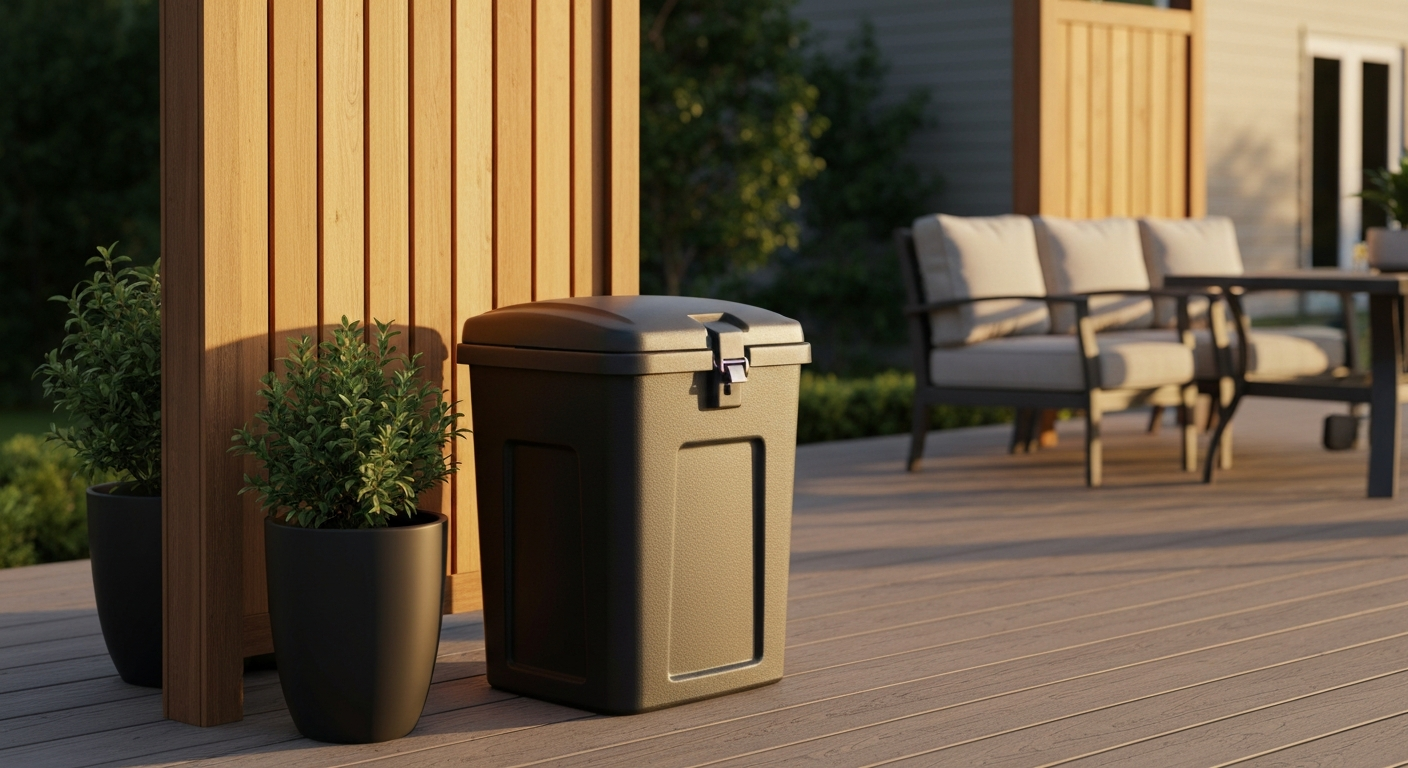
Quick Picks: Best Patio Trash Cans
These are the models I'd confidently recommend across different budgets and use cases. Each one has a clear reason it earned its spot.
- Suncast Trash Hideaway 33 Gal. — Best overall for most residential patios; resin construction, latching lid, and wide retail availability at a budget-friendly price.
- Rubbermaid BRUTE 32 Gal. with Lid — Best workhorse option; commercial-grade HDPE, thousands of verified positive reviews, and a near-indestructible build for heavy use or large gatherings.
- Toter 64 Gal. Rolling Cart — Best high-capacity pick; 41.75 in. tall, 10 to 12-year limited warranty, and wheeled mobility make it ideal for large patios or households that host frequently.
- Simplehuman 58 L Slim Open Can — Best premium/covered-area option; heavy-gauge stainless steel, 10-year warranty, and a sleek profile for covered patios or upscale outdoor kitchens.
- Sterilite 10 Gal. Wastebasket with Lid — Best small-space pick for balconies and compact patios; lightweight, stackable, and easy to stow.
- Bear-Tight or Kodiak by Kodiak Wildlife Products — Best for bear country; IGBC-certified, heavy-gauge construction, and compliant with Tahoe-basin and similar municipal ordinances.
- Behrens Galvanized Steel Locking Lid Can (20 Gal.) — Best for pest-prone areas without wildlife pressure; metal construction deters rodents, locks keep odors sealed.
At-a-Glance Comparison Table
| Model | Capacity | Lid Type | Material | Pest/Weather Features | Price Tier |
|---|---|---|---|---|---|
| Suncast Trash Hideaway | 30–33 gal | Swing/latch lid | Resin (HDPE) | Latching lid, UV-stabilized resin, rain-resistant | Budget–Mid ($30–$60) |
| Rubbermaid BRUTE 32 Gal. | 32 gal | Snap-on flat lid | HDPE (commercial grade) | Snap lid resists pests, impact-resistant body | Mid ($40–$70) |
| Toter 64 Gal. Rolling Cart | 64 gal | Hinged top lid | Resin/HDPE | Hinged lid, UV-resistant, wheeled stability | Mid ($80–$120) |
| Simplehuman 58 L Slim | 58 L (~15 gal) | Open top / liner pocket | Heavy-gauge stainless steel | Rust-resistant, fingerprint-proof, indoor/covered use | Premium ($100–$180) |
| Sterilite 10 Gal. w/ Lid | 10 gal | Swing lid | Lightweight plastic | Lid keeps out rain/light pests | Budget (under $20) |
| Bear-Tight / Kodiak IGBC Can | 30–45 gal | Locking lever lid | Heavy-gauge steel/HDPE | IGBC-certified bear-resistant, wildlife-grade lock | Premium ($150–$300+) |
| Behrens Galvanized Steel 20 Gal. | 20 gal | Locking flat lid | Galvanized steel | Pest/rodent-deterrent metal, odor-sealing lock | Mid ($50–$80) |
Actionable Buying Checklist
Run through this before you buy anything. It takes two minutes and saves you from returning a can that's either too big for your balcony or too flimsy for your climate.
- Size and capacity: Estimate peak waste volume (a weekend cookout can produce 15 to 25 gallons of trash alone). Match that to your pickup schedule — weekly pickup means you need a can that holds at least one full week of household plus entertaining waste.
- Lid type: Decide between swing, step-open, locking, or touchless based on your pest pressure and how you'll use the patio. Locking lids are mandatory in bear-prone areas and strongly recommended anywhere raccoons are active.
- Pest and weather resistance: Check for UV-stabilized materials, rust-resistant coatings, and tight lid gaskets or latches. If you live in a coastal zone, verify the material is 316 stainless or powder-coated rather than 304 stainless or bare metal.
- Material match for your climate: Resin/HDPE for most climates; galvanized or powder-coated steel for dry climates or pest-heavy areas; 316 stainless for humid coastal zones; wood or composite slipcovers for aesthetics only (always with an inner liner).
- Mounting and anchoring: Will the can sit freestanding, mount to a wall or post, be anchored to a deck, or live inside a built-in enclosure? Confirm your surface type (wood deck, concrete, pavers) before buying mounting hardware.
- Aesthetics: Choose a color and finish that complements your patio furniture and hardscape. Resin comes in neutral tones; stainless suits modern designs; galvanized suits farmhouse and industrial styles.
- Budget vs. premium: A $35 to $60 resin can handles 90% of residential needs. Spend $150 or more only if you need IGBC certification, heavy commercial use, or a high-end covered-patio look.
Choosing the Right Size and Capacity
This is where most buyers get it wrong in both directions. A 10-gallon can fills up by Saturday afternoon when you have six people over; a 96-gallon cart dominates a small deck and is overkill for a couple who rarely entertains. The right starting point is your trash pickup frequency and your peak-use day.
For a household of two to four people with weekly pickup and occasional entertaining, a 30 to 33-gallon can is the sweet spot. It holds roughly three to four kitchen-sized bags and won't overwhelm the average patio footprint. If you host regularly (think weekend BBQs from May through September), bump up to 45 to 50 gallons or add a second smaller can dedicated to recyclables. The Toter 64-gallon rolling cart is worth considering for large families or anyone who hosts frequently, since its 10 to 12-year warranty and wheeled design mean you can roll it to the curb without lifting a heavy load.
Seasonal use changes the equation too. If your patio is only active in summer, you can size down and store the can in the off-season. But in warmer climates like Texas, Florida, or Southern California where outdoor living runs year-round, size up and invest in a better lid seal because heat accelerates odors dramatically.
Lid Types, Opening Mechanisms, and Pest Control
The lid is the most important part of any outdoor trash can, and it's usually the first thing that fails or gets bypassed by wildlife. I've seen swing lids that work great for a season and then warp from UV exposure and stop sealing. Step-open lids are convenient for hands-free use but rarely seal tightly enough to deter determined raccoons or contain odors in summer heat. Here's how the main types stack up.
- Swing lids: Convenient and inexpensive. Fine for covered patios or low-pest-pressure areas. They do not lock and provide only light odor control. Not suitable for bear country or areas with active raccoons.
- Step-open / foot pedal lids: Hands-free operation is great for entertaining. Most residential step lids don't create a true seal, so expect odor leakage in heat. Good choice for covered patios where you want convenience over containment.
- Locking lids: The best option for pest control. Latching or lever-lock lids on models like the Suncast Trash Hideaway and IGBC-certified cans physically prevent wildlife from prying the lid open. Slightly less convenient but worth it in areas with raccoons, opossums, bears, or high rodent activity.
- Touchless/sensor lids: These are typically found on premium models designed for covered patios or outdoor kitchens. They require power (batteries or wired) and are not designed for full weather exposure. Use them only under covered structures.
- Locking bar or cable anchor systems: An add-on accessory for cans that don't have built-in locks. A steel cable looped through the handle and secured to a fixed post can deter most wildlife short of bears.
On the wildlife front, it's important to be honest about what 'bear-resistant' means. The Interagency Grizzly Bear Committee (IGBC) certifies products by testing them against captive bears for a set period. A certified can is resistant, not proof. The real-world guidance from UF/IFAS wildlife extension is consistent with IGBC testing: no container is 100% bear-proof if a bear is motivated enough. Certified containers dramatically reduce the risk and are legally required in some jurisdictions. In Tahoe-basin counties and parts of El Dorado County in California, for example, ordinances mandate IGBC-certified containers for residential and vacation-rental properties. See El Dorado County Ordinance No. 5083, Bear‑Resistant Garbage Can Requirements (PDF) for the specific local ordinance language requiring IGBC‑certified containers in parts of El Dorado County El Dorado County Ordinance No. 5083 — Bear‑Resistant Garbage Can Requirements (PDF). If you're in a regulated area, check your local code before buying.
From an accessibility standpoint, the U.S. Access Board's ADA guidance on operable parts specifies that receptacle lids should be operable with one hand, without tight grasping, and with no more than 5 pounds of force. If you're outfitting a patio for someone with limited grip strength or mobility, step-open or sensor lids are genuinely the better choice, and locking latches that require two hands may create real barriers.
Materials and Durability: What Actually Lasts Outside
Outdoor environments are hard on trash cans. UV radiation, temperature swings, rain, humidity, and wildlife pressure all degrade materials faster than indoor use ever would. The material choice matters a lot more here than it does for a kitchen can.
Resin and HDPE Plastic
This covers most of the consumer patio market, including the Suncast Trash Hideaway and Rubbermaid BRUTE. High-density polyethylene (HDPE) with UV stabilizers is the workhorse choice. Rubbermaid's commercial BRUTE line is built to a tighter spec than most consumer cans and backs that up with thousands of field reviews. The main durability risk for any plastic can is UV degradation over time: without UV stabilizers in the resin formulation, the material becomes brittle and cracks within a few years. EPA technical guidance on HDPE performance confirms that UV stabilizer packages significantly extend service life, so buy from brands that explicitly advertise UV-stable or UV-resistant formulations. Expect 5 to 10 years from a good-quality HDPE patio can with normal care.
Stainless Steel
Stainless steel is the premium choice and it earns that price on covered patios and outdoor kitchens. Simplehuman's heavy-gauge stainless models (the 58 L slim can, for instance) carry a 10-year warranty and look great in modern outdoor spaces. The critical detail most buyers miss is the grade. Type 304 stainless steel is the standard for most consumer products and handles most residential environments well. See MatWeb, 304 Stainless Steel (material datasheet) for detailed composition and corrosion performance data comparing 304 and 316 grades blank" rel="noopener noreferrer">MatWeb — 304 Stainless Steel (material datasheet). But in coastal or high-humidity environments with salt air exposure, 316 stainless (which contains molybdenum for added corrosion resistance) is the right call. Using 304 stainless in a salt-spray environment invites pitting and rust within a few seasons. Materials engineering data and coastal construction guidance are consistent on this point: chloride exposure accelerates corrosion in 304 significantly, while 316 holds up far better. If you're in Florida, the Gulf Coast, Hawaii, or anywhere within a mile or two of the ocean, specify 316 or go with a coated alternative.
Powder-Coated and Galvanized Metal
Galvanized steel like the Behrens line is a solid mid-tier choice for dry climates and pest-heavy areas. The zinc coating resists corrosion well in low-humidity environments but can develop rust at seams and scratches in wet climates. Powder-coated steel adds a layer of UV and weather protection but the coating must stay intact, chips and scratches expose bare metal and become rust points fast. Both are far better than bare steel at deterring rodents, which can chew through plastic but not metal. For dry Southwest climates (Arizona, New Mexico, parts of Texas), galvanized or powder-coated metal cans are a smart choice.
Wood and Composite Enclosures
These are slipcovers and enclosures, not standalone cans. A cedar or composite wood trash can enclosure looks beautiful and integrates well with deck furniture, but the actual waste containment comes from a plastic liner inside. Wood enclosures need regular sealing or staining in wet climates and can harbor pests in gaps and seams if not well-maintained. Composite enclosures (similar to composite decking material) hold up better with less maintenance. These are worth considering for aesthetic integration on a high-end patio, but the liner is doing the actual work.
| Material | Best Climate/Region | Expected Lifespan | Pest Resistance | Maintenance Level |
|---|---|---|---|---|
| HDPE/Resin (UV-stabilized) | All regions; best in moderate climates | 5–10 years | Good with locking lid | Low — rinse and occasional scrub |
| 304 Stainless Steel | Dry inland regions, covered patios | 10+ years (covered) | Good | Low — wipe down, avoid salt exposure |
| 316 Stainless Steel | Coastal, high-humidity, salt-air zones | 10–15+ years | Good | Low — occasional rinse |
| Powder-Coated Metal | Dry/low-humidity climates | 5–8 years (if coating intact) | Good | Medium — watch for chips/rust |
| Galvanized Steel | Dry inland climates | 8–12 years | Excellent (deters chewing rodents) | Low-Medium — inspect seams annually |
| Wood/Composite Enclosure | Any (with proper sealing) | 10–20 years (composite) | Moderate (depends on liner) | Medium-High (wood) to Low (composite) |
Mounting, Anchoring, and Placement
Where and how you place a patio trash can affects how well it works, how long it lasts, and whether it becomes a safety or pest problem. A freestanding can on an exposed deck in a windy climate is going to tip and scatter trash. A wall-mounted can in the wrong spot becomes a tripping hazard. Think through placement before drilling anything.
Freestanding Placement Tips
For most patios, freestanding is the default. Place the can in a corner or along a fence line where it's accessible but not in the main traffic flow. Shade placement is a genuine functional priority, not just an aesthetic one: a can sitting in direct afternoon sun in Texas or Arizona will bake and intensify odors far faster than one in partial shade. If you have a pergola, privacy screen, or outdoor kitchen wall, use it to tuck the can out of direct sun and wind.
Anchoring Against Wind and Wildlife
- Concrete anchor: For a patio slab, a masonry anchor bolt through the can's base ring or a purpose-built anchor bracket is the most permanent solution. Use a hammer drill with a masonry bit, set a wedge anchor, and attach a bungee or cable loop through the can's handle.
- Deck post cable: Loop a stainless steel cable through the can handle and around a deck post or railing anchor point. This prevents tipping in wind and deters wildlife from dragging the can away. Use a combination padlock for bear-country setups.
- Wall-mounted bracket: Several manufacturers sell mounting brackets for 32 to 44-gallon cans. Lag-screw into a stud or use masonry anchors on a block/stucco wall. Keep the base 2 to 4 inches off the ground to prevent water pooling underneath.
- Built-in enclosure: The most polished and pest-resistant option. A built-in trash enclosure with a hinged door and anchor bolts into the deck or slab eliminates the 'loose can' problem entirely. This is where hiring a local contractor makes sense — a skilled carpenter or deck builder can integrate an enclosure into your existing outdoor kitchen or deck structure for $300 to $800 in most markets.
When to Call a Pro for Built-In Solutions
If you want a fully concealed trash pull-out or a built-in enclosure that matches your outdoor cabinetry, that's a job for a contractor or outdoor kitchen installer. The rough cost for a custom built-in trash enclosure integrated into composite or hardwood decking runs $400 to $1,200 depending on materials and complexity. It's worth it if your patio is a significant investment and you want everything to look intentional. For most DIYers, a good quality can with a wall bracket or cable anchor achieves 80% of the functionality at a fraction of the cost.
Space-Saving and Mobile Solutions
Not every patio has room for a 33-gallon rollout cart. Balconies, small urban patios, and RV or toy hauler side patios require a completely different approach, and buying the wrong can for a tight space makes the whole outdoor area feel cluttered and cramped.
Balconies and Small Patios
For apartment balconies or small-footprint patios under 150 square feet, a 10 to 13-gallon slim can with a lid is the right call. The Sterilite 10-gallon wastebasket with a swing lid, for example, weighs almost nothing, stores flat-to-a-wall, and handles a day or two of waste between trips inside to the main bin. Collapsible silicone or fabric waste bins are another option for balconies where you want to stow the can completely when not in use, though they don't seal well enough for anything wet or aromatic. If you're looking for additional cleaning and maintenance tools to pair with a small-patio setup, a good compact hose makes quick rinsing much easier and is worth considering alongside your trash can choice. For compact, kink-resistant options and buying tips, see our guide to the best hose for small patio.
RV and Toy Hauler Side Patios
Toy haulers with side patios present specific constraints: limited floor space, no fixed wall to mount to, and a need to transport the can without it shifting or leaking. If you want recommendations, see our guide to the best toy hauler with side patio for models that combine usable outdoor space with secure, compact trash solutions. A 7 to 10-gallon can with a locking lid and a flat base that won't tip on a slightly uneven surface is the right spec. Slim rectangular cans fit against exterior walls better than round ones. Look for models with a carry handle so you can easily move them between the patio and a campground trash station. Avoid oversized cans for toy hauler setups: most campgrounds and RV parks require you to bring your trash to a central dumpster anyway, so an enormous rolling cart just eats floor space without adding utility.
For RV and mobile setups, also consider that you're often in wildlife-active areas like national forests, state parks, and dispersed camping spots. A locking lid is strongly recommended even if you're not technically in a designated bear zone. Raccoons and curious dogs at campgrounds are persistent. A simple latching lid is usually enough protection in non-bear areas, but if you're regularly camping in the mountain West, the Pacific Northwest, or the Appalachians, an IGBC-certified small can is worth the investment.
Rolling Cans for Flexible Layouts
Rolling cans like the Toter 64-gallon cart give you mobility without sacrificing capacity. On a large patio with multiple entertaining zones, you can wheel the can to where the action is and roll it to the curb on pickup day without lifting. The trade-off is footprint: the Toter 64-gallon measures roughly 24.25 inches wide by 31.5 inches deep, which is a real commitment of patio real estate. For most patios under 400 square feet, a 32 to 33-gallon rolling can or a fixed-placement 32-gallon BRUTE is the better balance.
Climate and Region-Specific Advice
What works in Colorado Springs won't necessarily work in Tampa or coastal Maine. Material choices, odor control, and pest-proofing requirements differ significantly by region, and I've seen homeowners waste money by buying a great product that was simply wrong for their environment.
- Hot, humid climates (Gulf Coast, Southeast, Hawaii): Odor control is the primary concern. Prioritize tight-sealing locking lids, odor-absorbing liner bags, and shade placement. UV-stabilized resin holds up well. Avoid bare galvanized steel in high-humidity coastal zones — it will rust at seams. If you're within a mile of saltwater, go 316 stainless or a quality powder-coated model and rinse regularly.
- Dry, hot climates (Southwest, Inland California, Arizona): UV degradation is the biggest threat to plastic cans here. Confirm UV-stabilized resin before buying. Powder-coated or galvanized steel lasts well in dry heat. Shade placement is essential to slow odor development in triple-digit temperatures.
- Cold climates (Upper Midwest, Mountain West, New England): Freeze-thaw cycles crack low-quality plastic. Invest in commercial-grade HDPE rated for cold temperatures. Avoid snap-on lids that can freeze shut or warp in extreme cold — hinged lids are more reliable. Galvanized steel handles cold well but can become brittle at the seams over time.
- Bear country (Rockies, Pacific Northwest, Appalachians, Sierra Nevada): IGBC certification is the non-negotiable starting point. Check your local jurisdiction for ordinances — Tahoe-basin counties and El Dorado County in California have specific approved-vendor lists and legal requirements. A bear-resistant can is expensive upfront but far cheaper than cleaning up a ransacked patio.
- High-wind regions (Great Plains, coastal areas, elevated mountain patios): Anchor or cable-secure any freestanding can. Heavier materials (galvanized steel, commercial HDPE) are harder to tip. Avoid lightweight plastic models in consistently windy locations.
Maintenance Routines and Useful Accessories
A patio trash can that never gets cleaned becomes a persistent odor and pest attractant. The good news is that a simple routine handles most of the maintenance work in under 10 minutes.
- Rinse the interior weekly in summer: A quick rinse with a hose after emptying prevents odor buildup and keeps flies from finding residue at the bottom. If you're on a small patio, this is where a compact hose or patio vacuum for detail cleaning earns its keep.
- Deep clean monthly: Mix one cup of white vinegar or a diluted bleach solution (1 tablespoon per gallon of water), spray the interior, scrub with a brush, and rinse. This handles bacteria, odors, and any organic residue that attracts pests.
- Use trash can liners sized for your can: Liner fit matters more than most buyers realize. An undersized liner bunches and allows waste to contact the can walls. An oversized liner hangs loose and can get pulled down into the can. Simplehuman and Rubbermaid both publish liner size guides matched to their can dimensions.
- Check and maintain the lid seal annually: Inspect the lid gasket or contact points each spring. Warped or cracked lids on plastic cans should be replaced — most manufacturers sell replacement lids separately. A failing lid seal defeats all the pest-resistance work you've done.
- Touch up powder-coated or galvanized surfaces: At the first sign of rust or chipping on a metal can, clean the area and apply a rust-inhibiting touch-up paint. Left untreated, surface rust spreads quickly, especially in humid climates.
Useful accessories worth having: odor-neutralizing can deodorizer discs (they stick to the lid interior and absorb odors between cleanings), a can lock cable for wildlife deterrence without buying a fully certified bear can, and a bag holder ring that keeps liners from slipping. If you're composting kitchen scraps separately, a dedicated small patio composter handles organic waste and keeps it out of the main trash can entirely, which dramatically reduces odor in summer.
How This Fits Into Your Broader Patio Maintenance Routine
A trash can is one piece of a functional outdoor space. If you're already thinking about how to keep your patio clean and organized, it's worth looking at your full maintenance toolkit. A patio vacuum handles fine debris, leaf litter, and spilled snacks between deep cleans and pairs well with a compact hose for rinsing hard surfaces and the trash can itself. If you're pulling weeds along your patio border regularly, a dedicated patio weeder makes that chore much faster. For recommendations, see our guide to the best patio weeder (aae69051-156b-4f93-b3bd-599dd43974b3). And if you're separating organic waste from your general patio trash, a genuinely good practice for reducing odors and volume, a patio composter is a natural companion to your trash can setup. Together, these tools make outdoor maintenance feel manageable rather than like a second job.
FAQ
What primary types of sources should I gather to write an accurate, actionable 'best patio trash can' article?
Collect hands-on product testing and roundup reviews (Reviewed, Good Housekeeping), manufacturer specs and manuals for dimensions/capacities/warranties (Toter, Rubbermaid, Suncast, Simplehuman), retailer review aggregates for real-world failure modes (Home Depot, Amazon), independent materials and engineering references (MatWeb, EPA HDPE guidance, FHWA/DoD corrosion guidance), and authoritative regional/wildlife guidance and ordinances (IGBC, local county ordinances, UF/IFAS extension). Combine test data, spec sheets and local rules to cover performance, sizing, and legal/safety needs.
Which product‑testing and review sources are most useful for vetting top picks and why?
Use independent hands‑on roundups (Reviewed, Good Housekeeping) to compare durability, lid performance and tipping resistance; BobVila and similar home‑advice roundups for market coverage and style options; and aggregated retailer reviews (Home Depot, Amazon) to spot common real‑world complaints (lids, missing parts, weathering). These together reveal performance in lab and daily use.
What manufacturer information do I need to gather and how does it inform recommendations?
Download product spec sheets, installation/owner manuals and warranty pages for each candidate model. Key details: exact dimensions and footprint, internal capacity (gallons/liters), material grade (HDPE, resin, stainless grade), mounting/anchoring options, weight, lid type, and warranty length. Use these to verify fit for patio sizes, mounting requirements, liner compatibility, and to contrast budget vs premium options.
How should I research climate‑ and region‑specific material and pest advice?
Combine authoritative engineering guidance on corrosion (WBDG/FHWA, MatWeb) and polymer durability (EPA HDPE reports) to recommend materials per climate (316 stainless or heavy galvanization for salt‑air/coastal; UV‑stabilized HDPE or resin for sun exposure). For wildlife/pest control, use IGBC testing protocol and university extension fact sheets (UF/IFAS) plus local municipal ordinances (Tahoe/El Dorado examples) to advise on bear‑resistant or raccoon‑proof solutions and any legally required container types.
What role do forums and social platforms play, and how should I use them ethically?
Use Reddit, homeowner forums and social posts to gather qualitative reports of failure modes (raccoon breaches, lid/lock problems, workarounds) and uncommon use cases (RV/toy‑hauler owners). Treat these as anecdotal evidence—verify patterns against product specs and formal reviews. Cite examples without personal data and avoid presenting single posts as definitive proof.
Which technical standards and accessibility guidelines should I consult?
Reference IGBC certification criteria for bear resistance, ADA/ABA operable‑part guidance for lid mechanisms and reach/force limits, and ASTM/engineering material standards (via MatWeb or manufacturer TDS) for corrosion and strength expectations. These guide recommendations for public or rental properties and ensure accessibility considerations are addressed.