
SEO Title: Best Hose for Small Patio: Top Picks, Sizes, and Storage Solutions (2026) | Meta Description: Find the best hose for a small patio with our practical guide covering hose types, lengths, storage, and top picks for every budget.
Best Hose for Small Patio: Flexible, Space-Saving Picks

Elise Prescott
25 Jul 2026
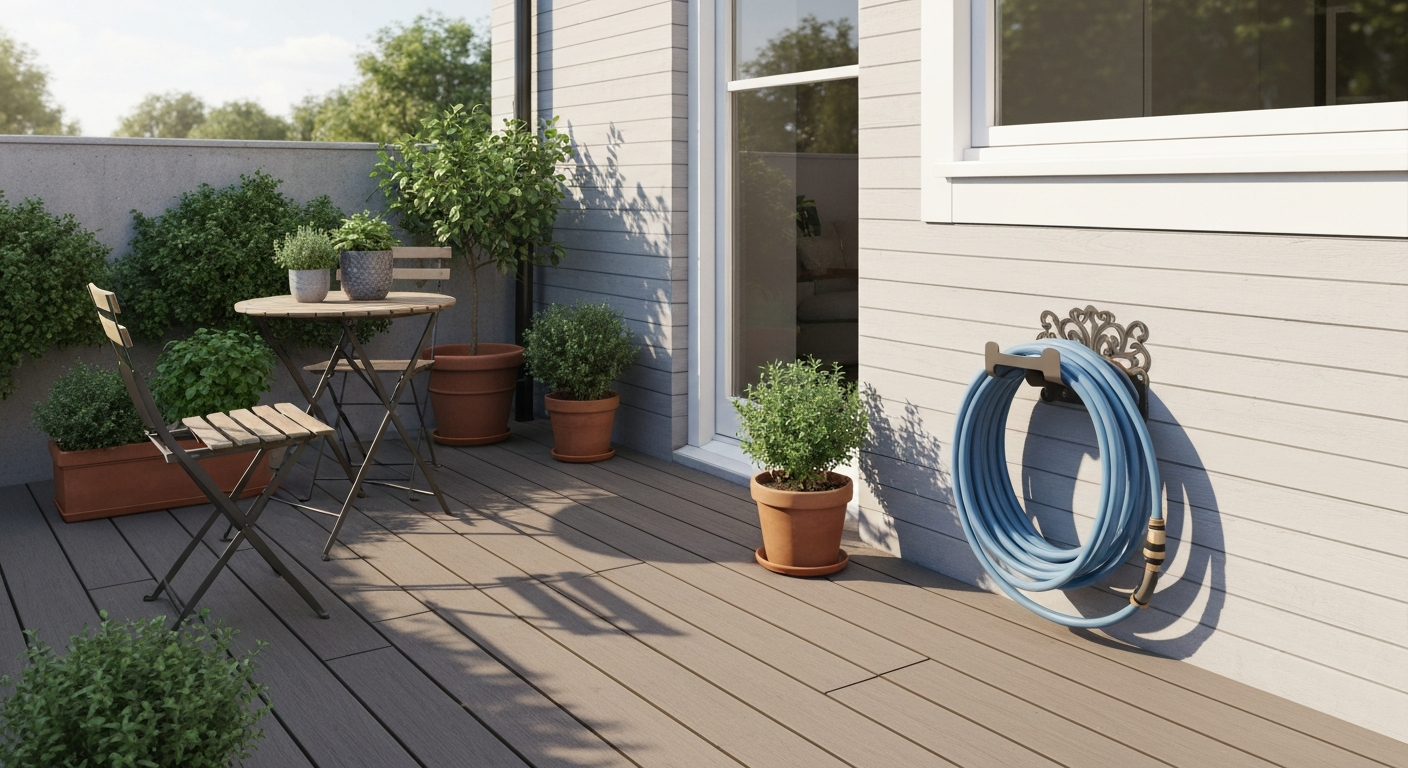
For most small patios, a 25- to 50-foot, 5/8-inch coiled or expandable hose is the right call. It gives you enough reach to water planters, rinse cushions, and top off a fountain without bunching up on a tiny deck or courtyard. If you have a spigot within 20 feet of everything you need to water, a 25-foot coiled hose can live right there permanently and never need storing at all. The moment you start lugging a 75-foot rubber hose across a 10x12 patio, you understand why hose choice matters more than people think.
Quick Take: Top Picks for Small Patios
These are the specific hoses I come back to when readers ask for a fast recommendation. Each one earns its spot for a clear reason, not just brand recognition.
| Category | Pick | Key Spec | Why It Wins |
|---|---|---|---|
| Best Overall | Flexzilla Pro 5/8" x 25 ft | 150 psi working pressure, SwivelGrip aluminum fittings | Lightweight, genuinely kink-free, premium fittings that don't strip |
| Best Budget | Gilmour Flexogen 5/8" x 25 ft | 400+ psi burst, reinforced construction | Durable rubber-hybrid at a lower price, holds up to UV and heat |
| Best Compact | Water Right 400 Series 1/2" x 25 ft | ~300 psi burst, polyurethane, NSF/ANSI-61 certified | Ultra-light, drinkable-water safe, coils into a tight loop for planter-only use |
| Best for Pressure-Washing | Flexzilla Pro 5/8" x 50 ft | 150 psi working pressure, 3/4" GHT fittings | Rated for high-pressure connections, remains flexible under sustained flow |
| Best for Planters | Camco TastePURE 1/2" x 25 ft | NSF/ANSI/CAN 61 certified, lead/BPA/phthalate-free | Safe for herbs, vegetables, and edible container gardens |
Why the Right Hose Actually Matters on a Small Patio
I hear people say a hose is just a hose, and then I watch them wrestle a kinked 75-foot green vinyl tube around a 120-square-foot concrete patio while knocking over a pot of basil. Space is the first and most obvious problem. A full-sized hose on a small patio is like parking a full-size truck in a compact space: technically possible, practically miserable. Every extra foot of hose you don't need is dead weight you're dragging, coiling, and tripping over.
Maneuverability compounds the space issue. On a larger yard, you can sweep a hose around in wide arcs. On a tight patio with furniture, planters, and maybe a grill, you need a hose that bends easily and doesn't pull fittings apart at sharp angles. Weight matters enormously here too. A 50-foot rubber hose weighs roughly 8 to 12 pounds when filled with water. A 25-foot polyurethane hose weighs under 2 pounds empty. For most people, especially those who don't want to drag hoses out and back in each time, a lighter hose actually gets used more consistently.
Water efficiency is a genuinely underrated benefit of right-sizing your hose. A shorter hose holds less standing water, which means less waste every time you run it, and less warm or chemically degraded water sitting in PVC tubing under a hot sun before reaching your plants. In drought-prone regions like Southern California, Arizona, or central Texas, this is not a trivial point. And if you're growing edibles in containers, which is increasingly common on small urban patios, the hose material itself can affect what's going into your soil and onto your food.
Longevity is the final piece. Cheap vinyl hoses get brittle in UV exposure within a single season in sunbelt climates. In Minnesota or Colorado, a hose left connected through a hard freeze can crack at the fittings and leave you with a puddle-sprayer in spring. Buying the right hose the first time, rather than replacing a $12 special every year, is genuinely the more economical path over a three- to five-year horizon.
Key Factors to Evaluate Before You Buy
Length
Measure the actual distance from your outdoor spigot to the farthest point you need to reach, then add 5 feet of slack. For most small patios, that number lands between 15 and 35 feet. A 25-foot hose covers the majority of small patio situations. Going longer than you need means more weight, more storage hassle, and more water sitting in the hose between uses. Flexzilla and Water Right both offer 25-foot models, which are genuinely the sweet spot for patios under 200 square feet.
Diameter and Flow
Garden hoses come in three common inner diameters: 1/2", 5/8", and 3/4". For small patios, 5/8" is the standard and handles almost every task well, delivering roughly 2 to 5 GPM at typical residential pressures of 40 to 60 psi. A 1/2" hose weighs less and works fine for watering planters but will feel underpowered if you're rinsing patio furniture or running a soaker line. A 3/4" hose moves significantly more water, which is useful for pressure-washing duty or connecting to a misting system, but adds weight and storage bulk that often isn't justified on a compact patio.
Weight and Flexibility
Polyurethane hoses (like Water Right's 400 and 500 series) are the lightest option, followed by hybrid hoses, then rubber. Flexibility matters most in cold weather: standard vinyl becomes nearly rigid below 50°F, while rubber and polyurethane stay pliable. In the Pacific Northwest or northern states, a hose that cracks up in cold morning temps makes early-season watering genuinely miserable. In a climate like Phoenix or Miami, UV resistance becomes more important than cold-weather flex.
Kink Resistance
Kink resistance is where cheap hoses consistently fail on small patios. The tight turns and close-quarters navigation around furniture, planters, and door thresholds create exactly the conditions that cause kinking. Coiled hoses return to shape automatically. The Flexzilla Pro earns its reputation specifically because its polymer jacket resists kinking under sharp angles at working pressure. Cheap vinyl hoses kink even on mild turns and then restrict flow enough to make a drip nozzle spit instead of spray.
Material
Rubber (especially EPDM, as in the Dramm ColorStorm) is the most durable and heat-tolerant, rated up to around 160°F for hot-water use, with burst pressures near 500 psi. Polyurethane is lightweight and food-safe but more expensive. Hybrid hoses blend rubber and vinyl for a middle-ground option at lower price points. Standard vinyl is the cheapest option and the worst long-term choice for any patio with significant sun exposure. The Ecology Center's garden hose study found that many vinyl and PVC hoses leach phthalates, lead from fittings, and other additives, which is worth knowing if you're using your patio hose near a food garden or for pet water. The Ecology Center/HealthyStuff garden‑hose testing (Garden Hose Study 2016, Ecology Center / HealthyStuff) tested many common hoses and found PVC/vinyl hoses frequently contain phthalates, lead in fittings, brominated flame retardants, and other additives, recommending polyurethane or NSF‑61 hoses for potable uses and advising flushing and avoiding stagnation Garden Hose Study 2016 — Ecology Center / HealthyStuff (chemical testing of hoses).
Fittings
All standard U.S. garden hoses and outdoor spigots use Garden Hose Thread (GHT), also called National Hose (NH), standardized under ANSI/ASME B1.20.7 as a 3/4" diameter straight thread at 11.5 TPI. This means virtually any hose connects to any standard spigot or nozzle without an adapter. The quality difference shows up in the fitting material: cast zinc and aluminum (like Flexzilla's anodized SwivelGrip connectors) resist corrosion and cross-threading far better than stamped metal or plastic. On a small patio, where you're connecting and disconnecting frequently, a swivel fitting is worth every penny.
Water Pressure
Residential supply pressure typically runs 40 to 60 psi, occasionally up to 80 psi. Every hose on this list handles that range easily. Where pressure ratings matter is if you're connecting a downstream pressure washer or booster pump, in which case the Flexzilla Pro's 150 psi working pressure or the Gilmour Flexogen's 400+ psi burst rating gives you real headroom. For standard watering tasks on a small patio, you won't stress any reputable hose at normal municipal pressure.
UV and Frost Resistance
If your patio is exposed to full sun, UV stabilization is not optional. Standard vinyl degrades visibly within one or two seasons in sunbelt climates, turning chalky and brittle. Rubber and polyurethane hoses hold up significantly better. For cold climates, disconnect and drain your hose before the first hard freeze. Even the most frost-tolerant hose can crack at the fittings when water expands inside a connected line. This is a maintenance step, not a product feature, but it determines whether your hose lasts three seasons or ten.
Hose Types and Trade-offs for Small Patios
| Type | Best Small-Patio Use | Pros | Cons |
|---|---|---|---|
| Coiled | Balconies, tiny patios near single spigot | Self-stores, no tangling, extremely compact | Limited length (typically 25–50 ft extended), reduced flow at stretch |
| Expandable | Patios where storage space is minimal | Collapses small when empty, lightweight | Inner liner can fail after 1–2 seasons, not for high-pressure tasks |
| Rubber (EPDM) | Heavy-duty use, hot climates, long-term ownership | Extremely durable, hot-water rated, high burst strength | Heavy, can be stiff in cold weather |
| Vinyl/PVC | Very light-duty or one-season use only | Cheapest upfront cost | Kinks easily, degrades in UV, potential chemical leaching |
| Hybrid | Everyday watering and rinsing on a budget | Lighter than rubber, more durable than vinyl, mid-range price | Not as flexible as polyurethane in cold temps |
| Flat/Soaker | In-ground planters, raised beds, drip irrigation | Delivers water directly to roots, water-efficient | Not useful for cleaning tasks, requires separate hose for rinsing |
Coiled hoses are the single best option for most apartment balconies and small patios where the spigot is close to the watering zone. They spring back into shape, require zero dedicated storage, and eliminate the tangling problem entirely. The trade-off is that they resist stretching and lose some flow rate when pulled to full extension, which is rarely an issue on a 10x10 or 10x14 patio.
Expandable hoses have exploded in popularity over the past few years because they collapse to almost nothing when empty. They're genuinely convenient for small patios with no storage. The honest caveat: the inner latex or TPU liner on budget models often fails within 12 to 18 months, especially with hot water or UV exposure. If you go expandable, buy from a brand with a warranty and avoid leaving it pressurized in direct sun.
Soaker and flat hoses belong in a separate category because they serve an irrigation function rather than a general-use one. If your small patio has a planter bed, raised box, or a row of containers, running a soaker line from a timer is genuinely the most water-efficient approach. But you'll still want a standard hose for rinsing furniture, filling a fountain, or connecting a misting system.
Space-Saving Storage and Mounting Solutions
Storage is where small patio hose ownership either works well or becomes a constant irritation. A hose piled on the ground is a trip hazard, an eyesore, and a fast track to kinking. Here are the options that actually work in tight spaces. If you're managing weeds on a patio, consider the best patio weeder for tight spaces.
Wall-Mounted Hose Reels and Holders
A wall-mounted hose holder is the most space-efficient option for a small patio. The Liberty Garden #670 decorative wall hose butler holds up to 125 feet of 5/8" hose and mounts flat against the wall, keeping the hose off the ground with zero footprint. For a 25- or 50-foot hose, a simple cast-iron or aluminum wall bracket takes up maybe 12 inches of wall space and keeps things tidy without blocking foot traffic. Mount it close to the spigot and at a height where you can coil the hose in one smooth motion.
Retractable Hose Reels
Retractable reels pull the hose back automatically when you release it. They're the best solution for people who want true hands-free storage. The trade-off is size and cost: a retractable reel takes up 12 to 18 inches of wall space and costs significantly more than a basic holder. On a small patio, a retractable reel mounted near the spigot at chest height is a premium but genuinely satisfying upgrade.
Freestanding Hose Pots and Hidden Storage
If you prefer a decorative look and don't want hardware on your walls, a hose pot like the Suncast Hose Hideaway works well. The Suncast PHH100DY measures approximately 21 inches wide by 15. The Suncast 100 ft. Hose Hideaway (PHH100DY) product page on The Home Depot lists a capacity of up to 100 ft of 5/8" hose and dimensions of about 21" W × 15.5" D × 16" H Suncast 100 ft. Hose Hideaway — The Home Depot product page (specs & capacity). 5 inches deep by 16 inches tall and holds up to 100 feet of 5/8" hose. For a 25-foot hose, it's nearly cavernous, but the design looks like a planter from a distance and keeps the hose completely out of sight. If you need a larger mobile outdoor living space, consider the best toy hauler with side patio for RV-style side patios and expanded entertaining areas. These work especially well on patios where the aesthetic matters as much as the function.
Placement Tips for Small Patios
- Mount wall holders within 3 to 4 feet of the spigot to minimize the hose slack needed to connect
- Keep the hose storage on the perimeter of the patio, never in a traffic path between furniture and doors
- On wood decks, use stainless or coated fasteners for any wall-mount hardware to prevent rust staining
- If you have a privacy fence or exterior wall, the far corner from your entrance is often the cleanest storage spot
- For coiled hoses, a simple over-the-spigot hook eliminates the need for any dedicated storage at all
Compatibility and Real-World Use Cases
Watering Pots and Planters
For container gardening, a 1/2" or 5/8" hose with a gentle flow nozzle is all you need. If you're growing herbs, vegetables, or anything you'll eat, use an NSF/ANSI/CAN 61 certified hose like the Camco TastePURE or Water Right 400 series. The NSF 61 certification means the hose material has been independently tested for compounds that could leach into water contacting food or drinking sources, which is not a marketing claim but a third-party verified standard. Flush the hose for 30 seconds before each watering session, especially in hot weather when water sitting in the hose may have degraded or absorbed heat.
Cleaning Patio Surfaces
Rinsing down concrete, pavers, or composite decking just needs good flow at normal pressure. A 5/8" hose with a jet nozzle handles this well. You don't need a pressure washer for routine cleaning. For weekly maintenance rinsing, the right hose paired with the right nozzle setting does the job without risk of etching softer paver surfaces.
Pressure-Washing
If you're running a downstream pressure washer from your outdoor spigot, use a 5/8" hose rated for at least 150 psi working pressure. The Flexzilla Pro is specifically built for this. Never use an expandable or thin-walled vinyl hose with a pressure washer, as the pressure spikes during nozzle changes can exceed what those hoses are designed for. A 50-foot 5/8" hose is the practical upper limit for a small patio pressure-washing setup; longer runs create enough friction loss that your washer's performance drops noticeably.
Filling Fountains and Water Features
Fountains and decorative water bowls are common on small patios. Any standard 5/8" hose handles this fine. If the fountain is a drinking source for pets, use an NSF-61 certified hose and let the water run for 30 seconds before filling to flush standing water from the hose. A short coiled hose kept near the fountain makes top-offs a 60-second task instead of a whole production.
Connecting to Misting Systems and Drip Irrigation
Patio misting systems and drip or soaker irrigation lines all connect via standard GHT fittings, so hose compatibility is rarely a problem. What matters is matching pressure: most residential misting systems are designed for 40 to 60 psi supply pressure, which is standard municipal tap pressure. High-pressure misting systems (1000+ psi) use a dedicated pump and separate tubing, not your garden hose. For soaker and drip irrigation off a garden hose connection, a simple Y-splitter at the spigot lets you run one line to a soaker loop through planters and keep a second port free for your regular hose.
Recommended Picks by Use-Case and Budget
Budget Picks (Under $30)
- Gilmour Flexogen 5/8" x 25 ft: The best value heavy-duty option at this price, with reinforced construction and 400+ psi burst strength that outlasts cheap vinyl by years.
- Camco TastePURE 1/2" x 25 ft: An inexpensive NSF/ANSI/CAN 61 certified hose that makes it the right budget choice specifically for herb and vegetable container gardens on a small patio.
Midrange Picks ($30 to $60)
- Flexzilla Pro 5/8" x 25 ft: The best all-around midrange hose for small patios, with a genuinely kink-free design, aircraft-aluminum SwivelGrip fittings, and 150 psi working pressure that handles everything from planter watering to light pressure-washing prep.
- Dramm ColorStorm 5/8" x 25 ft: An EPDM rubber hose rated to ~130 psi operating pressure and ~500 psi burst, ideal for hot climates where UV and heat exposure kill cheaper hoses fast.
Premium Picks ($60 and Up)
- Water Right 400 Series 1/2" x 25 ft: The lightest, most toxin-free option available, with NSF/ANSI-61 certification and a polyurethane construction that makes it the premium choice for organic container gardens and anyone prioritizing material safety.
- Flexzilla Pro 5/8" x 50 ft: If you need the reach and the pressure rating for cleaning or pressure-washing, this is the premium 50-foot pick with no real competition in its class for small-to-mid patio use.
Best Compact-Specific Pick
For a balcony, rooftop patio, or any space under 100 square feet: the Water Right 400 Series in 25 feet or the Flexzilla Pro in 25 feet. Both weigh well under 3 pounds empty, coil into a small loop, and cover every task a compact patio demands without dominating the space.
Sizing and Connection Guide
- Measure from your outdoor spigot to your farthest watering point and add 5 feet. This is your target hose length.
- Choose 5/8" diameter for general use or pressure-washing. Drop to 1/2" only if you exclusively water planters and want minimum weight.
- Confirm your spigot is standard GHT (3/4" straight thread, 11.5 TPI). Nearly all U.S. residential spigots are, but older or imported fixtures occasionally are not.
- Check that your chosen hose fittings are GHT-compatible. Nearly every hose listed here uses 3/4" GHT, and adapters are inexpensive if you need to connect to non-standard ports.
- If you plan to run a soaker or misting line off the same spigot, install a Y-splitter at the wall before attaching any hose. This keeps both connections accessible without repeated disconnects.
- Hand-tighten fittings until snug, then give a quarter-turn with pliers. Over-tightening brass fittings on aluminum connectors causes galling and can strip the thread.
Installation Notes and When to Call a Contractor
Installing a hose on a small patio is a pure DIY task: connect hose to spigot, done. Where a contractor becomes relevant is if you want a built-in retractable reel hardwired to a through-wall spigot extension, or if you're adding an outdoor water connection where one doesn't currently exist. Adding an exterior hose bib requires a plumber or experienced contractor in most jurisdictions, and in many areas requires a permit. If your small patio currently lacks an outdoor faucet and you're relying on an interior connection routed through a window or door, that's worth budgeting a plumbing visit to fix properly.
For wall-mounted reels and holders, the only installation consideration is finding solid blocking in a fence, wall, or deck post. A decorative holder loaded with a full 50-foot rubber hose holds 6 to 10 pounds of water and hose weight. Anchor into stud, post, or blocking, not just siding or fence boards, to prevent the mount from pulling out over time.
Maintenance, Winterizing, and Safety Tips
Everyday Maintenance
- Drain the hose completely after each use and store it out of direct sun whenever possible to extend UV life
- Flush the hose for 30 seconds before watering food plants, especially after the hose has sat in warm sun
- Inspect fittings at the start of each season for corrosion, cross-threading, or cracked washers, and replace rubber washers annually
- Avoid dragging the hose over sharp pavers or metal edges, which wears through the outer jacket faster than any other cause
- If your hose develops a small kink-induced weak spot, repair it with a hose mender rather than replacing the whole hose
Winterizing in Cold Climates
Before your first hard freeze (typically below 28°F for an extended period), disconnect the hose from the spigot, drain it fully, and store it coiled in a garage or interior space. Leave the outdoor faucet open briefly after disconnecting to let residual water drain from the spigot body. If your outdoor faucet is a frost-free sillcock (the handle is set back into the wall), closing the valve causes the water column to drain back past the frost line automatically, but you still want to disconnect the hose: a hose left attached defeats the frost-free design by trapping water at the valve seat.
Safety Notes
- Never drink directly from a hose unless it is NSF/ANSI/CAN 61 certified; water sitting in standard vinyl hoses in hot sun can contain leached phthalates and elevated lead levels from brass fittings
- Keep hoses off high-traffic walkways when in use to prevent tripping hazards
- Do not leave hoses pressurized and unattended in peak summer heat; water in a kinked section can expand and blow a fitting
- Check local watering restrictions before setting up automated drip or soaker systems; many drought-affected municipalities have specific rules about unattended irrigation
Your Small-Patio Hose Buying Checklist
- Measure your required hose length (spigot to farthest point plus 5 feet) and buy that length only
- Choose 5/8" diameter for general use, 1/2" for planter-only lightweight use, 3/4" only for high-flow or pressure-washing setups
- Select material based on climate: polyurethane or rubber for sunbelt and freeze-prone regions, hybrid for mild climates on a budget
- Require NSF/ANSI/CAN 61 certification if the hose will supply edible gardens, pet water, or human drinking use
- Verify GHT-compatible fittings and choose brass or aluminum over stamped steel
- Plan storage before you buy: wall mount, retractable reel, or hose pot, so the hose has a designated home from day one
- Budget for a Y-splitter if you want to run a misting system or drip line from the same spigot
- Set a calendar reminder to disconnect and drain before your region's first hard freeze
Pairing Your Hose with the Right Patio Gear
A good hose is one piece of a well-maintained small patio. If you're thinking about keeping your space clean and functional year-round, a patio vacuum makes short work of debris between rinse-downs, and a patio weeder keeps the cracks between pavers from turning green between hose-cleaning sessions. On the waste management side, a patio trash can with a lid that actually seals is worth pairing with any outdoor space where you're regularly working with soil, cuttings, or container garden debris. Consider an outdoor trash can with lid for patio to keep odors and pests out and protect debris from rain. For help choosing the best patio trash can that seals properly for garden waste, see our guide to the best patio trash can. If you're growing anything in containers, a patio composter nearby closes the loop on plant waste without it going to the landfill.
FAQ
SEO title and meta description for the article
Title: Best Hose for a Small Patio: Space‑Saving, Durable & Potable Options Meta description (≤160 chars): Find the best hose for small patios—compact, kink‑resistant, potable, and storage options for pots, cleaning, fountains, and misting systems.
What are the primary selection factors for choosing a hose for a small patio?
Headings: Key factors to evaluate - Length: Measure the run from faucet to farthest use point. For small patios most needs fit 10–50 ft; avoid oversizing which adds weight and storage trouble. - Inner diameter (ID): 5/8" is the best general balance for patio tasks (watering pots, cleaning); 3/4" gives higher flow for pressure washers or long runs. - Weight and flexibility: Lightweight hoses are easier to coil and store; flexible rubber or hybrid hoses handle tight corners better. - Kink resistance: Reinforced/cloth‑braided or multi‑layer designs reduce kinking—important where you’ll coil tightly. - Material and potable safety: For filling fountains or drinking‑water contact, use NSF/ANSI‑61 certified or polyurethane/EPDM hoses; avoid unknown PVC for potable uses (chemical concerns documented in hose testing studies). - Fittings: Match to GHT/NH (3/4" garden hose thread) for spigot compatibility; look for brass or anodized aluminum swivel connectors for durability. - Water pressure and flow: Typical household pressure ~40–60 psi—5/8" delivers ~2–5 GPM; choose 3/4" if you need higher flow or long run compensation. - UV/frost resistance: EPDM rubber and some hybrids handle UV and heat better; winterize to prevent freezing damage. Practical note: On a small patio prioritize compactness, flexibility, and potable safety when needed.
Which hose types and trade‑offs suit small patios?
Headings: Hose types and when to pick them - Coiled (spring) hoses: Extremely compact and self‑retracting for small spaces. Trade‑offs: limited reach, can tangle, lower flow and durability than full‑diameter hoses. Good for quick pot watering and misting. - Expandable hoses: Very compact when off; light and flexible. Trade‑offs: fittings and thin inner tubes can wear faster; avoid for high‑pressure or pressure‑washer use. - Rubber hoses (EPDM): Durable, kink‑resistant, UV and heat tolerant. Heavier but long‑lasting—good if you’ll leave hose in use or need hot‑water resistance (Dramm ColorStorm examples). - Vinyl hoses: Lightweight and cheap. Trade‑offs: stiffer in cold, more chemical additives—avoid for potable uses and heavy duty cleaning. - Hybrid/latex‑reinforced: Middle ground—lighter than rubber, more durable than vinyl; many contractor brands (Flexzilla, Gilmour Flexogen) offer high flexibility and pressure ratings. - Flat / soaker hoses: Excellent for irrigation under pots/planters or concealed drip lines; low profile and space‑saving but not for cleaning or pressure tasks. Selection tip: For a small patio, prefer 5/8" hybrid or EPDM if you want durability; coiled or expandable for tight storage and light duty; polyurethane/NSF hoses where potable water contact occurs.
What storage and mounting solutions save space on small patios?
Headings: Space‑saving storage options - Wall mounts & decorative holders: Metal holders (e.g., Liberty Garden decorative wall mount) keep hose off the floor and can double as décor. Good capacity for typical 5/8" lengths. - Enclosed pots/boxes: Suncast Hose Hideaway or hose pots hide coils and protect hose; check capacity for your hose length. - Retractable/reel units: Manual reels and spring‑retractable units tidy hoses automatically; pick compact models sized for your chosen length and ID. - Vertical reels & compact carts: Useful if you need occasional mobility but still want tight storage. - Hidden storage: Mount reels behind bench seating or under rail planters to hide hose entirely. Installation tip: Use anchors suitable for the wall type (masonry vs. wood) and place reel near spigot height for easy draw.
How do I match hose diameter and length to common patio use‑cases?
Headings: Use‑case compatibility & recommendation - Watering pots & planters: 5/8" x 25–50 ft is usually ideal—flexible and easy to coil. - Cleaning patio surfaces: 5/8" works for light cleaning; use 3/4" for larger patio areas or pressure‑washer inlets. - Pressure washing: Use the hose size recommended by the pressure washer—many require a 3/4" feed for full flow. - Filling fountains or reservoirs: Use NSF/ANSI‑61 or potable‑rated hoses (Camco TastePURE or Water Right polyurethane) to avoid leaching. - Misting systems/irrigation: Use small‑ID dedicated lines or soaker/flat hose runs; use adapters to connect to tap. Sizing rule: For runs under 50 ft and typical household pressure, 5/8" is sufficient; choose 3/4" when you need higher flow or have long runs or multiple simultaneous outlets.
Which specific hoses, fittings, and storage products are recommended by use‑case and budget? (short picks and rationale)
Headings: Recommended picks by budget & use‑case - Best overall flexible workhorse (midrange): Flexzilla 5/8" (25–50 ft) — highly flexible, 150 psi working rating, anodized aluminum swivel fittings; excellent for patios needing maneuverability. - Best heavy‑duty contractor (premium/durable): Gilmour Flexogen 3/4" — high burst ratings and reinforced construction for long life and kink resistance; pick for frequent heavy cleaning or long runs. - Best potable/edible‑garden option (premium potable): Water Right polyurethane or Camco TastePURE — NSF/ANSI‑61 or potable‑safe options; ideal for fountains, edible gardens, and potable needs. - Best compact/light duty (small spaces): Coiled spring hose (good brand examples fit most retailers) — ultra‑compact; ideal for quick potted‑plant watering. - Best value basic: Vinyl blend 5/8"—cheapest option for infrequent use; avoid for potable or heavy‑duty needs. - Recommended fittings: Brass or anodized aircraft‑grade aluminum swivel GHT fittings (3/4" GHT standard) for leak resistance and durability. - Storage: Suncast Hose Hideaway (enclosed pot) for hidden storage; small retractable reel for convenience; decorative Liberty Garden wall mount for style. Rationale: Picks balance flow, flexibility, potable safety, and storage needs—Flexzilla and Gilmour are proven mid‑to‑premium performers; Camco/Water Right for potable requirements; storage choices sized to chosen hose length.