
The best outdoor patio fountains balance three things most buyers underestimate: the right size for your actual patio footprint, a pump rated for your real operating head height (not just open-flow GPH), and a material that survives your local winters without cracking. For most homeowners, a mid-size freestanding resin or cast-stone fountain in the 200–400 GPH pump range hits the sweet spot between sound output, visual impact, and manageable maintenance. If you're in a freeze-thaw climate like Minnesota or Colorado, material choice is non-negotiable, concrete and ceramic crack unless they've passed ASTM C666 freeze-thaw testing. If you want zero electrical work, a solar-with-battery-backup kit gets you 2–4 hours of cloudy-day run time from a 1,500–3,000 mAh pack. This guide walks through all of it: top picks by type and budget, sizing, materials, installation, placement, maintenance, costs, and when to call a pro.
Best Outdoor Patio Fountains: Top Picks, Sizing & Install

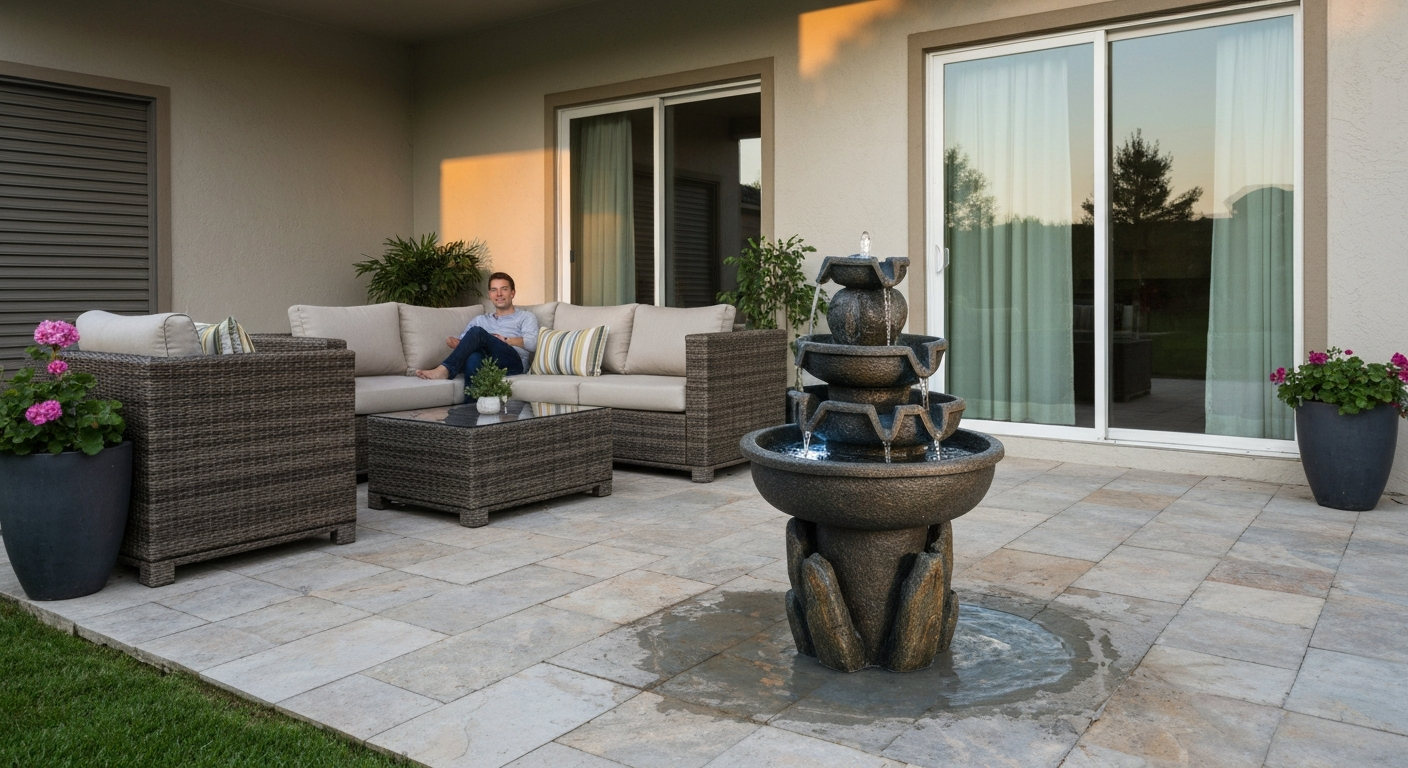
Who this guide is for and how to use it
Whether you're a DIY homeowner who wants to drop a fountain in over a weekend, or someone who's about to call a landscaper and wants to walk in knowing what to ask for, this guide is built for you. I've organized it so you can jump straight to the top picks table if you already know your patio type and budget, or work through the full guide if you're starting from scratch. Homeowners hiring professionals will find the cost breakdown, permit notes, and contractor vetting tips especially useful. DIYers will want to focus on the pump sizing, power, and placement sections before buying anything. If you're still deciding between a fountain and other water features like a pond, birdbath, or misting wall, there's a dedicated section for that comparison too. For a broader roundup of options, see our guide to the best patio water features.
Top picks at a glance: best outdoor patio fountains by type and budget
Here's a quick-reference breakdown of the best fountain categories by type and spending range. I'll go deeper on each in the sections below, but if you need a fast answer, this table covers the main use cases. For a curated list of options, see our guide to the best water fountain for patio.
| Type | Best For | Typical Price Range (unit) | Key Consideration |
|---|---|---|---|
| Tabletop / small solar | Apartment patios, accent pieces, budget shoppers | $50–$150 | Limited sound output; 2 W panel needs 6+ hours of direct sun |
| Freestanding (resin/polyresin) | Mid-size patios, DIY-friendly, most climates | $150–$600 | Lightweight, UV-resistant, easier to move for winter storage |
| Freestanding (cast-stone/concrete) | Statement installs, large patios, permanent placement | $400–$3,000+ | Requires ASTM C666-rated material in freeze-thaw zones |
| Wall-mounted | Small patios, vertical-space solutions, modern or Mediterranean styles | $200–$1,200 | Needs secure wall anchor and nearby GFCI outlet |
| Solar (battery-backed kit) | Off-grid setups, eco-conscious buyers, no-electrical zones | $80–$350 | Battery backup (1,500–3,000 mAh) gives 2–4 hrs cloudy-day run time |
| Pondless waterfall / spillway | Large patios, high-impact sound, landscape integration | $500–$5,000+ installed | 100–200 GPH per inch of spillway width; almost always a pro install |
Recommended models and categories for different patio types and budgets
Compact patios and budget buyers (under $200)
For small patios under about 150 square feet, or anyone spending under $200, the best move is a tabletop solar fountain or a compact plug-in tiered fountain. Solar kits in this range, like the Sunnydaze SL-P103E series, typically publish around 65 GPH open-flow, a 2 W (6–9 V) panel, and up to 4 hours of battery-backed run time on a full charge. That's enough to keep a small birdbath-style basin running through an overcast afternoon, but it won't fill a large bowl or generate meaningful sound. For patio use specifically, plug-in tiered resin fountains in the $100–$200 range from brands like Teamson Home or Alpine Corporation give you a real pump with 100–200 GPH, a standard cord, and enough water sound to be noticeable at close range. Just make sure your outdoor outlet is GFCI-protected before plugging anything in, NEC 210.8 requires it for all outdoor receptacles at dwellings, and your local jurisdiction may be on a stricter code cycle than you think.
Mid-size patios and the $200–$800 range
This is the most popular category and where the value is best. A freestanding polyresin or fiberglass fountain in the 24–40-inch height range, powered by a submersible pump in the 200–400 GPH range, is genuinely satisfying on a standard 200–400 square foot patio. Brands like Sunnydaze, Aquascape, and Henri Studio offer well-reviewed options with UV-stabilized finishes and corrosion-resistant pump housings. At this price point, pay close attention to pump spec sheets: look for rated GPH at actual head height, not just open-flow ratings. A pump rated at 400 GPH open-flow might deliver only 200 GPH at a 3-foot head, which is what actually matters if your fountain's top tier sits 3 feet above the basin. OASE's AquaMax pump line is a good benchmark here, their published head-vs-flow curves make honest sizing straightforward.
Statement fountains ($800 and up)
Large cast-stone, concrete, or heavy resin fountains in the 40-inch-plus range anchor a patio the way a piece of furniture anchors a room. Campania International and Henri Studio are the most referenced names in this category, and both publish comparative absorption and freeze-cycle test data on their cast-stone lines. If you're in a climate with hard winters, ask specifically whether the material has been tested to ASTM C666 standards for freeze-thaw durability, some decorative concrete fountains are not, and they'll crack within two to three seasons of wet-freeze cycling. At this budget, professional installation is worth it: a 300-pound fountain needs a level, structurally sound pad, a properly sized pump, and ideally a dedicated circuit with a weatherproof GFCI outlet. Installation costs for this tier typically run $800–$2,500 on top of the unit price, depending on your region and what site prep is required.
Low-maintenance solar picks
Battery-backed solar fountain kits with a 10 W or higher panel and 2,000+ mAh battery are genuinely viable for patios that get 5 or more hours of direct sun per day. The Sunnydaze 396 GPH Solar Pump and Panel Kit is one of the more capable units in this category, publishing a real-world flow rate and multiple pump head attachments. For planning purposes: small garden solar pumps typically use 2–10 W panels; anything under 5 W will struggle on a partially shaded patio. If your patio sits under a pergola or patio cover for most of the day, a direct-wired or cord-and-plug fountain will serve you better than solar.
Side-by-side comparison: which fountain type is right for your patio
Each fountain type has a genuine sweet spot. The table below compares them across the factors that matter most when you're making an actual buying decision.
| Type | Sound Output | Installation Complexity | Best Patio Size | Freeze-Thaw Risk | Move/Store Ease |
|---|---|---|---|---|---|
| Tabletop / solar | Low (gentle trickle) | None — set and plug in or use solar | Any (accent only) | Low if stored indoors | Very easy |
| Freestanding (resin) | Low to medium | Easy DIY — level surface + GFCI outlet | Small to medium | Low — resin doesn't absorb water | Easy — lightweight |
| Freestanding (cast-stone/concrete) | Medium to high | Moderate — heavy, needs stable pad | Medium to large | High if not ASTM C666-rated | Difficult — 100–500+ lbs |
| Wall-mounted | Medium | Moderate — wall anchor + GFCI outlet + tubing | Small to medium | Moderate — basin can crack | Not intended to move |
| Solar (battery-backed) | Low to medium | Easy DIY — no electrical work | Small to medium | Depends on material | Easy |
| Pondless waterfall / spillway | High | Complex — basin, liner, pump vault, grading | Large | Moderate with liner/vault protection | Permanent install |
My recommendation: if you're renting or want flexibility, go resin freestanding. If you want the biggest visual and acoustic impact and are willing to commit to permanent placement, a pondless waterfall or large cast-stone freestanding fountain is worth the investment. Wall fountains punch above their weight on small urban patios where floor space is tight, a 24-inch wall fountain delivers real water sound in a 6-inch footprint off the wall.
How fountains compare to other patio water features
Fountains are not always the right answer. Depending on what you're actually trying to achieve, wildlife habitat, ambient cooling, dramatic focal point, or just background sound, a different water feature might serve you better. Here's an honest comparison.
| Feature | Best Use Case | Maintenance | Approximate Cost | When to Choose It Instead |
|---|---|---|---|---|
| Fountain (freestanding/wall) | Focal point, ambient sound, aesthetic | Low-medium (weekly cleaning, annual pump service) | $50–$3,000+ | Default choice for most patios |
| Pond (in-ground) | Wildlife habitat, fish, large landscape integration | High (algae, filtration, fish care) | $2,000–$15,000+ installed | When you want ecosystem, not just aesthetics |
| Birdbath (with pump) | Wildlife attraction, small accent | Low (refill, weekly scrub) | $40–$300 | When budget is tight or patio is very small |
| Misting wall / misting system | Cooling effect in hot dry climates (AZ, TX, NV) | Medium (nozzle cleaning, winterize lines) | $300–$2,000+ installed | When heat control matters more than sound or aesthetics |
| Pondless waterfall | Sound impact, naturalistic look, large patio | Medium (annual pump inspection, leaf clearing) | $1,500–$8,000+ installed | When you want waterfall drama without open water maintenance |
| Fountain + misting combo | Premium patios in hot climates | Medium-high | $1,500–$5,000+ combined | When you want both cooling and focal-point aesthetics |
Misting systems and fountains are actually a good pairing on hot patios in Texas, Arizona, or Southern California, one cools, one anchors the space visually and acoustically. A misting wall alone doesn't give you the focal-point presence a fountain does. If you're comparing the two, think of them as solving different problems rather than competing for the same job.
Matching fountains to your patio size and layout
Oversized fountains on small patios don't look grand, they look cramped and they block circulation. Undersized fountains on large patios look like an afterthought. Here are practical sizing rules I've found actually work. For related advice on patio materials and gap fillers, see our guide to the best patio filler.
Small patios (under 150 sq ft)
Keep fountain height under 24 inches and basin diameter under 18 inches. Wall-mounted fountains are ideal here because they use vertical space instead of floor space. Position any freestanding unit in a corner or against a wall so it doesn't interrupt traffic flow. Tabletop units on a side table or ledge wall are the lowest-commitment option. Even on a small patio, keep the fountain at least 18–24 inches from patio edging, water splash and overflow will work into edge gaps and accelerate heaving in freeze-thaw climates. For more on protecting your patio edges from splash and freeze-thaw heaving, see our guide to the best patio edging for durable, weather-resistant borders.
Medium patios (150–400 sq ft)
This is where freestanding fountains in the 24–42-inch range shine. Place them as a focal point at the far end of a seating area, or centered in an open zone with at least 3 feet of clearance on all sides. If your patio has a defined sight line from a sliding door or main window, position the fountain on that axis, it makes a big difference to how the feature reads from inside the house. Avoid placing fountains directly under a patio cover or pergola unless drainage from the cover's drip edge is routed away from the basin: extra water input can overflow a small pump reservoir.
Large patios (400+ sq ft)
Large patios can carry a statement fountain 48 inches or taller, or a pondless waterfall feature integrated into a planting bed or retaining wall along the patio perimeter. For pondless and spillway features, professional design is strongly recommended: grading, basin sizing, liner selection, and pump vault placement all interact, and a miscalculated basin overflows and saturates the surrounding subbase. On a large patio, also think about where the fountain sits relative to outdoor speakers and fans, sound from a large fountain can interfere with speaker clarity at conversational distances, so keep major speaker zones at least 10–12 feet from a high-flow feature.
Flow, noise, and acoustic goals: sizing your pump and managing sound
Pump sizing is where most buyers make their biggest mistake. They see a GPH rating on the box and assume bigger is always better, or they buy the pump that came with a cheap kit without checking if it actually matches their fountain's head height. Here's how to do it right.
How to size your pump correctly
Every pump has a performance curve that shows how GPH flow drops as head height increases. A pump rated at 400 GPH open-flow might deliver only 180 GPH at a 3-foot head and 0 GPH at 5 feet, well within its published 'max head' but far below what you might expect. Always look for the GPH rating at your fountain's actual operating head height, not the open-flow number. The Hydraulic Institute and manufacturers like OASE publish these curves for every pump model. For waterfall and spillway features specifically, plan for 100–200 GPH per inch of spillway width at operating head. A 6-inch wide spillway needs at least a 600 GPH pump rated at your actual head height, meaning you may need an 800–1,000 GPH open-flow pump to achieve that.
Controlling sound output
This is more nuanced than people expect. More flow generally means more sound, but the character of the sound, whether it's a gentle trickle or a loud splash, depends on drop height and basin depth. A large drop into a shallow basin creates splashy, high-frequency noise. A short drop into a deep basin creates a lower, more muffled sound. If you want the fountain to be audible enough to mask street noise or HVAC equipment, you need meaningful flow and some drop height. If you want background ambiance that doesn't overwhelm conversation, keep drop heights under 12 inches and use a variable-speed pump with a flow adjustment dial. For noise-sensitive settings, close to bedroom windows, near a neighbor's fence line, independent pump noise testing data is worth looking at: well-isolated DC brushless submersible pumps can test as low as 20–40 dB at 1 meter, while larger AC pumps often test in the high-60s to low-70s dB range. Independent lab testers and consumer testing organizations document controlled noise and performance testing procedures and publish lab-tested product reviews; see Consumer Reports, How we test (example methodology pages and lab-tested product reviews) for methodology details and validated test data Consumer Reports — How we test (example methodology pages and lab-tested product reviews). WHO night noise guidelines target 40–45 dB Lnight, which is worth keeping in mind if your fountain runs after dark near a neighbor's window.
Practical noise management tips
- Use a pump with a built-in flow control valve so you can dial back volume at night
- Add a smart outlet timer to shut the fountain off at a set hour
- Lower the intake pipe slightly or add a foam pre-filter sleeve to reduce pump hum vibrating through the basin
- Place the pump on a rubber anti-vibration pad in the basin — this alone can drop perceived mechanical noise noticeably
- If the splash sound is too loud, add water to the basin to reduce drop height, or install a diverter plate at the bottom
- Position the fountain away from hard reflective surfaces like stucco or block walls that amplify sound
Materials and finishes tied to patio style
Material choice is where climate intersects with aesthetics, and where a lot of buyers get burned by making a purely visual decision without checking durability specs. Here's the honest breakdown.
| Material | Weight | Freeze-Thaw Durability | Maintenance | Best Style Match | Price Range |
|---|---|---|---|---|---|
| Cast stone / concrete | Very heavy (100–600 lbs) | Only if ASTM C666 rated; verify with manufacturer | Seal annually; algae-prone | Rustic, Mediterranean, formal garden | $$–$$$$ |
| Polyresin / fiberglass | Light to medium (15–80 lbs) | Good — doesn't absorb water like concrete | Easy — wipe clean; UV fade possible over 5–8 yrs | Any style with right finish | $–$$$ |
| Ceramic / glazed pottery | Medium (30–150 lbs) | Poor — glazed ceramic cracks in hard freezes; store indoors | Easy when stored properly | Mediterranean, Southwestern, coastal | $–$$$ |
| Copper / metal | Medium to heavy | Good if sealed; seams can corrode | Re-seal annually; patina develops naturally | Modern, industrial, coastal | $$–$$$ |
| Natural stone (granite, basalt, limestone) | Very heavy | Granite excellent; limestone moderate; all need sealing | Seal every 1–2 years; algae scrubbing | Natural, rustic, Japanese garden | $$$–$$$$ |
If you're in Minnesota, Colorado, Wisconsin, or any zone that sees hard freeze-thaw cycling, cast-stone is fine only if the manufacturer has tested it to ASTM C666 standards, ask for documentation. Campania International, for example, publishes comparative freeze-cycle test data on their cast-stone product lines, which is the kind of transparency you want to see. Polyresin and fiberglass are the most forgiving in variable climates because they don't absorb water and therefore don't crack from internal ice expansion. Ceramic and glazed pottery fountains are beautiful in warm climates but are risky above USDA Zone 7 unless you bring them in each fall.
Matching finishes to patio styles
- Modern / contemporary: smooth concrete-look resin or brushed copper/stainless; clean geometric forms; avoid ornate scrollwork
- Rustic / cottage: aged-stone resin, textured cast concrete, or natural basalt; tiered or stacked boulder styles work well
- Mediterranean: glazed ceramic or terracotta-look resin; urns, lion heads, and wall masks; warm earth tones or deep blues
- Coastal / tropical: copper, verdigris finishes, weathered zinc, or bleached concrete-look resin; natural patina encouraged
- Japanese / Zen garden: natural stone (granite or basalt tsukubai), bamboo spout fittings, minimal ornamentation
Power, pump, and installation options
Cord-and-plug vs hardwired vs solar
Most residential patio fountains run on a standard 120V cord-and-plug connection to an outdoor GFCI-protected outlet. This is the simplest setup and perfectly code-compliant as long as your outlet is already GFCI-protected, which NEC Article 210.8 requires for outdoor outlets at dwellings. If you don't have an outdoor GFCI outlet near your intended fountain location, you have two options: run an extension cord (temporary and not ideal for permanent use) or have an electrician add a weatherproof GFCI outlet, which typically runs $150–$300 in labor depending on your region. Hardwiring a dedicated circuit for a large fountain or pondless feature is more involved and requires an electrician permit in most jurisdictions.
Submersible pump basics
Nearly all residential patio fountains use a submersible pump sitting in the basin. Key specs to check: rated GPH at operating head height (not open-flow), wattage and amps (affects electrical planning), cord length (typical is 6–10 feet), inlet and outlet sizes (for tubing compatibility), and whether it has built-in dry-run protection. Dry-run protection shuts the pump off automatically if the basin runs dry, which saves the impeller from burning out. OASE's AquaMax line, for example, includes frost-proof ratings to -4°F and dry-run protection, useful specs to benchmark when comparing other brands. Match your tubing diameter to the pump's outlet size to avoid flow restrictions.
Installation scope and when permits are needed
A plug-in fountain on an existing GFCI outlet typically requires no permit. The permit picture changes when you start hardwiring a circuit (electrical permit), trenching for conduit or water supply (plumbing permit), or pouring a new concrete pad for a heavy fountain (potentially a building permit). blank" rel="noopener noreferrer">PermitMint guidance (example of how trade permits/building permits are triggered and differ across jurisdictions) notes that hardwiring electrical circuits, trenching for buried supply or conduit, and adding permanent foundation pads commonly trigger trade permits even when a building permit is not required, so always check your local AHJ/permit portal. Municipal practice varies significantly, some jurisdictions require a trade permit even for installing a new GFCI outlet; others don't. Always check your local Authority Having Jurisdiction (AHJ) before starting any electrical or plumbing work. Your NEC edition may also differ from the current national standard depending on when your state last adopted a new code cycle.
Placement, siting, and patio integration
Where you put a fountain on your patio matters almost as much as which fountain you choose. A few placement principles that consistently make a difference:
- Keep at least 12 inches of clearance from patio edging to minimize water intrusion into edge gaps and joints — this is especially important for patios with sand-set pavers where water infiltration accelerates settling
- Avoid placing a fountain directly beneath a patio cover or pergola drip line — roof runoff into the basin can overflow a small pump system during heavy rain
- Position away from outdoor speakers if you want clear audio at conversation distance — a high-flow fountain generates enough ambient noise to muddy speaker clarity within 8–10 feet
- Consider outdoor fans in the same zone: water mist from splash drift can reach fan blades and motor housings; keep fans at least 6 feet upwind or laterally from the fountain
- On concrete or paver patios, check that the surface under and immediately around the fountain slopes away from the basin — pooling water around the base accelerates material degradation and creates a slip hazard
- In hot climates (Texas, Arizona, Nevada), site fountains in partial shade if possible — direct afternoon sun accelerates algae growth and increases evaporation by 30–50% during peak summer, requiring more frequent refills
- Avoid placing directly adjacent to patio edging materials that are susceptible to water damage — clay brick and certain natural stone edges stain or heave when chronically wet
Drainage and slip safety
Any fountain will create some splash around its perimeter. On smooth concrete or glazed tile surfaces, this is a genuine slip risk. Use a textured or brushed concrete pad under and around the fountain base, or position the unit on permeable pavers that let splash drain rather than pool. If you're integrating a fountain into a gap-filler or decomposed granite zone of the patio, make sure the surrounding material doesn't wash out from chronic splash, compacted DG or polymeric sand-filled joints are more stable under sustained water exposure than loose infill.
Maintenance routines, winterizing, and expected lifespan
Routine maintenance
A fountain is low-maintenance, not no-maintenance. Weekly tasks during the running season include topping off the basin (evaporation in hot climates is surprisingly fast, plan for 1–2 inches per week in peak summer), wiping algae from the basin walls with a fountain-safe cleaner, and checking the pump intake screen for debris. Monthly, pull the pump, rinse the impeller housing, and check the tubing for kinks or algae buildup. Every 3–6 months, do a full basin scrub with white vinegar or a fountain enzyme treatment to prevent calcium and algae scaling. Mineral deposits (white crusty scale) are normal in hard-water areas, a 50/50 white vinegar soak dissolves most of it.
Winterizing in freeze-thaw climates
In any climate that sees sustained below-freezing temperatures, the protocol is straightforward: drain the basin completely before first hard freeze, remove and store the pump indoors (cold storage in a bucket of water keeps seals from drying out), and either store the fountain body indoors or cover it with a breathable fountain cover. Ceramic and most unrated concrete fountains must come indoors. ASTM C666-rated cast stone and polyresin can generally stay outside if drained, but a cover still protects the finish. Do not leave any water in the basin or tubing, expanding ice cracks basins, splits tubing, and destroys pump impellers. For pondless waterfall features, a de-icer or low-wattage stock tank heater in the basin reservoir can keep the pump accessible during mild cold snaps, but full winterization is still the right call once temps drop below 20°F consistently.
Expected lifespan and common repairs
A quality submersible pump with proper maintenance lasts 3–5 years; premium models with brushless DC motors can run 7–10 years. The pump is almost always the first thing to fail, budget $30–$120 for a replacement pump as part of your long-term cost picture. Fountain bodies in polyresin or fiberglass last 10–20 years with UV-protective coating maintenance. Cast-stone bodies that have been properly maintained and winterized regularly last 15–30 years or longer. The most common non-pump repair is basin crack sealing, hydraulic pool putty or a two-part epoxy designed for wet applications fixes most hairline cracks in resin and cast-stone without draining the fountain.
Budget vs premium: real cost ranges to plan around
Angi's market data pegs average outdoor water feature installation at roughly $2,700, with total project costs ranging from about $150 (DIY tabletop on an existing outlet) to $10,650 or more for a large professional feature on a custom pad with electrical and plumbing work. Here's a more granular breakdown by project type.
| Project Type | Unit Cost | Installation Cost | Ongoing Annual Cost | Total 5-Year Estimate |
|---|---|---|---|---|
| Tabletop / small solar (DIY) | $50–$150 | $0–$50 (existing outlet) | $10–$30 (pump replacement reserve) | $100–$350 |
| Mid-size freestanding resin (DIY) | $150–$600 | $0–$150 (GFCI outlet if needed) | $30–$80 | $330–$1,150 |
| Mid-size freestanding cast-stone (pro placed) | $400–$1,500 | $300–$800 (pad + labor) | $50–$120 | $1,200–$4,100 |
| Wall-mounted (pro installed) | $200–$1,200 | $400–$1,000 (wall anchor + electrical) | $40–$100 | $1,100–$3,700 |
| Statement cast-stone / large freestanding (pro) | $1,500–$5,000+ | $800–$2,500 | $100–$200 | $4,300–$13,500+ |
| Pondless waterfall (full pro install) | $500–$3,000 (materials) | $1,500–$5,000+ (labor + grading) | $150–$400 | $4,250–$18,000+ |
Regional labor rates matter significantly here. Electricians in San Francisco or New York charge 30–50% more than those in mid-size Midwestern cities. If you're near a freeze-thaw zone and buying cast-stone, build in $50–$150 per year for winterization supplies and materials. And always budget for at least one pump replacement over 5 years regardless of fountain type, it's the most predictable maintenance cost.
DIY vs professional: when to do it yourself and when to hire
DIY-friendly scenarios
Most tabletop, small solar, and mid-size freestanding fountains on an existing GFCI outlet are genuine weekend DIY projects. If you can level a surface, run a garden hose to fill a basin, and plug in a cord, you can install a freestanding fountain. Wall-mounted fountains are also DIY-accessible if you're comfortable finding wall studs, drilling into masonry or siding, and running a short piece of tubing, the plumbing is simple closed-loop and doesn't connect to your home water supply.
When to call a professional
- Any fountain over 200 lbs that needs a reinforced concrete pad — hire a landscaper or masonry contractor
- Any new outdoor electrical circuit, GFCI outlet installation, or hardwired pump connection — hire a licensed electrician
- Pondless waterfall or in-ground feature with grading, liner, and pump vault — hire a water feature contractor or landscape designer
- Any project that requires connecting to your home's water supply line — hire a licensed plumber
- If you're in a jurisdiction where even a GFCI outlet add requires a permit — hire an electrician to pull and close the permit properly
Vetting a local water feature contractor
Get at least three quotes for any project over $1,000. Ask each contractor specifically whether they will pull the required permits (not whether permits are required, whether they will handle them). Verify that their electrician sub is licensed in your state. Ask for photos of two or three comparable completed installations and contact references. For pondless and in-ground features, ask about liner brand and warranty, basin sizing calculations, and what the winterization protocol is for your specific climate. A contractor who can't answer pump sizing questions from a head-vs-flow curve perspective is probably sizing pumps by guesswork, not a good sign for long-term performance.
Buyer checklist and decision flow
Run through this before you buy anything. It sounds simple, but every item on this list represents a real mistake I've seen homeowners make.
- Measure your patio and decide where the fountain goes — confirm 3 feet of clearance from seating and at least 12 inches from patio edging
- Measure the intended installation spot and note the distance to the nearest outdoor GFCI outlet
- Decide on power source: existing GFCI outlet, new outlet (hire electrician), or solar (assess daily sun hours at that location)
- Set your budget for unit + installation + first-year maintenance combined, not just the unit price
- Identify your climate zone: if you're in a zone with hard freezes, filter to ASTM C666-rated cast stone or polyresin/fiberglass only
- Choose fountain type based on patio size (use the sizing guide above) and desired sound output
- Check pump spec sheet: confirm rated GPH at your actual operating head height, not open-flow
- Confirm warranty coverage: look for at least 1 year on the pump and 3–5 years on the fountain body
- For any project requiring electrical work, plumbing, or a structural pad — contact your local AHJ and get contractor quotes before buying the unit
- Plan your winterization protocol before the fountain ships — you should know exactly how you'll drain, store, and protect it before winter
A few final thoughts on getting this right
Outdoor patio fountains are one of the most satisfying upgrades you can make to a patio, the sound alone changes how the space feels. But they're also one of the categories where people most commonly overbuy on aesthetics and underbuy on durability. A $400 polyresin fountain that you properly maintain and winterize will outlast a $600 unrated concrete fountain that gets left outside through three Minnesota winters. Size your pump from a real performance curve. Protect your outlet with GFCI. Know your material's freeze-thaw limits before you buy. And if the project involves any new electrical work, a structural pad, or in-ground basin work, get a professional involved, the permit and installation costs are real but the alternative is redoing work that wasn't done right the first time.
FAQ
What primary research sources are required to make region‑aware, accurate recommendations for patio fountains?
Use authoritative building/electrical codes and AHJ resources (NEC and local adoption notes); pump industry technical references and pump performance curves (Hydraulic Institute, manufacturer curves); manufacturer product spec sheets and lab reports (OASE, Sunnydaze, Campania, etc.); ASTM/AASHTO standards for material durability (e.g., ASTM C666 freeze‑thaw); landscape/sustainability guidance (ASLA / SITES); independent test labs and consumer‑testing organizations (noise, longevity, failure modes); retailer/marketplace pricing and local contractor marketplaces (Angi/HomeAdvisor) for regional cost ranges; and solar panel/pump kit manufacturer data for off‑grid options. Combine national standards with local AHJ/permit portals and local pro quotes to capture regional differences.
Which legal and code references must be checked for electrical and permitting constraints?
Verify NEC requirements for outdoor receptacles and GFCI protection (NEC Article 210.8 and recent updates) and check local code adoption date or local amendment. Determine whether electrical work requires a licensed electrician, conduit, or a dedicated circuit; check permit triggers for electrical or plumbing work, trenching, and structural pads with the local AHJ/permit portal. Document jurisdictional differences and advise homeowners to confirm requirements with their local building department.
What pump‑sizing research and data must be collected and how should it be used?
Collect manufacturer pump performance curves (flow vs head) and rated GPH, max head, wattage/amps and inlet/outlet sizes. Use total dynamic head calculations for each fountain design (vertical lift + friction + fittings + return path) and pick a pump that delivers the desired GPH at that operating head. For spillway/waterfall features, reference rules‑of‑thumb (≈100–200 GPH per inch of spillway width) but always verify with pump curves. Capture real‑world noise data from independent testers for candidate pumps.
Which product specification fields should be extracted for each recommended model?
Gather pump GPH and flow‑at‑head table, max head (ft), wattage/amps, cord length and voltage, inlet/outlet sizes, dimensions/weight, material and finish, UV/frost ratings, frost‑performance or lab test data, included fittings and warranty period. For solar kits, collect panel wattage/voltage, battery mAh and runtime, and operating conditions (shade tolerance). Use manufacturer spec sheets or retailer tech PDFs as primary sources.
What material and durability research is needed to recommend stone, resin, ceramic, and metal options by climate?
Compile vendor test reports and third‑party comparisons on porosity, freeze‑thaw resistance, UV and corrosion resistance for cast‑stone/concrete, polyresin/fiberglass, ceramic, and metals (copper, stainless). Reference ASTM C666 for freeze–thaw testing where applicable. Collect manufacturer warranties and service-life claims and note actual field‑tested outcomes from specialty sites and brand guides. Translate results into clear climate recommendations (freeze climates, coastal salt air, high UV regions).
What noise and neighbor‑impact data should be sourced and used?
Use independent pump noise measurements (dBA at 0.5–1 m) and objective WHO environmental noise guidance (night guideline ≈ 40–45 dB Lnight) to set acceptable sound targets. Capture tested dB values for candidate pumps and fountain configurations, and provide siting/flow tradeoffs to meet noise objectives for patios near bedrooms or neighbors.