
You can buy patio misters at Home Depot, Lowe's, Walmart, Amazon, and Wayfair for basic hose-kit setups starting around $18 to $80. For mid-pressure booster systems or high-pressure commercial-grade installs, you'll want to look at specialty misting vendors like aerMist, Fogco, or MistCooling, where complete kits start around $999. Local irrigation supply houses and landscape contractors are often the best route for permanent, professionally installed systems that run $1,500 to $4,000 or more depending on size and options.
Where to Buy Patio Misters: Stores, Kits & Pro Install

Elise Prescott
13 Aug 2026
Who this guide is for and what it covers
If you're staring down a Phoenix summer or a humid Houston evening and wondering why your patio feels like standing inside a hair dryer, this guide is for you. It's written for homeowners, renters with cooperative landlords, and DIYers who want a real answer to where to shop, what to buy, and whether a $28 hose-kit will actually do the job or if you need to invest in something more serious. If you need detailed price ranges for different system types, see how much are patio misters. I'll walk through every place you can buy patio misters, compare system types honestly, explain the components you actually need, flag the things most buying guides skip (like backflow prevention and coastal corrosion), and give you cost ranges you can actually plan around. By the end you'll know exactly what to buy, where to get it, and whether to install it yourself or call a pro.
Quick buying checklist: decide these things before you shop
Jumping onto Amazon and ordering the first misting kit you see is tempting, but a few minutes of planning now will save you a wasted return trip or a system that underperforms. Work through this list before you add anything to your cart.
- Measure your patio perimeter or the linear footage of railing or roofline where tubing will run. Nozzle spacing is roughly 3 to 4 feet for full coverage, so a 30-foot run needs about 8 to 10 nozzles.
- Check your local climate. Dry heat (Phoenix, Las Vegas, El Paso) gets the most cooling benefit. Humid climates (Houston, Miami, New Orleans) see much less effect because the air is already saturated.
- Decide: open patio or covered? Open areas lose mist quickly to wind. Covered patios trap the cooled air and make misters dramatically more effective.
- Choose a pressure tier: low-pressure hose-kit for casual use, mid-pressure with a booster pump for better atomization, or high-pressure pump system for real performance.
- Locate your water source. You'll need a hose bib or irrigation supply line within reach, and you should confirm whether your municipality requires a backflow prevention device (most do for permanent connections).
- Decide DIY or professional install. Simple hose-kit setups take under an hour. High-pressure systems with pumps, filters, and automation are a half-day job at minimum and benefit from a pro.
- Set a budget including parts and any labor. Low-pressure DIY: $30 to $120. Mid-pressure DIY: $150 to $400. High-pressure or professionally installed: $800 to $4,000+.
- Note your environment. Salt air (coastal), hard water, or extreme UV exposure call for stainless steel or ceramic nozzles rather than brass or plastic.
How patio misters actually cool you down (and when they don't)
Misting systems work through evaporative cooling. When very fine water droplets are pushed into warm, dry air, they evaporate almost instantly, pulling heat energy out of the surrounding air in the process. The finer the droplet, the faster it evaporates, and the more cooling you feel. High-pressure systems that produce 10 to 30 micron droplets (called VMD, or volume median diameter) can deliver up to roughly 20 degrees Fahrenheit of perceived cooling under the right conditions. Low-pressure hose kits produce larger droplets that evaporate more slowly and wet surfaces and skin more than they cool the air.
The critical variable is relative humidity. In Tucson in July, the air at 2 p.m. might be 105°F with 15% humidity, and a good misting system will make that patio genuinely comfortable. In New Orleans at the same temperature but 85% humidity, there's almost no room left in the air for evaporation, and the mist just makes everything wet and sticky. This is the honest truth that most product listings don't tell you: if you live in a humid climate, misters are a partial solution at best. I cover this in more depth alongside fan pairings and other cooling strategies elsewhere on this site.
Misting system types compared
There are four main categories of patio misting systems, and they differ enormously in price, performance, installation complexity, and where you buy them. Understanding these differences is the most important thing you can do before spending any money.
| System Type | Operating Pressure | Typical Droplet Size | Best For | Typical Cost (Parts) | Where to Buy |
|---|---|---|---|---|---|
| Low-pressure hose-kit | 40–80 PSI (hose pressure) | Large (100+ µm) | Casual backyard use, plants, humid-climate edge cooling | $18–$80 | Home Depot, Lowe's, Walmart, Amazon |
| Mid-pressure with booster pump | ~160 PSI | Medium (50–80 µm) | Covered residential patios, better dry-climate performance | $130–$400 | Orbit direct, Home Depot, Amazon |
| High-pressure commercial system | 750–1,000 PSI | Fine (10–30 µm) | Commercial patios, serious residential installs, dry climates | $999–$2,500+ | aerMist, Fogco, MistCooling, specialty vendors |
| Ceiling/rail mount hybrid kit | Varies (low to mid) | Medium | Pergolas, covered patios, aesthetic installs | $60–$300 | Amazon, Wayfair, specialty misting vendors |
Low-pressure hose kits
These are the kits you'll find hanging on an endcap at Home Depot. Orbit's 12-foot Basic Preassembled Mist Cooling Kit (model 20030/20066) sells for $27.98 at Home Depot and around $18.99 to $63.49 depending on model and length at Orbit's own site. You connect them to a standard hose bib, zip-tie the tubing along a fence or railing, and you're done in 20 minutes. They run on typical home water pressure, 40 to 80 PSI, and produce larger droplets that work reasonably well for plant cooling and light personal comfort but won't dramatically drop the air temperature. For runs longer than about 75 feet, Orbit recommends adding a booster pump or pressure drops off significantly at the far end.
Mid-pressure booster systems
Adding a booster pump to a standard mist kit bumps operating pressure up to around 160 PSI, which produces noticeably finer droplets and better evaporation. Orbit's Professional 160 PSI booster pump (model 92100) retails at $128.99. Paired with a longer mist tubing kit, you're looking at a total parts cost of $150 to $400. This is the sweet spot for most covered residential patios in dry climates: meaningfully better than a bare hose kit, much cheaper than a full high-pressure system, and still DIY-friendly for most homeowners.
High-pressure commercial systems
High-pressure systems use dedicated pumps running at 750 to 1,000 PSI to push water through very small stainless steel or ceramic orifice nozzles that produce 10 to 30 micron droplets. These droplets are fine enough to evaporate almost before they hit a surface, which is what produces real felt-temperature drops in dry climates. The aerMist 050SA kit is a good example: a 50-foot, 10-nozzle starter configuration starts at $999 with options for stainless steel or ceramic nozzles depending on your water quality and environment. At this tier, proper pump sizing matters. You need to sum up the flow rate of all your nozzles (typically 0.02 to 0.05 GPM per nozzle at operating pressure) and select a pump with at least 15 to 30% headroom above that total. These systems are best bought from specialty vendors and often warrant professional installation.
Ceiling and rail mount kits
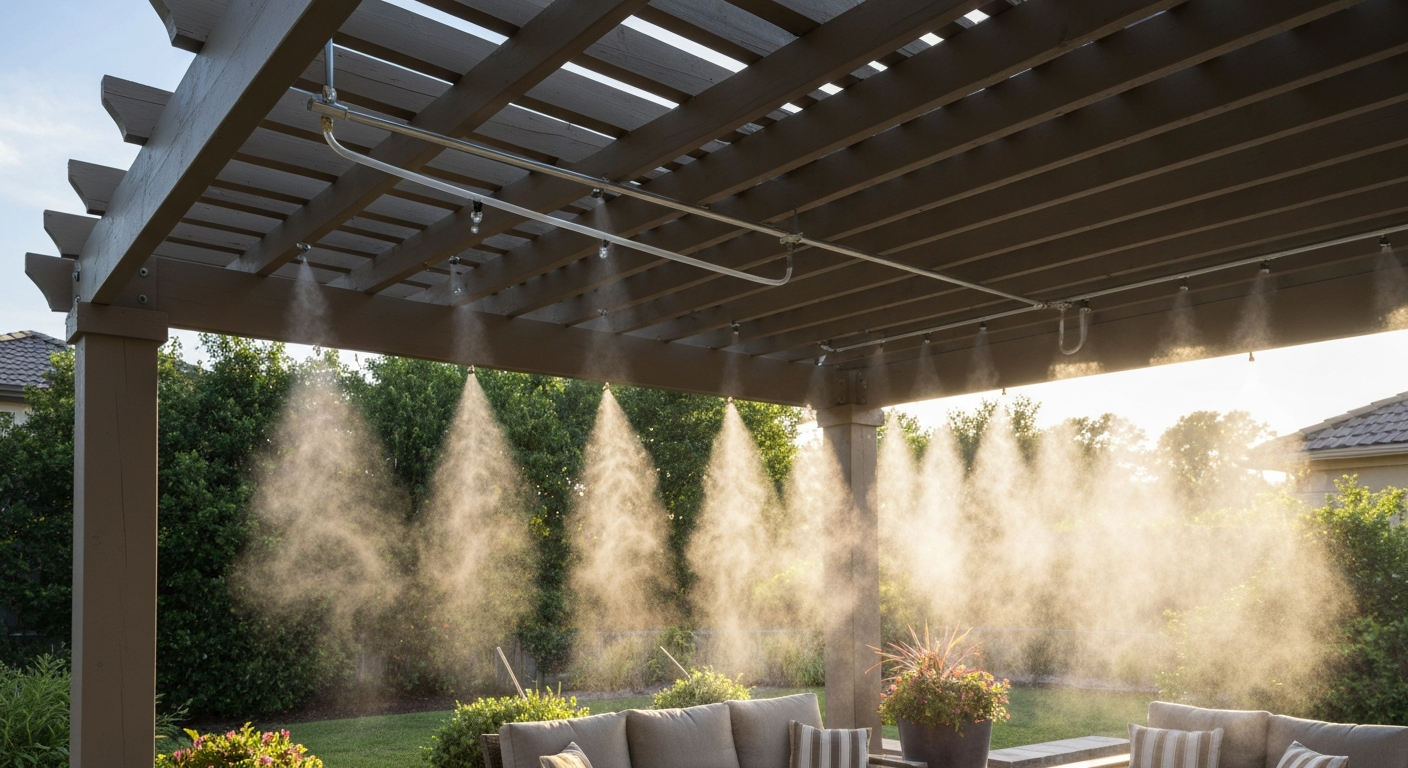
Ceiling and rail mount systems prioritize clean aesthetics over raw performance. The tubing runs along the ceiling joists or perimeter rail of a pergola or patio cover, keeping everything tidy and out of the way. They typically operate in the low to mid pressure range and are a practical choice for covered patios where appearance matters. You'll find these on Amazon and Wayfair in the $60 to $300 range, and many specialty misting vendors also sell them in custom lengths.
Climate and patio suitability: where misters shine and where they fall flat
I want to be honest with you here because a lot of product marketing glosses over this. Patio misters work best in climates with low relative humidity, typically below 60%, and ideally below 40%. If you want a deeper explanation of when and why they’re effective, see our guide on do patio misters work for a full breakdown of conditions and expectations. The American Southwest (Arizona, Nevada, New Mexico, inland California) and parts of Texas during dry spells are ideal. Covered patios amplify results significantly because the cooled air stays in place instead of blowing away. Open patios in any climate see reduced effectiveness, and windy sites are the worst case scenario: the mist drifts before it can evaporate properly and just wets everything downwind.
In humid climates like Florida, the Gulf Coast, or the Southeast, misters are not useless but you should reset expectations. A ceiling-mounted mist system on a well-covered screened porch might take the edge off on a humid evening, but it won't produce the dramatic cooling you'd see in Scottsdale. Pairing misters with a ceiling fan improves performance in marginal humidity by accelerating evaporation off your skin. For high-humidity climates, the decision of whether misters are worth it at all is worth thinking through carefully before you spend money.
- Best conditions: dry heat, relative humidity under 40%, covered patio, light wind
- Good conditions: dry heat, humidity 40–60%, covered or semi-covered patio
- Marginal: humidity 60–75%, open patio, moderate wind
- Poor: humidity above 75% (Gulf Coast, Florida, Pacific Northwest summers), open windy patios
The components you actually need
Understanding what's in a misting system helps you shop smarter, compare kits honestly, and avoid discovering a missing part on installation day. Here's what each component does and what to look for.
Pumps
Low-pressure kits use your home's water supply pressure and don't need a separate pump. Mid-pressure systems use a small booster pump, like Orbit's 160 PSI model at $128.99, that sits inline between the hose bib and the tubing run. High-pressure systems require a dedicated high-pressure pump rated for the specific PSI and flow rate your nozzle count demands. For commercial or restaurant patios running long hours, you need a continuous-duty rated pump, not a consumer-grade intermittent one. Pump sizing should match your total nozzle flow plus 15 to 30% headroom.
Nozzles
Nozzles are where most of the magic (or disappointment) happens. Low-pressure kits use brass 10/24 threaded nozzles that pass 0.5 to 1.5 gallons per hour each at household pressure. OutdoorMisterNozzles' nozzle pages list color‑coded brass 10/24 nozzle sizes with typical low‑pressure replacement flows around 0.5–1.5 gallons per hour and the minimum line pressures for each size. High-pressure systems use much smaller orifice nozzles, often stainless steel or ceramic, that pass 0.02 to 0.05 GPM at 800 to 1,000 PSI and produce droplets in the 10 to 30 micron range. For coastal installations or hard-water areas, ceramic or 316-grade stainless steel nozzles are worth the premium. Standard 304 stainless can pit and corrode in salt-air environments; 316/316L resists chloride corrosion significantly better. Spacing nozzles 3 to 4 feet apart gives full coverage without excessive overlap.
Tubing
Entry-level kits use flexible PVC or polyethylene tubing that's easy to cut and route. UV stabilization matters for outdoor use because unprotected tubing can become brittle in one to two seasons of direct sun. Higher-end systems use stainless steel or nylon-braided lines that hold pressure better and last longer. For any installation exposed to harsh sun, look for UV-stabilized tubing or plan to route it along shaded structural elements.
Filters
A sediment filter is non-negotiable for high-pressure systems and strongly recommended for mid-pressure setups. Fine nozzle orifices clog very easily, and one piece of mineral sediment can block a $15 nozzle. Most complete high-pressure kits include an inline filter; if yours doesn't, buy one. For areas with hard water, a scale-inhibiting filter adds life to nozzles and tubing.
Backflow preventers and valves
This is the part most DIYers skip and most municipalities require. Utilities and inspectors typically require listed, testable backflow assemblies and reference authoritative cross‑connection standards such as CCS Exam Reference Materials, WETRC (lists USC Foundation manual and AWWA M14) CCS Exam Reference Materials — WETRC (lists USC Foundation manual and AWWA M14). Because misting systems atomize water that can be inhaled and create a potential cross-connection back into the potable water supply, many jurisdictions require an approved backflow prevention device. Maricopa County (and many similar codes) explicitly lists misting systems as requiring backflow protection. The specific device required depends on your local rules and hazard classification: an atmospheric vacuum breaker (AVB) works for simple non-continuous non-backpressure applications, a double-check valve assembly (DCVA) covers most residential and light commercial misting setups, and a reduced-pressure zone (RPZ) assembly is required for higher-hazard classifications. Testable assemblies (DCVA and RPZ) typically require annual inspection by a certified tester. Check with your water utility before installing any permanent system.
Timers and automation
A simple hose timer is cheap ($15 to $30) and prevents you from accidentally leaving a system running overnight. Higher-end systems support smart controllers that tie into weather data and can shut the system off when humidity gets too high to bother misting. For commercial installations, automated controllers with zone control and scheduling are standard.
Mounts and hardware
For covered patios, ceiling-mount brackets that clip or screw to joists are cleaner than running tubing along railings. Rail-mount systems use saddle clamps that fit standard railing profiles. For any coastal or wet environment, use stainless steel or galvanized hardware rather than standard zinc-coated screws that will rust quickly.
Product-category recommendations by use case
Casual backyard use
An Orbit basic preassembled kit in 12 to 24 foot lengths is genuinely fine for this. At $28 to $65, it hooks straight to your hose bib, installs in 20 minutes, and is easy to store in winter. Don't overthink it for occasional use on a dry summer evening. If your backyard is in a wetter climate, add a fan before you add a misting system.
Covered residential patio
This is the best scenario for misters. A ceiling-mounted mid-pressure kit with a booster pump (Orbit 160 PSI booster plus a 30 to 50 foot mist line) will run you $200 to $400 in parts and delivers real cooling in dry climates. If you want a cleaner install with hidden tubing and smart timer controls, consider stepping up to a low-end high-pressure kit from a specialty vendor or hiring a local irrigation contractor to design and install the system properly.
Commercial or restaurant patio
Go high-pressure, continuous-duty rated, with stainless steel nozzles and a professional install. The aerMist 050SA or comparable systems from Fogco or MistCooling starting at $999 are the right starting point, and a professional installer will add the correct filtration, backflow device, and automation. Budget $1,500 to $4,000 installed depending on zone count and run length. A continuous-duty pump is not optional here: consumer-grade pumps not rated for continuous operation will fail quickly under restaurant hours.
Coastal and salt-air environments
Material selection is everything in coastal settings. You want 316 or 316L stainless steel nozzles and fittings, not 304 stainless and definitely not brass unless it's marine-grade. The difference between 304 and 316 stainless is chloride pitting resistance: 316's molybdenum content makes it significantly more resistant to the salt air that will eat 304 over one to two seasons. Most specialty high-pressure vendors offer 316 stainless or ceramic orifice options specifically marketed for coastal use. Tubing should be UV-stabilized and nylon-braided where possible. Budget for replacement nozzles annually even with good materials, as hard coastal water will deposit scale over time.
Where to buy patio misters: a channel-by-channel breakdown
Big-box stores: Home Depot, Lowe's, and Walmart
For low-pressure hose kits and basic components, big-box stores are hard to beat. Home Depot carries Orbit kits starting at $27.98 for the 12-foot basic model, and both Home Depot and Lowe's stock replacement nozzles, mist tubing by the foot, hose timers, and basic filters. Walmart carries similar hose-kit style misters in the $18 to $80 range. The big advantage here is same-day pickup, easy returns, and the ability to physically inspect the product. See our guide to the best misters for patio for curated comparisons and top picks across price and performance. The limitation is selection: you won't find mid-pressure booster systems on shelves, and high-pressure commercial equipment simply isn't in the store. If you're starting with a basic hose kit or need a replacement nozzle fast, walk in and grab it. If you need anything beyond that, you're ordering online or calling a specialty supplier.
Online marketplaces: Amazon, eBay, and Wayfair
Amazon is the most convenient source for the full range of low to mid-pressure kits, replacement parts, booster pumps, and accessories. You can find Orbit's booster pump, extension kits, and ceiling-mount hardware all in one order with next-day delivery in most metro areas. The risk on Amazon and eBay is inconsistent third-party sellers: always verify the brand, model number, PSI rating, and included components before buying, especially for anything electrical like a pump. Read reviews carefully for mention of quality control issues, and confirm the return policy before purchasing a pump or motor. Wayfair leans toward aesthetics and carries more ceiling-mount and rail-mount hybrid systems in the $60 to $300 range that prioritize clean looks over raw performance.
| Retailer | Best For | Price Range | Pros | Cons |
|---|---|---|---|---|
| Home Depot | Basic hose kits, Orbit brand, in-store pickup | $18–$80 | Same-day availability, easy returns, trusted brands | Limited to low-pressure consumer kits |
| Lowe's | Hose kits, mist tubing by the foot, accessories | $18–$80 | Consistent Orbit/generic selection, easy returns | Same limited selection as Home Depot |
| Walmart | Lowest-cost entry-level kits | $18–$65 | Cheapest prices on basic kits | Minimal selection, variable stock |
| Amazon | Full range of DIY systems, pumps, parts, accessories | $20–$500+ | Huge selection, fast shipping, easy comparison | Third-party quality varies, verify seller and specs carefully |
| eBay | Used or discounted specialty components | Varies | Can find deals on pumps and fittings | No warranty consistency, variable quality, buyer-beware |
| Wayfair | Aesthetic ceiling/rail mount kits | $60–$300 | Better-looking systems, design-forward options | Performance focus less than specialty vendors |
| aerMist / Fogco / MistCooling | High-pressure complete systems, commercial grade | $999–$2,500+ | Proper high-pressure kits, coastal material options, expert support | Higher cost, longer shipping lead times |
| Local irrigation/landscape supplier | Professional components, custom lengths, contractor pricing | Varies | Expert advice, right parts first time, local code knowledge | Requires knowing where to look; less convenient |
Specialty misting vendors
For anything above mid-pressure, specialty vendors are the right call. Companies like aerMist, Fogco, and MistCooling sell complete high-pressure systems with properly sized pumps, filtration, nozzle options for different water quality and environments, and usually offer phone support to help you configure the right system. For a curated list of the best misting systems for patio, see our detailed buying guide. The aerMist 050SA at $999 is a good benchmark: a 50-foot, 10-nozzle kit you can expand, with stainless or ceramic nozzle options. These vendors also sell individual components for custom runs, which matters if your patio is an unusual shape or you want to design a multi-zone system. Shipping takes longer than Amazon, but you're getting a product that was designed as a system rather than assembled from generic parts.
Local irrigation suppliers and landscape contractors
If you're going the professional installation route, start with local irrigation supply houses (often listed under irrigation supplies or landscape supply in your area) rather than calling a big-box store. They carry commercial-grade components, have people who understand local water quality and code requirements, and can sell you exactly the fittings and tubing lengths you need without paying retail markup for pre-packaged kits. Local landscape or irrigation contractors who do misting system installs can often supply and install in one engagement. National averages from Angi's marketplace put installed outdoor misting systems at around $2,747, with most homeowners paying between $1,957 and $3,584. That range is wide because it depends on system type, nozzle count, whether you need filtration and backflow devices, and local labor rates. Getting two or three quotes from local contractors is always worth the time for permanent installs.
DIY install vs. hiring a pro
Low-pressure hose kits are genuinely plug-and-play. If you can attach a garden hose and use zip ties, you can install one in 30 minutes. Mid-pressure booster kits are slightly more involved because you're mounting a pump and managing a longer tubing run, but still very approachable for a DIYer with basic tools. High-pressure systems are where the calculus shifts. The pump requires proper electrical connection (often a dedicated outlet), the system needs a correctly sized filter and backflow device, and proper nozzle placement and tubing routing takes some planning to do well. A bad high-pressure install that runs under-pressure, clogs frequently, or doesn't meet local backflow code is an expensive frustration. If your budget is $1,000 or more on the system itself, spending another $500 to $800 on professional installation is often the smarter move.
Maintenance, winterization, and warranties
Misting systems need periodic maintenance to stay effective. Nozzles clog with mineral scale over time, especially in hard-water areas. A quick soak in a white vinegar solution every season clears most deposits; ceramic and stainless orifices hold up better than brass over the long term. In freeze-prone climates, winterization means draining the lines completely: purge residual water with compressed air if possible and remove or cap exposed nozzles. Leaving water in tubing through a freeze will split fittings and crack nozzle bodies. For high-pressure pump systems, follow the manufacturer's winterization procedure for the pump housing specifically. On warranties: hose-kit components from Orbit typically carry one to two year limited warranties. High-pressure specialty systems vary by vendor; aerMist and similar vendors offer pump warranties of one to two years on the motor. Always confirm the return or exchange policy before buying a complete kit, especially from a third-party Amazon seller.
FAQ
Where can I buy patio misters?
Buy patio misters at multiple channels depending on budget and system type: online marketplaces (Amazon, eBay), big‑box retailers (Home Depot, Lowe’s, Walmart) for low‑pressure hose kits; specialty misting manufacturers and resellers (Orbit, aerMist, Fogco, MistCooling) for mid/high‑pressure and configurable kits; local irrigation/landscape suppliers for commercial‑grade parts and filtration/backflow hardware; HVAC/landscape contractors or licensed misting installers for turnkey installed systems. Compare prices, warranty terms, and available stainless/ceramic options for coastal or hard‑water areas.
What should be on my buying checklist before purchasing?
Quick checklist: measure patio coverage and nozzle spacing; choose pressure class (low, mid, high); verify water source and backflow prevention requirements; plan filtration and pump sizing (GPM at operating PSI); choose corrosion‑resistant materials for coastal use; budget parts vs. installed labor; confirm warranty/returns and availability of replacement nozzles; decide DIY or pro install; check local codes/permit needs.
How do low‑pressure, mid‑pressure (booster) and high‑pressure systems differ?
Low‑pressure: runs on household hose pressure (40–80 PSI), brass nozzles, inexpensive kits ($18–$80), easy DIY but larger droplets and less evaporative cooling efficiency. Mid‑pressure (booster): adds a booster pump (~160 PSI typical) for finer fog, better coverage and longer runs; kits and pumps cost more. High‑pressure commercial: purpose pumps (typically 750–1000+ PSI) producing 10–30 µm droplets for strong evaporative cooling and minimal wetting; components and installs are pricier ($800–$2,500 for systems; installed $1,500–$4,000+).
Which system type is best for my climate?
Misters cool by evaporation—most effective in dry, arid climates (desert, low humidity). In high humidity environments, perceived cooling is limited and mist can leave surfaces damp. Low‑pressure kits are fine for occasional shading/cooling in humid areas but expect less evaporative drop; high‑pressure systems give the finest spray and least wetting, improving performance in marginally humid climates but cannot overcome very high humidity.
What are typical cost ranges for parts and installation?
Parts: low‑pressure hose kits $18–$120; mid/high‑pressure component kits $800–$2,500 depending on pump and filtration; premium high‑pressure complete kits start around $999. Installation: simple DIY hookups $30–$200 (parts), professional installs typically range $1,500–$4,000 (many homeowners pay $1,957–$3,584 on average depending on system complexity).
What components are required for a permanent misting system?
Required components: appropriate pump (if mid/high pressure), nozzle lines/tubing and fittings, nozzles/orifices, filtration (sediment + fine filters for high pressure), backflow prevention device (AVB/DCVA/RPZ as required by local code), valves and zone controls, pressure gauges/regulators, timers or automation, mounting hardware, and service access for maintenance.