
Patio misters range from about $10 for a basic hose-end kit to $3,000 or more for a professionally installed high-pressure system. Most homeowners land somewhere in the middle: a decent DIY low-pressure kit runs $30 to $150, a mid-pressure fan-integrated setup costs $300 to $900 in hardware alone, and a full high-pressure professional install with pump, lines, and labor typically runs $1,500 to $4,000+ depending on patio size and local labor rates. Here is exactly what drives those numbers and how to figure out which tier makes sense for your setup.
How Much Are Patio Misters: Cost Guide for Homeowners

Elise Prescott
26 Jul 2026
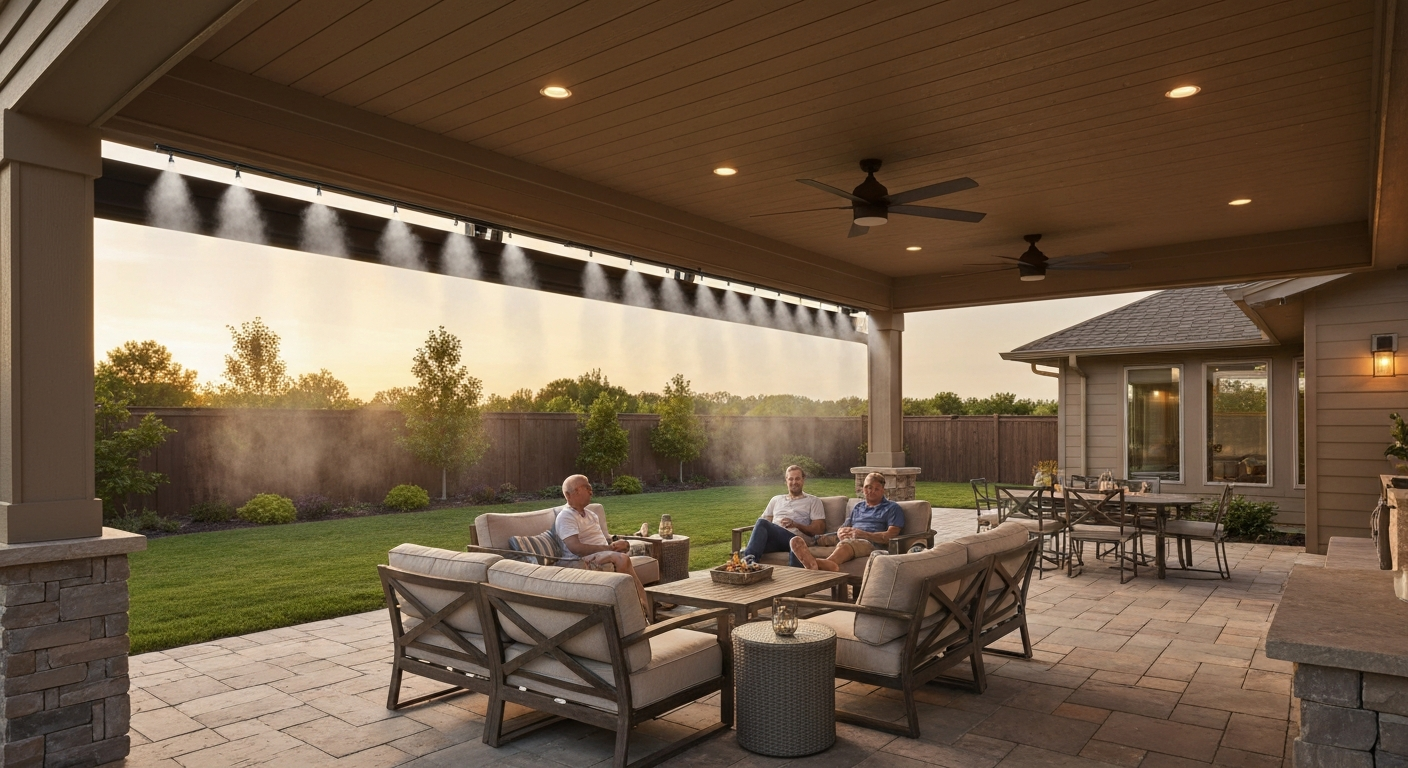
Who this guide is for and what it covers
Whether you are sweating through a Texas summer on a 200 sq ft covered patio or trying to cool off a sprawling Arizona backyard entertainment space, this guide walks through every cost category you will encounter. It covers DIY buyers shopping at Home Depot or Amazon and homeowners ready to call a contractor. You will find unit prices, component costs, installation labor estimates, operating costs, sizing guidance, and a checklist to move from research to purchase without second-guessing yourself.
Quick cost summary: from $10 kits to professional systems
Here is the honest top-line picture before we dig into details. Portable hose-end and clip-on misting kits start under $50 and require zero installation. Low-pressure DIY line kits that attach along a pergola or patio cover run $30 to $150 for hardware. Mid-pressure integrated fan kits from specialty suppliers like Cool-Off start around $295 and climb to $895 for ceiling-mount units. High-pressure pump-driven systems start at roughly $440 just for the pump kit and commonly cost $1,500 to $4,000+ all-in with professional installation. Operating costs add roughly $10 to $50 per season in water and electricity depending on run hours and system pressure.
At-a-glance price breakdown
| System Type | Unit / Hardware Cost | Installation Cost | Typical Operating Cost (per season) |
|---|---|---|---|
| Portable/hose-end kit | $10 – $60 | None (self-setup) | Water only, ~$5–$15 |
| Low-pressure DIY line kit (12–36 ft) | $30 – $150 | DIY: free; Pro: $75–$200 | Water only, ~$10–$20 |
| Mid-pressure fan or ceiling kit | $295 – $900 | DIY: free–$150; Pro: $200–$500 | $15–$40 (water + electricity) |
| High-pressure pump system (residential) | $440 – $1,500 (hardware) | $800 – $2,500 (labor) | $20–$60 (water + electricity) |
| High-pressure professional full install | $1,500 – $3,000+ (hardware) | $500 – $1,500+ (labor) | $30–$80 (water + electricity) |
| Fan-integrated ceiling misting system | $895 – $1,699 (hardware) | $300 – $800 (pro install) | $25–$60 (water + electricity) |
Detailed unit costs by system type
Portable and hose-end misting units
These are the simplest entry point and the ones you grab at Walmart or Home Depot on the way home. Prices cluster tightly between $10 and $60. Walmart listings show rechargeable portable pump units with roughly 26 ft of tubing at $34. Walmart currently lists an Outdoor Portable Misting System with Pump (Walmart product listing), a rechargeable unit with roughly 26 ft of tubing, for $34.99. 99, and small hose-end clip kits as low as $10 to $15. The RYOBI 12 ft Expandable Misting Kit (Model PMC3812K) sells at Home Depot for $49.97 and represents the upper end of this tier with better build quality. MistyMate 30-foot patio kits have appeared in promotional channels for as little as $20, though standard retail pricing runs $40 to $60. These units run entirely off your garden hose pressure (typically 40 to 60 PSI), so no pump is needed. The tradeoff is droplet size: larger droplets at low pressure evaporate more slowly and can leave surfaces slightly damp.
Low-pressure DIY line kits
Step up to a dedicated 12- to 50-ft line kit with multiple nozzles and you are still in DIY territory but with better coverage. Lowe's, Home Depot, and Amazon list brands like Orbit, Project Source, and similar options in the $30 to $80 range for 12- to 36-ft preassembled kits with 4 to 12 nozzles included. These screw onto your hose bib and mount along a pergola beam or patio cover edge with zip ties or included brackets. Installation is genuinely 20 minutes. The limitation is still pressure: most hose-bib systems deliver around 40 to 80 PSI, producing visible droplets rather than true fog. For dry climates like Arizona or Nevada, that is often enough. For humid climates like Florida or Georgia, high pressure matters a lot more because evaporation is slower.
High-pressure pump systems
This is where real fog happens. High-pressure systems run at 1,000 to 1,500 PSI, atomizing water into droplets smaller than 10 microns that evaporate almost instantly without wetting furniture or people. The pump is the biggest cost driver. Canpump lists residential triplex pump kits in the $440 to $875 range: a 1 hp kit starts around $440, a 2 hp / 1.0 gpm kit runs $704, a 2 hp / 1.5 gpm kit is $784, and a 2 hp / 3.0 gpm triplex kit capable of around 1,000 PSI is priced at $875. Motor electrical specs matter here: Canpump's 2 hp models draw 120V at 16A, which typically requires a dedicated GFCI circuit. Factor in $150 to $400 for an electrician if you do not have a suitable outlet near the pump location. Add tubing, nozzles, fittings, and a filter and you are realistically at $600 to $1,200 in hardware before any labor.
Fan-integrated and ceiling misting systems
These combine a fan's air movement with fine mist for a noticeably more effective cooling experience, because the fan accelerates evaporation and distributes cooled air across the patio. Cool-Off's product line gives a good real-world price ladder: their small low-pressure portable misting fans start around $295, the Tropic Breeze portable unit is $429, a Ceiling Mount Misting Fan runs $895, and the Pro-Mist Ceiling Misting Fan Kit reaches $1,599. MistKing starter systems (more common in enclosure misting but adaptable for small patios) retail around $250 to $500 depending on reseller. Fan-integrated ceiling systems typically require professional installation for the ceiling mount, wiring, and line routing, adding $300 to $800 in labor.
Component costs: building or expanding a system
If you are buying components separately to build a custom line or upgrade an existing kit, here is what individual parts typically cost at retail.
| Component | Typical Retail Price | Notes |
|---|---|---|
| Brass or stainless nozzles (10–20 pack) | $6 – $40 | Stainless costs more but resists clogging better |
| Misting tubing (per 50–100 ft roll) | $15 – $50 | 1/4 in. poly or stainless braided |
| Inline sediment/anti-scale filter | $8 – $40 | Required to protect nozzles from mineral buildup |
| Hose-end compression fittings (pack) | $8 – $25 | Tee, end-cap, and elbow sets |
| Timer/controller (basic) | $15 – $60 | Digital hose-end timers widely available |
| Mid/high-pressure pump kit | $440 – $875 | Canpump residential range |
| Backflow preventer / anti-siphon valve | $10 – $50 | Hose-bib vacuum breaker; required in many jurisdictions |
| RPZ backflow assembly (commercial grade) | $800 – $1,500+ | Required for hardwired municipal connection in some areas |
| Solenoid valve / zone controller | $30 – $120 | For automated multi-zone systems |
Professional labor, permits, and installation add-ons
Labor costs for misting system installation vary significantly by region and system complexity. For a straightforward low-pressure line along an existing patio cover, a handyman or irrigation contractor typically charges $75 to $200. A high-pressure system with pump mounting, dedicated line running, electrical hookup, and nozzle placement usually runs $500 to $1,500 in labor. If the job requires a licensed electrician to add a GFCI outlet or dedicated circuit, expect $150 to $400 extra. In areas where misting systems connecting directly to the municipal water supply require a permit and backflow inspection, permit fees typically run $50 to $200, and inspection fees can add another $50 to $150. Always ask your contractor whether the permit is included in their bid or billed separately.
Common installation add-ons that inflate budgets include: mounting hardware for concrete or stucco walls ($20 to $80 in materials), pump enclosure or weatherproof box ($60 to $200), and extended tubing runs beyond what a standard kit covers ($0.25 to $1.50 per linear foot for professional-grade stainless-braided line). A full professionally installed high-pressure system on a 300 to 500 sq ft covered patio typically lands between $2,000 and $4,000 all-in once you add pump, hardware, labor, electrical, and permitting.
Operating costs and seasonal care
Misting systems use surprisingly little water compared to irrigation. A single high-pressure nozzle flows roughly 0.1 to 0.3 gallons per hour. A 10-nozzle system running 4 hours a day uses 4 to 12 gallons, which at average US water rates costs pennies per day. Across a full cooling season of 90 days, even a busy high-pressure system with 20 nozzles running 6 hours daily adds roughly $5 to $25 to your water bill, depending on your local rate.
Electricity is a bigger variable for pump-driven systems. Canpump's 2 hp motor draws 16A at 120V, roughly 1,920 watts. Running 4 hours per day at $0.14 per kWh adds about $0.27 per hour or roughly $10 per month at that run time. A 1 hp pump is proportionally cheaper. Low-pressure hose-end systems use no electricity at all.
Winterizing is essential in freeze-prone climates. The steps are simple: shut off the water supply to the misting line, blow out residual water with compressed air, remove and store rubber washers and nozzles indoors, and drain the filter housing. Skip this and you risk cracked fittings, split tubing, or a seized pump. Annual servicing for a high-pressure system typically involves nozzle inspection, filter cartridge replacement ($8 to $40), and pump oil check if applicable. Budget $50 to $150 per year in consumables and about 1 to 2 hours of your time.
Do patio misters actually work?
Yes, with an important caveat tied to where you live. Misting systems work by flash-evaporating fine water droplets into the air. That phase change from liquid to vapor absorbs heat from the surrounding air, dropping the ambient temperature. High-pressure systems producing droplets under 10 microns can reduce perceived air temperature by 20 to 30 degrees Fahrenheit in dry climates. In humid climates, where the air is already saturated, evaporation slows down and cooling drops to maybe 5 to 10 degrees. That is still meaningful, but you will not get the dramatic fog-in-the-air effect that looks great in Arizona.
Coverage area depends on nozzle spacing and the number of nozzles. A standard rule of thumb is one nozzle every 18 to 24 inches along the perimeter of the patio. A 200 sq ft covered patio with a 60-ft perimeter would need roughly 30 to 40 nozzles for full-perimeter coverage. In practice, many homeowners cover just one or two sides and still get meaningful cooling in the seating zone. Fan-integrated systems have an edge here because the fan actively moves cooled air across the space rather than relying on passive convection.
If you are still weighing whether a misting system will actually make your patio usable, the full breakdown of real-world performance by climate and system type is worth a closer look in a dedicated guide on whether patio misters work. For a detailed, climate-specific performance breakdown, see our guide 'Do patio misters work'.
System types and when to choose each
The right system depends on your patio size, climate, budget, and how much effort you want to put into installation. Here is how the main options stack up:
| System Type | Best For | Not Ideal For | Price Range |
|---|---|---|---|
| Portable/hose-end kit | Renters, small patios, testing misting before committing | Large patios, high humidity, permanent setups | $10 – $60 |
| Low-pressure DIY line kit | Small-to-medium covered patios, dry climates, DIYers | Humid regions, large open patios | $30 – $150 |
| Mid-pressure fan kit | Medium patios, humid climates, balconies | Very large areas (over 500 sq ft) | $295 – $900 |
| High-pressure pump system | Large patios, hot/dry climates, no wet-surface tolerance | Budget installs, renters | $600 – $4,000+ |
| Fan-integrated ceiling system | Covered patios with existing ceiling, year-round use | Open pergolas without structure, budget builds | $895 – $1,699+ |
If you are comparing specific products across these categories, a focused guide on the best misting systems for patios can help narrow the field once you have locked in your system type and budget. For head-to-head product picks and buying tips, see our roundup of the best misters for patio setups. See our guide to the best misting systems for patio for product comparisons and top picks to match your budget and space.
Selection criteria and sizing guidance
Before buying anything, answer these five questions. First, how large is your patio in square feet and linear feet of perimeter? That drives nozzle count and line length. Second, what is your typical summer humidity? Relative humidity above 60 to 70% significantly limits cooling effectiveness from low-pressure systems. Third, is your patio covered or open? Misting works best under a cover because it traps cooled air; open patios lose the effect to wind. Fourth, do you have an existing hose bib nearby with adequate pressure (40 PSI minimum, 60 PSI preferred)? Low pressure is the most common reason cheap kits underperform. Fifth, do you plan to add patio fans? Fan integration dramatically improves coverage and you can size down your misting system if you pair it with a good fan.
For droplet versus fogging guidance: low-pressure systems (hose-bib fed, under 100 PSI) produce visible droplets of 80 to 200 microns. You will feel a light mist. Mid-pressure systems (150 to 250 PSI) produce droplets of 40 to 80 microns, mostly evaporating before hitting surfaces. True high-pressure systems (1,000 to 1,500 PSI) produce fog at under 10 microns with virtually no surface wetting. If you have cushioned outdoor furniture, electronics, or a fabric patio cover, high-pressure fog is the right call. Low-pressure mist hitting fabric cushions repeatedly will eventually cause mildew.
Compatibility with patio covers and awnings also matters. Retractable fabric awnings and misting lines are a poor combination: even fine mist can saturate fabric over time. Hard covers, pergola beams, or aluminum patio covers are ideal mounting surfaces. If you have a pergola with open slats, mount the line along the inner perimeter beams, not the top slats, to keep the mist directed downward into the occupied zone.
Sizing examples with line lengths, nozzle spacing, and pump specs
| Patio Size | Perimeter (approx.) | Recommended Nozzles | Line Length Needed | Recommended System |
|---|---|---|---|---|
| 100 sq ft (10x10) | ~40 ft | 10–15 nozzles | 20–30 ft of mist line | Low-pressure DIY kit, no pump needed |
| 200 sq ft (10x20) | ~60 ft | 15–25 nozzles | 40–50 ft of mist line | Low-pressure kit or mid-pressure fan kit |
| 300 sq ft (15x20) | ~70 ft | 20–30 nozzles | 50–60 ft of mist line | Mid-pressure kit or 1 hp pump system |
| 500 sq ft (20x25) | ~90 ft | 30–45 nozzles | 70–90 ft of mist line | 1–2 hp high-pressure pump system |
| 750+ sq ft (open/commercial) | ~110+ ft | 45–60+ nozzles | 100+ ft of mist line | 2 hp+ triplex pump, pro install recommended |
For pump sizing, Cool-Off's general guidance places patios under 250 sq ft in the low-to-mid pressure category. Canpump's 1 hp kits (starting around $440) comfortably handle up to 20 to 30 nozzles. Their 2 hp / 1.0 gpm kit at $704 handles up to 40 nozzles, and the 2 hp / 3.0 gpm kit at $875 suits larger residential or light commercial setups. Nozzle spacing of 18 to 24 inches along the line is standard; tighter spacing increases fog density but raises water and pump load.
Recommendations by budget and scenario
Budget DIY: under $150
For a 100 to 200 sq ft covered patio in a dry climate, a $50 RYOBI or similar low-pressure kit from Home Depot is a completely reasonable starting point. Add an inline sediment filter ($10 to $20) to protect the nozzles and a basic digital timer ($15 to $25) for automation and you have a functional system under $100. In humid climates, manage expectations: you will get some cooling, but do not expect 20-degree drops.
Midrange homeowner: $300 to $1,000
For a 200 to 400 sq ft covered patio where you want better performance without hiring a contractor, a mid-pressure fan kit from Cool-Off in the $295 to $895 range is a solid move. The Tropic Breeze portable fan at $429 needs no installation and delivers meaningful cooling for a medium-size seating area. If you want a ceiling-mounted look, the $895 Cool-Off ceiling unit is DIY-installable for someone comfortable with basic electrical work, or add $200 to $400 in labor to have it done. This tier covers most suburban homeowners with a standard covered back patio.
Premium and professional install: $1,500 to $4,000+
For 400+ sq ft patios, humid or extremely hot climates, or homeowners who want a permanent, furniture-safe fog system, a high-pressure pump system with professional installation is the right call. Budget $875 for a quality pump kit, $200 to $600 for tubing, nozzles, filter, and fittings, and $500 to $1,500 for professional labor and electrical work. All-in, expect $2,000 to $4,000 for a complete residential install. Professionally installed systems also tend to come with warranties on labor (ask for at least 1 year) and component warranties from the manufacturer.
Where to buy and who to call
For low-pressure and portable kits, Home Depot, Lowe's, and Walmart carry everything you need. Home Depot stocks the RYOBI kit and various Orbit and Project Source options. Walmart's online listings offer the widest range of price points including sub-$15 basics. Amazon fills in the gaps with import brands and larger nozzle packs.
For mid-pressure and fan-integrated kits, specialty misting suppliers like Cool-Off are worth buying from directly. Their product guides include sizing recommendations and their customer service can help you match a unit to your patio dimensions. MistKing is another specialist supplier, though more common for enclosure applications than open patios.
For high-pressure pump systems, Canpump and similar industrial pump suppliers sell direct-to-consumer online. Buying a pump kit directly and having a local irrigation contractor or HVAC technician install it can save $300 to $600 compared to a full turnkey installation quote. For a full turnkey professional install, get quotes from local irrigation contractors, outdoor living specialists, and HVAC companies. Landscaping companies occasionally offer misting installations too, though their pump expertise varies.
When calling vendors or contractors, ask: What pressure class does this system run at? What is the nozzle orifice size and material? Is a filter included or required separately? What is the warranty on pump and nozzles? For contractors, also ask whether they are licensed and insured, whether they pull permits, and what the backflow prevention plan is.
A broader comparison of where to source specific brands and products is covered in a dedicated guide on where to buy patio misters, which walks through online marketplaces versus local specialty dealers.
Maintenance, common problems, and lifespan
Routine maintenance tasks
- Flush the system and clean the inline filter at the start and end of each season
- Inspect nozzles monthly during peak use for clogs; soak clogged nozzles in white vinegar for 30 minutes
- Check all compression fittings for drips each spring; hand-tighten or replace worn O-rings
- Replace filter cartridges annually ($8 to $40 depending on type)
- Inspect tubing for UV degradation after 3 to 5 years; poly tubing typically lasts 5 to 8 years in full sun
- Check pump oil level each season for oil-lubricated triplex pumps (follow manufacturer schedule)
Common problems and fixes
Clogged nozzles are the number-one issue, almost always caused by mineral scale from hard water. An inline anti-scale filter ($15 to $40) prevents most of this. Dripping fittings usually mean a worn O-ring or an under-tightened compression fitting: $1 to $3 in O-rings fixes it. Pump failure in high-pressure systems is usually a sign of running the pump dry or running it with a clogged filter forcing the pump to overwork. Always install a pressure-relief valve and keep the filter clean. Low-pressure hose-end kits typically last 2 to 5 years before tubing or connectors crack. High-pressure professional systems with proper maintenance last 8 to 15 years. Pump life depends heavily on usage hours and water quality.
Winterizing checklist
- Shut off the water supply valve to the misting system
- Open the lowest nozzle or end cap to drain standing water
- Use compressed air at 30 to 50 PSI to blow out residual water from lines
- Remove all nozzles and store them indoors in a dry container
- Drain the filter housing and remove the filter cartridge
- For pump systems, disconnect and store the pump in a heated space if temperatures drop below freezing
- Inspect tubing for cracks and mark any sections needing replacement in spring
Water use, backflow prevention, and local regulations
Misting systems connected to municipal water lines raise backflow concerns. If contaminated water flows backward into the municipal supply (called back-siphonage), it is a health hazard. Most jurisdictions require at minimum a hose-bib vacuum breaker or anti-siphon valve at the connection point. These are inexpensive: hose-bib vacuum breakers retail for $10 to $50. For hardwired connections to supply lines, many jurisdictions require a testable Reduced Pressure Zone (RPZ) assembly, which costs $800 to $1,500+ for the hardware alone and requires annual testing by a certified backflow technician. Check with your local water utility before hardwiring any misting system.
Water restriction ordinances are common in drought-prone states including California, Texas, Arizona, Nevada, and Colorado. Many of these restrict decorative water use during drought conditions. Misting systems generally fall into a gray area: check whether your city classifies them as landscape irrigation or recreational water use, as the rules differ. During Stage 2 or Stage 3 drought restrictions, some municipalities ban misting systems entirely. Running a misting system on a timer during early morning hours (before 10 am) is the most defensible schedule under most water conservation ordinances.
Permits for misting system installation are typically required when the system involves a permanent hardwired connection to a supply line or when electrical work is needed. A simple hose-bib attachment requires no permit in most jurisdictions. A pump system with electrical hookup and supply line connection may require both a plumbing permit and an electrical permit. Your contractor should handle this: if they tell you no permits are required for a pump install with a new circuit, ask them to confirm that in writing.
Short action checklist before you buy
- Measure your patio perimeter in linear feet and note total square footage
- Check your hose-bib water pressure with an inexpensive pressure gauge (under $10 at hardware stores); you need at least 40 PSI, ideally 60+
- Assess your climate: look up your city's average July relative humidity — above 60% pushes you toward high-pressure systems
- Identify where you will mount the line: pergola beam, patio cover fascia, or ceiling joists
- Check whether your patio has a GFCI outlet within reach of the pump location
- Confirm your patio cover material: avoid mounting misting lines on retractable fabric awnings
- Look up your city or county water utility rules on backflow prevention requirements
- Get at least two contractor quotes if you are spending over $500 on the system
Questions to ask before hiring a contractor
- Are you licensed as an irrigation contractor or plumber in this state, and can I see your license number?
- Do you carry general liability insurance and workers' compensation coverage?
- Will you pull permits for the plumbing and electrical work, and is that cost included in your bid?
- What pressure class will this system run at and what pump brand and model are you specifying?
- What backflow prevention device are you installing and does it meet local code requirements?
- What nozzle material are you using (brass vs. stainless) and what orifice size?
- What is the warranty on your labor and on the equipment you are supplying?
- Have you done similar installs in this neighborhood and can you provide two or three references?
- How do I winterize this system and is a service agreement available for annual maintenance?
How low-pressure and high-pressure systems are laid out: a simple diagram guide
For a low-pressure hose-end line kit on a 10x20 covered patio, the layout is straightforward: the garden hose connects to a filter, then to the mist line. The line runs along the inner edge of the patio cover on three sides (two long sides and one end), with nozzles spaced every 18 to 24 inches pointing downward and slightly inward at a 45-degree angle. An end cap closes the fourth side. The timer sits at the hose connection. Total hardware: one 50-ft mist line, one inline filter, one digital timer, approximately 25 nozzles. This matches a $60 to $100 retail kit.
For a high-pressure system on a 20x25 covered patio, the layout adds a pump station. The supply line runs from the hose bib to the pump, which is mounted on the wall or in a weatherproof enclosure near a GFCI outlet. From the pump, high-pressure stainless-braided tubing runs to a main distribution manifold, then out to two or three misting lines covering the perimeter and, optionally, a central overhead grid line for fog density. A solenoid valve controlled by a digital timer automates the system. An inline filter sits between the hose bib and the pump inlet. Total hardware in a typical professional-installed setup: pump ($704 to $875), filter ($20 to $40), solenoid valve ($30 to $80), 80 to 100 ft of stainless tubing ($80 to $150), 35 to 50 stainless nozzles ($30 to $80), fittings and mounting ($50 to $100). Typical nozzle pack retail prices show consumer 5–20 piece brass or stainless nozzle packs typically retail for about $6–$40, depending on material and pack size consumer 5–20 piece brass/stainless nozzle packs typically retail for about $6–$40. Hardware total: roughly $900 to $1,300 before labor.
What to do next: DIYers and homeowners hiring pros
If you are a DIYer with a patio under 200 sq ft in a dry climate, start with a $30 to $80 low-pressure kit this weekend. Add an inline filter and a timer and you will have a functioning system in under an hour. If it works well and you want more coverage or better fog, that is the right time to consider upgrading to a pump system.
If you are a homeowner with a larger patio, high humidity, or a desire for a permanent solution, get two or three contractor quotes with the questions listed above. Ask each contractor to specify the exact pump model, pressure class, nozzle material, and backflow device in writing so you can compare bids apples-to-apples. The cheapest bid is not always the best value: a contractor who installs a code-compliant backflow preventer and pulls permits is worth a few hundred dollars more than one who skips both.
Patio misters are one of the most cost-effective ways to extend the usable hours on your outdoor space through a hot summer. A $50 DIY kit is a legitimate starting point and a $2,500 professional system is a legitimate long-term investment. The right answer depends entirely on your patio, your climate, and what you expect the system to do. Now you have the numbers to make that call.
FAQ
Search‑oriented title and meta description for the article
Title: How Much Are Patio Misters? Real Price Guide for DIY and Pro Installs Meta description: Patio mister costs, components, installation, and upkeep—clear price ranges and buying tips for DIY and professional systems (≤160 chars).
Quick cost summary
Portable/hoses & fan‑mist kits: $10–$200. DIY low‑pressure hang‑up kits: $20–$150. Mid‑pressure residential systems (consumer pumps + 10–30 nozzles): $250–$1,200. High‑pressure professional systems (triplex pumps, 500–1500+ PSI): $700–$3,500+ hardware. Professional installation: $300–$2,500+ depending on pump, plumbing, and permits. Operating costs: small — water (low), electricity for pumps (tens–hundreds $/year depending on pump size/use), periodic filter/nozzle replacement. All ranges are typical retail/market ranges.
How much do units and system types cost (unit cost breakdown)
Portable/consumer units: $10–$200 (hose‑end kits, small battery/rechargeable fans). Low‑pressure hang‑up kits (hose‑feed, brass nozzles): $20–$150 retail. Mid‑pressure residential kits (200–300 PSI, integrated pumps or small triplex): $250–$1,200. High‑pressure residential/commercial systems (1000–1500 PSI triplex pumps, multiple lines/nozzles): pump + manifold hardware $700–$3,500+, depending on pump GPM/PSI and scale. Fan/ceiling integrated misting fans: $295–$1,700+ (portable to ceiling kits). Prices are typical retail ranges.
What are common component costs (nozzles, pumps, tubing, fittings, controllers)
Nozzles: $0.50–$6 each for brass/stainless retail packs; multi‑packs $6–$40. Pumps: small diaphragm/mistking pumps $200–$600; triplex/plunger pumps for high pressure $440–$1,500+ (examples $700–$875 common). Tubing & line: bulk poly tubing $0.10–$0.50/ft; preassembled mist line kits vary $10–$100. Fittings/valves: $5–$50 each depending on material. Filters (inline sediment/anti‑scale): $15–$40. Controllers/timers: $15–$150 (basic timers to smart controllers). Backflow devices: simple hose vacuum breakers $10–$50; testable RPZ assemblies $800–$1,500+ for commercial grade.
What are typical professional labor, permit, and installation estimates
Labor: small DIY‑friendly installs may be zero if homeowner does it. Professional install (midrange residential): $300–$1,200 (hook up pump, mount lines, basic wiring). Larger high‑pressure installs (new dedicated plumbing, electrical circuit, RPZ/backflow, structural mounting): $800–$2,500+ labor. Permits: many areas don't require permits for low‑pressure hose‑fed systems; high‑pressure plumbing tied to potable water or permanent systems may require backflow prevention and permit/inspection—costs vary regionally ($0–$500+). Get local code confirmation.
What are ongoing operating costs (water, electricity, winterizing)
Water: depends on run time; misting uses fine droplets so volume is modest compared to irrigation—expect a few gallons/hour for small low‑pressure setups to tens of GPH for high‑flow fans. Electricity: small pumps draw little (tens of watts) → under $10–$50/year with light use; larger triplex pumps (1–2 HP) can draw 10–20+ amps when running → ~$50–$300+/year depending on run time and local rates. Maintenance/winterizing: annual filter/nozzle replacement and winter drain/winterizing may cost $10–$200/year. Estimates are typical and depend on use and system size.