
You can buy fake grass for a patio at Home Depot, Lowe's, Costco, Amazon, Wayfair, or through specialty turf manufacturers like SYNLawn and ForeverLawn. Durability - Artificial Turf, Product Value - FieldTurf notes that FieldTurf (global turf manufacturer) documents product construction and emphasizes 'face weight' / material weight per square foot as indicators of durability; manufacturer product pages and technical briefs explain that heavier face weight and robust backing often correlate with longer field/product life. If you want the widest selection and the ability to touch samples before buying, a local landscape supply house or installer showroom is worth the trip. If you want the lowest price on a small patio area, Amazon and Wayfair have pre-cut rugs starting around $45 to $90 for a 4x6 piece. And if you want a professional-grade product with a 10 to 15-year warranty and proper drainage for a dog run or permanent patio installation, going direct through a turf specialist or a distributor like SiteOne is the smarter move. The right channel depends on your patio size, budget, whether you have pets, and whether you're installing it yourself or hiring someone.
Where to Buy Fake Grass for Patio: Stores, Pet Options & Installation Guide

Why bother with fake grass on a patio (and who this guide is for)
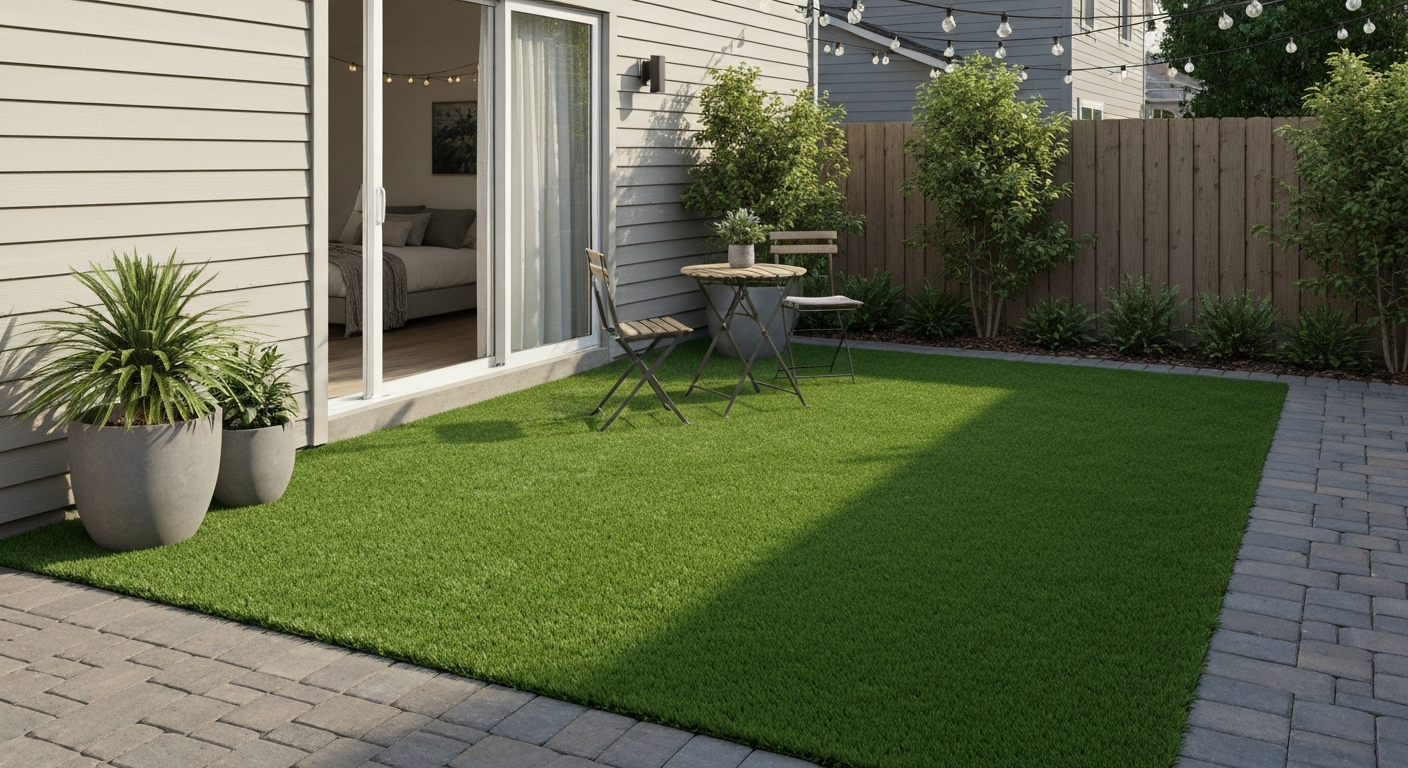
Artificial turf on a patio solves a handful of real problems at once. Concrete and pavers get blazing hot in summer and feel brutal underfoot. A bare deck with furniture feels unfinished. And if you have a dog, you already know the muddy-paw nightmare that comes with letting them out on bare dirt or patchy natural grass. Fake grass gives you a soft, green surface that stays put, doesn't need watering or mowing, and handles foot traffic without turning brown by August.
This guide is for homeowners who are ready to buy but don't want to make a $500 mistake on the wrong product from the wrong place. Whether you're a DIYer laying a 10x12 section of turf over your concrete patio this weekend, or you're hiring a contractor to do a full backyard install that includes a patio potty system for your dogs, this article covers every step: where to buy, what to look for, how to measure, what to pay, and how to avoid the most common ordering headaches.
Where to actually buy fake grass for your patio
There's no single best place to buy. Each channel has a different strength, and picking the right one saves you money, time, and frustration. Here's an honest breakdown of each option.
Home Depot and Lowe's
Both big-box stores carry artificial turf in rolls and cut-to-length formats, both in-store and online. Home Depot sells cut-to-length turf at prices around $6.25 per square foot for premium landscape options, which adds up quickly on anything larger than a small patio section. The advantage here is convenience: you can look at the product in person, load it in your truck, and start the same day. Lowe's goes a step further by offering professional artificial-grass installation services through their contractor network, which is a real perk if you don't want to DIY but also don't want to vet a random installer on your own. Lowe's also lists manufacturer warranties on select turf lines, with some products backed for up to 10 years. One important note on both retailers: read the warranty exclusions carefully. Lowe's product pages for some turf SKUs specifically call out damage from concentrated refracted light (like sunlight bouncing off low-E windows onto the turf) as a warranty exclusion, and that's a common issue in certain yard layouts.
Amazon and Wayfair
These are the go-to channels for small patios and budget shoppers. Wayfair lists artificial turf rugs and rolls in finished sizes like 4x6, 6x9, and runner formats, with common patio sizes priced between $70 and $220. Amazon's marketplace carries pre-cut grass rugs and pet-turf pads in the small-patio range, with top-selling 4x6 listings typically running $45 to $90. The tradeoff is quality consistency: you're buying off a product page without touching the turf first, and drainage specs, pile height, and backing quality can vary wildly between sellers. Stick to listings that clearly state drainage hole count, pile height, and face weight. Avoid anything that lists vague specs like 'premium quality' without numbers to back it up.
Costco
Costco carries branded turf products like the PreGra 50 oz Premium Artificial Turf through their website and warehouse sections. The value proposition at Costco is solid: you're getting a higher face-weight product at a competitive price point, and Costco's return policy provides some peace of mind. One useful detail on the PreGra listing: Costco product pages include instructions to request a free sample before committing to a full roll, with sample requests handled directly through the supplier (the listing notes a sample request email for PreGra). If you're considering a mid-size patio project and want a step up from Amazon-grade turf without going to a full specialty dealer, Costco is worth a look.
Specialty turf manufacturers
Companies like SYNLawn and ForeverLawn sell direct and through authorized dealers. For a quick comparison of recommended products and where to buy them, see our guide to the best fake grass for patio. These aren't impulse purchases, you're looking at professional-grade products with detailed spec sheets, verified drainage rates, UV-stabilized yarn compositions, and serious warranties. SYNLawn publishes technical specs on products like SYNCanine and SYNPro-PET, listing pile height, face weight in ounces per square yard, yarn type (UV-stabilized polyethylene), and drainage performance metrics that can exceed 1,000 inches per hour on some products. ForeverLawn's K9Grass line is purpose-built for dogs, using a knitted Flow-Through Backing for edge-to-edge drainage, antimicrobial additives (AlphaSan), and a 15-year product warranty on select lines. If you have dogs, a patio potty setup, or a large permanent install, these manufacturers are the right starting point.
Local landscape supply houses
SiteOne Landscape Supply is a national wholesale distributor with locations across the country, and they stock synthetic turf rolls, infill sands, turf adhesives, and accessories like shockpads and nailers. This is where most professional installers buy their materials, and many locations will sell to homeowners doing large DIY projects. Prices at wholesale distributors are often lower per square foot than big-box stores for larger quantities, and the staff can answer technical questions about backing types, infill options, and adhesive compatibility in a way that a big-box sales associate generally can't.
Installer showrooms
Local turf installation companies often operate showrooms where you can walk in, feel multiple products side by side, and talk through your specific project. If you're investing in a full patio install, this is the single best way to avoid regret. You can compare pile heights by touch, see how different turf looks under natural light, and ask about what's holding up best in your local climate. A showroom visit also gives you a chance to get a quote on installation, which helps you decide whether DIY or professional install makes more financial sense for your project.
What to actually look for in a patio turf product
Not all artificial turf is built the same, and the spec differences matter more than most product descriptions let on. Here are the criteria that should drive your decision, in plain terms.
Pile height
Pile height is how tall the grass blades are, typically measured in inches or millimeters. For patio use, shorter is usually better. A pile height of 1 to 1.5 inches (roughly 25 to 38mm) looks tidy, stays upright under furniture legs, and is easier to sweep clean. Longer piles above 2 inches look lush but flatten faster under patio furniture and trap more debris. For a dog potty area or kennel zone, shorter pile with no infill is the cleanest and easiest to hose down.
Fiber type and face weight
Polyethylene (PE) fibers are the standard for residential patio turf: they're soft underfoot, UV-stabilized, and hold up well over time. Nylon fibers are stiffer and more durable but less comfortable, making them better for high-traffic sport surfaces than patios. Polypropylene (PP) is the cheapest fiber and degrades fastest under UV exposure, so avoid it for any permanent outdoor install. Face weight (measured in ounces per square yard) is a durability indicator: higher face weight generally means more fiber, which means a denser, longer-lasting product. A 40 to 50 oz face weight is a solid range for residential patio use; products in the Costco/PreGra range hit 50 oz, which is above average for retail.
Backing and drainage
The backing is what keeps the turf together and allows water to drain through. For patio installs, you need a backing with drainage holes or a permeable construction, otherwise rain and pet urine pool on the surface, creating odor and mess. Standard backing with punched drainage holes works fine for most patios. For pet areas, a flow-through or knitted backing (like ForeverLawn's K9Grass) provides edge-to-edge drainage without relying on punched holes, which is significantly better for urine management. If you're installing over concrete, make sure both the turf backing and your base setup allow water to escape off the edges.
Infill
Infill is the material (usually silica sand or a coated sand) spread between the turf blades to add weight, keep the pile upright, and improve drainage. For most patios, a light silica sand infill is sufficient. For pet areas, antimicrobial or odor-absorbing infills are available and make a real difference. Some products marketed for pet potty areas are specifically designed for no-infill installation, which simplifies cleaning considerably. SiteOne stocks various infill sand products alongside their turf rolls for one-stop purchasing.
UV and stain resistance
Any turf on an exposed patio is going to get hammered by sunlight, especially in Sun Belt states. UV-stabilized yarns (look for this specific term in the spec sheet) resist fading and fiber breakdown over time. This matters most in Arizona, Texas, Florida, and other high-UV climates. In northern states with shorter, milder summers, UV stabilization matters less, but still look for it in any product you're paying more than $3 per square foot for. Stain resistance is mostly about the fiber coating: smoother coatings repel dirt and pet waste more effectively and make cleanup faster.
Odor control
If you have dogs, odor control is not optional. Look for antimicrobial treatments on the fiber (like AlphaSan, used in ForeverLawn K9Grass), odor-neutralizing infill options, and a drainage system fast enough to move urine through the backing before it sits and bakes in the sun. In hot climates, this is especially critical because heat accelerates odor development. A turf product marketed for general landscaping will not perform the same as one purpose-engineered for pet use.
Matching the turf to how you're actually using the patio
Your specific use case should drive your product choice more than price alone. A general patio entertaining space, a dog run, a patio potty area, and a zone under heavy outdoor furniture all have different requirements. Here's how to think through each one.
General patio entertaining
For a patio you're using for lounging, dining, and foot traffic, aesthetics and durability are the top priorities. A mid-pile PE fiber product (1 to 1.5 inch pile height, 40 to 50 oz face weight) hits the sweet spot. It looks good, stays upright, and cleans up easily with a hose and a stiff brush. You don't need the premium drainage or antimicrobial features of a pet-specific product, so you can save money here.
Dog owners and pet-friendly patios
If your dog spends significant time on the patio, you need turf built for that purpose. That means fast drainage, antimicrobial fiber treatment, and ideally a short pile or no-infill design that's easy to rinse clean. For a detailed comparison of pet-specific options, see our guide to the best patio grass for dogs. ForeverLawn's K9Grass and SYNLawn's SYNCanine are the names that come up most often among installers for good reason: they're engineered specifically for this application. The 15-year warranty on K9Grass is also a meaningful signal of product confidence. For a patio potty setup specifically (a contained turf section dogs use as their designated bathroom spot), short pile and flow-through backing are non-negotiable.
Under patio furniture
Heavy furniture legs will compress turf pile over time, and taller piles show compression marks more visibly. For zones where furniture sits permanently or near-permanently, go with a low-pile product (under 1 inch/25mm) or a denser face weight that recovers better. A flat-blade or S-blade fiber shape holds up better under compression than straight-blade designs.
High-traffic patio areas
Pathways, play zones, and heavily trafficked patio sections need higher face weight and a durable fiber. Nylon blended products or high-face-weight PE products (50 oz and above) handle traffic better than lighter options. If kids are playing on the surface regularly, consider a shockpad layer underneath for safety and comfort.
Best-for recommendations at a glance
| Use Case | Best Product Type | Key Features to Require | Where to Buy |
|---|---|---|---|
| General patio entertaining | Mid-pile PE landscape turf | 40-50 oz face weight, UV-stabilized, 1-1.5" pile | Home Depot, Lowe's, Costco, local installer showroom |
| Dog owners (patio use) | Pet-specific turf (K9Grass, SYNCanine) | Flow-through backing, antimicrobial fiber, short pile | ForeverLawn dealer, SYNLawn dealer, SiteOne |
| Patio potty area | No-infill pet turf with fast-drain backing | Edge-to-edge drainage, antimicrobial, easy-rinse fiber | ForeverLawn dealer, SYNLawn dealer |
| Under patio furniture | Low-pile, high-density turf | Under 1" pile, flat or S-blade fiber, high face weight | Home Depot, Lowe's, turf specialist |
| Budget patio (DIY, small area) | Pre-cut turf rug | Drainage holes, PE fiber stated, pile height listed | Amazon, Wayfair, Costco |
| Premium permanent install | Manufacturer-direct landscape or pet turf | 15-year warranty, UV-stabilized, verified drainage spec | SYNLawn, ForeverLawn, SiteOne (via installer) |
What you should expect to pay (and how to estimate your total project cost)
Artificial turf pricing has a lot of range, and the number on the product page is rarely the full cost of the project. Here's a realistic breakdown so you're not surprised at checkout or after the install.
Material cost per square foot
Budget-grade turf (polypropylene or thin PE rugs from Amazon/Wayfair) runs roughly $1 to $2.50 per square foot. Mid-range retail turf from Home Depot or Lowe's typically runs $3 to $6.25 per square foot depending on the product. Premium pet or landscape turf from specialty manufacturers can run $6 to $12 per square foot or more for the material alone. Costco's PreGra at 50 oz sits in the mid-to-upper end of the retail range and represents good value for the face weight.
Accessories and base materials
Turf is rarely the only thing you buy. Here's what else to budget for on a DIY install over concrete:
- Turf adhesive (for seaming or perimeter bonding): $30-$60 per tube/cartridge; professional fast-set adhesives like Pro-Trade Synthetic Turf Fast Set (available at SiteOne) run higher but cover more linear footage
- Infill sand (silica or antimicrobial): $20-$50 per 50 lb bag; a typical 200 sq ft patio section needs 1-2 bags
- Turf nails or staples (for securing edges to wood or soft sub-base): $15-$30 per box
- Shockpad or foam underlayment (optional but recommended for comfort and drainage over hard surfaces): $0.50-$1.50 per sq ft additional
- Edging or bender board (to finish perimeter and prevent turf edges from curling): $1-$2 per linear foot
Shipping costs
Pre-cut rugs under 10 lbs from Amazon or Wayfair usually ship free or at minimal cost. Large turf rolls (which can weigh 100-300 lbs for a 10x20 section) often ship via freight, and shipping costs of $50 to $150 or more are common for online orders. Home Depot and Lowe's offer in-store pickup for some roll products, which avoids freight charges. If you're buying from SiteOne or a local supplier, local delivery is often available at a flat rate or included above a purchase threshold.
Labor cost if hiring a pro
Professional installation for artificial turf on a patio typically runs $8 to $20 per square foot all-in (materials plus labor), depending on your region, the complexity of the job, and whether a base prep or drainage layer is needed. Lowe's installation services give you a baseline quote for comparison, but getting 2-3 local contractor quotes is always worth the time. In hot, high-demand markets like Texas or Southern California, installation prices trend toward the upper end.
Sample cost estimate template
| Cost Item | How to Calculate | Example (200 sq ft patio) |
|---|---|---|
| Turf material | Sq ft x price per sq ft | 200 x $5.00 = $1,000 |
| 10% overage for cuts/waste | Material cost x 1.10 | +$100 |
| Infill sand | 1 bag per 100 sq ft (approx) | 2 bags x $35 = $70 |
| Adhesive / nails | Perimeter linear footage | ~$50-$80 |
| Underlayment / shockpad | Sq ft x $0.75 (optional) | $150 (optional) |
| Edging / bender board | Perimeter in linear ft x $1.50 | 60 lf x $1.50 = $90 |
| Shipping (if ordering online) | Flat rate or freight quote | $75-$150 (large rolls) |
| Labor (if hiring out) | Sq ft x $10-$15 installed | 200 x $12 = $2,400 |
| Total DIY estimate (no labor) | Sum of material + accessories + shipping | ~$1,500-$1,650 |
| Total pro-installed estimate | Material + labor + accessories | ~$2,500-$3,200 |
How to measure your patio and order samples the right way
Measuring wrong is the most common (and expensive) mistake homeowners make when ordering turf. Turf rolls come in set widths (typically 12 or 15 feet wide), so your layout has to work around those dimensions or you'll end up with unnecessary seams or wasted material.
Step-by-step measuring guide
- Sketch your patio on paper and note all obstacles (furniture anchors, drains, posts, steps)
- Measure the longest length and longest width of the entire installation area in feet — these are your gross dimensions
- Add 6 inches on each side to your measurements for trimming allowance (so a 10x12 area becomes a 11x13 order)
- Note the location of any seams you'll need (standard roll widths are 12 or 15 feet; if your patio is wider than that, you'll need a seam)
- Sketch the roll direction: turf has a pile direction (like carpet), and all sections must run the same direction or the color will look different from different angles
- Calculate total square footage: length (with allowance) x width (with allowance)
- Add 10% to your total square footage for cuts, irregular edges, and waste
Ordering samples before you commit
For any turf purchase over $200, order samples first. Most specialty manufacturers and many retailers offer this. SYNLawn and ForeverLawn dealers provide samples on request. The Costco/PreGra listing specifically notes that free samples are available by emailing the supplier directly. Many big-box stores have turf swatches in the flooring or outdoor section. When you get samples, take them outside in your actual patio conditions: hold them in sunlight, lay them on your patio surface, and check how they feel underfoot. A sample that looks great on a warehouse floor can look washed-out or too bright in full Texas sun.
Sample order and measure reference card
| Step | What to Record | Notes |
|---|---|---|
| 1. Gross dimensions | Length ___ ft x Width ___ ft | Longest points of installation area |
| 2. Trimming allowance | Add 6" per side | Adjusted length ___ x width ___ |
| 3. Seam locations | Note any dimension over 12 or 15 ft | Mark on sketch |
| 4. Pile direction | Mark arrow on sketch | All sections must match |
| 5. Sq ft calculation | Length x Width = ___ sq ft | Use adjusted dimensions |
| 6. Add 10% waste | Sq ft x 1.10 = ___ sq ft to order | Round up to nearest roll length |
| 7. Sample request | Product name, retailer/supplier, contact | Request before finalizing order |
| 8. Surface type | Concrete / wood / compacted base | Affects backing/drainage choice |
Shipping, returns and warranty: what to check before you buy
This is the part most homeowners skim and then regret. Large turf orders have unique challenges around returns, and warranty language often contains exclusions that matter for specific patio setups.
Return policies by channel
Home Depot offers a 365-day return window for many purchases made with qualifying cards or Pro accounts, but custom-cut turf is typically non-returnable once cut, this is standard across retailers. Lowe's has similar limitations on cut-to-order materials. Amazon return policies vary by seller, and some third-party turf sellers on Amazon have restocking fees or won't accept returns on large rolls. Before ordering any large-roll or custom-cut turf online, call or message the seller and ask specifically whether uncut, unopened rolls can be returned if the product doesn't match the description. Get that answer in writing.
Warranty terms: what actually matters
Warranty length is the headline, but the exclusions are what matter in practice. Here's what to look for in any turf warranty before you buy:
- Coverage period: ranges from 5 years on budget products to 15 years on premium pet/landscape lines like ForeverLawn K9Grass; Lowe's lists 10-year warranties on select products
- UV and fade coverage: confirm that UV fading is covered; some warranties exclude 'normal weathering' which is vague enough to deny valid fading claims
- Installation requirements: many manufacturer warranties (including ForeverLawn's) require installation records and may specify that a certified installer must complete the work for warranty to remain valid
- Light reflection exclusion: Lowe's product pages and others specifically call out damage from concentrated reflected light (from low-E windows or glass surfaces) as excluded — check your patio layout for this
- Proration schedule: ForeverLawn and similar manufacturers use a prorated warranty, meaning the claim value decreases over time; understand what percentage is covered at year 5, 8, or 12
- Transferability: some warranties transfer to new homeowners if you sell the house; others do not — relevant if you're doing a permanent install before selling
Red flags when buying turf online or in-store
- No face weight or pile height listed in the product specs — this is a quality transparency red flag
- Polypropylene fiber listed as the material — avoid for any permanent outdoor installation
- No drainage holes specified on a backing product intended for outdoor use
- Warranty listed as '5 years' with fine print that excludes UV damage, staining, and installation errors (effectively no coverage at all)
- Seller refuses to provide samples before purchase on orders over $300
- No clear return policy stated on the product page for large rolls
- Suspiciously low price-per-square-foot (under $1.50) for a product claiming high face weight and UV stabilization — the numbers don't add up
- SiteOne's distributor-brand warranty documentation notes that improper installation or maintenance voids coverage — make sure your installer is aware of this before they start
DIY vs hiring a pro: an honest breakdown
DIY installation over a flat concrete patio is genuinely manageable for most handy homeowners. You're essentially measuring, cutting, positioning, and securing the turf with adhesive or nails around the perimeter. A 10x12 section can be done in a half-day with two people. Where it gets complicated is base prep (if you're not installing over concrete), seaming multiple pieces cleanly, and installing around irregular shapes or obstacles. If your patio install involves drainage grading, decomposed granite base work, or complex seaming, hiring a professional saves real headaches.
When hiring, get at least two quotes and ask each contractor to specify the product they're using (manufacturer, product name, face weight, and warranty). A contractor who can't or won't tell you what turf they're installing is a red flag. Ask whether the installation qualifies for the manufacturer warranty, and confirm they'll provide an installation record (which ForeverLawn and similar brands require for warranty claims). Lowe's installation services give you a starting point for comparison pricing, and local showrooms are another way to find contractors who work with vetted product lines.
Climate and regional considerations
Where you live changes what matters most in a turf product. In hot-sun states like Texas, Arizona, and Florida, UV stabilization and heat retention are the dominant concerns. Artificial turf surfaces can get very hot in direct sun, sometimes reaching surface temperatures of 150F or higher, so shade (from a patio cover or pergola) makes a real difference in usability and turf longevity. In the Pacific Northwest or upper Midwest, UV is less of a concern, but moisture management and mold resistance in the backing matter more. In coastal climates, salt air resistance in the fiber coating is worth asking about. In freeze-thaw climates like Colorado or Minnesota, make sure the turf backing and any adhesive used are rated for repeated freeze-thaw cycles, as some products can crack or delaminate in those conditions.
Keeping your patio turf in good shape
Fake grass doesn't maintain itself, but maintenance is minimal. Rinse the surface with a garden hose every week or two to remove dust, pollen, and loose debris. Brush the pile with a stiff-bristle broom or a power broom a few times per year to keep the blades upright and prevent matting. For pet areas, rinse with water after each use and do a deeper clean with a turf-specific enzyme deodorizer monthly. Avoid pressure washing on full power, which can damage the backing and dislodge infill. Keep sharp objects and hot items (like grill grease or cigarette ash) off the surface. Most turf products that fail early do so because of localized heat damage, weed growth coming up through a poorly prepped base, or edge lifting from inadequate adhesive or nailing, all of which are preventable.
If you're planning a more complete patio upgrade around your turf install, it's worth thinking about how a patio cover or shade structure affects both heat management and turf longevity, and how the overall design of the space (furniture layout, cooling systems, lighting) works together with your new turf surface. Fake grass is often one part of a broader patio transformation, and planning those pieces together from the start saves you from having to rework things later.
FAQ
Where can I buy fake grass for a patio — what vetted retail channels should I check?
Check multiple channels to compare price, samples and support: national big-box retailers (Home Depot, Lowe’s) for cut-to-length rolls and in-store pickup; warehouse clubs (Costco) for branded rolls and sample workflows; online marketplaces (Amazon, Wayfair) for finished-size rugs and small patio kits; turf specialists and manufacturers (SYNLawn, ForeverLawn/K9Grass, FieldTurf) for technical spec sheets, pet/turf systems and warranties; local landscape-supply distributors (SiteOne) for trade rolls, adhesives and accessories; and certified local installers who often sell materials and handle cutting/installation. Use big-box/marketplace options for budget or small rugs and turf specialists or SiteOne/distributors when you need technical specs, warranty-backed products, or professional-grade materials.
How do I choose the right artificial turf product for a patio? What product features matter?
Key selection criteria: pile height — short profile (10–20 mm) for patios and furniture areas, 20–40 mm if you want a softer, lawn-like look; fiber/yarn type — UV-stabilized polyethylene for softness and durability, nylon where resilience against heavy traffic is needed; face weight/oz per sq yd and stitch rate — higher values generally equal greater durability; backing and drainage — look for flow-through or perforated backing and stated drainage rates for patios and pet areas; infill — none or minimal infill for patio rugs/pet potty systems, silica sand or antimicrobial infills for stability and odor control when needed; UV and stain resistance — check UV-stabilized yarn and manufacturer stain/heat exclusions; antimicrobial/odor-control additives — useful for dog/potty areas; edge/backing quality and seams — heavy-duty backing and professional seam tape/adhesive improve longevity. Match these features to use: furniture, high foot traffic, pet potty, or purely decorative.
What are the best fake grass options for specific patio needs (best overall, best for dogs, best for patio potty)?
Best overall for patios: medium pile (20–30 mm), UV-stabilized polyethylene turf from a reputable brand (SYNLawn or FieldTurf lines) — balance of look and durability. Best for dogs: pet-specific products such as ForeverLawn K9Grass or SYNLawn SYNCanine — short pile, flow-through backing, antimicrobial additives and low/no-infill options for easy cleaning and odor control. Best for patio potty systems: dedicated pet pads/low-pile, permeable products with rapid drainage and optional gravel/drain tray systems; look for products specifically marketed as pet potty turf or modular potty kits (some manufacturers and retailers sell these). For budget or temporary solutions: pre-cut outdoor turf rugs from Wayfair/Amazon/Cosco in finished sizes.
How much does patio artificial turf cost — product, installation and accessories typical ranges?
Material-only: finished patio rugs $45–$220 (small 4×6 to 6×9 rugs); roll-grade turf ranges widely — budget turf $2–6/ft², mid-range $6–12/ft², premium turf $12+/ft² (based on pile, face weight, backing). Accessories: underlay/shockpad $0.50–2/ft²; seam tape/adhesive and nails $0.50–1.50/ft²; infill $0.20–1/ft² depending on type. DIY installation labor: none (owner time) — expect tools and rental costs $50–150. Pro installation: small patios $400–1,200; typical patio installs $1,000–5,000 depending on size, prep and materials; high-end or full drainage/pet systems can be $5,000+. Always get material+labor quotes and confirm what’s included (edging, base prep, disposal). Retail examples: Home Depot product pages show cut-to-length prices (example $6.25/ft² cited on some SKUs).
What should I expect for shipping, returns and warranties when ordering turf?
Shipping: rolls are heavy; expect freight charges or curbside delivery fees for large rolls. Sample/swatch shipping is usually free or low-cost from manufacturers (Costco/PreGra sample email workflows exist). Returns: big-box retailers (Home Depot) often have generous return windows (Home Depot documents 365-day refund for certain purchases) but check exceptions for cut-to-length or custom orders. Online marketplaces have variable return policies; finished rugs are generally easier to return than cut rolls. Warranties: manufacturer warranties vary by product — many turf specialists offer 10–15 year or limited-lifetime warranties (SYNLawn, ForeverLawn) with terms that depend on installation method and maintenance; read exclusions (common exclusions: concentrated refracted light/heat damage, improper installation, pet damage). Keep proof of purchase and installation records for claims.
How do I measure my patio and order the correct amount of turf? Any sample/order templates?
Measure length and width in feet; calculate area (length × width) and add 5–10% extra for cutting/seams and slope adjustments (more for irregular shapes). Template: 1) Measure longest length (L) and widest width (W). 2) Area = L × W. 3) Waste allowance = Area × 0.05–0.10. 4) Order area = Area + waste. For roll widths, note manufacturer roll width (most trade rolls 6–15 ft wide) and plan seam locations perpendicular to roll runs. For finished rugs, order the exact finished size. Always request physical swatches covering pile height and color, and verify backing/drainage details. If in doubt, request a site visit quote from a pro who will measure for you.