
Title: Best Patio Sealant UK 2026: Top Products for Every Surface and Budget
Best Patio Sealant UK: Top Sealers for Stone, Concrete

Elise Prescott
14 Jul 2026
Meta description: Find the best patio sealant in the UK for concrete, block paving, sandstone and more. Expert reviews, comparison table and DIY application guide.
For most UK patios, Smartseal Patio Sealer and Thompson's One-Coat Patio & Block Paving Seal are the two names you'll keep coming across, and for good reason. Both are genuinely available at major UK retailers, both have years of real-world use behind them, and both cover the most common surfaces: concrete, block paving, and pressed stone. If you want my single starting recommendation, Smartseal Patio Sealer is best overall for performance and longevity on block paving and concrete, while Thompson's One-Coat is the easier, lower-cost entry point for DIYers sealing a straightforward slab. But the right pick shifts quite a bit depending on your surface material, your local weather, and how long you want it to last, so it's worth reading through the full breakdown below.
Quick Summary: Top Patio Sealant Picks
Here are the standout picks for the most common buying scenarios UK homeowners face. For a detailed comparison of options, see our guide to the best patio sealers. These are based on product data, published coverage and VOC figures, independent testing claims, and verified retailer availability.
- Best overall: Smartseal Patio Sealer — solvent-based, TRL-tested for skid resistance, excellent durability on block paving and concrete, available direct from Smartseal UK and specialist suppliers
- Best budget: Thompson's One-Coat Patio & Block Paving Seal — widely available at Screwfix, B&Q and Toolstation, simple one-coat application, good for concrete and standard block paving
- Best for natural stone: Resiblock Superior Natural Matt — trade-grade penetrating sealer, explicit no-oil-stains guarantee, low sheen finish that suits sandstone and limestone without altering appearance
- Best anti-slip: Smartseal Patio Sealer with anti-slip additive, or Smart Seal Patio Perfect (non-slip water-based coating) — both tested or formulated specifically for slip resistance on pedestrian paving
- Best low-VOC: Any water-based acrylic patio sealer, including water-based options from Sealers Direct — solvent-based products like Thompson's One-Coat (670 g/L VOC) and Smartseal Patio Sealer (xylene-based) are significantly higher, so water-based is the category to look in if VOCs are a concern for you, your family or pets
Side-by-Side Product Comparison
| Product | Waterproofing | Stain Resistance | UV Protection | Slip Resistance | Coverage | Drying Time | Durability | VOCs | Typical Cost per m² | UK Retailer Availability |
|---|---|---|---|---|---|---|---|---|---|---|
| Smartseal Patio Sealer | Excellent | Excellent | Good | High (TRL/SRV tested) | 4–6 m²/L | Touch-dry ~1–2 hr; foot traffic ~4–6 hr | 3–5 years | High (xylene 70–90% w/w) | £1.50–£2.50 | Smartseal direct, Sealers Direct, Amazon |
| Thompson's One-Coat Patio & Block Paving Seal | Good | Good | Good | Moderate (additive available) | ~6 m²/L | Touch-dry 1–2 hr; full cure 24 hr | 2–3 years | High (670 g/L) | £1.00–£1.80 | Screwfix, B&Q, Toolstation, Wickes |
| Resiblock Superior Natural Matt | Excellent | Excellent (oil-stain guarantee) | Good | Good | 3–5 m²/L | Dry to touch ~2 hr; trafficking ~4 hr | Up to 10 years (trade use) | Moderate–High (solvent-based) | £2.50–£4.00 | Resiblock direct, Sealers Direct, specialist block paving suppliers |
| Smart Seal Patio Perfect (water-based non-slip) | Good | Moderate | Moderate | High (non-slip formulation) | First coat ~7.4–9.3 m²/US gal; second coat ~12 m²/US gal | Water-based; touch-dry ~1 hr | 2–3 years | Low (water-based) | £2.00–£3.00 | Smartseal US / limited UK specialist availability |
| Water-based Acrylic Sealer (e.g., Sealers Direct) | Moderate | Moderate | Good | Low–Moderate (additive optional) | 5–8 m²/L | Touch-dry 30–60 min; recoat 2–4 hr | 1–3 years | Low | £0.80–£1.50 | Sealers Direct, Amazon, specialist trade suppliers |
In-Depth Review: Smart Seal Patio Perfect
Smart Seal Patio Perfect is a water-based non-slip coating developed by Smart Seal in the US, though it is referenced and used in the UK context through Smartseal-affiliated channels. It is specifically formulated as a non-slip surface coating rather than a penetrating sealer, an important distinction. Where penetrating sealers soak into the substrate, Patio Perfect forms a film on top, which is where its slip-resistance properties come from.
Performance
Because it is water-based, Patio Perfect has notably lower VOCs than solvent-based alternatives, making it a better fit for enclosed or semi-enclosed areas, or anywhere pets and children will be using the surface shortly after application. The non-slip additive built into the formula is its headline feature, and the product data confirms the design intent: first coat coverage runs approximately 7.4 to 9.3 m² per US gallon, with the second coat going further at around 12 m² per US gallon, the first coat soaks in more deeply, the second builds the film. Its Safety Data Sheet (Product Code 156) does flag skin and eye irritation hazards and an aspiration risk, so gloves, eye protection and ventilation are still essential during application even though it is water-based.
Coverage, Drying and Durability
The two-coat system is important here, do not skip the second coat, as the first coat is partially absorbed. Drying between coats is relatively fast for a water-based product. Durability is in the 2 to 3 year range for pedestrian paving, which is reasonable for a non-slip coating but shorter than a premium solvent-based penetrating sealer.
Pros, Cons and Who It's Best For
- Pros: Water-based and lower VOC, built-in non-slip properties, good for areas with safety requirements, relatively fast drying
- Cons: Film-forming means it sits on top and can peel over time if surface prep is not thorough, shorter durability cycle than solvent-based penetrating sealers, US product with limited direct UK distribution
- Best for: Patios where slip resistance is the primary concern, areas used by elderly family members or children, anyone wanting a lower-VOC option without sacrificing anti-slip performance
In-Depth Review: Thompson's Patio Sealers
Thompson's (now part of Sherwin-Williams UK, sold under the Thompsons Weatherproofing brand) is probably the most widely recognised patio sealer name in UK DIY. You will find it in Screwfix, B&Q, Toolstation and Wickes, which means it wins on accessibility even before you look at performance. The Screwfix listing for the 5-litre One-Coat pack shows around 316 reviews averaging 4.6 stars, which is a genuinely solid real-world signal.
Range Overview
Thompson's UK patio sealer range includes One-Coat Patio & Block Paving Seal (the most commonly purchased), a Wet Look finish for a shinier result, a Satin option for something between wet look and natural, a Natural Finish for those who want protection without visible sheen, and a separate Patio & Block Anti-Slip Additive you can mix in. Thompson’s product listings (Decco / distributor catalogue showing Wet Look, Satin, Natural Finish and Anti‑Slip Additive) confirm the UK range includes Wet Look, Satin and Natural Finish patio/block options plus a dedicated Patio & Block Anti‑Slip Additive with pack sizes and example RRPs. This flexibility is a genuine strength: you can dial in the aesthetic finish and add the anti-slip component as needed rather than being locked into one formulation.
Performance
The One-Coat product data shows coverage of around 6 m² per litre on standard surfaces, touch-dry in 1 to 2 hours, and a VOC content of 670 g/L, which is high, so you need good ventilation and PPE during application. Hazard statements on the product include H226 (flammable liquid), H304 (aspiration hazard), H336 (may cause drowsiness/dizziness) and H411 (toxic to aquatic life), which reinforces the need for careful handling and disposal. On most concrete and block paving surfaces, Thompson's performs well for waterproofing and stain resistance. Where it gets complicated is with certain natural stones: reviews and forum discussions consistently report patching, whitening or altered appearance on Indian sandstone and some limestones. If you have natural stone, approach Thompson's with caution and always test a small hidden area first. For detailed user feedback on finishes and stone compatibility, see Thompson patio sealer reviews.
Pros, Cons and Who It's Best For
- Pros: Widely available across UK high-street retailers, competitive price point, flexible range with multiple finish options and an anti-slip additive, strong DIY community track record on concrete and block paving
- Cons: High VOC content (670 g/L), not ideal for natural stone (especially Indian sandstone and some limestones), hazardous waste disposal requirements, durability of 2–3 years is lower than premium sealers
- Best for: DIY homeowners sealing concrete or standard block paving who want a widely available, affordable, easy-to-apply sealer and are comfortable with solvent-based product handling
Other Top UK Patio Sealant Reviews
Smartseal Patio Sealer (UK)
Smartseal's own branded Patio Sealer is a solvent-based product with xylene listed at 70 to 90% by weight in its SDS (revised November 2021). That makes it one of the more chemically aggressive options in this roundup, but it is also one of the most durable. The manufacturer claims TRL (Transport Research Laboratory) testing for skid resistance, citing SRV/pendulum compliance, a meaningful credential for anyone concerned about a wet patio in a UK autumn. Coverage runs 4 to 6 m² per litre depending on surface porosity, which is standard for solvent-based penetrating sealers. The SDS makes clear that residues and contaminated materials must be disposed of as hazardous waste, not down the drain or in general rubbish. If you can handle the application safely and dispose responsibly, this is a genuinely high-performing option for block paving and concrete.
Resiblock Superior Natural Matt
Resiblock positions itself firmly in the trade and premium domestic market. The Superior Natural Matt product carries an explicit no-oil-stains guarantee, which is a confident claim for block paving on driveways and patios where cars or garden machinery can drip oil. Coverage is typically 3 to 5 m² per litre, which is lower than some competitors, reflecting the denser film it lays down. Durability is significantly longer than most DIY-shelf products, with trade applications potentially lasting up to 10 years before recoat is needed. This is the product a professional contractor is most likely to specify for a premium job. Cost per m² reflects that premium, sitting at roughly £2.50 to £4.00 depending on pack size and supplier. Available through Resiblock direct and specialist block paving suppliers.
Water-Based Acrylic Sealers (Sealers Direct and equivalents)
Water-based acrylic sealers from UK suppliers like Sealers Direct sit at the low-VOC, lower-cost end of the market. Coverage rates are typically generous at 5 to 8 m² per litre on smooth surfaces, drying is fast (touch-dry in 30 to 60 minutes), and the environmental footprint is considerably lower than solvent-based alternatives. The trade-off is durability: expect 1 to 3 years before recoating is needed, and stain resistance is moderate rather than excellent. For a budget renovation or a low-traffic area, these are perfectly capable products. They are also the most accessible option if you are concerned about children or pets re-entering the area quickly after application.
Expert Picks and Endorsements
Rob Parker, a UK-based patio and driveway specialist who has reviewed and recommended sealers across multiple platforms, is closely associated with a specific sealer recommendation that regularly appears in patio contractor and DIY circles. His recommendation tends to focus on penetrating block paving sealers that enhance colour without creating a heavily glossy or plastic-looking finish, the kind of result that looks natural but protects against oil, moss and weathering. For anyone researching his specific picks, it is worth looking at that recommendation in detail alongside this broader roundup, as his real-world testing on UK surfaces adds useful practical context to the manufacturer claims. For the specific product he recommends, see Rob Parker's best patio sealer for detailed real-world notes and application tips.
Beyond Rob Parker, trade and landscape contractors in the UK consistently favour Resiblock for premium block paving jobs, citing its oil-stain guarantee and longevity as justifications for the higher cost per m². For natural stone specialists, the consensus leans toward penetrating silane or siloxane-based sealers over film-forming acrylics, as film-forming products risk trapping moisture beneath the stone and causing spalling in a freeze-thaw cycle.
Sealant Types Explained
Penetrating vs Surface Sealers
Penetrating sealers (also called impregnating sealers) soak into the pores of the substrate and create a water-repellent zone below the surface. They do not alter the surface texture or sheen significantly, and they allow the material to breathe, critically important for natural stone, as trapped moisture is the main cause of frost damage and spalling. Surface or film-forming sealers sit on top of the material and create a visible coating. They typically offer better stain resistance and more control over finish (matt, satin, wet look), but they can peel if poorly applied, and they trap moisture if applied to damp or porous substrates without adequate prep.
Water-Based vs Solvent-Based
Solvent-based sealers (like Smartseal Patio Sealer and Thompson's One-Coat) penetrate deeply, cure to a durable film, and generally outperform water-based equivalents for longevity and stain resistance. The cost is high VOC content, strong fumes during application, flammability risk, and hazardous waste disposal obligations. Water-based products are lower in VOCs, dry faster, are easier to clean up, and are safer around people and pets, but they typically require more frequent recoating and offer slightly less aggressive protection against staining.
Acrylic Coatings
Acrylic sealers are a specific type of film-forming surface sealer, available in both water-based and solvent-based formulations. They are popular for enhancing colour on concrete and block paving (the 'wet look' is typically achieved with an acrylic). They are generally the most affordable category and have the shortest recoat cycle (1 to 3 years). Use acrylics where aesthetics and ease of application matter most, and where you are comfortable with the recoating schedule. Avoid them on natural stone where breathability is critical.
Which Sealant for Which Patio Material
| Patio Material | Recommended Sealer Type | Top Product Pick | Notes |
|---|---|---|---|
| Concrete (plain or printed) | Penetrating or film-forming acrylic | Thompson's One-Coat or Smartseal Patio Sealer | Concrete is forgiving — both penetrating and surface sealers work well; choose film-forming for wet look |
| Block paving (clay or concrete) | Penetrating solvent-based or high-performance trade sealer | Smartseal Patio Sealer or Resiblock Superior | Oil resistance and joint stabilisation are key concerns; Resiblock's oil-stain guarantee is worth the premium for driveways |
| Sandstone (Indian sandstone, buff sandstone) | Penetrating silane/siloxane — breathable | Penetrating natural stone sealer from Sealers Direct or Resiblock equivalent | Avoid film-forming sealers; Thompson's has caused patching on Indian sandstone — always test first |
| Limestone | Penetrating breathable sealer | Specialist limestone sealer (penetrating silane-siloxane) | Same caution as sandstone; film-forming sealers risk moisture trap and frost damage; avoid Thompson's One-Coat |
| Resin-bound paving | UV-stable clear top coat or manufacturer-specified sealer | Manufacturer-recommended product only | Resin-bound requires specific compatibility — using a generic sealer can cause discolouration or delamination; check with your installer |
Climate and Location Considerations
The UK throws a lot at outdoor surfaces. Rain is the obvious one, most of England averages 600 to 1,200 mm of rainfall annually, and the west of Scotland and Wales can push beyond 1,500 mm. Waterproofing performance is therefore non-negotiable in most of the country. But it is the freeze-thaw cycle that causes the most structural damage, particularly to natural stone. When water penetrates porous stone and then freezes, the expansion fractures the surface from within. This is why breathable penetrating sealers are so important for sandstone and limestone, a film-forming sealer that traps water can actively accelerate this damage over winter. If you are in a coastal area, salt-laden air adds another dimension: salt crystals form as moisture evaporates and can cause efflorescence and surface breakdown on block paving and concrete. Look for sealers with verified salt resistance or those specifically tested in marine environments. Anti-moss and algae resistance matters most in shaded, damp gardens, the north-facing patio that never fully dries will see biological growth faster, and a sealer with a biocide component will pay for itself quickly in a typical UK garden.
UK Buying and Application Checklist
Before you buy anything, run through this checklist. Getting the prep wrong is the single most common reason a patio sealer fails, peels, or looks patchy after the first winter.
- Identify your surface material (concrete, block paving, sandstone, limestone, resin-bound) and check product compatibility before purchasing
- Clean the surface thoroughly — remove moss, algae and stains first; a pressure washer is the minimum, and a dedicated patio cleaner or diluted bleach wash helps for biological growth
- For solvent-based sealers on concrete: consider an acid etch (diluted hydrochloric acid) to open the pores if the surface is dense or previously sealed
- Let the surface dry completely — most sealers require the surface to be fully dry (typically 24 to 48 hours after cleaning, or after dry weather)
- Check weather forecast: apply in dry conditions, ideally 10°C or above; avoid application if rain is expected within 4 hours, or if overnight frost is forecast
- Calculate area and coverage rate to confirm you have enough product — buy slightly more than calculated as porosity varies
- Gather tools: roller tray, short-pile roller (6 to 9 mm), extension pole, brush for edges, and a pump sprayer if applying a penetrating sealer to a large area
- PPE: chemical-resistant gloves, eye protection, and a respirator rated for organic vapours when using solvent-based products; ensure good ventilation
- Check recoat interval on the TDS — most sealers need 2 to 4 hours between coats if applying a second coat
- Post-application: keep foot traffic off for the recommended cure time (typically 4 to 24 hours depending on product), and keep rain off for the first 4 hours
Step-by-Step DIY Application Guide
I have applied patio sealers using both roller and sprayer methods on different surfaces, and the process is straightforward if you take the prep seriously. Here is the full sequence.
Step 1: Surface Preparation
Pressure wash the entire patio at 120 to 150 bar, working systematically to dislodge all organic material from joints and surface pores. For heavy moss or algae, apply a patio cleaner 24 to 48 hours before pressure washing and let it work. For concrete with oil stains, use a dedicated degreaser before washing. After cleaning, inspect joints in block paving, re-sand any that have washed out, as loose jointing sand will interfere with sealer penetration. Allow a minimum of 24 hours (preferably 48 hours) of drying time in fine weather before sealing. The surface should feel dry to the touch and show no visible moisture.
Suggested image: Before photo showing dirty, moss-covered block paving alongside after photo of cleaned, dried surface ready for sealing.
Step 2: Masking and Edge Protection
Mask off any adjacent surfaces you do not want sealer on, house walls, step risers, drainage channels, and adjacent lawns or borders. Solvent-based sealers can mark render and kill plant material on contact, so this is worth taking seriously.
Step 3: First Coat Application
For penetrating sealers on block paving: a pump garden sprayer is fastest for even coverage across jointing. Apply in a methodical overlapping pattern, working away from the house. For film-forming sealers on concrete or for a more controlled application: a short-pile roller (6 to 9 mm nap) on an extension pole gives good control and prevents puddling. Work in manageable 2 to 3 m² sections. Do not over-apply, a thin, even coat penetrates better and dries more evenly than a thick puddle. If you see the sealer sitting as a pool rather than absorbing, spread it out immediately with the roller.
Suggested image: Close-up of roller application technique on block paving, showing thin, even coverage with no pooling in joints.
Step 4: Second Coat (If Required)
Many penetrating sealers are one-coat products on moderately porous surfaces. Film-forming products like Smart Seal Patio Perfect require a second coat, apply after the recoat window specified in the TDS (typically 2 to 4 hours). The second coat goes on faster and covers more area per litre, as the first coat has sealed some of the surface porosity.
Common Mistakes to Avoid
- Sealing a damp surface — moisture trapped under the sealer causes whitening (blushing) and eventual peeling
- Applying too thick — pooling in joints on block paving leaves a sticky, uneven finish that shows every footprint
- Skipping the second coat on film-forming products — gives patchy protection and uneven sheen
- Applying in direct hot sun — solvent evaporates too fast and the sealer skins before penetrating
- Using Thompson's One-Coat on untested natural stone — always do a patch test in a hidden area and wait 48 hours to check for whitening or discolouration
- Forgetting to re-sand joints after pressure washing before sealing
Suggested image: Sprayer application technique on a large block paving area, showing systematic overlapping passes and correct distance from surface.
Maintenance Schedule and Expected Lifespan
Even the best patio sealant is not a permanent solution in the UK climate. Here is a realistic maintenance outlook for each sealer category, along with routine care that extends the life of any treatment.
| Sealer Type | Expected Lifespan | Routine Maintenance | Recoat Trigger |
|---|---|---|---|
| Water-based acrylic | 1–3 years | Brush or hose clean; avoid high-pressure washing once sealed | When water no longer beads on surface, or colour enhancement fades |
| Solvent-based penetrating (e.g., Smartseal, Thompson's) | 2–4 years | Gentle brush clean; pressure wash with care (avoid direct jets on joints) | When water absorption returns, staining increases, or colour dulls significantly |
| Trade penetrating (e.g., Resiblock Superior) | Up to 10 years (trade application) | Annual brush clean; inspect joints; treat biological growth with a suitable cleaner | When manufacturer's recoat recommendation is reached, or performance clearly declines |
| Film-forming non-slip coating (e.g., Smart Seal Patio Perfect) | 2–3 years | Gentle clean only; avoid abrasive tools that could abrade the film | When surface film shows wear, peeling or reduced slip resistance |
For routine cleaning between recoats, a diluted patio cleaner applied with a stiff brush every spring keeps moss and algae from re-establishing. Avoid bleach on natural stone as it can discolour. If you spot any areas where the sealer has peeled or failed, clean and re-treat just that patch rather than waiting for the whole surface to degrade, spot repairs extend the life of the surrounding sealed area.
Slip Resistance Guidance and Testing
In the UK, the recognised method for assessing slip resistance on pedestrian surfaces is the pendulum test, standardised under BS 7976 and BS EN 16165 Annex C. Both the Health and Safety Executive (HSE) and the UK Slip Resistance Group (UKSRG) use Pendulum Test Values (PTVs) as the interpretive framework for slip risk. A PTV of 36 or above is considered low slip potential under wet conditions, this is the benchmark you want any sealed external patio surface to meet or exceed. Smartseal explicitly claims TRL (Transport Research Laboratory) testing for its patio sealer against SRV/pendulum criteria, which is meaningful credibility in this space.
In practice, most smooth-finish film-forming sealers reduce natural surface friction, which is why anti-slip additives exist. If you are using a wet-look or high-sheen sealer on any surface that gets wet regularly, and in the UK that means almost every patio, either choose a product with a built-in anti-slip additive, or mix in Thompson's dedicated Patio & Block Anti-Slip Additive at the point of application. You can also apply sand-aggregate anti-slip additives to any sealer coat. For anyone with elderly family members using the patio, this is not optional.
Safety, Environmental and Pet-Friendly Considerations
The solvent-based products in this guide carry serious hazard classifications that are worth understanding before you buy. Smartseal Patio Sealer contains xylene at 70 to 90% by weight, xylene is a flammable solvent with aspiration hazard and vapour inhalation risk. Thompson's One-Coat carries H226 (flammable liquid), H304 (aspiration hazard), H336 (drowsiness/dizziness risk) and H411 (toxic to aquatic life with long-lasting effects). These are not scare stories, they are the actual hazard statements on the product labels, and they dictate how you handle, apply and dispose of the product.
Safe Application
- Always apply solvent-based sealers in well-ventilated conditions outdoors — never apply in enclosed spaces
- Wear chemical-resistant nitrile gloves, safety glasses or goggles, and a respirator with organic vapour cartridges (not just a dust mask)
- Keep children and pets off the treated surface until fully cured — check the specific product TDS for the safe re-entry time, which is typically 4 to 24 hours for solvent-based products
- Do not apply near open flames, BBQs, or any ignition source while using solvent-based products — storage and disposal rules apply to opened containers
Disposal and Environmental Obligations
Leftover solvent-based sealer, contaminated rags, used roller sleeves and empty containers must be treated as hazardous waste under UK Environment Agency rules, they cannot go in household bins or be poured down drains. UK government guidance identifies leftover solvent‑based paints and similar liquids as potentially hazardous waste and directs producers/holders to follow Environment Agency/local authority hazardous waste rules (consignment notes, registered carriers, and variable household waste recycling centre acceptance) Hazardous waste: how to complete your consignee return — GOV.UK (Environment Agency guidance). Your local household waste recycling centre may accept small quantities from domestic users, but this varies by council. For larger quantities from a professional job, you will need a registered waste carrier and possibly consignment notes. Water-based products are significantly simpler to dispose of, but even these should not be bulk-discharged to drains or waterways.
Low-VOC and Pet-Friendly Options
If you want to minimise VOC exposure and get back to using the patio quickly, focus on water-based products. Water-based acrylic sealers from suppliers like Sealers Direct, or Smart Seal Patio Perfect's water-based non-slip coating, have significantly lower VOC content than any of the solvent-based options reviewed here. Look for products marketed as 'low-VOC' or 'water-based' and check the SDS for the actual g/L figure if you want to compare properly. For certification, LEED-compliant or GreenGuard-certified products are the formal standards, though UK-specific eco-labels for patio sealers are not yet widely established at retail level.
DIY vs Hiring a Vetted Local Contractor
Most patio sealing jobs are genuinely DIY-friendly, if you can pressure wash a path and use a roller, you can seal a standard concrete or block paving patio. Where it gets complicated, and where a professional is worth the cost, is on larger areas, natural stone that requires specific product knowledge, or any surface with existing sealer that needs stripping first.
When to DIY
- Standard concrete or block paving patio up to about 40–50 m²
- No existing sealer (or a sealer that has fully worn through rather than peeled)
- Good access and a dry weather window of at least 2 days
- You are comfortable handling solvent-based products safely, or are choosing a water-based product
- Budget is the primary driver and time is available for proper prep and application
When to Hire a Pro
- Natural stone (sandstone, limestone, slate) where product choice mistakes are expensive and irreversible
- Large areas over 50–100 m² where professional sprayer equipment makes a significant quality and efficiency difference
- Existing failed sealer that needs stripping — chemical strippers and mechanical prep on a large area is a significant undertaking
- Resin-bound surfaces that require manufacturer-approved products
- Any area where a slip-resistance guarantee or professional certification is needed (commercial or rental property)
Ballpark Costs and Timeframes
DIY sealing a 40 m² patio with Thompson's One-Coat or Smartseal will cost roughly £60 to £120 in materials (product plus cleaning supplies), plus your time (allow a full day for cleaning and a second half-day for sealing and drying). A professional contractor sealing the same area will typically charge £150 to £400 for labour plus materials, depending on location, access, and surface condition, London and the South East tend to be at the higher end. For larger or more complex jobs, always get at least three quotes. When vetting contractors, ask specifically whether they are familiar with the surface material, which products they plan to use and why, and whether they carry public liability insurance. A good contractor will be happy to explain their product choice.
Where to Buy Patio Sealant in the UK
UK availability varies quite a bit by product. Here is a practical breakdown of where to find each type.
| Retailer / Supplier | Product Range | Format | Notes |
|---|---|---|---|
| Screwfix | Thompson's One-Coat (5L and 25L), limited other brands | High-street and online with click and collect | Best for Thompson's; competitive pricing, easy returns |
| B&Q | Thompson's range, some own-label options | High-street and online | Good for Thompson's wet look and natural finish variants |
| Toolstation | Thompson's range | High-street and online | Similar range to Screwfix; useful if local |
| Wickes | Thompson's and selected acrylic sealers | High-street and online | Useful for bundling with other project materials |
| Smartseal UK (direct) | Full Smartseal product range including Patio Sealer and Block Paving Sealer | Online direct / delivery | Best source for Smartseal products; technical support available |
| Resiblock (direct) | Full Resiblock range including Superior Natural Matt | Online direct and trade distributors | Trade quantities available; distributor network UK-wide |
| Sealers Direct | Wide range of penetrating, acrylic and specialist sealers | Online only | Good for natural stone sealers and water-based low-VOC options; specialist advice available |
| Amazon UK | Various brands including Smartseal, Thompson's, and own-label | Online delivery | Convenient but check pack sizes carefully — some listings are small packs at poor value per litre |
Recommended Images for This Guide
- Before and after: dirty moss-covered patio vs cleaned, sealed finished surface — show the transformation clearly
- Surface prep close-up: pressure washing block paving joints at correct distance and angle
- Prep close-up: re-sanding joints after washing, before sealing
- Roller application technique: short-pile roller on extension pole applying sealer in thin even coats on concrete
- Sprayer application technique: pump sprayer being used on a block paving area, showing systematic overlapping passes
- Finished surface textures: side-by-side of wet look finish vs natural/matt finish on the same block paving material
- PPE setup: gloves, goggles and organic vapour respirator laid out before application of solvent-based product
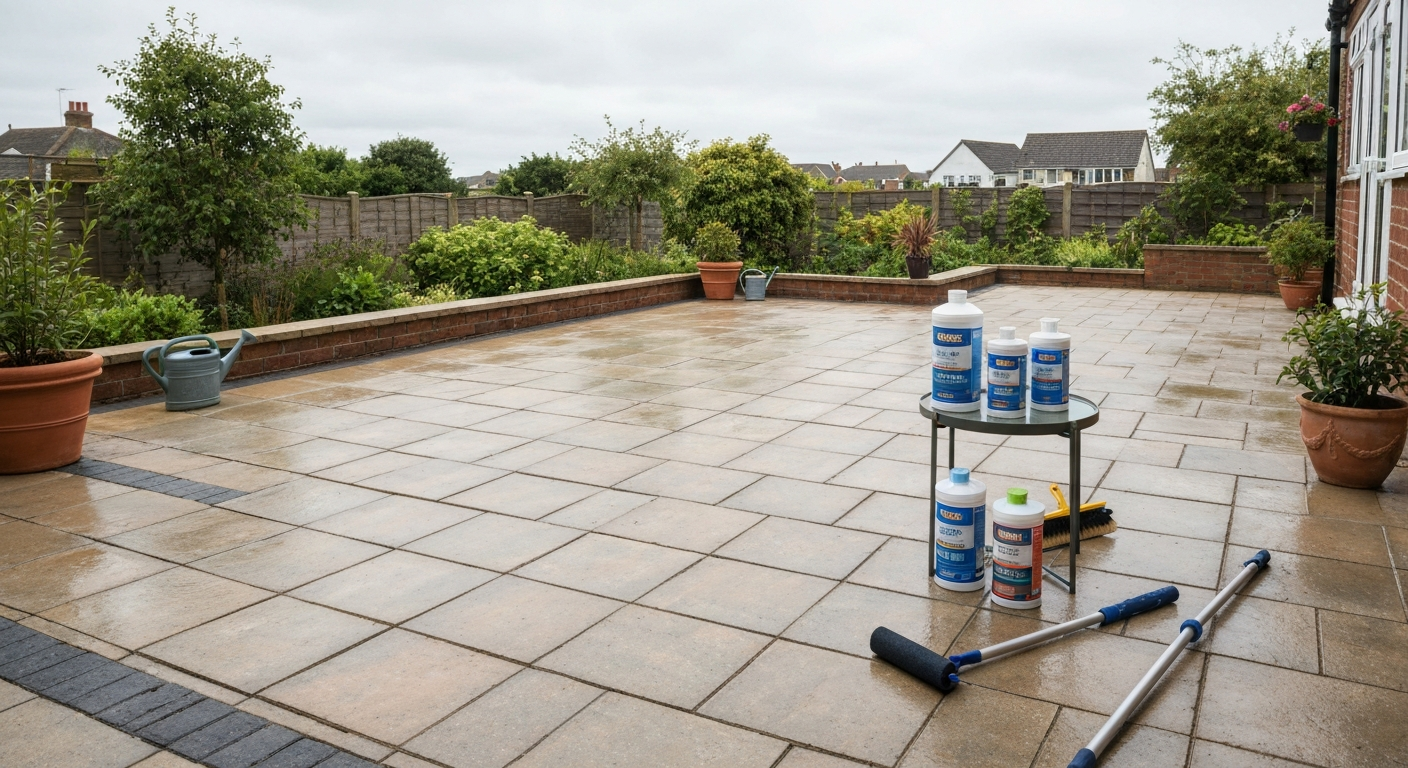
- Product comparison: five product containers side by side for the comparison table products
More From Best Outdoor Patio Ideas
Once your patio surface is sealed and protected, the natural next step is thinking about how to make the space genuinely comfortable and usable year-round. Patio covers, from pergolas to solid roof structures, transform a sealed slab into an outdoor room, and material choice there has the same logic as sealant choice: match the solution to your climate. If you are in a part of the UK that gets real heat in summer (increasingly common), patio fans and misting systems are worth investigating, the same wet conditions that drive your choice of sealant also influence which climate control approach suits your space. The site covers all of these in depth, and the same practical material-and-climate logic runs through every recommendation.
Final Verdict and Clear Next Steps
Here is the straight answer for the most common UK scenarios: For product-specific recommendations, see our guide to the best patio coating for UK patios.
- Standard concrete or block paving patio, DIY, tight budget: Thompson's One-Coat from Screwfix or B&Q — widely available, honest performance, just handle it safely and add the anti-slip additive if the surface will be wet regularly
- Block paving patio, want genuine longevity and oil resistance, happy to spend more: Smartseal Patio Sealer or Resiblock Superior Natural Matt — both outperform Thompson's for durability; Resiblock is the premium pick for a surface you want to last 5 to 10 years before recoating
- Indian sandstone, limestone or other natural stone: do not use Thompson's One-Coat without a patch test, and strongly consider a dedicated penetrating breathable sealer from Sealers Direct or a specialist natural stone supplier — the risk of irreversible damage is real
- Slip resistance is the primary concern (elderly household, young children, shaded damp garden): Smart Seal Patio Perfect water-based non-slip coating, or any sealer with anti-slip additive mixed in, and aim for a PTV of 36 or above on your finished surface
- Low-VOC, pets, fast re-use of the patio: any quality water-based acrylic sealer — accept the shorter recoat cycle in exchange for the safety and convenience advantages
- Large area, natural stone, or existing failed sealer: get at least three quotes from vetted local contractors with experience on your specific surface material — the cost is justified and product mistakes on natural stone are expensive to fix
The one step that applies to every scenario: prepare the surface properly. A good sealer on a clean, dry, sound surface will outperform a premium sealer slapped on a damp or dirty one every single time. Take the prep seriously, match the product to the surface, and your patio should stay protected through UK winters and looking significantly better than it did before you started.
FAQ
What is the best patio sealant in the UK for most homeowners?
Best overall: a quality film‑forming acrylic or polyurethane patio sealer from a reputable UK supplier (e.g., Smartseal Patio Sealer or Thompson’s One‑Coat) — chosen for coverage, durability and compatibility with your patio material. Pick an acrylic for easy DIY and aesthetic enhancement; choose urethane/polyurethane for higher abrasion resistance and longer life.
Which patio sealant is best on a budget?
Best budget pick: Thompson’s One‑Coat Patio & Block Paving Seal (widely stocked in 5L) — affordable, good coverage and quick drying. Be cautious on highly absorbent natural stone where patching can occur; always test a small area first.
What sealant should I use for natural stone (sandstone, limestone)?
Best for natural stone: use a breathable penetrating silane/siloxane or a specialist stone sealer (trade brands such as Resiblock Superior Natural Matt for block/stone). Avoid solvent film‑formers that can cause darkening/patching without testing; always do a trial to check appearance.
Which sealer is best if I need anti‑slip performance?
Best anti‑slip: choose a product tested to meet slip criteria (pendulum/TRL/SRV) or add a certified anti‑slip aggregate/additive (Thompson’s anti‑slip additive or Smart Seal’s non‑slip Patio Perfect). Look for published pendulum/PTV results or TRL testing claims.
Which patio sealant has the lowest VOCs for a pet‑ and eco‑conscious household?
Best low‑VOC: choose water‑based penetrating sealers or water‑based acrylics with low VOC ratings. Many solvent‑based trade products (some Smartseal and Thompson variants) have high VOCs; check the product TDS/SDS for exact g/L values and pick water‑based labelled low‑VOC.
Is Smart Seal Patio Perfect available in the UK and is it safe to use?
Smart Seal Patio Perfect (product literature and SDS available) is a water‑based non‑slip coating in the brand range; safety data sheets list skin/eye irritation and application precautions. Observe PPE, ventilation and correct disposal; follow the SDS and manufacturer instructions.