
The best patio hot tub for most homeowners is a plug-and-play or mid-range acrylic model in the 4–6 person range, sitting on a reinforced concrete pad or structurally verified deck, wired to a dedicated 240 V GFCI circuit. That setup balances cost, convenience, and long-term reliability far better than either a bargain inflatable or a full built-in spa for the majority of outdoor patios. But the right answer really does depend on your climate, your patio structure, your budget, and how seriously you plan to use it, so this guide walks through all of it.
Best Patio Hot Tub: Complete Buying & Planning Guide for You

Elise Prescott
10 Aug 2026
Who this guide is for
This is a buying-and-planning guide for homeowners and DIYers who are seriously considering adding a hot tub to an existing patio or designing one into a new outdoor space. Whether you're pricing out a $600 inflatable for a rental property, planning a $12,000 acrylic spa with a pergola overhead, or somewhere in between, this covers the full picture: types, sizing, structural checks, electrical and permit requirements, climate considerations, integration with your patio design, and what it actually costs to run one year-round. If you're also redesigning the broader patio space around your hot tub, you'll find that the design decisions for a great hot tub area overlap heavily with the decisions behind any great patio build.
The four main types of patio hot tubs
Hot tubs get lumped together in casual conversation, but the four main categories are genuinely different in terms of cost, installation complexity, performance, and how well they work on a typical patio. Here is what you need to know about each one before you spend a dollar.
Inflatable and portable hot tubs
Inflatables like the Coleman SaluSpa and Intex PureSpa line are the most accessible entry point. A typical 4–6 person model holds around 242 gallons, plugs into a standard 110–120 V outlet with an integral GFCI, and produces a filled weight in the range of 2,100 lb. They set up in under an hour, require no permits or wiring in most jurisdictions, and cost $400–$900. The honest downsides are real though: they heat slowly (often 1–2°F per hour), they lose heat fast in cold weather because the walls have almost no insulation, the jets are air-driven rather than water-pressure jets, and they rarely survive more than two or three seasons of heavy use. They make sense as a try-before-you-buy option, for renters, or for very occasional use in mild climates.
Plug-and-play hot tubs
True plug-and-play hot tubs are hard-shell acrylic or rotomolded units that run on 120 V without any electrical upgrade. Brands like Essential Hot Tubs and some entry-level Bullfrog models sit in this space. They typically seat 2–4 people, hold 200–300 gallons, and cost $2,500–$5,000. Because they run on 120 V, heating is slower and maintaining temperature in sub-freezing weather is difficult. They are a good fit for mild climates where you want a solid, durable tub without hiring an electrician. Most owners who use them more than a couple of times per week eventually wish they had gone straight to a 240 V model, so be honest with yourself about usage frequency.
Acrylic plug-in (240 V) hot tubs
This is the sweet spot for most homeowners. These are the classic shell-and-cabinet acrylic spas, think Jacuzzi, HotSpring, Sundance, Bullfrog, and similar brands. A mid-size unit like the Jacuzzi J-335 holds 450 gallons, has a published filled weight of 4,684 lb, and requires 230 V service. The HotSpring Grandee carries about 455 gallons with a filled weight around 5,810 lb and a 4.0 kW heater. They cost $6,000–$16,000 depending on brand, size, and features. You'll need a licensed electrician to run a dedicated 240 V, 50–60 A GFCI-protected circuit before delivery day. They heat faster, hold temperature better, deliver real hydrotherapy jets, and last 15–20 years with proper maintenance. This is also the category where placement and structural load calculations matter most, because you're putting 4,500–6,000 lb in one spot.
Built-in and in-ground spas
Built-in or inset spas are gunite, fiberglass, or tiled structures set into the patio or deck surface. They look stunning and feel integrated into the landscape, but they are expensive ($15,000–$35,000+), require full excavation and plumbing rough-in, and involve multiple contractor trades simultaneously. They also require full permitting in virtually every jurisdiction, and the construction timeline runs weeks to months. If you're doing a full patio or backyard renovation from scratch, a built-in spa can make sense and look incredible. For most people upgrading an existing patio, a high-end acrylic unit is far more practical.
| Type | Typical Cost | Power | Filled Weight | Install Complexity | Best For |
|---|---|---|---|---|---|
| Inflatable/Portable | $400–$900 | 120 V standard outlet | ~1,800–2,200 lb | DIY, no permits | Renters, mild climates, trial use |
| Plug-and-Play (hard shell) | $2,500–$5,000 | 120 V standard outlet | ~2,000–3,000 lb | DIY-friendly, no electrician | Mild climates, occasional use |
| Acrylic 240 V (plug-in) | $6,000–$16,000 | 240 V dedicated circuit | ~4,000–6,000 lb | Electrician required | Most homeowners, year-round use |
| Built-in/In-ground Spa | $15,000–$35,000+ | 240 V + full plumbing | Structural (in-ground) | Full contractor team + permits | New builds, full patio renovations |
How to choose the right hot tub for your patio
Once you know the type you're leaning toward, these are the selection factors that actually determine whether a specific model works for your specific situation. Run through each one before you visit a showroom or add anything to a cart.
- Capacity: How many people will genuinely use it at once? A 2-person couple rarely needs more than a 4-person tub. Buying bigger than you need means more water, more energy, more chemicals, and more deck load.
- Footprint: Most 4–6 person acrylic spas run 7x7 ft to 8x8 ft square, or up to 9x7 ft rectangular. Measure your patio including required clearances (typically 3 ft on service side, 1–2 ft minimum on others) before shopping.
- Power requirements: Decide early whether you can realistically run a 240 V circuit to the location. If your panel is full or the run is very long, factor in an electrician's quote before finalizing your budget.
- Plumbing and drainage: Acrylic and built-in spas need a drain plan. Many homeowners drain to a yard or cleanout; some municipalities require connection to sanitary sewer. Confirm before installation.
- Budget (total cost of ownership): Add equipment cost + electrical install ($500–$2,000 typical) + concrete pad if needed ($500–$1,500) + chemicals and cover + estimated annual energy cost ($50–$150/month depending on climate and cover quality).
- Aesthetics and integration: What does your patio look like? A wood-cabinet acrylic spa blends naturally with a deck or pergola. A rotomolded tub in a bright color can look out of place in a refined patio design.
- Climate: Cold climates demand full-foam insulation, high R-value covers, and freeze-protection features. Hot and humid climates need good drainage and corrosion-resistant components. Coastal properties need marine-grade hardware.
Top patio hot tub picks by type and budget
These aren't comprehensive reviews of every model on the market, but they represent the categories and price bands where real homeowners are shopping right now. Prices reflect 2026 retail and may vary by region and dealer.
Best budget pick: inflatable
The Intex PureSpa Plus 4-Person Bubble Spa consistently comes up as the best value in the inflatable category. It runs on 120 V with an integral GFCI, heats at roughly 2°F per hour, and costs around $500–$700. If you want to try hot tub ownership before committing to a hard-shell unit, this is the logical starting point. The Coleman SaluSpa is similarly priced and uses the same Bestway manufacturing platform. Either one is a reasonable proof of concept, not a long-term solution.
Best plug-and-play pick
Essential Hot Tubs 14-Jet Award Series is one of the more reliable 120 V hard-shell options, coming in around $3,000–$4,500. It seats 2–4, requires no electrical upgrade, and uses full-foam insulation that outperforms any inflatable in cold weather. This is a solid pick for mild climates (coastal California, Pacific Northwest mild zones, Texas Gulf Coast) where you won't be fighting freezing temps and want a real tub without an electrical project.
Best mid-range acrylic pick
The Jacuzzi J-335 is one of the best-selling mid-size acrylic hot tubs for good reason: it seats 6, holds 450 gallons, has a published filled weight of 4,684 lb, and runs on 230 V. It's priced around $9,000–$12,000 depending on features and dealer. The HotSpring Limelight Flair and Sundance Optima are comparable competitors in the same bracket. All three deliver true hydrotherapy performance, reasonable energy efficiency with a quality cover, and 15+ year lifespans with proper water care. Any of these earns the title of best patio hot tub for a homeowner who's committed to year-round use. See our guide to the best patio raspberry finishes for recommended color and cabinet treatments.
Best premium pick
The HotSpring Grandee is one of the best-regarded large acrylic spas on the market. It holds around 455 gallons, weighs approximately 5,810 lb filled, runs a 4.0 kW heater on 230 V, and seats 7. Retail pricing runs $14,000–$18,000. For homeowners who entertain regularly, use the tub multiple times per week, and want genuinely luxurious jet performance and energy management, this tier of spa pays off over time. At this price point, always get the dealer to include delivery, installation setup, and a water-care orientation in writing.
Best built-in/inset option
For a sunken or in-ground spa, fiberglass shells from companies like Latham or San Juan Pools offer a middle ground between custom gunite and a freestanding acrylic tub. They run $15,000–$25,000 installed, are faster to install than gunite, and look genuinely stunning integrated into a patio surface. If you're planning a full patio renovation, this is worth a conversation with your landscape contractor.
Sizing and placement: getting the location right
Placement decisions made before the tub arrives are far easier than ones made after. The three main placement configurations each have real trade-offs worth thinking through.
Deck placement
Placing an acrylic hot tub on an existing wood or composite deck is extremely common and can look great, but you must verify the structure can handle the load before anything is delivered. A filled 450-gallon spa weighs over 4,600 lb, which distributed across an 8x8 ft footprint works out to roughly 72 psf, well above the IRC's standard 40 psf design live load for exterior decks (Table R301.5). That doesn't mean your deck automatically fails; it means you need to actually check it, not assume. In most cases, reinforcing a deck for a hot tub means adding posts and footings beneath the tub's footprint area, upgrading beam sizing, or both. Get a structural engineer's eye on this if your deck was built to standard residential loads.
Inset and sunken placement
Sunken hot tubs look exceptional in a patio design and make entry and exit easier, no climbing up or stepping over a cabinet edge. They typically require excavation, a concrete surround, and more complex plumbing access planning. If you're building a new patio from scratch, this placement is worth the extra cost. On an existing concrete patio, retrofitting a sunken spa involves cutting and removing a section of slab, which adds $2,000–$5,000 to the project minimum.
Stand-alone on concrete or pavers
Most acrylic hot tubs are installed on a poured concrete pad. Manufacturers like HotSpring explicitly recommend a minimum 4-inch-thick reinforced concrete pad as the foundation for outdoor installation and warn that inadequate foundations can void warranty coverage. A standard 10x10 ft pad costs $500–$1,500 depending on region and reinforcement. This is almost always the simplest, most cost-effective, and most code-friendly approach for a freestanding unit. Pavers can work but require a compacted and level base; any settling over time can rack the cabinet and affect the shell.
Clearance requirements
- Leave at least 3 feet on the service access side (typically where the equipment cabinet panels are) for filter changes, pump access, and repairs.
- Allow at least 1–2 feet on the remaining sides to prevent trapped moisture against fences, walls, or structures.
- Overhead clearance matters too: most manufacturers specify at least 6–7 feet of clearance above the water line if placing under a pergola or patio cover.
- Keep the hot tub at least 5 feet from the electrical panel or subpanel as a general NEC-informed practice, and confirm exact setback distances with your electrician.
- Check local zoning for property-line setbacks — many municipalities require hot tubs to be at least 5 feet from property lines.
Structural and load-bearing checklist
This is the part most homeowners skip because they don't know to ask about it, and then they're surprised when a contractor raises the issue on delivery day. Do this work before you buy anything.
The math is straightforward once you have the numbers. One gallon of water weighs 8.34 lb. A 450-gallon spa holds 3,753 lb of water alone. Virginia Cooperative Extension, Rain Barrel Fact Sheet (notes weight: one gallon ≈ 8.34 lb) reports one U.S. gallon of water weighs approximately 8.34 pounds, so 450 gal × 8.34 lb/gal ≈ 3,753 lb of water Virginia Cooperative Extension — Rain Barrel Fact Sheet (notes weight: one gallon ≈ 8.34 lb). Add the dry shell weight (roughly 800–950 lb for a mid-size acrylic spa), and you're at 4,500–5,000 lb before anyone gets in. Add the weight of 4–6 occupants at about 175 lb each, and a large spa can exceed 6,000 lb on its footprint. Distributed across a typical 7x7 ft (49 sq ft) footprint, that's over 120 psf, three times the standard IRC deck live load.
If your hot tub will sit on a deck
- Hire a licensed structural engineer or certified deck inspector to evaluate the specific area where the tub will sit before purchase or delivery.
- Standard residential decks are typically designed to 40 psf live load (IRC Table R301.5). A filled hot tub footprint area typically requires 100–125 psf capacity or concentrated-load footings beneath the tub.
- Common reinforcement approaches include adding posts and concrete footings directly below the hot tub footprint, doubling joists under the tub's perimeter, or installing a steel beam across the tub area.
- Warning signs that your deck needs immediate inspection before adding any hot tub: bouncy or springy feel underfoot, visible rot or soft spots in joists or ledger boards, inadequate post sizing (4x4 posts under a deck more than 6 ft high is a red flag), or a ledger board attached to rim joist only rather than structural framing.
- Never rely on a visual estimate alone. A structural engineer's assessment typically costs $300–$600 and is worth every dollar.
If your hot tub will sit on a concrete pad
A properly poured 4-inch reinforced concrete slab handles the load of virtually any residential hot tub. If you're pouring new concrete, use 3,000 psi mix with #3 or #4 rebar on 18-inch centers. If you're placing the spa on existing concrete, check for cracks or significant settling that could create an uneven base. The pad must be level to within 1/4 inch across the entire tub footprint, most manufacturers specify this tolerance in their installation manuals.
Electrical, plumbing, and permit requirements
I want to be direct about this section: electrical and permit work is where homeowners most commonly get into trouble, either by skipping it entirely or by underestimating what is involved. This is the part of the project where hiring a licensed professional is not optional in most jurisdictions.
Electrical requirements (NEC Article 680)
Permanently installed hot tubs fall under NEC (NFPA 70) Article 680, which governs electrical safety for pools, spas, and hot tubs. The key requirements that apply to a typical acrylic 240 V hot tub installation are: a dedicated branch circuit (no sharing with other loads), GFCI protection on all pump and lighting circuits, an accessible emergency disconnect located within sight of the spa but not less than 5 feet from the water's edge, and equipotential bonding of all metal components within the spa's perimeter using a minimum #8 AWG solid copper conductor. Portable inflatable and plug-and-play 120 V models that are cord-connected are typically handled under storable-spa provisions and may use listed cord-and-plug equipment with integral GFCI. That said, always confirm with your local inspector which edition of NEC your jurisdiction has adopted and how they interpret the storable vs. permanent distinction.
What an electrician will typically do
- Run a new dedicated circuit from your main panel to the spa location (50–60 A at 240 V is typical for most mid-size acrylic spas).
- Install a GFCI breaker in the panel and a disconnect box near the spa meeting the 5-ft setback rule.
- Install the equipotential bonding grid connecting all metal spa components and the bonding lug on the spa equipment pack.
- Inspect and verify all connections before energizing.
- Pull the required electrical permit and schedule inspection.
A typical hot tub electrical hookup (new circuit from panel, conduit run, disconnect, GFCI breaker) costs $500–$2,000 depending on panel distance, run length, whether trenching is needed, and local labor rates. Don't let anyone wire a hot tub without pulling a permit. If an uninspected installation causes a fire or electrocution, your homeowner's insurance has a legitimate reason to deny the claim.
Plumbing and drainage
Most hot tubs drain via a built-in bottom drain using a garden hose connection and gravity, you'll drain to a yard, garden, or driveway in most cases. Some municipalities, particularly in water-sensitive areas like Los Angeles County, require draining spa water to the sanitary sewer rather than to a lawn or storm drain when chemicals are present. Check your local ordinance before planning your drain location. If you're installing a built-in spa, you'll need a licensed plumber to run supply and return lines, and the rough-in must be inspected before any concrete is poured.
Permits: what triggers one and where to check
Permit requirements vary significantly by jurisdiction, and getting this wrong can create real problems at resale. Here is a practical summary of how this tends to work across the U.S.
| Scenario | Typical Permit Requirement | Representative Jurisdictions |
|---|---|---|
| Inflatable/portable, cord-connected, 120 V | Usually no permit required | Most U.S. cities and counties |
| Hard-shell plug-and-play, 120 V, not hardwired | Usually no building permit; check local rules | Many suburban jurisdictions |
| Acrylic 240 V hot tub, hardwired, permanent | Building + electrical permit required in most jurisdictions | LA County, Miami-Dade, Denver, Dallas, NYC |
| In-ground/built-in spa | Building + electrical + plumbing permits, plan review required | Essentially all U.S. jurisdictions |
| Hot tub with safety barrier/fence | Barrier permit may also be required where depth exceeds 24 in. | NYC, many states with residential pool laws |
Los Angeles County issues a combined building/electrical/plumbing permit for pools and spas. Los Angeles County issues a combined building, electrical, and plumbing permit for pools and spas (see Los Angeles County Code of Ordinances, Combined Swimming Pool Permit (example of local permit approach)) Los Angeles County Code of Ordinances — Combined Swimming Pool Permit (example of local permit approach). Miami-Dade enforces safety-barrier requirements alongside building and electrical permits. NYC treats spas deeper than 24 inches like pools and requires compliance with barrier rules or ASTM F1346 safety cover standards. Denver and Dallas both require building, electrical, and plumbing permits for permanently installed hot tubs, with typical fee ranges of a few hundred to a few thousand dollars for plan review and inspection. The fastest way to get the right answer for your address is to look up your municipality's online permit portal or call the building department directly, five minutes there saves weeks of potential hassle.
Seasonal and climate-specific planning
Where you live dictates some of the most important decisions in this whole process. A hot tub that works beautifully in coastal Southern California with minimal effort will need completely different infrastructure in Minnesota or even coastal North Carolina. Here is how to think about this by region type.
Cold climates (Mountain West, Upper Midwest, Northeast)
If you're in Denver, Minneapolis, Chicago, or anywhere temperatures regularly drop below 20°F, your hot tub decisions need to account for freeze protection from day one. First, buy a spa with full-foam insulation in the cabinet, not partial foam or base-only foam. Full foam fills every gap around the plumbing lines and provides both thermal retention and freeze-damage protection. Second, invest in the highest R-value cover you can find. Consumer spa covers range from roughly R-3 to R-15 depending on foam density and thickness; in a cold climate, pay for R-10 or better. Third, confirm that your model includes a freeze-protection mode (most 240 V acrylic spas do) that automatically runs the pumps when internal temperature drops toward freezing. Fourth, if you ever plan to shut the spa down for more than a few days in winter, hire a spa technician to winterize it properly, draining lines, blowing them out with an air compressor, and removing all equipment water. Freeze damage is specifically excluded from most manufacturer warranties, and a single freeze event can crack a heater manifold or split plumbing lines, costing $500–$2,000 in repairs.
Hot and humid climates (Gulf Coast, Southeast, Lowcountry)
Heat and humidity create a different set of challenges. The water in your spa will try to climb toward ambient air temperature in summer, so you may find yourself cooling rather than heating it. Some premium spas include a cooling mode for this reason. More pressing is the combination of humidity, salt air on coastal properties, and UV exposure on cabinet materials. Specify marine-grade or stainless hardware on any spa going within a mile of saltwater. UV-stabilized cabinet materials (HDPE or synthetic wood) hold up significantly better than real cedar in humid-UV-intense environments. Also plan for drainage carefully: if the spa is under a screen enclosure, make sure there's a path for draining and cleaning without flooding the enclosure.
Coastal properties (Pacific Coast, Atlantic Seaboard)
Salt-laden air accelerates corrosion on any exposed metal components: jets, fittings, heater elements, and control panels. Prioritize spas that use titanium or coated stainless heater elements and fully sealed equipment packs. The cabinet should be synthetic or treated for coastal exposure. Keep the spa covered when not in use to reduce salt and debris contact with water and equipment. Budget for slightly more frequent equipment inspections, every 6 months rather than annually is smart within a quarter mile of the ocean.
Covers, shelters, and enclosures
A quality thermal cover is the single best investment you can make in hot tub operating efficiency. A typical spa cover with R-10 foam inserts can reduce standby heat loss by 50–75% compared to no cover, translating directly to lower monthly energy bills. In cold climates, the cover R-value difference between a cheap R-3 cover and a well-made R-12–15 cover can mean $30–$60 per month in heating cost reduction. Beyond the cover itself, placing the hot tub under a pergola, patio cover, or partial enclosure reduces wind chill (a major heat-loss factor in exposed locations) and extends usable seasons. Full enclosures like gazebo kits or screen rooms further reduce heat loss and improve year-round comfort, though they add cost and may trigger their own permit requirements. Make sure any overhead structure provides adequate clearance per your spa manufacturer's installation guide, typically at least 6 feet above the waterline.
Integrating your hot tub with the patio design
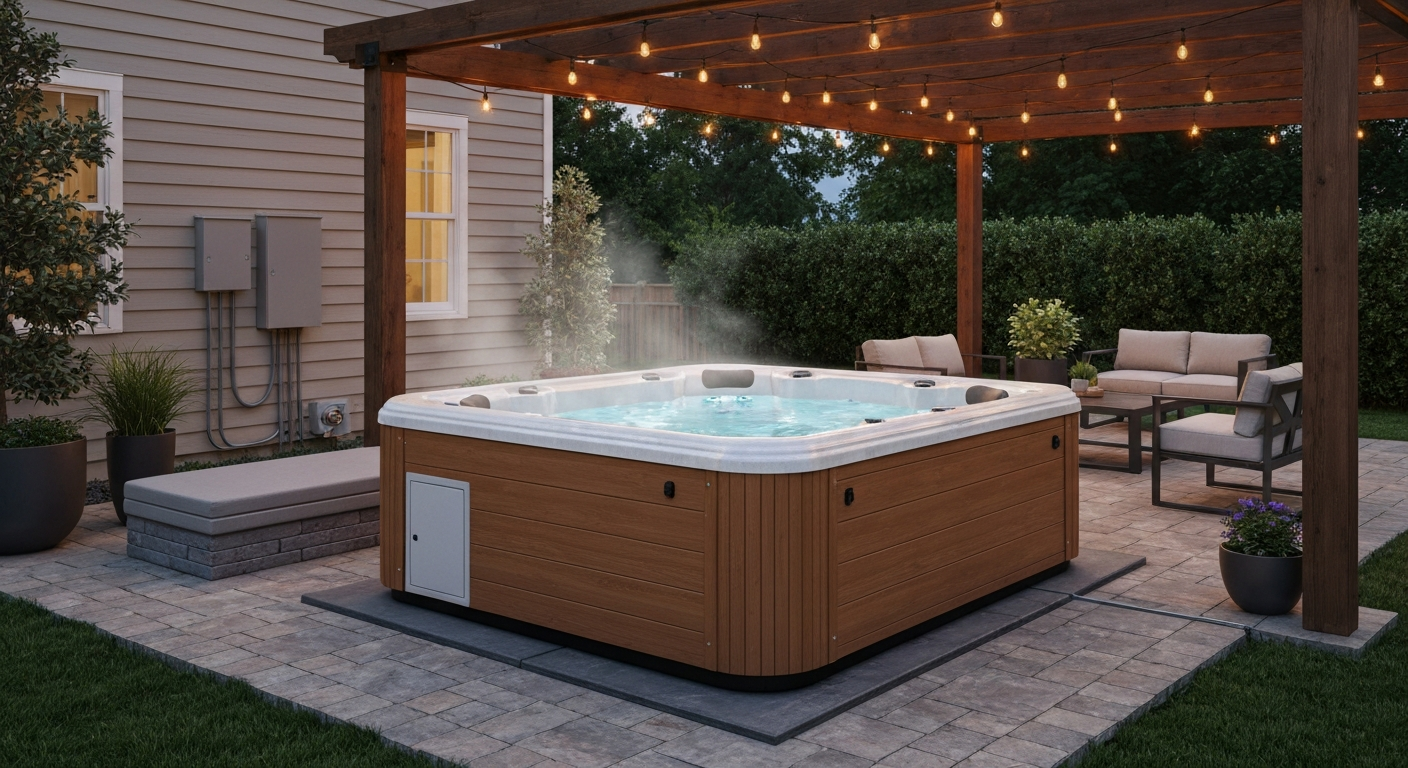
A hot tub dropped into a patio without any design thought looks like exactly that. The installations that look intentional and beautiful all share a few common elements: the hot tub is at the same level or slightly elevated from the surrounding patio surface, there's a consistent material theme between the spa cabinet, decking, and surrounding hardscape, and there is at least one overhead element (pergola, shade sail, patio cover) that frames the spa visually. For examples and ideas on cohesive material choices and framing elements, see best patio looks. If you're redesigning the broader patio area, consider adding structures like pergolas, screen rooms, or a best patio greenhouse to extend seasonality and protect plants. For inspiration on creating the best patio ever, see our patio design guide. Good outdoor lighting is essential, both functional (so you're not stumbling into the tub at 10 pm) and ambient. Recessed LED lighting in surrounding deck boards or step risers, string lights overhead, and landscape lighting that doesn't shine directly into the tub are all solid approaches.
Misting systems are an interesting pairing in hot climates, a pergola-mounted misting line around the perimeter of the hot tub area creates a cooling buffer for the air around bathers' shoulders and faces while they soak in hot water, which sounds counterintuitive but feels great in Texas or Arizona summers. Outdoor speakers mounted under a pergola overhead complete the experience without the water-damage risk of bringing portable Bluetooth speakers into the spa environment. Privacy screening is often overlooked until the first time a neighbor walks by, fence extensions, lattice panels, or dense ornamental grasses planted around the spa perimeter all work depending on how permanent you want the solution.
Energy efficiency and operating costs
Running a hot tub costs real money, and the range is wide depending on climate, usage, insulation, and cover quality. Here are realistic estimates for a 240 V acrylic spa used 3–4 times per week.
| Climate Zone | Estimated Monthly Energy Cost (240V acrylic spa) | Key Variables |
|---|---|---|
| Mild (coastal CA, PNW) | $30–$60/month | Low ambient heat loss, minimal heating demand |
| Hot/Humid (Gulf Coast, SE) | $40–$75/month | Possible cooling mode use in summer, high humidity |
| Temperate (mid-Atlantic, Midwest) | $60–$100/month | Seasonal swings, cover quality matters most |
| Cold (Mountain West, Upper Midwest, NE) | $90–$150+/month | Freeze protection, high standby heat loss without quality cover |
The biggest levers you control are cover quality (R-value), whether the spa runs eco/sleep modes when not in use, and how often the cover is on versus off. A spa sitting uncovered and fully heated in a Minnesota January will approach the upper end of those cold-climate estimates. The same spa running with an R-12 cover and eco-mode scheduling during off-hours can land closer to $80–$100/month. Insulation quality in the cabinet itself matters too: full-foam insulated models consistently outperform partially insulated ones in real-world energy use.
Maintenance and water care
Maintenance is where a lot of hot tub enthusiasm goes to die if you're not prepared for it. The good news is that a consistent simple routine keeps a spa clean and functional without consuming your weekends. Here's what the routine actually looks like for a mid-size acrylic spa.
- Test water chemistry 2–3 times per week using test strips or a digital meter. Key parameters: pH (target 7.4–7.6), alkalinity (80–120 ppm), sanitizer (bromine 3–5 ppm or chlorine 1–3 ppm), and calcium hardness (150–250 ppm).
- Add sanitizer and balance chemicals as needed after testing. This takes 5–10 minutes on an average session.
- Shock the water weekly (or after heavy use) with a non-chlorine or chlorine shock treatment to oxidize organics and restore sanitizer effectiveness.
- Rinse the filter cartridge every 2 weeks with a garden hose. Replace filter cartridges every 12–18 months.
- Wipe the waterline with a spa-safe cleaner every 2–4 weeks to remove biofilm buildup.
- Drain and refill the spa every 3–4 months (every 2–3 months with heavy use). The general rule of thumb is to divide your water capacity in gallons by 3 and then by daily bather count to get days before refill.
- Inspect the cover monthly for waterlogging, tears, or strap damage. A waterlogged cover can weigh 75–100 lb and provides minimal insulation.
- Have the equipment (pumps, heater, control board, jets) professionally inspected annually.
Safety and code checklist
Hot tubs present real safety risks, primarily electrical and drowning-related, and meeting code requirements is not optional. Run through this checklist before your first soak.
- GFCI protection on all circuits: verified and tested by a licensed electrician.
- Emergency disconnect installed within sight of the spa, at least 5 feet from water edge.
- Equipotential bonding completed on all metal components using #8 AWG solid copper minimum.
- Anti-entrapment drain covers installed (VGBA-compliant dual drains or approved single-drain covers).
- Safety cover or locking cover installed to prevent unsupervised access by children.
- Non-slip surfaces on steps and surrounding deck area.
- No electrical appliances, extension cords, or non-rated outdoor electronics within 5 feet of the water.
- Posted water temperature guidelines (max 104°F per most health codes); avoid use during pregnancy or with heart conditions without physician clearance.
- First-use inspection by the installing electrician and local building inspector signed off.
Accessories worth budgeting for
A few accessories make a real difference in the day-to-day experience and long-term protection of your investment. These are the ones I'd actually spend money on.
- Cover lifter: A hydraulic or assisted cover lifter turns a heavy, awkward two-person task into a one-handed operation. Budget $150–$400. Non-negotiable if your cover is a full-size insulated unit.
- Steps with handrail: Proper entry steps with a grip rail reduce the risk of slipping. Built-in steps that match the spa cabinet look far better than freestanding plastic ones. Budget $100–$400.
- Spa chemicals starter kit: Your dealer should include or offer this at purchase. A good starter kit with test strips, shock, sanitizer, pH adjuster, and alkalinity increaser typically costs $80–$150.
- Floating thermometer: Simple but useful for quick visual temperature checks without unlocking the control panel.
- Spa-side caddy or tray: For keeping drinks and phones off the ground and out of the water. Budget $30–$80.
- Insulated spa blanket (floating thermal blanket): A thin floating cover placed under the hard cover adds another R-value layer and reduces evaporation, helping in cold climates. Budget $50–$100.
- Enclosure or gazebo: If you plan to use the tub year-round in a cold or rainy climate, a purpose-built spa gazebo (budget $800–$3,500) or custom pergola enclosure makes the experience dramatically more comfortable.
DIY vs. hiring a professional: where the line is
There's a real range here. Some of this project is genuinely DIY-friendly. Other parts are not, and being honest about the distinction saves money, stress, and potential code violations.
| Task | DIY-Friendly? | Notes |
|---|---|---|
| Site selection and measuring | Yes | Anyone can measure and plan clearances |
| Concrete pad prep and pour (small) | Experienced DIYers | Simple 4-in slab is manageable; large pours benefit from a contractor |
| Electrical hookup (240 V) | No | Licensed electrician required; permitting and code compliance are non-negotiable |
| Structural deck evaluation | No for acrylic spas | Hire a structural engineer; visual inspection is not sufficient |
| Spa delivery and set placement | Dealer/installer | Most dealers include delivery and crane/dolly set with purchase |
| Water fill and chemistry start-up | Yes | Straightforward with dealer orientation |
| Ongoing water maintenance | Yes | Weekly routine is homeowner-manageable |
| Annual equipment inspection | Hire spa tech | Pump seals, heater, control board benefit from professional eyes once a year |
| Winterization (cold climates) | Hire spa tech | Improper winterization voids most warranties and risks freeze damage |
The realistic total professional cost for a 240 V acrylic hot tub installation (beyond the tub purchase price) runs $1,500–$4,500 depending on what the site requires. That includes: electrician hookup and permit ($500–$2,000), concrete pad if not existing ($500–$1,500), structural engineer if deck placement is involved ($300–$600), and permit fees ($100–$500 depending on jurisdiction). On the high end if everything is needed from scratch; on the low end if you have an existing concrete pad and a close panel. Budget the full range and treat savings as a bonus.
Final decision checklist
Before you finalize any purchase, run through this list. If you can check off every item, you're ready to buy with confidence.
- Decided on spa type (inflatable, plug-and-play, 240 V acrylic, built-in) and confirmed it fits your climate and usage goals.
- Measured the exact patio location including all clearances on all sides and overhead.
- Confirmed placement surface: concrete pad (existing or new), deck with structural assessment, or new inset/sunken plan.
- If deck: hired or consulted a structural engineer and confirmed load capacity or reinforcement plan.
- Received an electrician's quote for 240 V hookup and confirmed timeline relative to delivery date.
- Checked your local permit portal and confirmed what permits are required for your installation type.
- Calculated total budget including tub, delivery, electrical, concrete or structural work, permit fees, cover, accessories, and first-year chemical costs.
- Read the warranty PDF for the specific model: confirmed exclusions for freeze damage, improper installation, and water chemistry damage.
- Confirmed drain plan: where the water goes on each drain-and-refill cycle.
- Have a plan for ongoing maintenance: either a committed weekly routine yourself or a spa service agreement with a local technician.
FAQ
What building-code and structural standards must be consulted for safe patio hot tub placement and deck support calculations?
Use the International Residential Code (IRC) live‑load rules (baseline 40 psf, Chapter 3 / R301.5) and local amendments; consult municipal/borough codes for additional requirements. For deck/support design, obtain the hot tub’s dry and filled weights from the manufacturer and perform load calculations (water gallons × 8.34 lb/gal + dry weight). Because spa loads are concentrated, get a licensed structural engineer to compute point loads, required joist/post sizing, or to specify reinforced footings or a poured concrete pad. Document the engineer’s calculations for permit applications and warranty compliance.
Which electrical codes and practices are essential for hot tub installations?
Follow the National Electrical Code (NEC / NFPA 70) Article 680 for pools, spas and hot tubs: requirements include dedicated branch circuits, GFCI protection, equipotential bonding of metal parts, and emergency disconnects (location/distance rules). Verify local adoption/edition of the NEC and inspector interpretations (storable/plug‑in units versus permanently hard‑wired units differ). Typical bonding uses a #8 AWG solid copper conductor minimum; have a licensed electrician produce wiring diagrams and a permit-ready plan.
What manufacturer data and product specs are required to produce accurate sizing and load assessments?
Collect each model’s dry weight, water capacity (gallons), published filled weight, footprint dimensions (length/width/height), required electrical service (voltage, breaker/ampacity, hard‑wired vs. cord‑and‑plug), heater kW, and installation foundation guidance. Use official spec sheets/installation manuals (manufacturer PDF) and note warranty language that may void coverage for improper foundation or deck placement.
What municipal permit and inspection evidence should be checked and included regionally?
Query the local building department for thresholds and fees: which spas require building, electrical and plumbing permits; whether portable plug‑in tubs are exempt; fence/barrier requirements; local setbacks and drainage rules; and any county/city-specific rules (examples: LA County combined pool permits, Miami‑Dade stricter electrical rules, NYC rules for tubs >24 in.). Document permit timelines, typical fees, and required plan submittals for the reader’s jurisdiction or provide links to local permitting portals.
Which electrical and plumbing details must be documented for contractor or DIY guidance?
Provide circuit sizing (voltage, required breaker/amperage), conduit and disconnect location, pump and heater kW, GFCI requirements, equipotential bonding details, and plumbing connections (drain lines, filtration, hot/cold hookups if relevant). Include region‑sensitive notes on utility voltages (120 V vs. 240 V norms), trenching/underground utilities, and wastewater/discharge rules. Recommend licensed trades for hard‑wired or subpanel work and include example wiring/spec references from manufacturer installation manuals.
What climate‑specific data and products are needed for seasonal recommendations and energy estimates?
Use local climate data (design winter low temps, degree‑days, freeze risk zones) and utility rates to model standby heat loss and running costs. Collect R‑values and construction details for spa covers, insulation options, cold‑climate kits, and recommended shelter/enclosure types. Include manufacturer heater ratings (kW) and real operating COP estimates to produce seasonal energy and cost estimates by region. Source climate data from NOAA/PRISM and utility rate information from local providers.