
The best patio ever is the one that fits how you actually live outside: cool enough to use in July, sturdy enough to survive your climate, and built on a foundation that won't heave or crack in three years. That means making deliberate choices about materials, structure, shade, and comfort systems before a single shovel hits the ground. This guide walks you through every decision, from first-pass budget to final contractor conversation, so you end up with an outdoor space you use every day instead of one you stare at through the window.
Best Patio Ever: Design, Build & Upgrade for Homeowners

Elise Prescott
6 Aug 2026
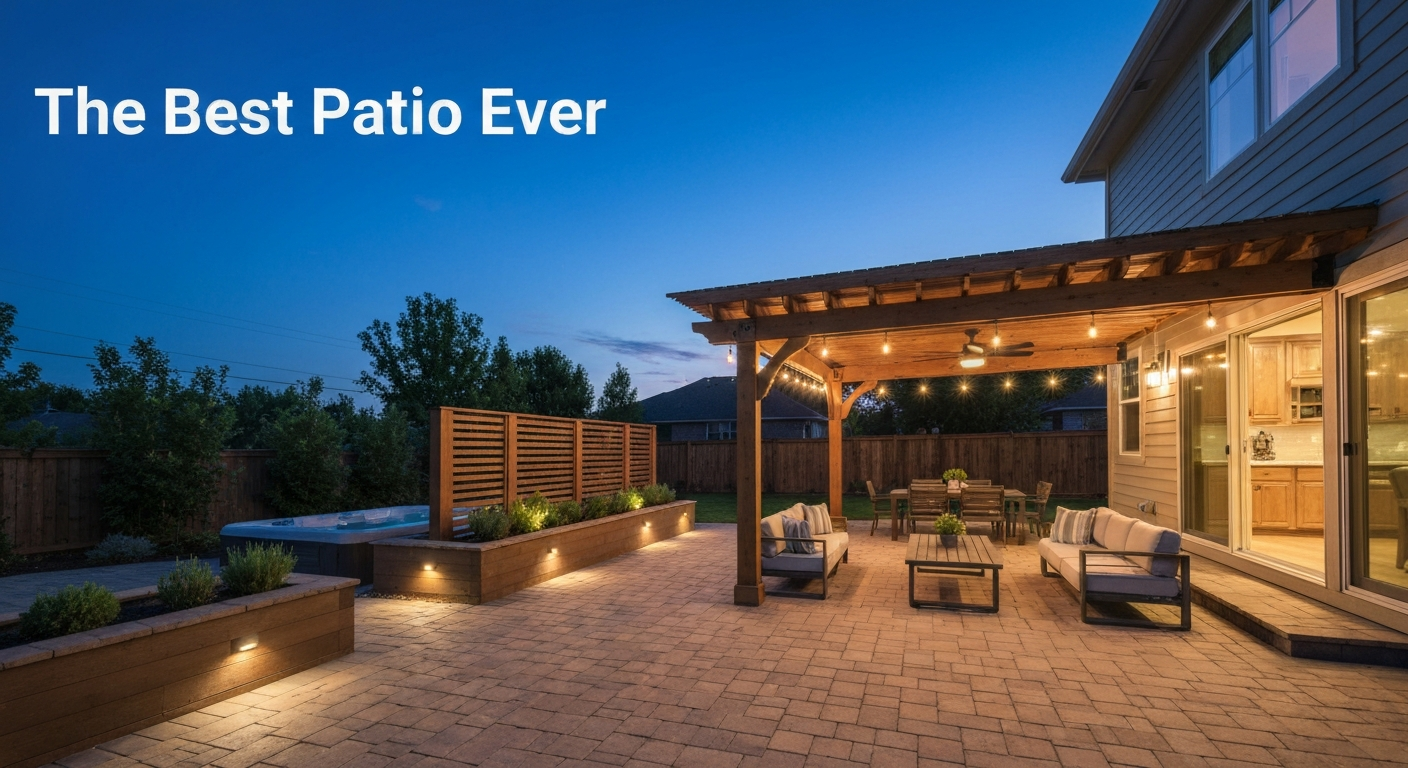
What actually makes a patio the best one ever
Most disappointing patios share the same origin story: someone poured a concrete slab, added a table, and called it done. What makes a patio genuinely great is the intersection of four things: comfort (shade, temperature control, and weather protection), usability (layout, circulation, and furniture scale), durability (materials and foundation appropriate for your climate), and personality (plants, lighting, color, and features that reflect how your household actually entertains). None of those elements costs more money by itself. They just require more thought up front.
A hot tub nook tucked behind a pergola, a raised planter bed doubling as a privacy screen, a ceiling fan on a covered section, a speaker system wired before the pavers go in: these are the details that separate a patio you brag about from one that just exists. The goal of this guide is to give you the decision framework to get there, whether your total budget is $5,000 or $50,000.
Planning checklist: goals, site survey, and priorities
Before you pull a single permit or request a single bid, spend time on the three fundamentals: what you want, what your site will allow, and what your budget will actually cover. Skipping any of these leads to expensive mid-project changes.
Goals and use-case questions
- How many people do you typically entertain at once? (This drives square footage.)
- Do you want a covered section, an open section, or both?
- Will you add a hot tub, outdoor kitchen, fire pit, or greenhouse space now or later?
- Do you need pet-friendly, kid-friendly, or wheelchair-accessible surfaces?
- How much weekly maintenance are you realistically willing to do?
- Is privacy a priority, or are you fine being visible from the street or neighbors?
Site survey checklist
- Measure the usable area and note any grade changes, slopes, or drainage patterns
- Identify where the sun hits hardest and at what times of day
- Locate underground utilities (call 811 before any digging in the US)
- Check setback requirements from property lines, easements, and structures
- Note existing trees (roots affect base depth and drainage)
- Identify your soil type: clay soils require deeper subbase than sandy soils
- Determine if downspouts or natural runoff drain toward the planned patio area
Timeline and budget priorities
A realistic residential patio project takes 2 to 6 weeks from permit approval to final walk-through for a mid-size installation. Permitting alone can add 2 to 6 weeks before work starts, so factor that in. Prioritize the foundation and drainage in your budget before surface finishes: a beautiful paver surface over an inadequate base will fail within a few seasons. Lock in rough-in work (electrical conduit, gas lines, speaker wire chases) before any hard surface goes down, because retrofitting is expensive.
Budgeting and cost ranges
According to Angi's 2026 data, the national average installed patio cost is around $4,005, with a typical range of $2,036 to $6,107 for basic builds. That range expands dramatically when you add covers, comfort systems, or premium materials. Here is how the numbers shake out across three budget tiers for a 300 to 400 square foot patio.
| Budget Tier | Surface | Cover | Comfort | Estimated Total (300–400 sq ft) |
|---|---|---|---|---|
| Budget ($) | Poured concrete slab ($5–$12/sq ft installed) | None or basic shade sail | Portable fan, no misting | $2,000–$5,500 |
| Mid-Range ($$) | Concrete pavers ($10–$30/sq ft installed) | Wood pergola or retractable awning | Ceiling fan, basic misting kit | $8,000–$20,000 |
| Premium ($$$) | Natural stone or composite deck ($20–$47/sq ft installed) | Aluminum pergola or insulated roof cover | Built-in speakers, misting system, patio heater, hot tub prep | $25,000–$60,000+ |
Labor typically accounts for 40 to 65 percent of total installed cost. In high-cost urban markets, skilled paver crews run $50 to $150 or more per hour, and a 300 to 400 square foot paver patio commonly requires 35 to 40 labor-hours for site prep, base, setting, and jointing. Budget for at least 10 to 15 percent contingency on any project that involves excavation, drainage work, or permitting, because surprises under the ground are common.
Design guidance: layout, zoning, scale, and flow
Good patio design works like good interior design: you zone the space for different activities, ensure people can move between zones without bumping into furniture, and keep the proportions human-scaled. A 12 by 12 foot zone (144 sq ft) is the practical minimum for a dining table for four. A 16 by 20 foot open area gives you comfortable dining plus a secondary lounge zone. If you are working with a long, narrow yard, use a perpendicular layout with a path connecting two distinct patio zones rather than one long rectangle.
Circulation matters more than most homeowners expect. Leave at least 36 inches of clearance between furniture edges and any wall, railing, or planter. If you plan to add a grill station, keep a 4 to 5 foot clear zone around it for safety and usability. Use different materials or elevation changes to define zones visually without building walls. A covered dining area in natural stone with an open lounge area in composite decking, for example, reads as intentional and polished rather than expensive.
Aesthetically, repetition of materials and a limited color palette (two to three dominant tones) create cohesion. Warm-toned pavers (buff, tan, terracotta) read as inviting and work well with natural wood pergolas and greenery. Cool-toned materials (grey concrete, slate, charcoal composite) pair well with modern aluminum covers and clean-line furniture. Match your patio's aesthetic vocabulary to your home's exterior: a craftsman bungalow benefits from warm wood tones and natural stone, while a contemporary home suits large-format concrete or porcelain pavers. For inspiration on styling and the best patio looks, see our visual gallery and styling guide on this site.
Greenhouse and edible-plant options: container gardens and kitchen gardens
One of the most satisfying upgrades on any patio is a food-producing element, and you do not need a dedicated greenhouse structure to get there. Raised planter beds built into a patio perimeter double as privacy screens and yield real harvests. Container-grown raspberries are a particularly good patio crop: varieties like 'Heritage' (everbearing) or 'Raspberry Shortcake' (a dwarf bred specifically for containers at 2 to 3 feet tall) thrive in large planters with full sun and regular watering. For help choosing the best patio raspberry varieties for containers, see our best patio raspberry guide. A 5-gallon container is the practical minimum; 15-gallon containers produce noticeably better yields. Use a well-draining potting mix amended with compost, and position containers where they get 6 to 8 hours of direct sun.
If you want a true greenhouse extension on or adjacent to your patio, lean-to greenhouse structures attached to the house wall are the most efficient choice: they benefit from the home's thermal mass, require only three exterior walls, and can be permitted as an accessory structure in most jurisdictions. A 6 by 8 foot lean-to gives you room for seedlings, year-round herbs, and a few dwarf citrus trees in colder climates. Pair it with a patio hot tub or lounge area to create a relaxing indoor-outdoor transition space. Use USDA Plant Hardiness Zone data (updated 2023) and your local NOAA climate normals when selecting plants, since what thrives in a Houston patio planter is very different from what survives a Minneapolis winter.
A simple kitchen-garden layout combines a 4 by 8 foot raised bed (herbs, tomatoes, leafy greens) with two or three large containers for raspberries or dwarf fruit trees. Position edible plants nearest the kitchen door for convenience. Install drip irrigation before the patio surface goes down: retrofit drip lines under pavers or decking are a headache.
Material selection: pavers, concrete, composite decking, and wood
Every patio surface material involves a tradeoff between upfront cost, long-term maintenance, and how well it handles your specific climate. Here is an honest look at each option.
| Material | Installed Cost (per sq ft) | Maintenance Level | Lifespan | Best For | Watch Out For |
|---|---|---|---|---|---|
| Poured concrete | $5–$12 | Low (seal every 2–3 years) | 25–40 years | Budget builds, large areas, contemporary looks | Cracking in freeze-thaw climates; hard to repair patch-free |
| Concrete pavers | $10–$30 | Low-medium (joint sand refresh every few years) | 30–50+ years | Most climates; flexible repair | Uneven settling if base is inadequate |
| Natural stone / flagstone | $20–$40+ | Medium (seal periodically, repoint mortar) | 50+ years | Premium aesthetics, unique looks | High cost; slippery when wet if polished |
| Composite decking | $20–$47 all-in | Very low (clean annually) | 25–30+ years (manufacturer warranty) | Raised platforms, wet climates, low maintenance households | Higher upfront cost; gets hot in direct sun |
| Pressure-treated wood | $15–$30 | High (stain/seal annually) | 10–20 years with maintenance | Budget decking; good DIY workability | Ongoing cost and labor; splinters if neglected |
| Hardwood (Ipe, Teak) | $25–$45+ | Medium (oil annually or let silver) | 25–50+ years | Premium wood look with real durability | High cost; sourcing (look for FSC-certified) |
Composite decking brands like Trex offer 25-year limited residential warranties covering fading and staining on many product lines, making it genuinely low-maintenance over the long haul. Pressure-treated wood, by contrast, typically delivers a 10 to 20-year service life depending on how consistently it is stained and sealed. If you hate maintenance, composite or pavers are the smart call. If you love the look and smell of real wood and will actually maintain it, hardwood decking is worth the investment.
Patio covers, pergolas, and awnings: which one is right for you
The single most transformative upgrade on any patio is overhead coverage. A covered patio extends your usable season by months, protects furniture, and makes evening entertaining genuinely comfortable. The challenge is choosing the right structure for your climate, aesthetic, and budget.
| Cover Type | Approx. Installed Cost | Sun/Rain Protection | Snow Load Capable | Maintenance | Best Climate |
|---|---|---|---|---|---|
| Wood pergola (open lattice) | $3,000–$12,000 | Partial sun only, no rain | No (open) | Medium (stain/seal) | Mild, dry climates |
| Aluminum pergola (louvered) | $8,000–$25,000+ | Adjustable: full or open | Often rated; check spec | Very low | Most climates |
| Retractable awning | $2,500–$8,000 | Good sun; rain depends on pitch | No (retract before snow) | Low | Sunny, mild-wind areas |
| Solid patio cover (aluminum/insulated) | $10,000–$30,000+ | Full sun and rain | Yes (if engineered) | Very low | Rain, snow, humid climates |
| Polycarbonate roof panel | $4,000–$14,000 | Good sun/rain; UV filtering | Moderate (check loading) | Low (clean panels) | Rain-heavy climates |
| Shade sail (fabric) | $500–$3,000 | Good sun only | No (remove seasonally) | Low | Dry, low-wind climates |
Under the 2024 International Residential Code (IRC Appendix BF), patio covers must sustain dead loads plus a minimum vertical roof live load of 10 psf, unless local snow loads require more. Appendix BF, Patio Covers (2024 International Residential Code) | ICC specifies that patio covers must sustain dead loads plus a minimum vertical roof live load of 10 psf, unless local snow loads require a greater value See Appendix BF — Patio Covers (2024 International Residential Code) | ICC for the official requirement that patio covers sustain dead loads plus a minimum 10 psf vertical roof live load (unless local snow loads require higher).. Wind load requirements follow IRC R301.2.1. If you live in a snow or high-wind region, always verify that any cover structure (including prefab kits) is engineered to meet your local adopted code, since ASCE 7-22 introduced updated reliability-targeted snow maps that affect design loads in many areas. A louvered aluminum pergola rated for your region's snow load is a much safer investment than an over-the-counter wood kit that was never designed for it.
Outdoor comfort systems: misting, speakers, fans, heaters, and hot tubs
This is where a good patio becomes a genuinely great one. Comfort systems are most affordable and cleanest-looking when roughed in before the surface and cover go in, so make these decisions early even if you install them later.
| System | Installed Cost Range | Primary Benefit | Trade-offs | Best Region |
|---|---|---|---|---|
| High-pressure misting system (1000 psi) | $1,500–$4,000+ | Drops ambient temp 20–30°F in dry heat | Less effective above 60% humidity; needs filtration and line winterization | Arid/semi-arid (Southwest, Texas) |
| Low-pressure misting kit (DIY) | $150–$500 | Affordable cooling for dry climates | Wetting effect in humid areas; shorter lifespan | Dry climates only |
| Outdoor ceiling fan (covered areas) | $200–$800 installed | Comfort cooling, year-round circulation | Requires covered area and electrical rough-in | All climates with covered patio |
| Outdoor in-ceiling/wall speakers | $400–$2,500+ per pair installed | Whole-patio audio without clutter | Requires audio system and low-voltage wiring before pavers | All climates |
| Infrared patio heater (electric) | $300–$1,200 installed | Effective heat for cool evenings | Adds to electric bill; not for freezing temps | Mild-to-cool climates |
| Natural gas/propane patio heater | $400–$1,500 installed | High heat output | Gas line required; clearance requirements | Cool, cold climates |
| Hot tub (built-in or portable) | $5,000–$25,000+ | Relaxation, hydrotherapy, social centerpiece | High upfront and operating cost; structural load, electrical 240V required | All climates; heated cover needed in cold zones |
Misting systems are genuinely transformative in dry climates: a properly installed high-pressure system (1,000 psi pump) can drop perceived temperature by 20 to 30 degrees Fahrenheit with almost no wetting effect because the water flash-evaporates. In humid climates above 60 percent relative humidity, that physics breaks down and you just get wet. If you are in the Southeast or Gulf Coast, skip the misting system and invest in ceiling fans and infrared heaters instead.
Hot tubs deserve early planning. See our guide to the best patio hot tub for sizing, site-prep, and electrical requirements. A filled hot tub weighs roughly 3,000 to 5,000 pounds depending on size, which means your slab or deck structure must be designed for that point load from the start. You also need a dedicated 240V GFCI electrical circuit within 5 feet of the tub (per NEC requirements) and ideally a gas line if you want a heated cover or nearby fire feature. Plan the electrical and gas rough-in before the patio surface is poured or set.
Structural and foundation requirements
The biggest money-wasting mistake in patio construction is skimping on the base. A beautiful surface over a poorly prepared subgrade will heave, settle, and crack within a few seasons, especially in freeze-thaw climates. Per industry installation standards (ICPI and major paver manufacturers like Belgard), a typical pedestrian paver patio requires excavation to accommodate a 6 to 10-inch compacted aggregate base (8 to 12 inches in areas with heavy loads or poor soils), 1 inch of screeded bedding sand (ASTM C33), edge restraint, and polymeric sand swept into joints after final compaction. Skipping the edge restraint is the single most common DIY failure point.
For concrete slabs, a standard residential 4-inch unreinforced slab is adequate for furniture and foot traffic, but add a 6-inch reinforced slab (with #3 rebar on 18-inch centers) wherever you plan to park a hot tub, outdoor kitchen, or heavy planter. Footings for pergolas and covered structures must extend below the frost line in cold climates: in Minneapolis that means going 42 to 48 inches deep; in Houston, 12 inches may be sufficient. Check your local frost depth in the building department's published frost maps or contact a local engineer.
Drainage is non-negotiable. All hard-surface patios should slope away from the house at a minimum of 1/8 inch per foot (1 percent grade) and ideally 1/4 inch per foot (2 percent grade). If your site naturally drains toward the house or toward a neighbor's property, install a French drain or channel drain at the patio perimeter. Permeable pavers are a legitimate option for low-volume areas with appropriate soils: per EPA guidance, they require a stone reservoir layer beneath and potentially underdrains depending on soil infiltration rates and local stormwater requirements.
Climate-specific adaptations and regional recommendations
What works perfectly in Phoenix will fail in Minneapolis. Regional climate is the most underserved variable in most patio planning guides, so here is a straightforward breakdown by climate type.
| Climate / Region | Surface Priority | Cover Priority | Comfort Systems | Key Watch-Out |
|---|---|---|---|---|
| Arid / Southwest (AZ, NV, NM) | Light-colored pavers (heat reflection) | Solid cover or louvered pergola essential | High-pressure misting system, ceiling fans | UV degradation of wood and fabric; extreme slab heat |
| Hot-Humid / Southeast / Gulf Coast (TX, FL, LA) | Non-slip pavers or composite decking | Full solid cover for rain and sun | Ceiling fans, infrared heaters for winter evenings | Mold on wood; hurricane wind loads; flooding drainage |
| Cold / Upper Midwest / Northeast (MN, WI, ME) | Concrete pavers (freeze-thaw rated); avoid natural stone with absorption issues | Engineered cover rated for snow loads (ASCE 7-22) | Gas or electric patio heaters, insulated hot tub cover | Frost heave; footing depth; winter storage of furniture and accessories |
| Mild / Pacific Northwest (OR, WA) | Composite decking or pavers with good drainage | Polycarbonate or solid roof for rain | Ceiling fans, outdoor heaters | Algae and moss on wood; slip hazard on wet surfaces |
| Coastal (any salt-air zone) | Concrete pavers or porcelain tile (salt-resistant) | Aluminum or powder-coated steel cover (no raw iron) | Corrosion-resistant fans and fixtures (marine grade) | Salt corrosion on fasteners, metals, and untreated wood |
For plant selection in greenhouse or garden elements, use the 2023 USDA Plant Hardiness Zone map and NOAA climate normals for your zip code. USDA Plant Hardiness Zones Updated (2023), (summary & interactive map resources) provides the updated interactive zone map and, together with NOAA climate normals, serves as an authoritative baseline for regional plant selection, sun/insolation, and precipitation norms USDA Plant Hardiness Zones Updated (2023) — (summary & interactive map resources). Container raspberries need USDA zones 3 to 9 for most common varieties, making them versatile across most of the continental US. In zones 9 and 10, choose low-chill raspberry varieties and provide afternoon shade to prevent heat stress.
DIY vs. professional: decision matrix
Not every task on your patio build needs a professional, but some tasks genuinely do. Getting this wrong in either direction costs you money: over-hiring adds unnecessary expense, while under-hiring on structural and electrical work creates safety and liability problems.
| Task | DIY Viability | Risk if DIY | When to Hire a Pro |
|---|---|---|---|
| Design and layout planning | High | Low (revisions are cheap at the planning stage) | Complex sites, sloped yards, or permit-required drawings |
| Utility locating (call 811) | Required by law before any digging | Extreme (gas/electrical strikes) | Always call 811; do not skip |
| Excavation and subbase compaction | Moderate (rent a plate compactor) | High if base is inadequate; leads to surface failure | Hire for large areas, heavy equipment needed, poor soils |
| Paver installation (small/simple) | Moderate-high for experienced DIYers | Medium (edge restraint and compaction errors common) | Hire for complex patterns, large areas, or slopes |
| Concrete pouring and forming | Low-medium | High (pour timing, finishing, curing are skill-dependent) | Almost always hire for structural slabs |
| Pergola/cover framing (wood) | Moderate for experienced builders | Medium (structural errors possible) | Hire if engineered for snow/wind loads |
| Electrical rough-in (fans, lighting, hot tub) | Low (permit and inspection required in most jurisdictions) | Extreme (fire, electrocution) | Always hire a licensed electrician |
| Gas line installation (heaters, grills) | Not recommended | Extreme (explosion, CO risk) | Always hire a licensed plumber/gas fitter |
| Misting system installation (DIY kit) | High | Low | Only if custom high-pressure system with pump and filtration |
| Speaker/low-voltage wiring | High for experienced DIYers | Low | Hire if running wire through finished walls or conduit |
| Drainage and French drain installation | Moderate | Medium (improper slope leads to flooding) | Hire for complex grading or large drainage challenges |
A professional paver crew completes a 300 to 400 square foot patio in roughly 35 to 40 labor-hours under good conditions. If you DIY the same project, budget two to three times that in hours, especially if you are new to base compaction. The base work is where most DIY patios fail, not the surface installation.
Vetting contractors: bids, credentials, and red flags
The contractor vetting process is where homeowners lose the most money. Here is a practical checklist that filters out bad actors and surfaces the professionals worth hiring.
- Get a minimum of three written bids for any project over $3,000. Bids should itemize labor, materials, subbase, drainage, and permits separately.
- Verify the contractor's state license number on your state's licensing board website. Do not accept a license number on faith.
- Request a certificate of general liability insurance (minimum $1M per occurrence) and workers' compensation. Have it sent directly from their insurer to you.
- Ask for three references from projects completed in the last 12 months with a similar scope. Call them. Ask specifically about schedule adherence and how problems were handled.
- Confirm who actually does the work: the person you meet, or a subcontractor? Subcontracting is not inherently bad, but you should know who is on your property.
- Never pay more than 10 to 25 percent upfront. A final payment of at least 20 percent held until punch-list completion gives you leverage for unfinished or defective work.
- Get a written contract that specifies start date, completion date, materials by brand and spec, payment schedule, and a warranty on labor (1 year minimum for installation defects is reasonable).
Red flags to walk away from
- Asking for 50 percent or more upfront before any work begins
- No physical business address or only a P.O. box
- Pressure to decide immediately or 'this price is only good today'
- Vague materials descriptions ('good pavers' instead of brand, thickness, and spec)
- Unwillingness to pull permits ('it's just a patio, we don't need permits')
- No written contract or contract with handwritten modifications after signing
- Significantly lower bid than all others without a clear explanation (scope gap or inferior materials)
Permits, inspections, and safety considerations
Permit requirements vary significantly by jurisdiction, but as a general rule: any covered structure (pergola, patio cover, sunroom) requires a building permit in most US municipalities. Electrical work for fans, lighting, and hot tubs always requires a permit and inspection. Gas line work requires a mechanical or plumbing permit. Simple open paver patios at grade often do not require a permit, but setback and impervious-surface limits still apply, and your HOA may have additional restrictions.
Key safety considerations by system: Hot tubs require a dedicated 240V GFCI circuit with a disconnect within sight of the tub per NEC Article 680. Outdoor electrical outlets must be GFCI-protected and rated for wet locations. Gas connections to patio heaters and grills must use flexible stainless-steel connectors approved for outdoor use, and all connections must be leak-tested. Patio covers in snow regions must comply with ASCE 7-22 snow load requirements (per 2024 IBC), which means an engineer stamp may be required. Setbacks from property lines for covered structures range from 3 to 10 feet in most residential zones, but check your specific zoning ordinance.
Unpermitted work creates problems at resale: buyers' inspectors flag it, title companies may require remediation, and your homeowner's insurance may not cover damage arising from unpermitted structures. Pulling permits is an inconvenience; dealing with unpermitted structures at closing is genuinely expensive.
Maintenance schedules and seasonal care
A well-built patio is low-maintenance, not no-maintenance. Consistent small-effort care prevents the expensive repairs that come from years of neglect.
| Frequency | Task | Applies To |
|---|---|---|
| Weekly | Sweep or blow off debris | All surfaces |
| Weekly | Wipe down fan blades and fixtures | Ceiling fans, light fixtures |
| Monthly | Check paver joint sand for voids; top up with polymeric sand as needed | Paver patios |
| Monthly | Flush and check misting nozzles for clogs | Misting systems |
| Monthly | Test GFCI outlets and hot tub safety shutoff | Electrical systems |
| Seasonally (spring) | Clean and inspect cover structure for damage; tighten fasteners | Pergolas, awnings, patio covers |
| Seasonally (spring) | Re-oil or seal wood surfaces (decking, pergola) | Wood elements |
| Seasonally (fall) | Blow out misting lines and winterize; drain hot tub or switch to winter mode | Misting systems, hot tubs |
| Seasonally (fall) | Retract and store fabric awnings; cover outdoor speakers and fans if not winter-rated | Awnings, exposed components |
| Annually | Seal concrete pavers or slab (every 2–3 years depending on product) | Concrete and paver surfaces |
| Annually | Inspect and repoint mortar on natural stone or mortared installations | Natural stone patios |
| Annually | Check pergola/cover posts for rot, insect damage, or shifting at footings | All covered structures |
| Annually | Service hot tub pump, filters, and heater per manufacturer schedule | Hot tubs |
Sample layouts and configuration examples
Layout planning is easier with concrete size examples. Here are three configurations based on yard size and priority features.
Small patio (120–200 sq ft): apartment-adjacent or townhouse
- 12 x 16 ft concrete paver base in a simple running bond pattern
- Wall-mounted retractable awning for sun and light rain coverage
- Two large container raspberry planters flanking entry for edible privacy screen
- Freestanding propane patio heater (no gas line needed)
- Surface-mounted outdoor speaker on house wall
- Estimated budget: $4,000–$9,000 installed
Medium patio (300–500 sq ft): suburban backyard workhorse
- 16 x 20 ft paver dining zone plus 10 x 14 ft composite decking lounge zone
- Freestanding aluminum louvered pergola over dining zone
- Ceiling fan and built-in speakers on covered section
- High-pressure misting system on pergola perimeter (dry climates) or omit in humid regions
- 4 x 8 ft raised kitchen garden bed integrated into perimeter border
- Estimated budget: $15,000–$30,000 installed
Large patio (600–900 sq ft): entertainer's full build
- Natural stone or large-format porcelain paver main zone (400 sq ft)
- Composite decking hot tub surround with reinforced slab beneath (150 sq ft)
- Engineered aluminum solid-roof cover over dining and kitchen zones
- Outdoor kitchen island with gas grill, sink, and mini fridge
- Full ceiling fan, speaker, and misting system integration
- Lean-to greenhouse attached to house or garage wall (6 x 10 ft)
- Estimated budget: $40,000–$80,000+ depending on finishes and hot tub spec
Product-spec cheat sheet: what to look for when buying
| Product Type | Key Specs to Check | Minimum to Look For |
|---|---|---|
| Misting system | Pump pressure (psi), nozzle orifice size, line material (stainless vs. plastic) | 1000 psi for flash-evaporation; stainless steel nozzles; sediment pre-filter |
| Outdoor ceiling fan | ETL/UL Wet or Damp rating, blade pitch (12–15°), CFM airflow rating | Wet-rated for open areas; Damp-rated for fully covered areas; 5,000+ CFM for 15 x 15 ft space |
| Outdoor speakers | IP weatherproof rating, power handling (watts), frequency response | IP55 or higher; 50W+ RMS per channel; 80 Hz–20 kHz frequency range |
| Patio heater (electric infrared) | Wattage (1,500–3,000W typical), IP rating, mounting type | 1,500W minimum for small covered zones; IP44 minimum |
| Patio heater (gas) | BTU output, fuel type compatibility, tip-over shutoff | 40,000–50,000 BTU for open areas; CSA certified |
| Hot tub | Shell material (acrylic), jet count, pump HP, insulation R-value, electrical spec | R-value 12+ for cold climates; GFCI-required 240V; minimum 2 HP pump |
| Patio cover kit (aluminum pergola) | Load rating (psf), gauge of aluminum, warranty length, louvre motor rating | 10 psf minimum live load; 6063-T5 aluminum or better; 15-year structural warranty minimum |
Region-specific material and feature priorities at a glance
| Region | Best Surface | Best Cover | Skip This | Add This |
|---|---|---|---|---|
| Desert Southwest | Light concrete pavers or travertine | Solid aluminum cover or louvered pergola | Dark composite decking (surface heat) | High-pressure misting system, ceiling fans |
| Gulf Coast / Southeast | Non-slip textured pavers or composite decking | Solid cover with good drainage pitch | Untreated wood (mold, rot) | Ceiling fans, GFCI outdoor outlets, French drain |
| Upper Midwest / Great Plains | Freeze-thaw rated concrete pavers | Engineered cover with ASCE 7-22 snow rating | Poured concrete slab (crack risk) | Frost-depth footings, gas heater, insulated hot tub cover |
| Pacific Northwest | Composite decking or textured pavers (anti-slip) | Polycarbonate or solid cover for rain | Open wood pergola (moss, rot) | Channel drain at patio perimeter, anti-slip additive in sealers |
| Coastal (all regions) | Porcelain tile or concrete pavers | Powder-coated aluminum (no raw steel) | Untreated iron hardware | Marine-grade fans and fixtures, stainless fasteners throughout |
Closing summary and your next steps
Building the best patio ever is not about spending the most money. It is about making the right decisions in the right sequence: understand your climate and site constraints first, lock in your foundation and drainage spec second, rough in all utilities before any surface goes down, and then layer in comfort systems and aesthetics. The homeowners who end up with patios they genuinely love are the ones who spent two weekends planning before they spent a single dollar building.
Here is a prioritized action plan to move from reading to doing: Start with the site survey and use-case goal list this week. Get your local permit office's requirements in writing before you finalize any design. Request three bids from vetted contractors using the checklist above. Choose your surface material and cover type based on your climate region before you fall in love with aesthetics. Rough in electrical, gas, and low-voltage wiring before any hard surface goes in. Finally, add comfort systems, edible garden elements, and finishing details once the structure and surface are solid.
If you want to go deeper on any individual system, the most high-value next reads are the detailed comparisons of patio covers and pergolas, the misting system buyer's guide for your specific climate zone, the outdoor ceiling fan and speaker selection guides, and the contractor directory for finding vetted local professionals in your area. Each of those topics has its own full guide on this site, and the rabbit hole is absolutely worth it.
FAQ
What primary research questions must be answered to write a region-aware, actionable 'Best Patio Ever' article?
1) What are current installed-cost ranges (national and regionally adjusted) for common patio types (pavers, poured concrete, composite decking, wood, natural stone)? 2) What are typical labor productivity rates and labor-cost shares by region for patio construction and decking? 3) What are manufacturer and trade installation standards (base depths, bedding, edge restraints, concrete thickness, reinforcement) for each surface material? 4) What building-code and structural requirements apply to patio covers, pergolas and roofed structures (minimum loads, wind and snow load methods, connection details)? 5) What permit triggers and local jurisdiction rules commonly affect patios, covers, electrical, plumbing (hot tubs) and gas heaters? 6) What are climate-specific design adaptations (sun angles, snow loads, rainfall, freeze‑thaw, humidity, drainage/permeable-pavement guidance)? 7) What are proven options and tradeoffs for shading/cover systems (solid covers, pergolas, retractable awnings, misting) including pros/cons, typical costs, maintenance and lifecycle? 8) What outdoor comfort systems (speakers, fans, heaters, misting, hot tubs) options exist, their typical specs, electrical/gas requirements and weather/IP ratings? 9) What are typical warranties, longevity and maintenance regimes for key materials (composite, treated wood, natural stone, pavers)? 10) What contractor selection criteria, vetting steps, typical contract terms and red flags should homeowners use? 11) What DIY vs pro decision factors (skill/time/cost/risk matrix) apply for typical patio tasks? 12) What sample layout/configuration examples and region-tailored planting/shade/edible-plant recommendations are appropriate (based on USDA hardiness and local microclimate)? 13) What credible cost-estimating data sources and methods (unit-pricing, RSMeans region factors, sample budgets) should be used to produce reliable budget ranges?
What authoritative source types are required to support cost and estimating guidance?
1) RSMeans (Gordian) unit-price datasets for region-adjusted construction unit costs. 2) National installer/marketplace surveys (Angi, HomeAdvisor, HomeGuide) for recent consumer-installed cost ranges and labor-share insights. 3) Manufacturer price guidance and technical specification sheets (TREX, Belgard, EP Henry, concrete suppliers) for material costs, warranty and installation recommendations. 4) Local contractor bids and regional contractor-company pages to validate local labor rates and site-cost adjustments. 5) Recent trade/industry installation guides (ICPI, Belgard, Hardie, composite decking makers) for installation best practices and base/subbase specs.
What authoritative source types are required for structural, code and permits guidance?
1) Adopted model codes and commentary (IRC, IBC, ASCE 7 series) and the local jurisdiction’s adopted editions for snow/wind load and structural design requirements. 2) ICC/IRC Appendix BF (patio-cover guidance) and ASCE/IBC snow-load provisions for roofed covers and pergolas. 3) Local building department permit handbooks and checklist pages for electrical, mechanical and structural permit triggers and submission requirements. 4) Manufacturer load tables and engineered connection details for pergolas, awnings and patio covers when providing prescriptive guidance.
What source types are required for climate- and planting-related recommendations?
1) USDA Plant Hardiness Zone maps (2023 update) for plant selection and edible-plant zone guidance. 2) NOAA climate normals and local weather-station data for sun, precipitation, freeze/thaw and humidity norms. 3) EPA and state stormwater/permeable-pavement manuals for drainage and permeable-surface design. 4) Extension service publications and reputable horticulture resources for container gardening (e.g., raspberries in containers) and greenhouse microclimate tips.
What source types support guidance on outdoor comfort systems and electrical/installation requirements?
What specific research questions cover product performance, warranties and long-term maintenance?
1) What are manufacturer warranty terms (length and coverage) for composite decking, treated wood, natural stone, outdoor speakers and heaters? 2) What are empirical service-life expectations and typical failure modes by material and climate? 3) What are recommended maintenance schedules and tasks (cleaning, sealing, re-leveling pavers, gasket checks on speakers/heaters) with frequencies adjusted by climate? 4) What are replacement/upgrade cost expectations over typical lifecycles?