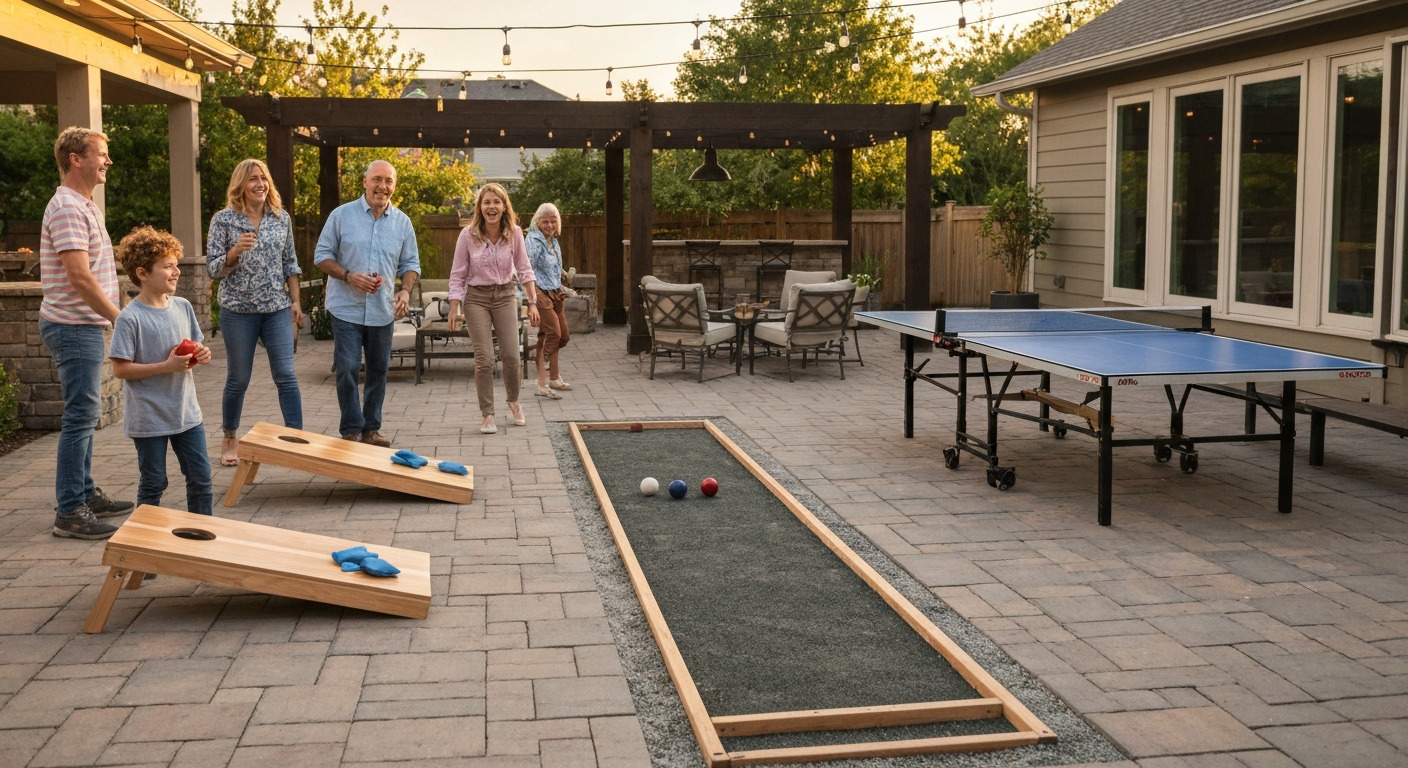
The best patio games for most homeowners are cornhole, bocce, and a portable tabletop game like KanJam or Kubb. For a fuller list and buying tips, see our guide to the best outdoor patio games. They cover the full range of ages, pack away easily, work on nearly any surface, and won't eat your entire outdoor budget. That said, the right pick depends heavily on how much space you have, who's playing, what your patio surface is made of, and how close your neighbors are. This guide walks through all of it, from regulation footprints to noise courtesy rules, so you can make a smart choice before you buy.
Best Patio Games: Complete Buyer & Planning Guide for Homeowners

Elise Prescott
18 Jul 2026
How to use this guide
Whether you're setting up a brand-new patio or just trying to make better use of an existing one, games are one of the fastest ways to turn an underused outdoor space into the spot everyone actually wants to hang out. I've tested and researched options across all categories, dug into official regulation dimensions, materials specs, and noise ordinance guidance, and pulled together the practical stuff most buying guides skip. You'll find curated picks by category and age, surface-specific advice, space and noise rules, layout descriptions for three common patio sizes, a full comparison matrix, and clear criteria for what to look for when you're actually shopping. If you're also thinking about patio gifts, decorations, or gadgets to round out the space, those topics are worth exploring alongside this guide.
Quick planning checklist before you buy anything
Running through these five factors before you pick a game will save you from buying something that ends up in the garage after one use.
- Space: Measure your usable patio area in feet. A regulation cornhole setup needs roughly 30–35 ft of clear length and 10–12 ft of width. Bocce scaled for a backyard needs 50–60 ft. A balcony or small patio under 200 sq ft steers you toward tabletop or compact active games.
- Budget: Decent portable lawn game sets start around $30–$60. Mid-range tournament-quality sets (solid wood, weatherproof finish) run $80–$200. Built-in or permanent installations like a horseshoe pit or bocce court can run $500–$3,000+ depending on materials and whether you hire a contractor.
- Noise level: Think honestly about your proximity to neighbors and your local quiet-hours rules. Tossing a beanbag is quiet. Spike-ball rallies, ladder toss clacking, and outdoor table tennis rallies generate real noise. WHO Environmental Noise Guidelines recommend keeping outdoor residential exposure below roughly 55 dB(A) daytime; most city ordinances enforce quiet hours starting at 9 or 10 PM.
- Climate and surface: A resin-top folding game table that works great in San Diego will warp, crack, or rust faster in Minnesota winters or Gulf Coast humidity. Match materials to your NOAA climate region: freeze-thaw north, high-UV south, humid subtropical, and coastal salt-air zones all have different durability needs.
- Intended users: Kids under 8, teens, adults, mixed-age parties, and seniors all have different coordination, strength, and attention-span profiles. Pick games that cover your actual guest list, not just the youngest or oldest attendee.
Top patio games by category and age
Here are curated picks across six categories. I've tried to flag the most important specs and honest trade-offs for each one rather than just listing names.
Lawn games (open space, standing play)
Cornhole is the most versatile starting point. Official ACA regulation boards are 48 x 24 inches with a 6-inch hole centered 9 inches from the top, and regulation pitch distance is 27 feet between front board edges. For backyard play, most people shorten that to 20–25 feet, which still works fine. The AllCornhole Tournament Series is a consistently recommended pick among enthusiasts for its solid hardwood construction, clean finish, and durability. Expect to pay $120–$200 for a quality set. Budget sets under $50 exist but typically use thinner plywood that dents and warps within a season outdoors.
Bocce ball is slower-paced, low-noise, and genuinely fun for ages 5 through 85. Regulation club courts run 76–91 feet long depending on the federation, but a scaled backyard court at 50–60 feet by 10–12 feet plays great and fits in most suburban backyards. You don't need a dedicated court to enjoy bocce, but if you want to build one, budget 2–4 feet of walking clearance outside the side boards. A decent bocce set with resin balls runs $25–$60; premium Italian-made sets with metal balls cost $80–$150 and last significantly longer.
Kubb is a Swedish lawn game where you knock over wooden blocks using wooden batons. It's quiet, skill-based, and plays well with 2 to 12 people. A regulation Kubb court is roughly 26 feet by 16 feet, but informal play works in less space. Natural hardwood sets weather reasonably well if stored dry; look for sets made from hardwood rather than softwood dowels for durability.
Active games (higher energy, more movement)
Spikeball is compact, intensely active, and requires about a 15–20 foot diameter clear zone. It's best for teens and adults. The net and frame store in a bag about the size of a small duffel. It generates moderate noise from ball impact and player movement, so consider your neighbor proximity. KanJam is another great option in this tier: two players stand roughly 50 feet apart and deflect a flying disc into a cylindrical goal. It sets up and packs down in minutes and works on virtually any flat surface.
Ladder toss (sometimes called ladder golf) uses bolas, which are two balls connected by a rope, thrown at a three-rung ladder about 15 feet away. The clacking of bolas hitting the rungs is genuinely noisy, something worth noting if you have close neighbors. Quality sets with metal or solid plastic rungs run $30–$60. Avoid very cheap sets where the rungs flex and wobble, which makes scoring inconsistent.
Tabletop games (works anywhere with a table)
Outdoor table tennis is a premium option that transforms a patio into a full activity hub. Cornilleau makes some of the best outdoor tables available, with Aluzinc or aluminum composite tops, powder-coated steel frames, and warranties up to 10 years on their outdoor models. Expect to pay $600–$1,500 for a quality outdoor table. The footprint is roughly 9 feet by 5 feet for the table itself, plus 8–10 feet on each end for gameplay, putting total space needs at around 25 feet by 12 feet minimum.
For smaller surfaces, giant Jenga and oversized playing cards are patio staples that require almost no space. Giant Jenga sets made from smooth-sanded pine or bamboo work well outdoors in dry climates; in wet climates, look for sets with a sealed finish or use an outdoor-rated wood treatment annually. Magnetic travel games and waterproof card decks are worth considering for balcony setups where space is at a premium.
Quiet games (for neighbor-sensitive or evening play)
Bocce, horseshoes, and chess/checkers played on an outdoor set are your quietest options. Horseshoes generate some metal-on-metal clanging but less sustained noise than active games. If you're playing after 9 PM, you're really in bocce, card game, or board game territory. Glow-in-the-dark versions of cornhole and bocce exist for evening play; they use LED or glow inserts and are quieter than you might expect because the game mechanics don't change.
Family-friendly games (mixed ages, kids included)
Ring toss, bocce, and oversized Connect Four are excellent mixed-age picks because skill gaps between adults and children close faster than in games like cornhole or Spikeball. Giant Connect Four sets made from powder-coated steel frames and durable plastic discs hold up outdoors well. Ring toss sets are inexpensive ($15–$35) and pack flat. These are also natural fits as patio gifts, especially for families with young kids.
Adult party games
Outdoor pong tables, cornhole with custom scoring rules, and drinking-game variations of existing sets dominate this category. Most outdoor pong tables are folding aluminum or high-density polyethylene (HDPE) topped with waterproof surfaces; decent ones start around $80–$150. For serious entertaining, a permanent built-in bar ledge or game table is worth discussing with a local carpenter, especially if your patio already has a pergola or shade structure as an anchor.
Matching games to your climate and patio surface
This is the section most guides skip, and it's where a lot of homeowners end up frustrated after their first full year. What works in Phoenix will crack, warp, or rust in Maine. Here's how to think about surface and climate compatibility.
Pavers and concrete
Hard, flat, and durable, pavers and concrete are the most forgiving surfaces for almost any game. The main risk is that dragging or dropping heavy game equipment can chip pavers, so use rubber-footed board stands or place mats under equipment. Cornhole boards and bocce are excellent matches. Permanent horseshoe pits can be built adjacent to a paver patio by digging into a grass or gravel area rather than cutting into the hardscape.
Wood decking
Wood decks require more care. Avoid dragging anything with metal feet across composite or hardwood decking; even composite can scratch. Place rubber pads or outdoor rugs under game equipment. Heavy rolling items like bocce balls can dent softer woods. Table tennis on a deck works well if the surface is level. Spikeball's center spike should not be used on decking without a protective base plate.
Gravel
Gravel is actually one of the best surfaces for bocce and horseshoes because it naturally absorbs impact and allows some ball movement. It's terrible for active games requiring quick footwork, like Spikeball or ladder toss, because footing is unstable. Pea gravel at 2–3 inch depth with a compacted base is a classic bocce court substrate.
Artificial turf
Artificial turf is a great all-around game surface. It cushions falls for active games, provides even footing, and looks clean. Heat is the main concern in high-UV southern climates (NOAA's warm/hot south climate region): artificial turf can reach 150–180°F surface temperatures in direct afternoon sun, which is uncomfortable for bare feet and can soften or warp plastic game equipment. Schedule active play in morning or evening hours and look for turf with heat-reduction infill options.
Small balconies
With under 100 square feet of usable floor space, your game options narrow to tabletop games, magnetic games, card and tile games, and compact two-person options like tabletop shuffleboard. A folding card table that stores flat when not in use is a practical investment. Ring toss with a weighted base that doesn't scratch flooring is a workable active option. Avoid anything with projectiles (flying discs, bolas) that can sail over the railing.
Climate region material guide
| Climate Region | Primary Risk | Recommended Materials | Avoid |
|---|---|---|---|
| Freeze-thaw North (Zones 3–5) | Cracking, warping, rust | UV-stabilized HDPE, powder-coated steel, cedar/teak with annual finish | Untreated pine, thin MDF, bare metal hardware |
| High-UV South (Zones 8–10) | UV degradation, heat warp | UV-stabilized HDPE, aluminum, sealed marine plywood | Dark-colored plastic composites, thin resin |
| Humid Subtropical (Southeast) | Moisture, mold, rot | HDPE poly lumber, teak, cedar, marine-grade plywood | Untreated wood, particle board, unsealed MDF |
| Coastal/Salt-Air | Corrosion, salt damage | Marine-grade aluminum, HDPE, stainless hardware | Galvanized steel (eventual corrosion), bare iron |
| Arid Southwest (low humidity) | UV fade, heat | UV-stabilized HDPE, powder-coated aluminum | Natural rubber seals (dry-cracking), untreated wood |
Western red cedar is a reliable natural-wood choice across most climates thanks to its natural decay resistance (confirmed by wood durability research). When you need a plywood top for something like a cornhole board that will face heavy rain or standing water, marine-grade plywood with WBP phenolic glue and low-void cores holds up significantly better than standard exterior plywood and resists delamination season after season. For the absolute lowest-maintenance option in harsh climates, UV-stabilized HDPE poly lumber can realistically last 20-plus years outdoors with no finish maintenance.
Space and noise rules: what actually matters
Sizing and sightlines
Every game has a minimum safe activity zone that extends beyond the game footprint itself. Cornhole needs 30–35 feet of clear length and 10–12 feet of width for both player lanes and spectators. Ladder toss needs at least 20 feet of clear length (toss line to ladder is 15 feet, plus clearance behind each). Bocce scaled for a backyard needs 50–60 feet by 10–12 feet with 2–4 feet of clearance outside the side boards. Horseshoe pits per NHPA specs allow pit widths of 31–36 inches with pit lengths of 43–72 inches depending on configuration, and you need a clear approach zone behind each stake. Don't forget vertical sightlines for flying discs or bolas: overhanging branches, pergola beams, and string lights can all interfere.
Circulation and traffic flow
Keep at least 3 feet of walkway clear between any game zone and seating, food tables, or doorways. This matters both for safety during active play and for guests who aren't playing to move around freely. If your patio has a grill or outdoor kitchen, position game zones on the opposite side of the space to prevent a flying disc or errant horseshoe from landing near hot equipment.
Noise levels and neighbor courtesy
WHO Environmental Noise Guidelines recommend keeping average outdoor residential area noise exposure below roughly 55 dB(A) during the day and around 45 dB(A) at night. The EPA has similarly cited an outdoor day-night average of around 55 dB as an upper benchmark for residential areas. These aren't hard legal limits in most jurisdictions (your local municipal code is what actually gets enforced), but they're useful calibration points. In practice, ladder toss clacking, Spikeball hits, and competitive cornhole shouting all push well past 55 dB during active rallies. This isn't a problem at 3 PM on a Saturday, but it absolutely is at 10 PM.
City ordinances vary significantly. Los Angeles, for example, enforces rules against noise audible beyond a specified distance or that raises ambient levels by a set decibel amount. HOAs commonly set quiet hours starting between 9 and 10 PM that are stricter than municipal codes, and they can enforce those rules through fines. Before you set up a game zone and invite 20 people over, spend five minutes checking your local ordinance and HOA rules. The practical rule of thumb: keep active, loud games to before 9 PM, switch to bocce and card games after that, and keep voices down after 10 PM.
Layout descriptions for three common patio sizes
Small balcony (under 100 sq ft)
Think of a small balcony as a single social zone with one multi-purpose table at the center. Place a folding card table or small bistro table in the middle third of the space, leaving at least 18–24 inches of circulation on each side. Seating lines the walls or railing. Game storage goes under the table in a weatherproof bag or flat storage bin. Active games don't belong here, so stick to card games, tile games like dominoes, and tabletop versions of larger games. If you want any physical game element, a ring toss target with a weighted base that doesn't need to be anchored is the best option, set against the far wall and removed when guests are moving around.
Medium patio (100–300 sq ft)
A medium patio can usually support one lawn game zone and one seating zone, but not simultaneously in the same footprint. The key is zoning with flexibility. Position your seating cluster (chairs, small side tables) along one edge or corner, leaving the central and far portion of the space open for a game. Cornhole boards at a recreational 20-foot pitch rather than regulation 27-foot work well here. Store boards flat against the house wall or in a vertical board rack when not in use. A folding outdoor table in the seating zone doubles as a game surface for tabletop options. Keep circulation paths of at least 3 feet open between the seating zone and the game zone.
Large entertaining patio (300+ sq ft)
A large patio can support dedicated game zones, a seating zone, and a dining or grill zone as distinct areas. Zone games toward the back or side of the property, away from the grill and main dining table. In a 400+ sq ft space, a full 27-foot cornhole lane running along the long axis with spectator space on both sides is achievable. A bocce zone works well on a side lawn adjacent to the patio hardscape. A table tennis table at one end, if you have 25 feet by 12 feet to spare, anchors a permanent activity zone. Use low border plantings, a change in surface material (turf to pavers), or string lights overhead to visually delineate zones without hard barriers. Traffic flow should have clear paths connecting the dining area, grill station, seating, and game zones without forcing guests to walk through any active play area.
At-a-glance comparison: picking the right game for your setup
| Game | Footprint Needed | Noise Level | Portability | Storage Size | Skill Curve | Best Age Range | Price Range |
|---|---|---|---|---|---|---|---|
| Cornhole | 30–35 ft x 10–12 ft | Low–Medium | High (2 boards + bag) | Medium (boards lean flat) | Low | 6+ | $50–$200 |
| Bocce Ball | 50–60 ft x 10–12 ft | Low | High (bag of balls) | Small (bag) | Low | 5+ | $25–$150 |
| Kubb | 26 ft x 16 ft | Low | High (bag) | Small–Medium | Medium | 8+ | $30–$80 |
| Spikeball | 15–20 ft diameter | Medium | High (bag) | Small (bag) | Medium–High | 12+ | $50–$80 |
| KanJam | ~50 ft x 8 ft | Low–Medium | High (2 goals + disc) | Small | Low | 8+ | $30–$50 |
| Ladder Toss | ~20 ft x 6 ft | Medium–High | High (folds flat) | Small–Medium | Low–Medium | 8+ | $30–$60 |
| Horseshoes | ~40 ft x 6 ft (with pits) | Medium | Low–Medium (needs pit) | Medium (stakes + shoes) | Low | 10+ | $30–$80 (set); $200–$500 pit build |
| Outdoor Table Tennis | 25 ft x 12 ft min | Medium | Low (table stays put) | Large (table) | Medium–High | 8+ | $600–$1,500 |
| Giant Jenga | ~6 ft x 6 ft | Low | High (carry bag) | Medium (tall bag) | Low | 5+ | $30–$80 |
| Giant Connect Four | ~4 ft x 4 ft | Low | Medium (frame folds) | Medium | Low | 4+ | $50–$120 |
| Ring Toss | ~6 ft x 4 ft | Low | High | Small | Low | 3+ | $15–$35 |
What to look for when you're actually buying
Materials and finish
For wood frames and boards, look for solid hardwood (maple, birch, oak) or naturally rot-resistant species like Western red cedar, teak, or redwood. Avoid sets made from MDF, particle board, or thin softwood dowels. For cornhole boards specifically, marine-grade plywood tops are worth the premium if you live in a rainy climate or plan to leave boards outside between uses. Metal components should be powder-coated steel or aluminum, not bare galvanized, especially in coastal or humid climates. For plastic components, UV-stabilized HDPE is the material to look for in product listings; it handles heat, UV, and moisture significantly better than generic polypropylene or ABS.
Portability and anchoring
Portability matters even if you think a game will stay in one place. You'll want to bring it inside during severe weather, store it in winter if you're in a freeze-thaw climate, and move it for cleaning. Look for folding legs, carry bags included with the set, and handles or straps on heavier pieces. For games that require ground anchoring (Spikeball, some ladder toss frames), check that the anchoring spike or base is rated for your surface. Never drive metal spikes into composite decking or pavers.
Warranties and lifespan
A warranty is a useful proxy for build quality. Cornilleau outdoor table tennis tables carry warranties up to 10 years on many models, which reflects confidence in their aluminum composite tops and powder-coated frames. For lawn game sets under $100, a one-year warranty is common; anything less suggests a manufacturer expecting early failure. If a product listing has no warranty information at all, treat that as a warning sign. High-quality HDPE sets often come with lifetime or multi-decade claims from reputable manufacturers.
Safety features
- Smooth, splinter-free edges on wood boards and frames (critical for kids)
- Non-slip rubber feet on boards that sit on hard surfaces
- Rounded or capped metal tube ends on ladder toss and similar frames
- Bola and disc weight specs within safe ranges for the intended age group
- Stable base design for freestanding games; tip-over risk is real on uneven surfaces
- Age rating labels (look for ASTM or CPSC compliance claims on children's products)
Where to buy: retail vs specialty makers
For budget to mid-range sets, major retailers like Amazon, Target, Walmart, and Costco carry most of the popular games in this guide. Prices are competitive and return policies are generous if something arrives damaged. For higher-quality or tournament-level sets, specialty retailers and direct manufacturers are worth the extra step. GoSports, Champion Sports, and Franklin Sports offer solid mid-range options across multiple game types. For cornhole specifically, AllCornhole and GetThemSets make competition-grade boards that don't cost as much as you'd expect ($100–$180 for solid sets). Cornilleau for outdoor table tennis is best purchased through authorized dealers like PingPong Depot or direct from Cornilleau's own website to ensure warranty coverage. For custom or built-in game installations (permanent bocce courts, horseshoe pits, built-in game tables), get quotes from local contractors and carpenters who specialize in outdoor living spaces rather than trying to adapt indoor furniture makers.
Build vs buy: when to hire a contractor
Most portable lawn and tabletop games are buy-it-and-play propositions. The only real case for hiring a contractor is permanent installations: a poured-concrete horseshoe pit surround, a leveled and bordered bocce court with a proper gravel base, or a custom built-in game table integrated into a pergola or outdoor kitchen. A horseshoe pit with proper pit dimensions (31–36 inch wide, 43–72 inch long per NHPA specs) and concrete surrounds runs $200–$800 in materials and a day of labor. A gravel bocce court with lumber or concrete borders and a compacted base runs $500–$2,500 depending on size and material quality. For either project, a local landscape contractor or hardscape specialist is a better hire than a general handyman; they'll understand drainage, base preparation, and surface leveling in ways that matter for long-term playability.
Keeping games, your patio, and your neighbors intact
The best patio game setup is one that gets used without creating friction, whether that's with the playing surface, the people playing, or the neighbors next door. For common pitfalls to avoid, see our guide on the worst patio decorating mistakes. For complementary gear and accessories, see our roundup of the best patio gadgets. Invest in a weatherproof storage solution (a deck box, a vertical board rack, or a covered storage shelf under a pergola) so games are always accessible and never left out to degrade. Apply a UV-protective sealer or outdoor spar urethane to wood game surfaces annually in wet climates, or every two years in drier ones. Follow manufacturer storage guidance for winter in cold climates: bring HDPE and wood pieces inside for the hard freeze months if possible. And remember, even the most durable bocce set and the most level gravel court don't matter if your neighbors have filed a noise complaint. Keep active play to reasonable hours, know your local ordinance, and when in doubt, switch to a quieter game before 9 PM. A well-designed patio game setup becomes a reason people want to spend time at your house, and that's really the whole point. For quick tips on avoiding common layout and décor errors, also see the short guide titled 5 worst patio decorating mistakes. Pair your game zones with the best patio decorations to create inviting sightlines and comfortable seating areas that encourage guests to stick around.
FAQ
What exact product specifications and official dimensions do I need for each game category (lawn, tabletop, active, quiet)?
Regulation and common recreational dimensions for each game: cornhole boards (48×24 in, 6‑in hole centered 9 in from top; 27 ft pitch), ladder toss toss line (~15 ft), horseshoe pit widths/lengths per NHPA (pit widths 31–36 in, lengths 43–72 in), bocce court options (regulation ~76–91 ft × 10–13 ft; backyard scaled 50–60 ft × 10–12 ft), Spikeball/net game clearances, table‑tennis outdoor table specs (folded and play dimensions). Also include recommended clearances for players and spectators (e.g., add 2–4 ft walkways and 10–12 ft lane widths where relevant) and alternative shortened distances for casual/backyard play.
Which authoritative rulesets and governing bodies should be cited for game footprints and scoring?
Primary sources: American Cornhole Association (ACA) and American Cornhole Organization (ACO) for cornhole rules and court layout; National Horseshoe Pitchers Association (NHPA) for horseshoes; national or international federations for bocce and other organized sports where applicable; manufacturers' official rule pages for branded games (e.g., Spikeball guidance). Use these for competition footprints and to justify recommended backyard scale adjustments.
What climate and material data are required to recommend weatherproofing and expected lifespans?
Local climate classification (USDA Plant Hardiness Zones and NOAA climate regions) to categorize freeze‑thaw, humid, coastal salt‑air, and high‑UV environments. Material performance data: decay resistance of wood species (Western red cedar, teak, redwood), marine‑grade plywood specs (WBP phenolic glue), UV‑stabilized HDPE/poly‑lumber longevity and formulation notes, metal finishing specs (galvanizing, powder coat), and manufacturer warranty/longevity claims (e.g., Cornilleau outdoor table warranties). Include expected maintenance intervals by climate.
What surface‑and‑site prep information is needed to advise placement without damaging patio finishes?
Substrate compatibility: which games work on pavers, poured concrete, wood decking, artificial turf, and lawn. Recommendations for protective pads or brackets to avoid scratching/indentation, anchoring methods for different surfaces (sandbags, ground stakes vs. screw‑in anchors on decks), surface drainage/grade guidance to prevent standing water under game fixtures, and instructions for temporary non‑penetrating anchorage to protect finishes.
What noise and neighborhood‑courtesy references should be used when advising game selection and scheduling?
WHO Environmental Noise Guidelines (health‑based day/night thresholds), EPA historical outdoor noise benchmarks (~55 dB Ldn), and local municipal noise ordinances (example: Los Angeles code) for legal limits. HOA rules and typical quiet‑hour policies (Nolo/Hoa guidance) to recommend quiet‑hours, sound‑mitigation options (softer equipment, rubber backs, playtime limits), and template neighbor courtesy agreements.
What safety, legal, and liability guidance is necessary for homeowners and contractors?
Basic safety guidance: clearance zones, trip‑hazard mitigation, anchoring and wind‑load precautions, and child‑safety recommendations (soft edges, supervised play). Legal references: local noise ordinances, HOA covenants, and permits if building permanent fixtures that alter drainage or require structural changes. Recommend contractors verify local building/permit requirements and carry liability insurance and written contracts specifying scope/warranty.