
Home porch and patio kits range from sub-$500 canopy setups to engineered louvered pergolas that cost $10,000 or more installed. If you are trying to pick the right structure for your space, the honest answer is that no single kit wins for everyone. A cedar pergola kit from Yardistry (starting around $909) works beautifully in the Pacific Northwest but can warp fast in Florida humidity. A powder-coated aluminum louvered roof handles Gulf Coast sun and rain without complaint but is overkill for a dry Colorado patio. This guide walks through every major category, side-by-side specs, real assembly time estimates, climate-specific material guidance, and what buyers consistently report in verified reviews so you can make a confident call whether you are swinging a wrench yourself or hiring a crew.
Home Porch and Patio Kits Reviews: Compare, Choose, Install.

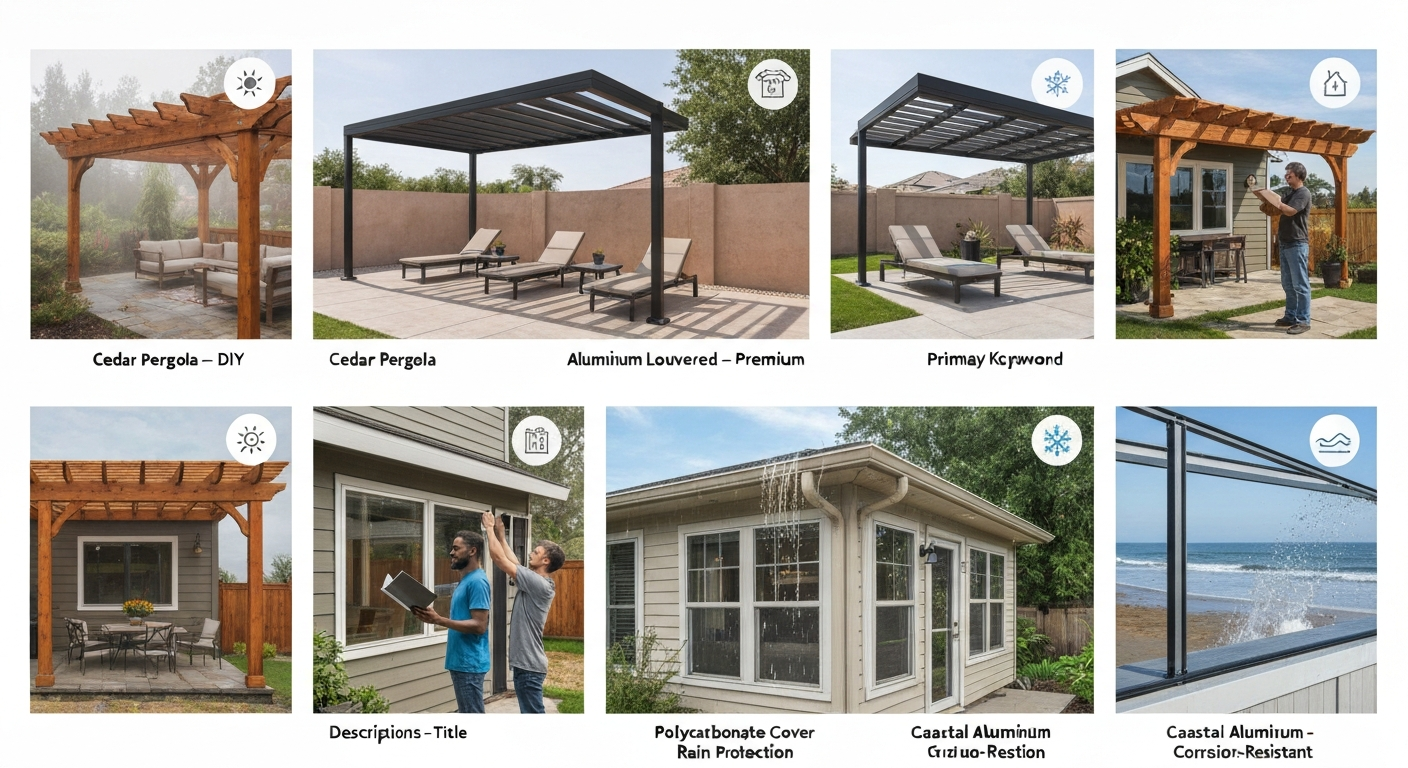
Who This Guide Is For and What It Covers
This article is written for homeowners, renters with landlord approval, and DIYers at any skill level who are comparing porch and patio structure kits before spending money. It covers four product categories: patio kits (complete deck or enclosure bundles), pergolas, retractable and fixed awnings, and patio covers or carport-style shade structures. You will find a quick-comparison table, detailed feature and price comparisons, assembly difficulty and realistic install time estimates, materials durability guidance broken down by climate zone, and mini-reviews of the porch and patio paints most commonly paired with these structures. The article also points toward recommended accessories (fans, misting systems, lighting, heaters) and flags when a project crosses the line from weekend DIY into permit-required professional work.
Quick Comparison at a Glance
The table below compresses the key decision variables across the four main categories. Use it to quickly narrow your shortlist, then dig into the detailed sections that follow for the full picture.
| Category | Typical Price Range (DIY kit) | Avg. Assembly Time | Best Climate Fit | Top Budget Pick | Top Premium Pick |
|---|---|---|---|---|---|
| Patio Kits (deck/enclosure bundles) | $300 – $2,500 | 8 – 24 hrs | All climates (material-dependent) | Palram Vista Patio Cover | TEMO Enclosure System |
| Pergolas (freestanding/attached) | $900 – $3,500+ | 10 – 20 hrs | Dry/temperate; cedar in cool-wet | Yardistry 10x12 Cedar (~$909) | StruXure Pergola X (louvered) |
| Awnings (retractable/fixed) | $200 – $3,000+ | 2 – 6 hrs | Sun-heavy regions; wind-sheltered | Advaning Classic Series | SunSetter Pro XL (motorized) |
| Patio Covers (solid/polycarbonate) | $400 – $2,800 | 4 – 12 hrs | Rain-heavy; UV-intense | Palram Feria 3000 Polycarbonate | Stratco Outback Curved Roof |
Top Picks by Use Case
- Best for a first-time DIYer on a budget: Yardistry 10x12 Cedar Pergola Kit (~$909 at Home Depot) — modular, well-documented manual, and a large verified-buyer review base.
- Best for rain and full coverage: Palram Feria polycarbonate patio cover — UV-filtering panels, aluminum frame, and a 10-year structural warranty.
- Best for hot, sunny patios: Retractable awning (SunSetter or Advaning) paired with a ceiling fan mount — the combo drops perceived temperature by 10–15°F without a permanent structure.
- Best for high-wind or permit-required zones: StruXure Pergola X, which carries an ICC-ES Evaluation Report (ESR-5321P) confirming IBC design compliance — useful for permit submittals in strict jurisdictions.
- Best moderate-budget pergola with longevity: Yardistry 12x16 with galvanized hardware, or a vinyl kit in freeze-thaw climates where wood maintenance is a burden.
What Each Category Actually Means
These terms get used interchangeably at retail, and that causes real buyer confusion. Here is what each category is and when to choose it.
Porch and Patio Kits
A patio kit is a bundled package that includes most or all of the structural components needed to build or enclose an outdoor space. The kit may include frame posts, roofing panels, hardware, and sometimes flooring. Budget versions (under $1,000) are typically simple open-roof lean-to structures that attach to a house wall. Mid-range and premium kits ($1,200 and up) may include polycarbonate or tempered glass roofing, gutters, and screened sides. Choose a kit when you want a turnkey material list with no sourcing guesswork and a matched hardware set.
Pergolas
A pergola is an open-roof structure with posts, beams, and rafters that provides filtered shade but not rain protection unless paired with a canopy, louvered roof, or polycarbonate inserts. Freestanding pergolas sit away from the house and require footing anchors or concrete piers. Attached pergolas mount to a ledger board on the house wall. ModernPergolaKits publishes span limits for their lumber: 16 feet for 2x6 rafters, 22 feet for 2x8, with minimum footing depth tied to your local frost line. Louvered-roof pergolas like StruXure add adjustable aluminum slats that open and close for sun or rain control, but they cost significantly more and usually require professional installation. Choose a pergola when you want an architectural focal point, don't need full rain coverage, and plan to layer in a canopy or fabric cover later.
Awnings
Awnings are fabric or metal shade extensions mounted above doors, windows, or the entire patio perimeter. Retractable awnings roll up when not in use, protecting the fabric from wind damage and allowing winter sun in. Fixed awnings are less expensive but permanent. A motorized retractable awning (SunSetter Pro XL, roughly $1,500–$2,800 installed) is the fastest path to patio cooling with no footings, no permits in most jurisdictions, and a two- to four-hour install. The tradeoff is that most awning fabrics need replacement every seven to twelve years, and cheap fabrics fail faster in high-UV climates like Arizona or Texas. Choose an awning when wall-mounting is practical, you want reversible shade, or your HOA restricts permanent structures.
Patio Covers
A patio cover provides a solid or semi-transparent roof over an existing patio slab, deck, or porch. They attach to the house fascia or sit on freestanding posts and are designed to shed rain, block UV, and in some configurations provide insulation. Polycarbonate panel covers (like Palram Feria) transmit light while blocking up to 99% of UV. Solid aluminum or steel pan covers block all light but are virtually maintenance-free. Choose a patio cover when you want full weather protection without the cost of a room addition, especially in climates with heavy summer rain or intense UV.
Side-by-Side Feature and Price Comparisons
The following table compares specific kit models across the specs that matter most in a purchase decision. Prices reflect retail listings as of mid-2026 and will vary by retailer and region.
| Product | Size (ft) | Material | Warranty | Approx. Price (kit only) | Included Hardware | Avg. Assembly Time |
|---|---|---|---|---|---|---|
| Yardistry 10x12 Cedar Pergola | 10 x 12 | Cedar wood, galvanized hardware | 1-year limited | ~$909 | Yes (bolts, brackets) | 10–14 hrs |
| Yardistry 12x16 Cedar Pergola | 12 x 16 | Cedar wood, galvanized hardware | 1-year limited | ~$2,200 | Yes (bolts, brackets) | 14–18 hrs |
| ModernPergolaKits 16x16 Freestanding | 16 x 16 | Pressure-treated or cedar lumber | Varies by wood | ~$1,800–$2,500 | Yes (full hardware kit) | 16 hrs (per Lowe's listing) |
| Palram Feria 3000 Patio Cover | 9.8 x 19.6 | Aluminum frame, polycarbonate panels | 10-year structural | ~$1,200–$1,600 | Yes (all fasteners, gutters) | 6–10 hrs |
| SunSetter Pro XL Retractable Awning | 20 x 10 | Aluminum arm, Sunbrella-grade fabric | 5-year on fabric, lifetime on frame | ~$1,500–$2,800 | Wall mount hardware included | 2–4 hrs |
| StruXure Pergola X (louvered) | Custom (10x10 common) | Extruded aluminum, powder-coated | Lifetime on frame (ICC-ES certified) | $8,000–$20,000+ installed | Engineered — pro install | Professional only |
| Advaning Classic S Series Awning | 10 x 8 | Aluminum frame, polyester fabric | 3-year on fabric, 5-year on frame | ~$280–$450 | Wall mount hardware included | 2–3 hrs |
A few things stand out in that comparison. The Yardistry 10x12 is the most accessible entry point for a pergola with a real wood look, but its one-year warranty is short relative to the Palram's ten-year structural coverage. The ModernPergolaKits 16x16 is the best value at the 16-foot span class if you want lumber you source locally matched to the hardware kit. StruXure is a different category entirely: it is an engineered product with an ICC-ES report backing permit submittals, which matters in jurisdictions with strict wind-load requirements.
How We Rate and Compare These Products
Because outdoor structure kits sit in a category that does not have standardized third-party lab testing the way appliances or electronics do, our ratings combine manufacturer-published specifications, verified retailer review aggregates, applicable ASTM test standards referenced in material data sheets, and contractor feedback. Here is exactly what each rating dimension reflects.
- Assembly difficulty: Based on the manufacturer's own step-count and tool list from installation manuals, cross-referenced against recurring buyer complaints in verified retailer review pages. A Yardistry pergola, for example, draws consistent comments about unclear rafter-alignment steps on Home Depot's review aggregate.
- Material durability: Referenced against ASTM G154 (fluorescent UV lamp exposure testing) and ASTM B117 (salt-spray corrosion testing) where manufacturers publish compliance data. Powder-coated aluminum frames that cite G154 and B117 compliance are rated higher for coastal and high-UV climates.
- Fastener and hardware quality: Evaluated using Simpson Strong-Tie's corrosion guidance, which specifies that ACQ/CA pressure-treated wood requires hot-dip galvanized fasteners meeting ASTM A153, or stainless steel — not standard zinc-plated hardware. Kits that include compliant fasteners out of the box are rated higher.
- Warranty value: Compared numerically. Trex composite decking, for reference, offers 25- to 50-year residential limited warranties depending on product line — a benchmark that most wood kit warranties (often one year) fall well short of.
- Price-to-value: Scored by dividing usable square footage by total kit cost and adjusting for warranty length and included hardware quality.
- Real-world assembly time accuracy: Manufacturer-stated times are benchmarked against buyer review commentary and, where available, timestamped YouTube walkthroughs published by manufacturers or verified DIYers.
Where independent lab test data is not available from the manufacturer, we note that gap explicitly rather than extrapolating. Budget kits, in particular, rarely publish ASTM compliance data, which is itself a differentiating factor worth weighing.
Assembly Difficulty and Realistic Install Times
DIY Assembly: What to Expect
The Lowe's listing for the ModernPergolaKits 16x16 freestanding pergola states an average assembly time of 16 hours. That is a honest number for two reasonably handy adults working with a complete tool set. Smaller kits like the Yardistry 10x12 typically run 10 to 14 hours for first-time builders. Suncast's pergola installation manual (available via Home Depot) explicitly requires two people and lists a minimum tool set including a post level, socket wrench set, and rubber mallet. Factor in site prep (clearing, leveling, marking footing locations) and add two to four hours on top of the manual's stated assembly time for a realistic first-build total. Most manufacturers also link to step-by-step YouTube series that serve as a useful reality check before you buy.
Retractable awnings are the fastest DIY install in this category, typically two to four hours for a mid-size unit. You need a stud finder, a level, a drill, and ideally a second person to hold the bracket housing during positioning. Polycarbonate patio cover kits (like Palram Feria) run six to ten hours and require careful attention to panel sealing to prevent leaks at the ridge.
When to Hire a Professional, and What It Costs
If your project involves setting concrete footings deeper than 12 inches, attaching a ledger to a structural wall, exceeds 200 square feet, or sits in a jurisdiction that requires a building permit, hiring a licensed contractor is strongly worth considering. Angi's national cost data puts professional pergola installation at roughly $2,000 to $6,000 for a standard 10x12 to 12x16 freestanding kit, inclusive of labor, concrete, and minor site work but excluding the kit itself. Premium louvered-roof systems like StruXure start around $8,000 to $10,000 for a 10x10 installed and scale up sharply with size. Permits in most jurisdictions for structures over a threshold size (commonly 200 sq ft, though this varies) add $150 to $500 to the project cost. Always check with your local building department before starting, the Suncast installation manual explicitly advises this, and ignoring it can trigger a stop-work order or complicate a future home sale.
| Project Type | DIY Time Estimate | Pro Labor Cost (national avg) | Permit Typically Required? |
|---|---|---|---|
| Small pergola kit (10x12) | 10–14 hrs | $800 – $2,500 labor | Sometimes (check locally) |
| Large pergola kit (16x16+) | 16–20 hrs | $2,000 – $4,500 labor | Often yes |
| Polycarbonate patio cover | 6–10 hrs | $600 – $1,800 labor | Sometimes |
| Retractable awning (wall-mount) | 2–4 hrs | $200 – $600 labor | Rarely |
| Louvered pergola (engineered) | Not DIY | $5,000 – $15,000+ installed | Usually yes |
| Enclosed porch/sunroom kit | 20–40+ hrs | $3,000 – $10,000+ labor | Usually yes |
Materials and Durability by Climate
This is where most buyers go wrong. They pick a material based on looks in a showroom photo rather than how it will perform after three summers in their actual climate. Here is the honest breakdown.
Wood (Cedar, Pressure-Treated Pine)
Cedar is naturally rot-resistant and dimensionally stable in moderate climates. It performs well in the Pacific Northwest, New England, and the Upper Midwest if sealed every two to three years. In humid subtropical climates (Florida, Gulf Coast, parts of the Southeast), cedar can hold moisture and begin to check and warp within two to three seasons without consistent maintenance. Pressure-treated pine is more affordable and more resistant to insects and rot, but it requires fasteners rated for chemical compatibility. ACQ and CA treated lumber is corrosive to standard zinc-plated fasteners; Simpson Strong-Tie's technical guidance is clear that these applications require hot-dip galvanized fasteners meeting ASTM A153, or stainless steel for high-retention treatments. Simpson Strong‑Tie, Corrosion Information for all Product Lines provides technical notes on fastener compatibility with ACQ/CA treated wood and recommends hot‑dip galvanizing or stainless steel and coating classes (for example, Class 55 mechanically applied zinc) where required Simpson Strong‑Tie — Corrosion Information for all Product Lines. AWPA use category guidance (UC4A for ground contact, UC3B for above-ground exposed) should match the treatment rating of any lumber you buy for structural posts. Wood moisture content should be measured before and after installation in humid climates using an ASTM D4442-compliant moisture meter to avoid post-install warping.
Aluminum (Powder-Coated)
Powder-coated aluminum is the most versatile material across all climate zones and the dominant choice for premium kits. A properly applied architectural powder coat resists UV degradation (tested to ASTM G154 fluorescent UV exposure protocols) and salt-spray corrosion (tested to ASTM B117). For coastal environments within one mile of saltwater, look for manufacturers that specify marine-grade anodizing or a two-coat powder finish, as standard powder coat can show corrosion at cut edges and fastener holes in salt-spray conditions within five to ten years. Inland and mountain climates are much less demanding on aluminum, making it an excellent freeze-thaw performer since it does not absorb moisture and does not crack the way wood or vinyl can in repeated freeze-thaw cycles.
Vinyl (PVC)
Vinyl pergola kits are maintenance-free in appearance: they do not need painting or staining and resist rot and insects. The tradeoff is structural. Vinyl is less rigid than wood or aluminum and can sag over long spans in high heat. In climates above 100°F (Phoenix, Las Vegas, inland California), vinyl rafters on spans over 10 feet can visibly deflect under canopy loads. In freeze-thaw climates (Minnesota, Colorado, the Dakotas), vinyl holds up well provided it uses UV-stabilized PVC, which resists the chalking and brittleness that non-stabilized vinyl develops after five to seven years of UV exposure.
Steel
Steel pergola and cover kits are common at the budget end of the market and in commercial-grade structures. Galvanized steel handles moisture and freeze-thaw well, but bare or poorly coated steel will begin surface-rusting in two to three seasons in humid or coastal climates. If you are buying a steel-frame kit, confirm the coating standard: hot-dip galvanizing per ASTM A153 provides significantly longer corrosion protection than electrogalvanizing or zinc spray. Engineered steel covers for carports are often the most affordable full-cover option per square foot but require more careful site anchoring in wind-prone regions.
Fabrics (Canopy and Awning Covers)
Awning and canopy fabrics vary enormously in UV and mold resistance. Solution-dyed acrylic (Sunbrella and equivalent grades) is the performance standard: the pigment runs through the fiber rather than surface-coating it, giving it five to ten year service life even in high-UV southern climates. Standard polyester canopies typically last three to five years in full sun and are more susceptible to mildew in humid climates. Look for a UPF 50+ rating and a water-resistance treatment (not waterproof, most awning fabrics are water-resistant, meaning they shed rain in moderate intensity but can soak through in a sustained downpour). In high-wind climates, retractable awning arms should be rated for at least 25–35 mph gusts, and motorized units with wind sensors retract automatically when wind thresholds are exceeded.
Climate Summary Table
| Climate Type | Best Material Choice | Materials to Avoid | Key Concern |
|---|---|---|---|
| Hot/dry (Phoenix, Las Vegas) | Powder-coated aluminum, solution-dyed fabric | Unsealed wood, non-UV-stabilized vinyl | UV degradation, thermal expansion |
| Hot/humid (Florida, Gulf Coast) | Aluminum, composite, stainless-fastened PT wood | Cedar without sealant, standard zinc fasteners | Moisture, mold, corrosion |
| Temperate/rainy (Pacific Northwest) | Cedar (sealed), aluminum, polycarbonate covers | Vinyl over long spans | Rot, moss, surface moisture |
| Cold/freeze-thaw (Minnesota, Colorado) | UV-stabilized vinyl, aluminum, galvanized steel | Unsealed wood, standard vinyl | Frost heave, freeze-thaw cracking |
| Coastal (within 1 mile of saltwater) | Marine-grade aluminum, stainless steel fasteners | Standard powder coat, zinc-plated hardware | Salt-spray corrosion |
| High-wind zones (Tornado Alley, hurricane coast) | Engineered aluminum (ICC-ES certified), anchored steel | Lightweight vinyl, unsecured canopy | Wind uplift, structural failure |
Pros and Cons by Product Category
Patio Kits (Complete Bundles)
- Pro: Everything matched and pre-engineered — no hardware guesswork or sourcing separate components.
- Pro: Usually includes installation guide, all fasteners, and manufacturer support.
- Pro: Mid-range polycarbonate kits offer genuine rain and UV protection at a fraction of a room-addition cost.
- Con: Kit dimensions are fixed, so odd-shaped patios often require custom cuts or leave awkward gaps.
- Con: Budget kits under $600 frequently use thin aluminum extrusions that flex under snow or canopy load.
- Con: Warranty on budget kits is often one year or less on structural components.
- Common tradeoff: Cheaper panels (twin-wall polycarbonate under 8mm) let in more UV and show yellowing faster than thicker or triple-wall alternatives.
Pergolas
- Pro: Open-roof design allows airflow and feels less confining than a fully enclosed cover.
- Pro: Wide style range from rustic cedar to modern aluminum; high curb-appeal return.
- Pro: Modular kits like Yardistry allow size expansion over time.
- Con: Provides no rain protection without an added canopy, curtains, or louvered roof system.
- Con: Wood pergolas require annual inspection and sealant every two to three years to prevent checking and graying.
- Con: Large kits (16 ft+) often require footing excavation, concrete, and potentially a permit.
- Common tradeoff: The louvered roof upgrade that makes a pergola genuinely weatherproof often costs as much as the base kit, doubling the total project price.
Awnings
- Pro: Fastest install in the category — typically a half-day project with two people.
- Pro: Retractable versions are fully reversible and HOA-friendly.
- Pro: Can reduce patio surface temperature by 10–15°F in direct sun.
- Con: Fabric requires replacement every seven to twelve years depending on quality and UV exposure.
- Con: Not designed for sustained heavy rain or snow load — must be retracted in storms.
- Con: Fixed awnings collect debris, bird droppings, and standing water in low-pitch installations.
- Common tradeoff: A motorized unit adds convenience and wind-sensor safety but adds $300–$700 to the cost and a wiring requirement.
Patio Covers (Solid and Polycarbonate)
- Pro: Best rain and UV protection of all non-enclosed structures.
- Pro: Polycarbonate covers transmit diffused natural light while blocking 95–99% of UV.
- Pro: Solid aluminum pan covers are virtually maintenance-free and handle snow load well.
- Con: Blocks more natural light than a pergola or awning, which can darken an adjacent room.
- Con: Attached covers require proper flashing at the house connection to prevent wall leaks.
- Con: Solid covers require gutters and downspouts to manage runoff — often sold separately.
- Common tradeoff: Polycarbonate panels that are thin (4mm single-wall) rattle loudly in rain and degrade faster in UV; spending $150–$250 more on 10mm triple-wall panels makes a significant difference in both acoustics and longevity.
Porch and Patio Paints and Coatings: Mini-Reviews
Whatever structure or flooring you are working with, the right coating extends life and improves appearance significantly. These four products come up most often in porch and patio projects and pair naturally with the structural categories above.
Behr Porch and Patio Floor Paint (available at Home Depot) is a 100% acrylic latex coating formulated for horizontal concrete and wood surfaces. It handles foot traffic well, resists scuffing, and is available in a wide color range. It works best on properly prepped concrete, acid-etched or pressure-washed and fully cured, and is a reliable choice for covered porches and garage-adjacent patios that see moderate wear. It is not the right call for pool decks or areas with standing water pooling.
Valspar Porch Floor and Patio Paint is a similar acrylic latex formula with a slightly lower price point at Lowe's. It earns good marks for coverage (typically 300–400 sq ft per gallon on smooth concrete) and dries to a hard, scuff-resistant finish. The color palette is narrower than Behr's but the price-to-coverage ratio is competitive for budget projects.
AllFlor Porch and Patio Paint is a water-based formula positioned between a paint and a coating. It is particularly noted for adhesion on previously painted or hard-to-coat surfaces, making it a practical choice for renovation projects where an existing coating is worn but not fully stripped. It is not as widely stocked as Behr or Valspar, so availability can be a limiting factor depending on your region.
Olympic Patio Tones Deck Coating is a thicker elastomeric-style product designed to fill minor surface cracks and texture-coat rough concrete or composite decking. It provides more of a resurfacing effect than a traditional paint and works well on older, weathered slabs that have surface crazing or minor spalling. It is not a structural repair product, but for cosmetic restoration on a sound slab it can add several years of clean appearance without the cost of a full resurface.
Accessories Worth Pairing with Your Structure
The structure alone rarely makes an outdoor space genuinely comfortable in summer heat. These accessories are consistently worth the investment when added at the same time as the primary structure.
- Outdoor ceiling fan: A 52- to 60-inch damp-rated fan mounted to a pergola or cover beam drops perceived temperature by 8–12°F in still-air conditions. Wet-rated models (IP55 or higher) are required for uncovered or rain-exposed installations.
- Misting system: Low-pressure mist systems (40–80 PSI) attached to pergola rafters or cover edges add evaporative cooling of 15–25°F in dry climates. Effectiveness drops significantly above 60% relative humidity, making them a poor choice in Florida but excellent in Texas, Arizona, and New Mexico.
- Outdoor lighting: LED string lights, recessed soffit LEDs, or post-mounted fixtures transform a patio for evening use and add minimal load to a pergola's structure. Solar-powered string lights avoid wiring entirely.
- Patio heater: Infrared heaters (electric or propane) extend the usable season in cold-climate patios by two to three months. Electric infrared mounts cleanly to covered structures; propane floor models are flexible but require propane storage.
- Outdoor speakers: Weatherproof in-ceiling or rock-style speakers (Polk Audio Atrium series, Klipsch AW series) pair well with covered structures and add minimal visual clutter when mounted inside rafter bays.
Maintenance and Warranty Notes
Wood kit warranties (Yardistry: one year) are primarily against manufacturing defects, not weathering, which means cracking and graying from UV exposure are almost never covered. Seal cedar every two years with a penetrating oil or semi-transparent stain to maintain appearance and structural integrity. Aluminum frame warranties on mid-range kits run three to fifteen years on structural components; premium brands like StruXure offer lifetime coverage on the frame. Fabric warranties on awnings are typically three to five years, with solution-dyed acrylic fabrics at the upper end. Polycarbonate panel warranties (like Palram's ten-year structural warranty) cover yellowing and impact failure but require that the panels were installed with proper UV-coated side facing up, reversing the panel voids the UV warranty.
Inspect all fastener connections annually, particularly on wood structures using ACQ-treated lumber. Galvanized hardware in contact with high-retention preservative treatments can show surface corrosion within two to five years in wet climates; US Forest Service exposure testing data on fasteners in preservative-treated wood shows measurable gravimetric corrosion rates that compound over time if not addressed. Retighten loose bolts, spot-treat surface rust, and re-seal cut lumber ends that were exposed during installation.
Your Pre-Purchase Decision Checklist
- Measure your patio footprint, including any overhangs or steps that limit post placement.
- Identify your primary use case: shade only, rain cover, or full enclosure.
- Check your local building department's permit threshold — most jurisdictions require a permit for structures over 200 sq ft or any structure attached to the house.
- Determine your climate zone and cross-reference the materials table above before finalizing a kit material.
- Confirm fastener compatibility if using pressure-treated lumber — match to AWPA use category and verify galvanized or stainless requirement.
- Assess your tool availability and honest DIY skill level against the manufacturer's stated assembly time and tool list.
- Get two to three contractor quotes if the project involves footings, ledger attachment, or a permit.
- Add 15–20% to the kit price for accessories (fasteners, post bases, stain or sealant, lighting) to build your realistic total budget.
- Read verified buyer reviews on the retailer's product page for your specific model — look for recurring complaints about parts quality, unclear instructions, or missing hardware.
- Confirm the return and warranty process before purchasing — large kit returns are often subject to restocking fees of 15–25%.
Finding and Hiring a Vetted Contractor
If your project scope, local permit requirements, or structural complexity points toward professional installation, the process of hiring a contractor does not have to be stressful. Use Angi, HomeAdvisor, or local contractor directories to get at least three bids on the same scope of work. Provide each bidder with the kit's installation manual so labor estimates are based on the actual assembly complexity. Ask specifically for the contractor's experience with permit submittal for outdoor structures, not every general contractor is familiar with the local code triggers for patio covers and pergolas. For engineered products like StruXure Pergola X, confirm the installer is a certified dealer, as the ICC-ES report (ESR-5321P) that supports permit submittals requires that the system is installed according to the manufacturer's approved specifications. Verify license, insurance (general liability minimum $1M, workers' comp if using employees), and at least two references from similar patio structure projects in the past 24 months.
FAQ
What primary product data should I collect for each porch/patio kit (kits, pergolas, awnings, covers)?
Collect SKU/model, retail price (range/history), vendor/brand, complete spec sheet (dimensions, weight, clear opening, span limits, post/beam sizes), materials (wood species/treatment, metal type and coating, composite formulation), hardware list (fastener types/grades and counts), included accessories (screens, brackets, anchors), published assembly time and recommended crew size, required tools, published warranty text (term, coverage, exclusions), installation manual/PDF, and any ICC/engineering reports or ESRs.
Which authoritative sources and documents should be used to verify manufacturer claims and engineering limits?
Manufacturer installation manuals and product PDFs (parts lists, footing/anchor/embedment requirements), ICC‑ES evaluation reports or stamped engineering documents, product technical data sheets (TDS), published installation videos from manufacturer, and retailer product pages with spec tables (Lowe’s, Home Depot). Prefer tier‑1 authoritative docs (ICC‑ES, ASTM standards, manufacturer engineering reports) for numeric limits and permitting guidance.
What retail and market‑pricing data are required for accurate price comparisons across budget, midrange, and premium segments?
Current MSRP and typical retail listing prices from multiple large retailers (Home Depot, Lowe’s), historical price snapshots (to show discounts/seasonality), common SKU examples in each price tier, and average installed price ranges from contractor cost aggregators (Angi/HomeAdvisor/RSMeans). Include shipping/handling and typical accessory add‑ons to produce ‘all‑in’ buyer prices.
How should assembly difficulty and real DIY installation time be measured and reported?
Use manufacturer 'average assembly time' and manual step counts as baseline, corroborate with verified customer review aggregates (frequency of long builds/problems), and step‑by‑step installation videos (time‑stamped) to observe real assembly durations. Record required crew size, number of lift/heavy components, estimated hourly labor equivalence, and common failure modes. Report a standardized difficulty scale (easy/moderate/difficult) with typical time ranges and parts/tools likely to require pro help.
What data are needed to estimate professional installation costs and regional variability?
Collect national installer cost ranges from contractor aggregators (Angi, HomeAdvisor), itemized labor hours from installer quotes or RSMeans, permit fees by sample jurisdictions, typical equipment/rental needs (post‑hole auger, concrete mixer, boom/lift), and regional adjustment factors (labor rate indices). Provide low/median/high installed price cases and note permit/inspection cost triggers.
Which material and durability metrics should be gathered and how do they map to climate guidance?
For each material: corrosion class/coating (e.g., galvanized class, powder coat type, stainless grade), wood species and preservative (ACQ, CA, CCA) with AWPA use category, composite formulations and ASTM D7032 ratings, UV/stability data, and documented performance in salt/COASTAL exposure (ASTM B117 salt spray data). Map these to climate zones (coastal high‑salt, humid subtropical, freeze/thaw, arid UV‑intense) and recommend fastener/finish choices for each zone.