
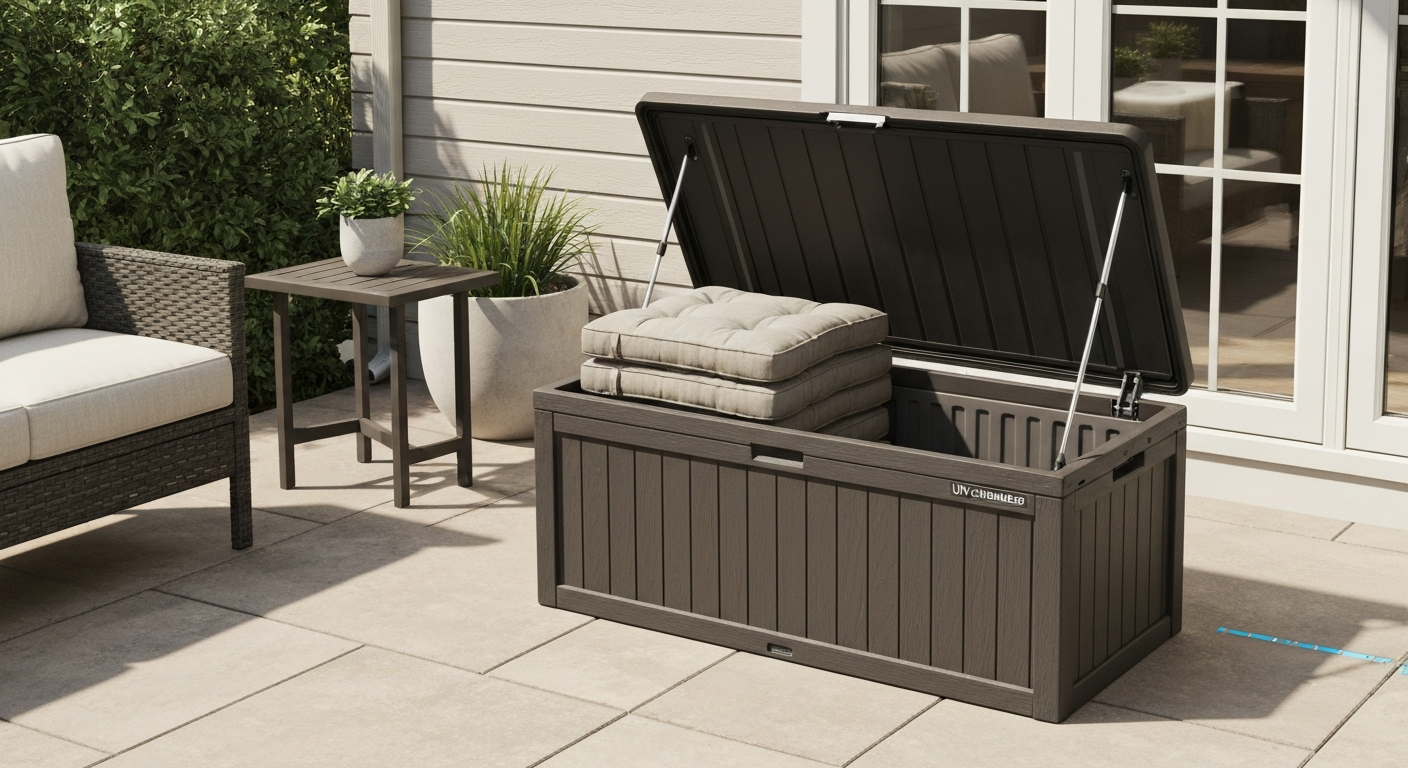
The best patio box for most homeowners is a 70- to 130-gallon resin deck box with a vented lid, gas-spring lid support, and UV-stabilized construction. That range fits four to six standard seat cushions (roughly 24" x 24" x 3" each), works on patios from about 150 to 400 square feet, and costs somewhere between $80 and $250 depending on brand and features. If you have a larger sectional or store pool gear alongside cushions, step up to 150 gallons or more. If you're tucking a box onto a small balcony, a 50-gallon unit will do the job without eating your floor space.
Best Patio Box: Sizing, Materials & Features for Homeowners

Elise Prescott
15 Jul 2026
Who this guide is for
Whether you're furnishing a brand-new patio or finally replacing that waterlogged wicker trunk that's been ruining your cushions for three seasons, this guide covers everything you need to make a smart purchase. I'll walk you through how to measure your cushions and your patio footprint, what capacity and dimensions to target, which materials hold up in your climate, and which features actually matter versus which are marketing fluff. I'll also flag when a custom-built or contractor-installed storage solution makes more sense than an off-the-shelf box. If you're still figuring out how large your patio should be in the first place, the sizing math in this article connects directly to patio footprint planning and related decisions like outdoor fan sizing, which affects how much airflow you want around your storage placement. For guidance on matching fan size to patio footprint and airflow needs, see what size ceiling fan for outdoor patio (ed2e501e-52ac-490f-8cbc-9d8f0a898e87). If you need guidance on overall patio dimensions, see our article on what is a good size for an outdoor patio. For guidance on how large a patio should be, see our article on determining a good size patio.
Quick buying checklist before you shop
Before clicking 'add to cart,' run through these checkpoints. They take about five minutes and will save you a return trip to the store.
- Measure your cushions: length, width, and thickness for every piece you plan to store (see the step-by-step section below).
- Count the cushions: seat cushions, back cushions, and any throw pillows you want protected.
- Calculate the minimum interior volume you need in cubic feet or gallons (one 24" x 24" x 3" seat cushion equals roughly 1.0 cubic foot or 7.5 gallons; use that as your base unit).
- Measure your available patio floor space and note any clearance restrictions — lid swing or rear-hinge clearance typically needs 6 to 12 inches behind the box.
- Identify your climate: humid/coastal, hot/dry, freeze-thaw, or mild — this determines which material you should prioritize.
- Decide on secondary use: bench seating, side table, or planter integration will affect lid weight rating and footprint requirements.
- Set a realistic budget range: $80 to $150 covers reliable resin; $200 to $400 gets you composite or wood; $400-plus enters custom/contractor territory.
- Look for these images/labels on the product listing: UV-stabilized or UV-resistant marking, lid weight capacity rating, interior dimensions (not just exterior), and ventilation or drainage slot notation.
How to measure your patio area and cushions
This is the step most people skip, and it's exactly why boxes end up too small or too awkwardly shaped. Grab a tape measure and spend three minutes doing this right.
Measuring your cushions
- Seat width: measure straight across the front face of the cushion from left edge to right edge.
- Seat depth: measure from the front edge to the back edge of the cushion while it lies flat.
- Cushion thickness: measure at the thickest point, usually the center — this is the dimension most people forget, and it directly controls how tall your stack will be inside the box.
- Back cushion height: if you're storing back cushions flat (recommended), treat height as depth for stacking purposes.
- Write down L x W x T for every unique cushion type, then multiply L x W x T in inches to get cubic inches. Divide by 1,728 to convert to cubic feet (1 cubic foot = 1,728 cubic inches). A 24" x 24" x 3" cushion is exactly 1,728 cubic inches, or 1.0 cubic foot.
- Add 15 to 20 percent to your total calculated volume as a compression and wiggle-room buffer. Cushions don't stack perfectly, and you'll appreciate the extra space the first time you're rushing to get things put away before a storm.
Measuring your patio footprint for box placement
- Measure the total patio length and width in feet. A 12 x 14-foot patio is 168 square feet — enough for a medium to large box without crowding a seating arrangement.
- Identify the intended placement zone: along a wall, behind a sofa, near a gate, or in a corner. Sketch it roughly.
- Note clearance behind the box for lid opening. Most hinged lids need 6 to 12 inches of rear clearance; double-lid models that open from the center need less.
- Check that your chosen spot has adequate drainage around it — a box sitting in a low spot that collects water will degrade faster regardless of material.
- If the box doubles as bench seating, make sure the lid sits at a comfortable seat height: 17 to 19 inches from ground to lid top is the ergonomic sweet spot for most adults.
One common mistake I see repeatedly: homeowners measure exterior dimensions listed on the box and assume those are the usable interior space. They are not. A box with a 46-inch exterior width might have only a 42-inch interior width. Always match your cushion dimensions against interior specs, not exterior specs.
Recommended patio box sizes by cushion count and patio footprint
Here's how small, medium, and large boxes map to real-world cushion counts and patio sizes. These ranges reflect actual manufacturer interior specs from tested products across the consumer market.
| Size Category | Capacity Range | Typical Interior Dims (W x D x H) | Cushions Stored (24"x24"x3") | Ideal Patio Footprint |
|---|---|---|---|---|
| Small | 30–60 gallons | ~36" x 17" x 18" | 2–3 seat cushions | Under 150 sq ft / balcony |
| Medium | 60–100 gallons | ~42" x 19" x 21" | 4–6 seat cushions | 150–300 sq ft |
| Large | 100–150 gallons | ~50" x 22" x 24" | 6–9 seat cushions | 300–500 sq ft |
| Extra-Large / Multi-Use | 150–200+ gallons | ~60"+ x 24"+ x 26" | 10+ cushions or mixed gear | 500+ sq ft or pool/deck combo |
The Suncast 73-gallon deck box is a solid real-world example of the medium tier: 46 inches wide, 23.75 inches deep, 25.5 inches tall on the exterior, with an interior of 42 x 19.25 x 21 inches and a lid rated for 300 pounds of seated weight. The Lifetime 130-gallon model steps up to 16.4 cubic feet of interior capacity with a lid weight rating of 900 pounds, that's genuinely sturdy bench use. The Rubbermaid Extra-Large at 134 gallons is another large-tier benchmark that third-party testers have consistently praised for durability. These three product families effectively anchor the medium and large tiers in the current market.
What size deck box do you actually need for patio cushions
This is the most common search question I hear from readers, and the answer depends entirely on what you're storing. Let me give you concrete examples instead of a range of ranges. For a clear answer on what size deck box for patio cushions, see the linked sizing guide that walks through converting cushion dimensions into the gallon capacity you'll need.
- 2-piece bistro set (2 seat cushions at 18"x18"x2"): each cushion is about 0.375 cubic feet. Two cushions total under 0.75 cubic feet — a 30- to 40-gallon box is enough.
- 4-chair dining set (4 seat cushions at 20"x20"x3" plus 4 back cushions at 20"x18"x2"): seat cushions total about 4.6 cubic feet, back cushions add about 2.1 cubic feet — aim for at least 70 gallons (roughly 9–10 cubic feet interior).
- 3-seat outdoor sofa + 2 lounge chairs (3 sofa seat cushions at 24"x24"x4" plus 4 lounge cushions at 22"x22"x3"): sofa seats alone are 3 cubic feet; lounge cushions add about 3.3 cubic feet — you need 80 to 100 gallons minimum.
- Large sectional (6 x 24"x24"x3" seat cushions plus 6 back cushions at 24"x20"x3"): seat cushions are 6 cubic feet, back cushions add about 5 cubic feet — look at 130 gallons or more, or consider two separate medium boxes.
- Mixed-use storage (cushions plus outdoor throws, a garden hose, and small tools): add 20 to 30 gallons to whatever your cushion math says.
The conversion math is straightforward once you have it: multiply cushion L x W x T in inches, divide by 1,728 for cubic feet, then divide by 0.134 to convert cubic feet to gallons. Or just multiply cubic feet by 7.48. A single standard 24 x 24 x 3-inch cushion is 1.0 cubic foot or 7.48 gallons. Three of those cushions need 22.4 gallons of pure volume, but because nothing stacks perfectly, plan for 30 gallons just for those three cushions. That 30 to 35 percent buffer is not padding; it reflects real-world compression and air gaps. Choosing the right deck box size for your specific cushion collection is something worth spending ten minutes on before buying, especially if you're buying for a large sectional or a patio set with back cushions.
Features that actually matter: what to look for
I've tested and reviewed enough of these boxes to know which features earn their keep and which are just bullet points on the packaging. Here's the honest breakdown.
Ventilation
This is the most underrated feature on any deck box. Building-science guidance is clear: sealed, unventilated enclosures trap humidity, and trapped humidity means mildew on your cushions. Building‑science guidance recommends passive venting (low and high vents), breathable liners, and avoiding impermeable plastic bags to prevent trapped humidity and mildew (Condensation Control (Building America Solution Center / PNNL)). Look for vents, typically small slots or mesh panels near the lid or upper walls, that allow passive air exchange. The best designs use a low-vent-plus-high-vent arrangement that promotes convective airflow, drawing fresh air in at the bottom and letting humid air escape at the top. Avoid storing cushions in tightly sealed plastic bags inside a sealed box; that doubles down on trapping moisture. A breathable liner or just leaving cushions loosely stacked is better.
Drainage
Any water that gets inside, from a leaky lid seal, condensation, or a brief lid-open rainstorm, needs somewhere to go. Small drainage holes or slotted floor channels at the base of the box are essential. If a product doesn't mention drainage anywhere in the specs, assume it lacks it and factor that in. Stagnant water pooling at the bottom of a closed box is a reliable way to ruin both cushions and the box floor.
Lid support: gas springs vs. friction hinges
Gas-spring lid struts are worth the modest price premium. They hold the lid open at any position without it crashing down on your hands or wrists while you're retrieving gear. Gas spring suppliers typically rate their struts at 10,000 to 100,000 double-stroke cycles depending on model and quality grade, so a well-made strut should outlast the box itself. Cheap friction hinges or no support at all is a hands-on frustration every single time you open the box. If you're buying for a box that will double as bench seating, confirm the hinges can handle the weight and repeated use; lid weight ratings on quality models run from 300 to 900 pounds.
Locks and security
A padlock hasp or built-in lock is useful for keeping expensive outdoor tools or accessories secure, especially in a shared apartment complex or accessible side yard. It won't stop a determined thief, but it keeps opportunistic access to a minimum. If security is a real priority, look for a box with a reinforced hasp that accepts a disc lock, not just a small standard padlock.
Wheels and handles
If you plan to move the box seasonally or store it in a garage over winter, integrated wheels on the base are genuinely useful. Most consumer boxes that advertise wheels have two fixed wheels at the rear and two feet at the front, you tilt and roll like a dolly. That works fine for smooth concrete or composite decking. On gravel or pavers with gaps, it's awkward, but still better than dragging a 150-pound loaded box.
Interior liners
Some boxes come with fabric liners; others let you add an aftermarket liner. A liner protects cushion fabric from rough interior walls (common on lower-cost resin boxes) and adds a slight thermal buffer. It also makes cleanup easier when debris or moisture accumulates at the bottom. It's a small feature, but if you're storing premium cushions, it's worth having.
Materials comparison: what holds up where
The material question is where climate really matters. What works beautifully in San Diego will crack in Minnesota or rust on the Florida coast. Here's the practical breakdown across the five most common materials.
| Material | Best Climate | Durability | Maintenance | Cost Range | Notes |
|---|---|---|---|---|---|
| Resin / HDPE | All climates | Excellent (UV-stabilized) | Very low | $80–$200 | UV-stabilized HDPE resists cracking and fading; look for ASTM-tested UV resistance |
| Wood (Cedar/Teak) | Mild, dry or moderate humid | Good with upkeep | Medium-high | $200–$500+ | Requires AWPA-rated preservative treatment for wet/coastal use; beautiful aesthetics |
| Metal (Powder-coated steel/aluminum) | Dry, low-humidity | Good if coated well | Medium | $150–$400 | Avoid uncoated steel near salt air; specify 316 stainless hardware within 3 miles of coast |
| Rattan / Wicker (synthetic PE) | Mild to moderate | Moderate | Low | $100–$300 | Synthetic PE rattan is better than natural; not ideal for freeze-thaw or heavy UV zones |
| Composite (wood-plastic composite) | Most climates | Very good | Low | $250–$600+ | Resists rot and UV better than wood alone; heavier; check for drainage design |
Resin and HDPE: the practical all-rounder
UV-stabilized HDPE (high-density polyethylene) is the dominant consumer deck-box material for a reason: it doesn't rot, rust, or require annual sealing. Manufacturers test these materials under ASTM accelerated UV weathering standards (including ASTM D4329 and G154), and research shows that HDPE formulations with UV stabilizers or carbon-black pigmentation dramatically outlast unstabilized versions in outdoor service. If you're in Texas, Arizona, or Florida where UV load is intense, insist on UV-stabilized or UV-resistant labeling. A box that just says 'resin' without UV qualification may fade, chalk, and become brittle within two to three seasons.
Wood: beautiful but demanding
Wood boxes are genuinely attractive, and a well-built cedar or teak box will outlast most resin options if properly maintained. The blank" rel="noopener noreferrer">American Wood Protection Association's Use Category System (AWPA U1) defines preservative treatment requirements by exposure level, a box that sits outside year-round on a wet Pacific Northwest deck needs UC3B or UC4 treatment. Untreated or under-treated wood in humid or wet climates will check, crack, and begin to decay within a few seasons. Teak requires very little treatment but is expensive. Cedar is more accessible and responds well to annual applications of a penetrating oil or water repellent. If you want wood aesthetics without wood maintenance, look at composite.
Metal: use it carefully
Powder-coated steel or aluminum boxes look sharp and are genuinely sturdy, but metal and moisture is a relationship that requires careful management. For coastal homeowners, generally defined as within about three miles of saltwater, AMPP (formerly NACE) and corrosion industry guidance calls for specifying 316 or 316L stainless steel hardware and fasteners rather than 304 stainless or zinc-plated steel. ASTM B117 salt-spray testing results show dramatic differences in time-to-rust between coating types and alloy grades. If you're in a coastal city and you want a metal box, make sure the fasteners and hinges are rated for marine environments. Inland, powder-coated aluminum is a solid, lightweight choice.
Synthetic rattan and wicker
Synthetic PE rattan boxes are popular because they match common patio furniture aesthetics. The good ones hold up reasonably well in mild climates, but they're not the right call for freeze-thaw zones or high UV environments. The weave structure makes true weatherproofing difficult, water can get in through the gaps, so synthetic rattan boxes work best where cushions are only stored overnight or for short periods, not all winter. If you're in a climate with harsh winters, use a rattan box as a decorative accent and keep your main seasonal storage in a sealed resin or composite unit.
Composite: the premium middle ground
Wood-plastic composite boxes give you the visual warmth of wood with significantly better rot and UV resistance. They're heavier than resin, usually more expensive, and not all composites are created equal, check that the product specifically mentions UV stabilization and that it has integrated drainage. For homeowners who want a high-end look that genuinely handles four seasons, a quality composite box is worth the extra cost.
Weatherproofing, sealing, and maintenance by climate
What you do after you buy the box matters as much as what you buy. Here's how to protect both your box and its contents across the four main climate scenarios.
Hot and humid climates (Gulf Coast, Southeast US, Hawaii)
- Ventilation is your top priority. Confirm the box has passive vents; add moisture-absorbing desiccant packets inside if you're storing cushions for more than a few weeks.
- Position the box in shade if possible — direct sun exposure heats the interior and accelerates humidity cycling, which damages cushion foam.
- Check for mildew on cushions every four to six weeks during the humid season; a light spray of white vinegar solution (1:1 with water) and air-drying prevents buildup.
- For wood boxes in this climate, apply a mildew-resistant finish and inspect yearly for soft spots or discoloration at joints and base rails.
- Ensure the box sits on feet or a raised base rather than flush on a concrete or wood deck surface — this allows airflow underneath and prevents the base from wicking ground moisture.
Hot and dry climates (Southwest, Mountain West)
- UV degradation is your main threat. Choose UV-stabilized resin or composite; avoid untreated wood boxes in full desert sun.
- For wood boxes, use a UV-blocking exterior oil or water repellent annually; the dry heat will cause untreated wood to check and crack faster than humid climates.
- Thermal expansion and contraction cycles can stress lid hardware and hinge mounts — check these each spring for looseness and retighten before heavy-use season.
- Dust and debris accumulate quickly; clean interior surfaces at the start of each season to prevent abrasive grit from damaging stored cushion fabrics.
Wet and rainy climates (Pacific Northwest, Great Lakes)
- Drainage is critical. Make sure the box base has drainage holes and is elevated slightly to prevent the box from sitting in pooled water during extended rain events.
- Lid seals should be inspected each fall and spring; a lid that no longer sits flush will allow water infiltration during heavy rain. Many manufacturers sell replacement gaskets.
- For wood boxes, follow AWPA use-category guidance for your specific exposure level and reapply preservative finishes on the schedule the product manufacturer recommends.
- Consider silicone-caulking lid-edge seams on plastic boxes that have shown minor leakage — this is a legitimate and effective DIY fix.
- Store cushions only when they are completely dry; putting damp cushions in any box in this climate is a reliable way to get mold regardless of box quality.
Cold and freeze-thaw climates (Midwest, Northeast, Mountain states)
- Empty and clean the box before first hard freeze; water left in the box — even small amounts in drainage grooves — expands when it freezes and can crack resin or split wood joints.
- High-quality UV-stabilized HDPE handles freeze-thaw well; cheaper resin boxes may become brittle and crack in sustained sub-zero temperatures.
- If possible, move the box into a garage or shed for the winter. If it must stay outside, position it against a south-facing wall and cover it with a breathable (not sealed plastic) outdoor furniture cover.
- Inspect all hardware — hinges, gas struts, hasp locks — in early spring; cold cycles can cause metal components to seize or weaken. Lubricate moving parts with a silicone-based lubricant, not petroleum-based products that can degrade rubber gaskets.
- Do not store foam cushions outdoors through a hard winter in any box; bring them inside or into a heated garage to prevent foam cell breakdown from freeze cycles.
Placement, anchoring, and multi-use options
Where you put the box and how you anchor it shapes how useful it is day to day. Against a wall or fence line is the most common placement, and it works well as long as you have lid clearance behind the box. Corner placement with a 90-degree double-lid model maximizes a tight footprint. For a box that doubles as a bench, place it so it faces into the seating area, guests will use it naturally without being asked to move around it.
Anchoring matters in high-wind zones and for security. Most resin boxes have anchor point holes in the base or a wall-anchor channel. In areas where sustained winds exceed 35 to 40 mph regularly, anchoring is worth doing. Use stainless lag screws into decking joists or concrete anchors with galvanized hardware for decks; never anchor into composite decking face boards alone without backing support from a joist below.
Multi-use integration is one of the most practical upgrades you can make. Boxes designed with flat, weight-rated lids function as outdoor benches (300- to 900-pound ratings are common across the medium and large tiers), pair them with a weather-resistant bench cushion on the lid and they double as seating. Some homeowners integrate planter boxes on top using a planter bracket kit, creating a vertical element that softens the boxy look. Others use a deck box as a low side table next to a lounge chair. The key constraint for all of these dual uses: confirm the lid's structural rating before loading it with planters, stools, or people.
Budget vs. premium: what you actually get for the money
At $80 to $130, you're getting a functional resin box that will do the job for three to five seasons in a mild climate. These boxes are often thinner-walled, use cheaper hinges, and may not have gas-spring lid support. They're fine for a rental property or a first apartment patio where you're not sure how long you'll stay. At $150 to $250, the construction quality jumps noticeably: thicker HDPE walls, genuine gas-spring struts, better-sealed lids, and more reliable UV stabilization. This is the sweet spot for most homeowners who plan to stay put for several years. At $300 to $500, you're into premium resin, quality composite, or entry-level teak, these boxes look significantly better and will last longer, especially in demanding climates. Above $500, you're in custom-built or contractor-installed territory, and that only makes sense if you need something built-in to your deck structure, custom dimensions that off-the-shelf won't cover, or a specific aesthetic that the consumer market doesn't offer.
DIY builds and when to hire a contractor
A DIY built-in storage bench is genuinely achievable for someone comfortable with basic carpentry, a cedar box with a piano-hinged plywood lid, a simple frame on deck blocking, and an exterior finish can be built for $150 to $300 in materials and will look custom because it is. Use AWPA-appropriate treated lumber for the base frame if it's in contact with or close to a deck surface, exterior-grade plywood for the box walls, and a quality exterior sealer. Design in a 1-inch gap at the base for drainage and passive airflow following basic building-science ventilation principles.
The case for hiring a contractor is specific: if you want the storage integrated into a built-in bench that's structurally part of the deck, requires deck permits, or involves routing drainage or electrical conduit nearby, a licensed contractor is the right call. A deck contractor can also size and position built-in storage so it complements the overall patio footprint rather than fighting it, which connects to broader patio planning decisions about how much usable space you need overall. Budget around $500 to $1,500 for a custom built-in box/bench installation depending on size, material, and your region.
Final recommendations by use case
| Use Case | Recommended Size | Recommended Material | Must-Have Features |
|---|---|---|---|
| Small balcony or bistro set | 30–50 gallons | UV-stabilized resin | Compact footprint, lid vent, drainage |
| Standard 4-chair dining set | 70–90 gallons | UV-stabilized resin or composite | Gas-spring lid, drainage, lock hasp |
| Large sectional or sofa set | 130–150+ gallons | HDPE or composite | High lid weight rating, vents, drainage, wheels |
| Coastal / salt-air environment | Any size | Resin or composite | 316 SS hardware, sealed lid, UV-stabilized |
| Freeze-thaw climate | Any size | Heavy-gauge HDPE | Tight lid seal, freeze-rated resin, drainage |
| Bench seating + storage combo | 100–130 gallons | Composite or premium resin | 300+ lb lid rating, gas springs, flat lid |
| Custom / built-in deck storage | Custom dimensions | Cedar, teak, or composite | AWPA-treated frame, ventilation gaps, drainage channel |
The bottom line is that most homeowners will be well-served by a 70- to 130-gallon UV-stabilized resin box with gas-spring lid support, passive ventilation, and base drainage. Spend a few extra minutes measuring your actual cushions before you buy, the math is quick and it prevents the most common mistake in this purchase category. Match material to your climate honestly, and if you're in a coastal, freeze-thaw, or extreme heat zone, treat the climate-specific guidance in this article as non-optional. A good patio box should last a decade or more with basic maintenance. A cheap one bought without a plan can be an annual frustration.
FAQ
What primary measurements and conversion data are required to size a patio box accurately?
You need step‑by‑step furniture/cushion measurements (seat width, seat depth, back height, armrest/clearance, and cushion thickness). Capture cushion counts and convert L×W×T (in inches) to storage volume using conversion constants (1 cubic foot = 1,728 cubic inches; 1 cubic inch = 0.0163871 liters). Record both interior usable dimensions and exterior footprint to ensure fit and clearance for lids/doors.
Which product specification fields should be collected from manufacturers for comparison and selection?
Collect exterior and interior dimensions (W×D×H), listed capacity (gallons/liters/cubic feet), usable interior geometry (clearances around corners/hinges), lid load/seat weight rating, material and construction (e.g., single/dual‑wall HDPE, wood species/treatment, metal gauge/finish, rattan weave), hardware specs (hinges, gas springs, locks, fastener material/grade), drainage features, ventilation, assembly requirements, warranty, and coastal/corrosion claims.
What industry standards and lab tests should be referenced when evaluating materials and hardware?
Reference ASTM standards for UV and weathering of plastics (ASTM D4329, G154/D2565), corrosion testing standards (ASTM B117, ISO 9227), wood preservation/use categories (AWPA U1/UC1–UC5), and building‑science guidance on moisture control/ventilation (Building Science Corporation/Building America). For fasteners in coastal areas, specify marine‑grade stainless (316/316L) per corrosion authority guidance (AMPP/NACE).
What empirical and third‑party testing or review evidence strengthens product recommendations?
Use hands‑on lab/field tests and published reviews that report measured interior/exterior dimensions, real usable capacity, observed drainage/venting performance, lid durability, UV fade/warping after exposure, ease of assembly, and hardware corrosion outcomes (e.g., BobVila‑style tested roundups). Note independent test methods and exposure durations where available.
How should ventilation, drainage and moisture control be evidenced in guidance?
Cite building‑science sources recommending low/high passive vents, drainage paths, breathable liners, and avoidance of fully sealed cavities for long‑term wet storage. Document presence/location/size of vents or drain holes in product specs and describe venting strategies (e.g., raised internal platform, removable drain plugs) that reduce condensation and mildew risk.
What material‑specific evidence is needed for claims about durability and climate suitability?
For plastics (HDPE/resin): provide manufacturer UV‑stabilizer claims and reference ASTM accelerated UV tests and peer‑reviewed studies showing stabilized HDPE longevity. For wood: specify species, preservative treatment and reference AWPA use categories for wet/coastal exposures. For metals: cite coating/finish specs and salt‑spray/ASTM B117 data or manufacturer hours‑to‑rust. For composites/rattan: document UV/fade resistance and maintenance needs from manufacturer tech data.