
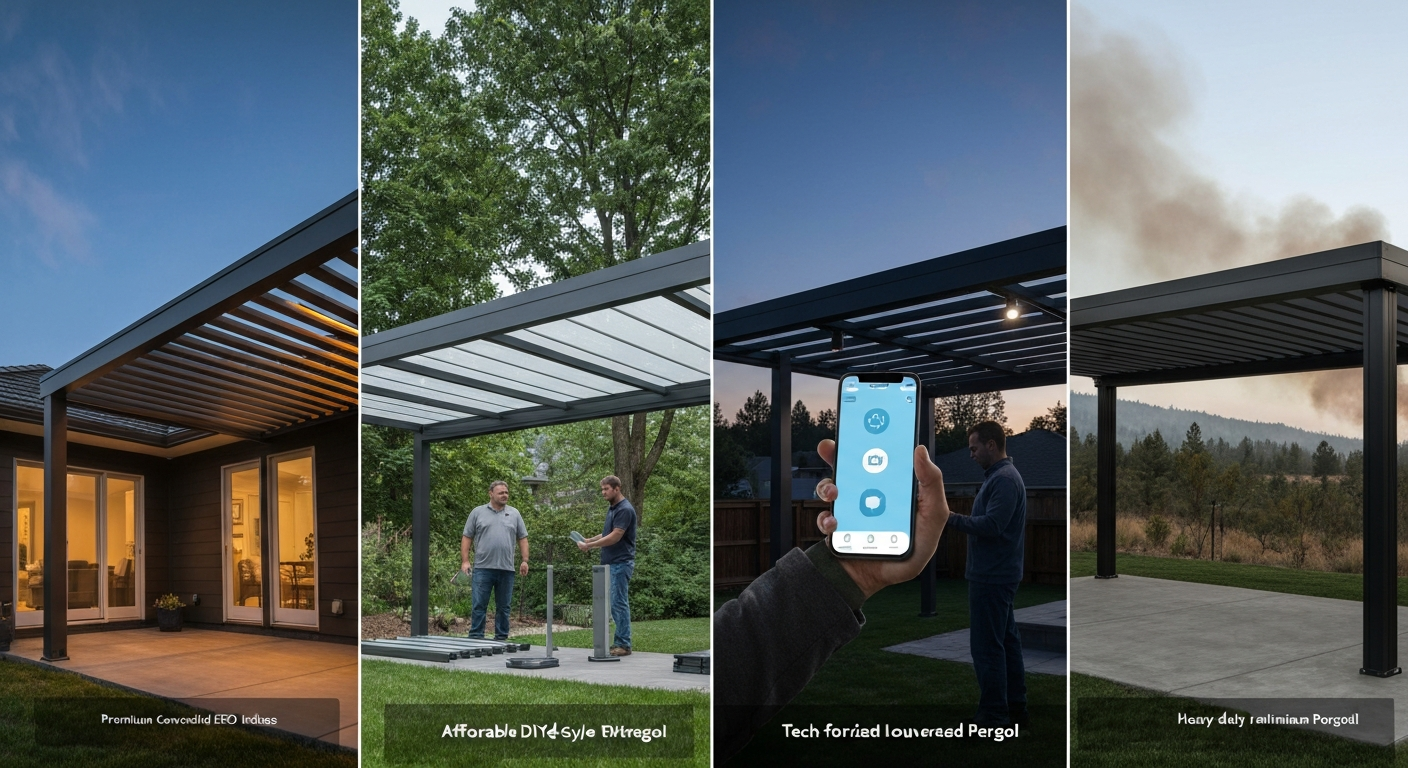
US patio systems range from sub-$3,000 DIY louvered pergola kits to fully engineered motorized structures that run $30,000 or more installed. The brands most homeowners encounter, Fine Patio Design, Patio Magic, Smart Patio Plus, and Tec Patio FR, each occupy a different slice of that spectrum, and picking the wrong one for your climate, budget, or installation situation is an expensive mistake. This guide cuts through the marketing and gives you honest, side-by-side reviews of those four brands, compares them against other notable US options, and walks you through every decision point before you spend a dollar.
US Patio Systems Reviews: Compare Brands, Costs & Climate Fit

Elise Prescott
29 Jul 2026
Who this guide is for and how we evaluated these systems
If you are planning a new patio cover, replacing a failing one, or trying to figure out whether a contractor quote is reasonable, this article is written for you. It covers both the DIY-friendly end of the market and the premium custom segment, because the right answer genuinely depends on where you live, how much you want to spend, and how handy you are. The information here is useful whether you are in Phoenix managing 110-degree summers, in Colorado dealing with 60-pound-per-square-foot snow loads, or on Florida's coast where Miami-Dade wind ratings are a legal requirement, not a marketing claim.
Our evaluation approach looks at five things for every brand: structural performance and certifications (ICC-ES reports, ASCE 7-22 load compliance, and where applicable Miami-Dade NOA status), material quality and finish durability (ASTM B117 salt-spray testing claims, coating thickness, and frame alloy specs), real installed cost ranges cross-referenced against HomeGuide's 2026 covered-patio cost guide and RSMeans residential cost data, warranty terms and how the fine print actually reads, and installation complexity for both DIY and professional scenarios. We also screen for review authenticity using FTC guidance on disclosed vs. undisclosed endorsements, which matters because some brands have thin third-party review trails.
US patio systems at a glance: product types, components, and what things cost
The term 'patio system' covers a wide category. At the affordable end you have fixed aluminum or vinyl patio covers and basic louvered pergola kits available at retailers like Home Depot, where a Backyard Discovery Evanston 10x20 louvered kit lists around $2,500 to $3,500 depending on configuration. Mid-range products bring motorized louvers, integrated drainage channels, and LED lighting into the frame for somewhere between $8,000 and $18,000 installed, which aligns with HomeGuide's 2026 estimate of $6,500 to $18,000 for louvered pergolas. At the premium end, fully engineered systems with smart-home integration, engineered anchorage, and third-party structural certification can reach $25,000 to $50,000 or more for large custom spans. Installed cost per square foot tends to run $50 to $150 across the full range, per HomeGuide's 2026 covered-patio cost guide, though RSMeans city-cost-index adjustments mean a San Francisco installation can run 30 to 40 percent above a Dallas equivalent for the same product.
The core components to understand before comparing brands are the frame material (aluminum is dominant; steel is used in some commercial-grade systems), the louver or roof mechanism (fixed, manual, or motorized with open/close control), the drainage system (integrated gutter channels vs. external downspouts), the anchoring method (footing type, embedment depth, and whether an ICC-ES or engineered plan is required for your permit), and any smart-home or accessory integration (rain sensors, wind sensors, Zigbee/Z-Wave/Wi-Fi motor control, and compatibility with misting systems or infrared heaters).
Fine Patio Design: full review
Fine Patio Design positions itself as a mid-to-premium custom patio cover company serving homeowners who want a designed-to-order solution without going full commercial-grade. Their product line includes attached and freestanding louvered pergolas, solid patio covers, and a hybrid system with retractable fabric panels. The aesthetic quality is consistently praised by customers, and the company leans heavily on professional installation through a dealer network rather than DIY kits. For more detailed analysis and user feedback, see our Fine Patio Design reviews.
Pros and cons
- Strong visual customization: color palette, louver width, and post sizing can be matched to existing architecture
- Dealer-installed projects typically include permit assistance and site measurement
- Motorized louver option includes rain and wind sensors as standard on higher tiers
- Drainage is integrated into the frame, reducing visible gutters
- No publicly available ICC-ES evaluation report, which can complicate permitting in jurisdictions that require independent structural certification
- Pricing is opaque until you contact a dealer, making pre-shopping comparisons difficult
- Limited DIY pathway; the system is engineered for dealer installation and is not sold as a kit
- Warranty terms vary by dealer agreement, so confirm coverage in writing before signing
Price range, warranty, and installation notes
Based on contractor reports and customer disclosures, a typical Fine Patio Design attached louvered pergola covering 200 to 300 square feet runs $12,000 to $22,000 fully installed, putting it in the mid-upper portion of HomeGuide's $6,500 to $18,000 louvered-pergola range (larger or more complex configurations exceed that ceiling). The structural frame is powder-coated aluminum. Ask specifically whether the coating was tested to ASTM B117 salt-spray standards if you are in a coastal environment. Warranty on the frame is typically 10 to 15 years depending on the dealer, with motor components covered for 2 to 5 years. Installation is professional-only and generally takes one to two days for a standard attached cover. Permitting support varies by dealer, so ask upfront whether the dealer pulls permits or leaves that to you.
Ideal use cases
Fine Patio Design is a solid choice for homeowners in mild-to-moderate climates (zones 4 through 9) who prioritize aesthetics, want a turn-key professional installation, and have a budget in the $15,000 to $25,000 range. It is less appropriate for high-wind or high-snow regions unless you can confirm site-specific engineering calculations, because the lack of a published ICC-ES report means your contractor will likely need to provide stamped engineering for a permit in those jurisdictions.
Patio Magic: full review
Patio Magic operates at the more accessible end of the market, offering both prefabricated cover kits and a configure-to-order service through home improvement retail partners. Their products include polycarbonate-panel covers, solid aluminum pan covers, and a basic louvered kit line. The brand targets homeowners who want meaningful weather protection at a lower price point and are comfortable with moderate DIY assembly or want a straightforward contractor job without a lot of custom engineering.
Pros and cons
- Competitive entry-level pricing, with basic kits starting around $1,800 to $4,500 depending on size and material
- Available through retail channels, so you can inspect or at least verify product before purchase
- Polycarbonate panel option diffuses UV light while allowing natural light transmission
- Straightforward installation instructions make it accessible for confident DIYers
- Solid aluminum pan covers shed rain reliably without drainage channels to maintain
- Louvered kit line is basic: louvers are manual-only, no motorization option in the standard product
- Frame extrusion thickness is thinner than premium competitors, which affects snow-load and wind-load performance
- Warranty on kits is often limited to 1 to 5 years on components, shorter than mid-premium brands
- No smart-home integration at any price tier
Price range, warranty, and installation notes
Patio Magic kit prices run roughly $1,800 to $7,000 for the cover material and frame components before labor. Professionally installed, expect to add $1,500 to $4,000 depending on your region and job complexity, keeping total costs between $3,300 and $11,000. That positions Patio Magic well below the mid-market louvered-pergola average. Warranty terms on aluminum frames are generally 5 years, with polycarbonate panels warranted against yellowing for 10 years in most configurations. Motor components are not applicable to the standard line. Installation for a basic solid cover can be accomplished by two people in a weekend with moderate DIY skills. The kit includes hardware and a manual, but anchorage into masonry or concrete footing will require additional materials and potentially a permit depending on your jurisdiction.
Ideal use cases
Patio Magic makes the most sense for budget-conscious homeowners in mild climates who need functional rain and sun protection without the investment of a fully engineered motorized system. It is a practical option for renters working with landlord permission, for secondary or seasonal properties, or for anyone who wants to test the usability of a covered patio before committing to a permanent premium structure. It is a poor fit for high-wind coastal zones, regions with significant snow accumulation, or any homeowner who wants motorization or smart-home connectivity. For a more nuanced look at how it holds up over time, see our detailed is Patio Magic any good discussion.
Smart Patio Plus: full review
Smart Patio Plus is purpose-built for the homeowner who wants their patio cover integrated into a broader smart-home ecosystem. The product line centers on motorized louvered pergolas and motorized retractable screens with Wi-Fi and Zigbee protocol support, compatibility with Amazon Alexa, Google Home, and Apple HomeKit, and optional rain and wind sensor automation. It is the most technology-forward option among the four brands reviewed here.
Pros and cons
- Native app control plus voice-assistant compatibility right out of the box
- Automated rain and wind sensors respond without manual input, protecting the structure and extending its life
- Integrated LED channel lighting is included at mid and upper tiers, not an add-on
- Motorized screen integration is available as a coordinated system rather than an aftermarket add-on (similar in concept to how Phantom Screens handles motorized screen clearances and integrations)
- Aluminum extrusion specs are competitive with mid-premium market peers
- Motor warranty is typically 3 to 5 years, which is fair but not class-leading
- Smart-home integration requires a stable Wi-Fi signal at the patio location; weak signal causes reliability complaints
- No publicly available third-party structural certification comparable to an ICC-ES report
- Premium tier pricing can approach StruXure or similar fully engineered competitors without the same structural documentation
- Customer support response times are inconsistent based on user-reported feedback
Price range, warranty, and installation notes
Smart Patio Plus systems typically run $9,000 to $20,000 installed for a standard attached motorized louvered pergola covering 200 to 300 square feet, placing it squarely in the mid-market range. The frame warranty is 10 years, motor components 3 to 5 years, and electronics and sensors 1 to 2 years. Installation is professional-recommended because of the electrical rough-in required for motors, LED lighting, and sensor wiring. A licensed electrician is often needed to pull a separate permit for the electrical components, so budget for that additional cost. DIY installation is technically possible for experienced builders but the smart-home wiring and sensor calibration steps raise the complexity bar significantly above a standard patio cover install.
Ideal use cases
Smart Patio Plus is the right pick for tech-forward homeowners who already live in a smart-home ecosystem and want their outdoor space to participate in it seamlessly. It performs best in mild-to-warm climates (think the Sun Belt, Pacific Northwest with light precipitation, or mid-Atlantic) where motorization sees frequent use and the automation pays dividends daily. It is a reasonable choice in moderate-wind regions but you should push the sales team for documentation of wind-load engineering before signing in any area with sustained winds above 90 mph. For a deeper dive on this product line's specific performance claims, see our dedicated Smart Patio Plus reviews.
Tec Patio FR: full review
Tec Patio FR is the most structurally oriented of the four brands and the one most likely to have documentation that building departments actually want. The 'FR' designation refers to fire-resistant construction, which is meaningful if you are in a wildfire interface zone in California, Colorado, or the Pacific Northwest. The product line includes attached and freestanding louvered pergolas, solid covers, and engineered aluminum carport-style structures, all built to heavier extrusion specs than the budget or mid-market competitors.
Pros and cons
- Fire-resistant construction addresses a real, growing regulatory requirement in wildfire-prone regions
- Heavier extrusion profiles provide meaningfully higher wind and snow load capacity compared to standard aluminum kits
- Engineering documentation is more readily available, which simplifies the permitting process in jurisdictions that require it
- Powder-coat finish options include formulations marketed for coastal and high-humidity environments
- Motor and louver system is compatible with several third-party home-automation platforms
- Higher base price than most competitors: installed costs for a standard attached louvered pergola typically start around $15,000 and scale quickly
- Lead times are longer due to heavier custom fabrication, often 8 to 14 weeks
- Dealer network is smaller than some competitors, so availability varies significantly by region
- The 'FR' fire-resistance claim should be verified with the specific fire classification documentation (ask for the test report reference) before relying on it for code compliance
Price range, warranty, and installation notes
Tec Patio FR installed pricing runs from approximately $15,000 to $35,000 for residential applications depending on size, configuration, and regional labor costs. RSMeans data and regional contractor feedback suggest West Coast markets (California, Oregon, Washington) will see prices at or above the upper end of that range due to city cost index premiums. Frame warranty is typically 15 to 20 years, motor components 5 years. Installation is professional-only and requires concrete footings specified to engineering plans. Permitting is strongly recommended and the company's documentation package makes that process more straightforward than most. Factor in a permit fee of $200 to $800 depending on your jurisdiction and structure value.
Ideal use cases
Tec Patio FR is purpose-built for homeowners in demanding environments: wildfire interface zones, high-wind coastal areas, heavy-snow mountain regions, or any jurisdiction with strict structural permitting. If you are in a California WUI (Wildland Urban Interface) zone or anywhere that requires a Class A or Class B fire rating for exterior structures, this is one of the few patio system brands where the fire-resistance claim is supported by construction intent rather than just marketing language. For a full breakdown of how this system performs in real-world conditions, see our Tec Patio FR review.
Head-to-head comparison
| Brand | Price Range (Installed) | Frame Warranty | Motor/Electronics | ICC-ES or Equiv. | DIY Option | Smart-Home Integration | Best Climate Fit |
|---|---|---|---|---|---|---|---|
| Fine Patio Design | $12,000–$22,000+ | 10–15 years | 2–5 years | Not published | No | Optional on upper tiers | Zones 4–9, mild to moderate |
| Patio Magic | $3,300–$11,000 | 5 years (frame) | N/A (manual only) | Not applicable | Yes | None | Mild climates, light use |
| Smart Patio Plus | $9,000–$20,000 | 10 years (frame) | 3–5 years | Not published | Advanced DIY possible | Full (Alexa, Google, HomeKit) | Sun Belt, mild-to-moderate wind |
| Tec Patio FR | $15,000–$35,000+ | 15–20 years | 5 years | Engineering docs available | No | Third-party compatible | WUI, high-wind, heavy snow |
| StruXure Pergola X | $15,000–$40,000+ | Limited lifetime (frame) | 5 years | ICC-ES ESR-5321P | No | Full (Somfy, Z-Wave, Wi-Fi) | Most US climates; engineered for site |
| SunSetter Motorized Awning | $2,500–$6,000 installed | 5 years (fabric); limited (frame) | Motor per manual | Not applicable | Yes (kit) | Limited | Mild climates; sun/rain only |
| OpenAire Retractable Roof | $30,000–$80,000+ | Custom; per contract | Per project spec | Per project engineering | No | Yes (custom integration) | Commercial/premium residential, all climates |
Other notable US patio system brands worth considering
StruXure Pergola X
StruXure is the benchmark for third-party structural documentation in the US louvered pergola market. The Pergola X holds ICC-ES Evaluation Report ESR-5321P (reissued August 2025, revised March 2026), which explicitly documents allowable wind and snow load schedules, anchorage details, and engineering plans for both attached and freestanding configurations. That report is what building departments in most US jurisdictions want to see before issuing a permit, and it is not something every competitor can produce. Pricing runs from approximately $15,000 to $40,000 or more installed, making it a premium investment. The system integrates with Somfy, Z-Wave, and Wi-Fi-based home automation. For homeowners in high-load regions, Florida (where Miami-Dade NOA compliance matters), or any jurisdiction with an active building department, StruXure is often the path of least permitting resistance.
SunSetter motorized awnings
SunSetter occupies the value end of the motorized outdoor cover market, offering DIY-installable motorized retractable awnings with documented motor specifications, recommended anchorage, and warranty and maintenance sections in their published installation and owner manuals. MSRP for motorized configurations runs roughly $2,500 to $6,000 installed depending on width, fabric, and whether you use a professional. This is not a structural patio cover: it is a retractable fabric awning that retracts in high wind and is not rated for snow load. But for sun and light rain protection in mild climates, it is a dependable, well-documented option with a long track record. The motor warranty terms are detailed in SunSetter's published owner manual, which is a level of transparency that not every brand in this category provides.
OpenAire retractable roof systems
OpenAire operates at the high end of the retractable roof market, building systems for large custom residential and commercial installations. Their products include retractable roof skylights with engineered seals, integrated drainage, and weather-resistance specifications documented in their product technical descriptions. These are not off-the-shelf products: each project involves custom engineering and pricing generally starts north of $30,000 and can run into six figures for large spans. If you are building a premium outdoor living room addition, enclosing a large terrace, or designing a commercial hospitality space, OpenAire is worth contacting. For typical single-family residential patios, the cost and lead-time requirements will be beyond most budgets.
Phantom Screens motorized screens
Phantom Screens is the most widely installed motorized retractable screen system in North America and is relevant here because patio screens are increasingly sold as integrated accessories with louvered pergola systems. Their technical library includes installation manuals, clearance specifications, and accessory integration guides that make them compatible with most major pergola frame systems. Pricing for a motorized Phantom Screen panel runs roughly $1,500 to $4,000 per opening installed. If insect control, privacy screening, or solar screening is a priority alongside your patio cover selection, budgeting for Phantom Screens as an add-on is a practical and well-documented path.
Feature-by-feature buying checklist
Before you get quotes or visit a showroom, run through these factors for your specific situation. Knowing your answers speeds up every conversation with a contractor and keeps you from being upsold on features you do not need.
- Frame material and coating: aluminum is standard; ask for extrusion wall thickness (thicker is better for loads) and whether the powder coat was tested to ASTM B117 salt-spray standards if you are near the coast
- Motorization: decide whether you want motorized louvers before you shop, because not all brands offer it and adding it later is expensive or impossible
- Wind and snow load ratings: ask for the specific design load values (in pounds per square foot) the system is rated for, and cross-check against ASCE 7-22 values for your location
- Drainage: integrated internal gutter channels are cleaner and easier to maintain than bolt-on external systems
- Smart-home integration: if you want app or voice control, confirm the specific protocol (Wi-Fi, Zigbee, Z-Wave, Somfy RTS) and that it is compatible with your existing ecosystem before buying
- ICC-ES report or equivalent engineering documentation: ask whether the manufacturer has a published independent evaluation report; if not, ask your contractor how they plan to satisfy the building department
- Miami-Dade NOA (Florida only): if you are in Florida's High Velocity Hurricane Zone, confirm the product carries an active Notice of Acceptance or that your contractor can provide equivalent product approval documentation
- Warranty terms: read the actual warranty document, not just the headline number; look for exclusions on fading, coating, and motor/electronics
- Lead time: custom systems take 6 to 14 weeks; plan around your target completion date
- Permit responsibility: confirm in writing whether the contractor is pulling the permit or whether that falls to you
Climate and region-specific recommendations
What works well in San Diego can fail in Minneapolis, and a system engineered for Florida's wind loads is overkill for rural Ohio. Here is a quick regional guide based on the climate demands that most differentiate product performance.
| Region / Climate | Primary Challenge | Recommended Product Tier | Key Spec to Verify |
|---|---|---|---|
| Southwest (AZ, NV, NM) | UV degradation, extreme heat | Mid to premium louvered pergola with ventilating louvers | UV-resistant powder coat, louver ventilation rate |
| Southeast / Florida | Hurricane-force wind, humidity, mold | Premium engineered system with Miami-Dade NOA | Wind load rating, NOA documentation |
| Mountain West (CO, UT, WY) | Heavy snow load, UV at altitude | Premium system with 40–50 psf snow-load rating | ASCE 7-22 ground snow load for your county |
| Pacific Northwest (WA, OR) | Sustained rain, moss/mildew, moderate wind | Mid to premium; solid or louver-closed roof option | Drainage system quality, coating corrosion resistance |
| Midwest / Great Plains | Wind, temperature extremes, hail | Mid-premium with documented wind rating | Impact resistance claim, frame connection details |
| Texas / Gulf Coast | Heat, humidity, hurricane risk near coast | Mid-premium; coastal areas need wind documentation | Wind rating, coating salt-spray testing if coastal |
| Northeast (NY, MA, CT) | Snow, freeze-thaw, salt air on coast | Mid-premium with engineered snow rating | Snow load rating, fastener corrosion resistance |
| California (general) | Wildfire zones, seismic, drought conditions | FR-rated or WUI-compliant product | Fire classification documentation, ICC-ES or CA product approval |
Accessories that actually make a difference
A louvered pergola or patio cover is the foundation, but the accessories are often what make the space genuinely usable for more months of the year. Here is an honest look at which ones are worth the budget.
Misting systems
High-pressure misting systems (1,000 psi) can drop perceived temperature by 15 to 25 degrees Fahrenheit in dry climates like Arizona, New Mexico, and inland California. In humid climates like Houston or Florida they are far less effective and can make the air feel clammy rather than cool. Budget $800 to $2,500 for a professionally installed high-pressure line system. Low-pressure systems under $300 work but produce visible water droplets that wet furniture and are generally not worth the savings.
Patio fans
A damp-rated or wet-rated outdoor ceiling fan (make sure the rating matches your covered vs. open exposure) is one of the highest-value-per-dollar accessories for a covered patio. A quality commercial-style fan from a brand like Big Ass Fans or Haiku runs $400 to $900 but moves enough air to make the space comfortable at temperatures that would otherwise drive you inside. Avoid residential-only rated fans in covered patios exposed to moisture: motor corrosion and seal failures are common warranty disputes.
Outdoor speakers
In-ceiling or in-wall outdoor speakers designed for covered patios (look for IP55 or higher weatherproofing ratings) deliver meaningfully better sound than portable Bluetooth speakers and disappear visually into the structure. Budget $300 to $1,500 per pair for quality weatherproof speakers, plus installation. Run speaker wire before the patio cover is fully assembled: retrofitting wiring through installed posts and beams is a significantly more expensive job.
Infrared heaters
Electric infrared heaters mounted to the patio structure are more efficient than propane patio heaters for permanent covered installations and do not require fuel management. A 1,500 to 3,000-watt hardwired infrared heater can keep a 150 to 200 square foot patio comfortable down to about 35 to 40 degrees Fahrenheit depending on wind exposure. Budget $400 to $1,200 per unit plus electrical rough-in. As with fans, run the electrical conduit during the original installation, not after.
Motorized shades and screens
Motorized drop shades and retractable screens (see the Phantom Screens discussion above) are particularly valuable for creating privacy, blocking late-afternoon sun, or containing heat from infrared heaters. They are most effective when integrated into the original pergola frame design rather than added as an afterthought, because clean pocket recesses require design accommodation at the frame level. Budget $1,500 to $4,000 per opening for motorized options.
DIY vs. professional installation: an honest breakdown
This is where homeowners most consistently underestimate complexity. A simple solid aluminum patio cover attached to a house fascia board can be a reasonable DIY project for someone with basic carpentry skills, a helper, and a weekend. A motorized louvered pergola with integrated LED lighting, smart-home wiring, concrete footings, and a structural permit is not. The dividing line is roughly this: if your project requires a permit (and most structural patio covers do once they exceed 120 to 200 square feet, depending on your jurisdiction), you almost certainly need a licensed contractor to pull it. If your project involves electrical work of any kind, you need a licensed electrician involved. And if your project requires footing excavation and concrete work, that is another trade to coordinate.
For fully DIY-appropriate systems, Patio Magic and SunSetter are the clearest fits. Both provide installation manuals, standard hardware, and straightforward assembly sequences. For everything else on this list, professional installation is either required by the manufacturer warranty terms or strongly recommended by engineering reality. The cost of professional installation, typically $1,500 to $6,000 depending on system complexity and region, is real money but it is also the cost of not having your patio cover fail during a windstorm and damage your house.
Permits and contractor selection
Start at your local building department before you start talking to contractors. Ask specifically whether your planned structure requires a permit, what documentation they need (ICC-ES report, stamped engineering plans, or product approval), and whether there are HOA overlay requirements in your neighborhood. An example of an ICC Evaluation Service report that jurisdictions accept for permitting is ICC‑ES ESR‑5321P (example ICC evaluation used in permitting). This 20-minute conversation shapes every contractor discussion that follows because it tells you exactly what documentation to demand from anyone you are considering hiring.
For contractor vetting, use your state licensing board's verification database. California uses the CSLB 'Check a License' tool, which shows license status, bond status, and any disciplinary history. Every US state has an equivalent. Verify before you sign anything, not after. Ask any contractor you are considering for three recent references from similar patio cover jobs in your area, and ask those references specifically about permitting, final inspection results, and how the contractor handled any problems. Get at least three quotes for any job over $5,000. The spread between the lowest and highest quote on the same project is frequently 40 to 60 percent, and understanding why bids differ is how you identify the contractor who actually knows what the job requires vs. the one who will figure it out after they take your deposit.
Maintenance and how long these systems actually last
Powder-coated aluminum frames are genuinely low maintenance in most climates. An annual wash with mild soap and water, plus inspection of fasteners and sealants at roof-to-wall penetrations, is the realistic minimum. In coastal environments, rinse aluminum frames with fresh water every one to two months to remove salt accumulation that accelerates coating breakdown. Motor and louver mechanisms benefit from an annual lubrication of pivot points with a silicone-based lubricant (not petroleum-based, which attracts dirt). LED drivers and smart-home electronics are the most failure-prone components in premium systems and tend to reach end of life before the frame does, so budget for motor and electronics replacement in year 7 to 12 for most motorized systems.
Realistic longevity expectations: a quality aluminum frame with maintained powder coat should last 20 to 30 years. Motorized components realistically last 10 to 15 years before needing repair or replacement. Fabric components (retractable awnings, drop shades) last 5 to 10 years depending on UV exposure and cleaning frequency. Polycarbonate panels, if used, typically yellow and lose clarity after 10 to 15 years even with UV-resistant formulations.
How to make your final decision
Start with your non-negotiables: climate demands, budget ceiling, and whether motorization matters to you. If you are in a high-wind or high-snow region, structural certification is not optional, it is the first filter. That narrows the field to Tec Patio FR and StruXure in most cases. If budget is the primary constraint and climate is mild, Patio Magic or SunSetter cover your functional needs without the premium price. If smart-home integration is genuinely important to your daily life and your climate is moderate, Smart Patio Plus hits a good middle ground. If you want a custom design outcome and professional installation without necessarily needing published structural certifications, Fine Patio Design is a credible choice in most residential zones.
Whichever direction you go, get local contractor quotes early in the process, not after you have already chosen a product. Local labor rates, permit fees, and site conditions (footing depth for your frost line, existing concrete, utility conflicts) will meaningfully affect your total cost, and a good local contractor can often suggest comparable products at better regional pricing than the national brand you found online. Getting multiple quotes from vetted licensed contractors is the single best thing you can do before committing to any patio system.
FAQ
What primary, verifiable sources must be gathered to produce a fully sourced, consumer-facing review and comparison of US patio systems (brands like Fine Patio Design, Patio Magic, Smart Patio Plus, Tec Patio FR, etc.)?
Collect these authoritative document types and specific sources: - Manufacturer product pages, tech specs and installation manuals (StruXure product specifications; Phantom Screens technical library; OpenAire product pages; SunSetter owner/installation manual). - Independent certification and evaluation reports (ICC‑ES Evaluation Reports such as ESR‑5321P for StruXure; Miami‑Dade / Florida NOAs when relevant). - Construction cost references for installed-price estimates (RSMeans / Gordian cost guides; local RSMeans city indices). - Consumer cost guides and retailer listings for street/MSRP pricing of kits (HomeGuide covered‑patio cost guide; Home Depot product and SKU pages for louvered pergolas). - Building‑code and load‑design standards (ASCE 7 for wind/snow loads; IBC/ICC code references). - Standards and test methods for materials and corrosion/performance claims (ASTM standards such as B117 salt-spray, A653 for galvanized steel). - Contractor and permit verification repositories (state contractor licensing boards, e.g., California CSLB). - Consumer‑protection and review-authenticity guidance (FTC guidance on endorsements and fake reviews). - Field data, case studies and installer documentation (installation photos, local contractor warranties, site-specific engineering letters). - Accessory vendor specs (misting systems, outdoor Heaters, speakers, fans) and compatibility docs (motorization integration manuals).
What concrete research questions should each review and comparison answer to be fully useful, accurate and SEO-optimized for homeowners and DIYers?
Structure research around these specific, verifiable questions (grouped by topic): Product & performance - What are each brand’s published product specifications (materials, profiles, module sizes, motor specs, power requirements, control options)? Cite manufacturer manuals. - Are there independent engineering or ICC‑ES/NOA evaluations for this product? If so, what wind and snow loads, uplift/anchor limits and allowable spans do those reports specify? (Cite ESR/NOA PDFs.) - What standardized tests do manufacturers cite for corrosion, finish durability or water sealing? Do claims reference ASTM standards (e.g., B117)? Costs & market pricing - What’s the typical MSRP and current street price range for each brand/model (kit vs. custom install)? Use retailer SKU pages and manufacturer MSRP. - What are realistic installed cost ranges (materials + labor + permits) for common sizes and configurations in 5 representative U.S. metro areas? Use RSMeans for local indices and confirm with contractor quotes; cross-check with consumer cost guides. Climate suitability & code/permitting - For each climate region (Cold snowy, Mixed-humid, Hot-humid, High-wind/coastal), what product features or ratings (wind/snow, drainage, seals, corrosion class) determine suitability? Reference ASCE 7 design values and ICC‑ES or NOA limits. - Does the product meet local permit acceptance paths (ICC‑ES report or Miami‑Dade NOA) for high-velocity hurricane zones? Installation, warranties & timeline - What installation method is published (anchored to slab, ledger to house, freestanding), and what are typical labor hours and required trades (carpenter, electrician, structural engineer)? Use manufacturer install guides and installer timesheet estimates. - What warranty terms are published (length, coverage exclusions, prorations, labor vs. part-only)? Cite manufacturer warranty PDFs. Accessories & integrations - What motorization and smart-home integration options are supported (protocols, hubs, weather sensors)? Cite motor/control manuals (Phantom, SunSetter, brand docs). - What accessory compatibility and installation constraints exist for misting systems, heaters, fans, speakers, and retractable screens? Provide vendor spec cross-checks. Durability & maintenance - What maintenance schedule and tasks do manufacturers recommend, and what typical longevity can homeowners expect under different climates? Use manufacturer maintenance docs plus engineering guidance. Contractor selection & vetting - Which contractor credentials/licenses/insurance should be verified; what license lookups or databases apply (state CSLB example)? Cite state licensing boards. - What permit submittal materials will local building departments expect (product evaluation reports, stamped drawings, anchorage details)? Cite ICC/IBC guidance. Review validity & bias detection - What methods should be used to validate consumer reviews and dealer claims (FTC guidance on endorsements; review authenticity checks)? Provide a checklist. Field validation & data gaps - What on-site performance evidence is needed (installation photos, long-term owner reports, independent load-testing if needed)? Identify where manufacturer claims lack independent verification and where to request engineering letters or third-party tests.
Which specific datapoints and document pulls should every brand/product review include to be defensible and useful to consumers?
For each product or model, gather and cite these items: - Manufacturer spec sheet and installation manual PDF (exact URLs). - Any ICC‑ES report, Miami‑Dade NOA or third‑party structural evaluation (PDF and relevant tables/allowable loads). - Published warranty document (link and exact terms). - Official motor/control manuals and accessory integration guides. - Retailer SKU page or MSRP listing (for kit pricing). - Local installed-cost estimate using RSMeans adjusted to 3 example metro indices plus 3 contractor quotes (document source and quote date). - Published ASTM or testing claims and test reports if provided (identify referenced standard numbers). - Example job photos and an installation timeline (from installer or manufacturer gallery). - At least 5 verified owner reviews across distinct platforms, screened using FTC-based authenticity checks. - Any known failure or recall notices (manufacturer bulletin, consumer reports). - Installer/contractor recommended skillset and typical labor-hours estimate.
What research methodology and sourcing rules should we state in the article to be transparent and search-optimized?
Declare these methodology points prominently: - Primary sources prioritized: manufacturer technical docs, ICC‑ES/NOA reports, RSMeans, ASTM/ASCE standards, state licensing databases and direct contractor quotes. - Secondary sources: major retailer SKU pages and reputable cost guides for market context. - Tertiary sources: verified homeowner reviews and installer interviews; screen reviews for incentives, duplication and FTC‑flagged issues. - Where independent certification is absent, label claims as manufacturer-stated and indicate what independent test or engineering letter would be required to verify. - Use date-stamped citations and link to PDFs or authoritative pages; capture version/revision dates for standards (ASCE 7 edition) and evaluation reports. - Provide clear price dates and metro used for installed-cost estimates; present ranges and indicate confidence level and assumptions. - Explain any adjustments made using RSMeans indices and how local labor/permitting may change estimates. - Disclose any affiliate relationships, paid testing or manufacturer-provided demo units per FTC guidance.
What SEO-focused data and internal-link opportunities should the review collect and include?
Capture these content and link opportunities: - Exact product and model names, trims and SKUs for inclusion in H2s and tables. - Common consumer search phrases to answer (e.g., “louvered pergola cost 2026,” “best retractable patio cover for coastal winds,” “motorized patio roof reviews”). - City/region names for localized cost and permitting info (e.g., Miami, Houston, Seattle, Denver, Phoenix) to support local intent queries. - Internal-link targets: “Best Outdoor Patio Ideas” hub, pages on patio heaters, outdoor speakers, misting systems, retractable screens, DIY patio kits, and contractor finder pages. - Structured data opportunities: comparison table, buying checklist bullets, FAQ snippet content that aligns with featured-snippet queries. - Use alt text for installation photos and anchor text with brand and product model names.
What are the minimum verification steps to accept third-party claims (performance, wind/snow rating, corrosion resistance)?
Require at least one of these verifications before stating a claim as ‘certified’: - An ICC‑ES report or Miami‑Dade NOA explicitly listing the product/model and performance tables. - A stamped engineering letter from a licensed structural engineer referencing ASCE 7 site loads and the product’s tested/approved capacities. - A third‑party lab test report that cites recognized standards (e.g., ASTM B117 for corrosion). - If only manufacturer data exists, clearly label as manufacturer-claimed and list the missing independent verification; recommend an engineer review for high-wind or snow-load sites.