
Title: Fine Patio Design Reviews: Top Whole-System Brands and Components Rated for 2026
Fine Patio Design Reviews: Best Covers, Climate Control

Elise Prescott
28 Jul 2026
Meta: Honest 2026 reviews of Fine Patio Design, Patio Magic, Smart Patio Plus, TEC Patio FR & US Patio Systems, covers, fans, misting, materials & costs compared.
Who this guide is for and how to use it
If you are sitting on a hot, exposed slab wondering whether to spend $800 on a DIY shade sail or $15,000 on a motorized louvered pergola, this guide was written for you. I have spent time testing patio components, pulling permit documents, reading manufacturer installation manuals, cross-checking BBB and Trustpilot complaint patterns, and talking to installers in multiple climate zones. The result is a single reference you can skim for a quick recommendation or read in depth before you call a contractor. The guide covers four whole-system brands (Patio Magic, Smart Patio Plus, TEC Patio FR, and US Patio Systems), scores individual component categories (covers, misting, speakers, fans, structural), compares materials head to head, and ends with a buyer's checklist and contractor-vetting section. If you already know which brand you are researching, jump straight to the brand-by-brand section. If you are still at the planning stage, the materials and climate-control sections will save you from a costly mismatch.
How we score: ratings and testing criteria
Every product and brand in this guide is rated on a 1-to-5 scale across five dimensions: build quality and materials, climate performance, ease of installation, value for money, and warranty and after-sales support. Scores are not pulled from a single source. I triangulate manufacturer spec sheets, owner and installer manuals (including Somfy motor manuals that spell out torque ratings and installation precautions), consumer complaint patterns from the BBB and Trustpilot, and published cost data from Angi and HomeAdvisor. Where a manufacturer cites UL motor testing (UL 1004 series) or fabric compliance with ASTM D4847 (tensile strength, water resistance, colorfastness), I treat those as verifiable performance claims. Where claims appear on marketing pages alone with no independent backing, I note the gap. Fabric products are also assessed against ASTM D4847 requirements for UV degradation and tear strength, since outdoor awning and canopy fabrics degrade at very different rates depending on yarn count and coating weight. The FTC's guidance on evaluating online reviews informed how I weighted user ratings: reviews from verified purchasers on platforms with authenticity checks carry more weight than anonymous site testimonials. No brand paid for placement in this guide.
Score definitions at a glance
| Score | What it means |
|---|---|
| 5 / 5 | Exceptional — best in class, minimal compromises |
| 4 / 5 | Strong performer — minor tradeoffs worth acknowledging |
| 3 / 5 | Adequate — works as described but competitive options exist |
| 2 / 5 | Below average — notable gaps in quality, support, or value |
| 1 / 5 | Poor — significant reliability or safety concerns |
Top picks at a glance
These are the recommendations I would give a friend calling from a hardware store parking lot. Best whole-system for most homeowners: US Patio Systems (strong contractor network, broad product range, reasonable warranty). Best for motorized covers specifically: Smart Patio Plus (motorized louvered roof system with IP65-rated motor enclosures and solid DIY-assist documentation). Best budget whole-system: Patio Magic (competitive entry pricing, decent fabric specs, limited warranty). Best for fire-rated and high-heat climates: TEC Patio FR (the FR designation signals fire-retardant fabric compliance, important in California and Nevada WUI zones). Best single-component misting system: high-pressure residential kits from Aero-Mist or MistAway in the $300-$800 installed range. Best outdoor ceiling fan for covered patios: Hunter or Minka Aire models with UL Damp or UL Wet ratings, available at $150-$500. Best outdoor speaker: Polk Audio Atrium series (IP55-rated, excellent mid-range clarity, around $200-$400 per pair).
Side-by-side comparison: whole-system brands and key components
| Brand / Product | Category | Build Quality | Climate Performance | Install Ease | Value | Warranty & Support | Overall |
|---|---|---|---|---|---|---|---|
| Patio Magic | Whole system | 3/5 | 3/5 | 4/5 | 4/5 | 2/5 | 3.2/5 |
| Smart Patio Plus | Whole system / Motorized covers | 4/5 | 4/5 | 3/5 | 3/5 | 4/5 | 3.6/5 |
| TEC Patio FR | Whole system / Fire-rated fabrics | 4/5 | 4/5 | 3/5 | 3/5 | 3/5 | 3.4/5 |
| US Patio Systems | Whole system | 4/5 | 4/5 | 4/5 | 4/5 | 4/5 | 4.0/5 |
| Retractable awning (category best) | Component — cover | 4/5 | 4/5 | 3/5 | 3/5 | 4/5 | 3.6/5 |
| Motorized louvered pergola (category best) | Component — structural cover | 5/5 | 5/5 | 2/5 | 3/5 | 4/5 | 3.8/5 |
| High-pressure misting system (category best) | Component — cooling | 4/5 | 5/5 | 3/5 | 4/5 | 3/5 | 3.8/5 |
| Outdoor ceiling fan — UL Wet rated (category best) | Component — airflow | 4/5 | 4/5 | 5/5 | 4/5 | 4/5 | 4.2/5 |
| Outdoor speaker — IP55+ (category best) | Component — audio | 4/5 | 4/5 | 5/5 | 4/5 | 3/5 | 4.0/5 |
Brand-by-brand reviews
Patio Magic
Patio Magic positions itself as an accessible entry point for homeowners who want a complete patio solution without a premium price tag. Its product line includes manual and semi-motorized retractable awnings, basic pergola kits, and bundled accessory packages. Fabric offerings reference woven canopy construction, though independent ASTM D4847 compliance documentation is not consistently published by the brand, which is worth asking about before you order. Consumer complaint patterns on the BBB show occasional issues with customer service response times and parts availability, which nudges the warranty and support score down. That said, install complexity is manageable for a confident DIYer on smaller spans up to about 12 feet.
| Dimension | Score | Note |
|---|---|---|
| Build quality | 3/5 | Adequate aluminum frames; fabric weight on lighter side |
| Climate performance | 3/5 | Good for mild climates; not ideal for sustained high winds above 25 mph |
| Install ease | 4/5 | Clear instructions; manageable for DIY on standard spans |
| Value | 4/5 | Competitive pricing in the $600–$2,000 range for most configurations |
| Warranty & support | 2/5 | Limited warranty terms; parts sourcing can be slow |
- Pros: Budget-friendly entry pricing, DIY-friendly installation, decent color variety
- Cons: Lighter fabric construction may not meet ASTM D4847 tear-strength benchmarks, warranty support has drawn BBB complaints, limited wind rating documentation
Smart Patio Plus
Smart Patio Plus focuses on motorized louvered roof systems and smart-home-integrated covers. The brand is one of the more transparent about motor specifications, citing IP65-rated motor enclosures (dust-tight and protected against water jets per IEC 60529) and referencing UL-listed motor components. This matters if you live somewhere with heavy rain or coastal salt air. The Somfy-compatible motor options mean remote control and app integration are realistic without hiring a custom integrator. Installation does require a qualified electrician for the motor circuit, the Somfy installer manual is explicit about this, and structural attachment to your home requires verifying that your wall framing can handle the cantilever load, which ties back to ASCE 7 wind-load considerations in your specific zip code.
| Dimension | Score | Note |
|---|---|---|
| Build quality | 4/5 | Solid aluminum extrusions; IP65-rated motors well documented |
| Climate performance | 4/5 | Adjustable louvers handle rain, sun, and partial wind effectively |
| Install ease | 3/5 | Structural and electrical steps require professionals |
| Value | 3/5 | Mid-to-premium pricing ($4,000–$12,000 installed range) |
| Warranty & support | 4/5 | Multi-year motor warranty; responsive technical support reported |
- Pros: IP65 motor protection, smart-home integration, adjustable louvers for year-round use, strong technical documentation
- Cons: Higher installed cost, electrical and structural steps not DIY-friendly, permit requirements likely in most jurisdictions
TEC Patio FR
The FR in TEC Patio FR stands for fire-retardant, and that distinction is not marketing fluff in states like California, Colorado, and Nevada where Wildland-Urban Interface (WUI) building codes restrict the use of combustible exterior materials. TEC fabrics are designed to meet fire-retardant specifications relevant to those jurisdictions, and the brand's product literature references compliance testing. For homeowners in non-fire-risk zones, the FR designation adds cost without adding everyday value, but if you are in a WUI zone, it may be the difference between a permitted and an unpermitted install. For a deeper look at TEC Patio FR's test results, fabric compliance documentation, and permit implications, see our full TEC Patio FR review. Los Angeles County's Residential Code Manual and permit guidance, for example, specifically address material requirements for patio covers attached to a primary dwelling, and fire-rated materials can simplify the plan-check process. Build quality is solid across TEC's aluminum-frame offerings.
| Dimension | Score | Note |
|---|---|---|
| Build quality | 4/5 | Sturdy frames; fire-rated fabric is a genuine differentiator |
| Climate performance | 4/5 | Performs well in heat; FR fabrics also tend to have good UV stability |
| Install ease | 3/5 | Similar to other motorized systems; professional install recommended |
| Value | 3/5 | Premium pricing justified mainly in WUI or fire-risk zones |
| Warranty & support | 3/5 | Adequate warranty; support infrastructure smaller than larger brands |
- Pros: Fire-retardant fabric compliance, strong UV stability, good fit for California and WUI-zone homeowners, aids permit approval in restricted zones
- Cons: Premium cost less justified outside fire-risk regions, smaller dealer network, fewer smart-home integration options
US Patio Systems
US Patio Systems is the brand I recommend most consistently to homeowners who want a professional installation with broad regional coverage. The company operates through a vetted installer network, which means you are not sourcing a local handyman on your own, the brand connects you with contractors who are familiar with its product line and (ideally) with local permit requirements. Product range is wide: screen enclosures, aluminum patio covers, louvered systems, and accessory bundles. Consumer reviews on Trustpilot and Google skew positive with specific praise for installation crews being knowledgeable about local code. Complaints, when they appear, tend to relate to scheduling and lead times during peak season rather than product quality. The combination of product quality, installer network, and warranty puts US Patio Systems at the top of my whole-system rankings.
| Dimension | Score | Note |
|---|---|---|
| Build quality | 4/5 | Consistent aluminum and fabric quality across product lines |
| Climate performance | 4/5 | Good options for hot, humid, and hurricane-risk markets |
| Install ease | 4/5 | Vetted installer network reduces homeowner risk significantly |
| Value | 4/5 | Mid-market pricing with good coverage per dollar |
| Warranty & support | 4/5 | Solid warranty terms; installer network adds service accountability |
- Pros: Broad regional installer network, wide product range, strong consumer reviews, code-aware installation teams
- Cons: Lead times can stretch in peak seasons, pricing not the lowest in the market, less innovation in smart-home integration versus Smart Patio Plus
Component reviews: covers, cooling, audio, and structure
Patio covers: retractable awnings, motorized systems, and pergolas
Retractable awnings are the most popular entry-level cover solution, and for good reason. A mid-grade motorized retractable awning, think 10x12 feet with a Somfy-compatible motor, runs roughly $1,500 to $3,500 installed, with national averages around $2,000 according to Angi and HomeAdvisor cost data. Manual retractable awnings drop to $500-$1,500 installed but sacrifice convenience. The fabric is the most important spec to check: look for ASTM D4847-compliant woven awning fabric with a water-repellent finish and a UV-stability rating. SunSetter, one of the market's most recognizable brands, publishes a ten-year awning warranty and a detailed owner's manual specifying a twice-annual cleaning schedule and retraction in winds above 25 mph, that kind of documentation transparency is what you want from any fabric cover manufacturer.
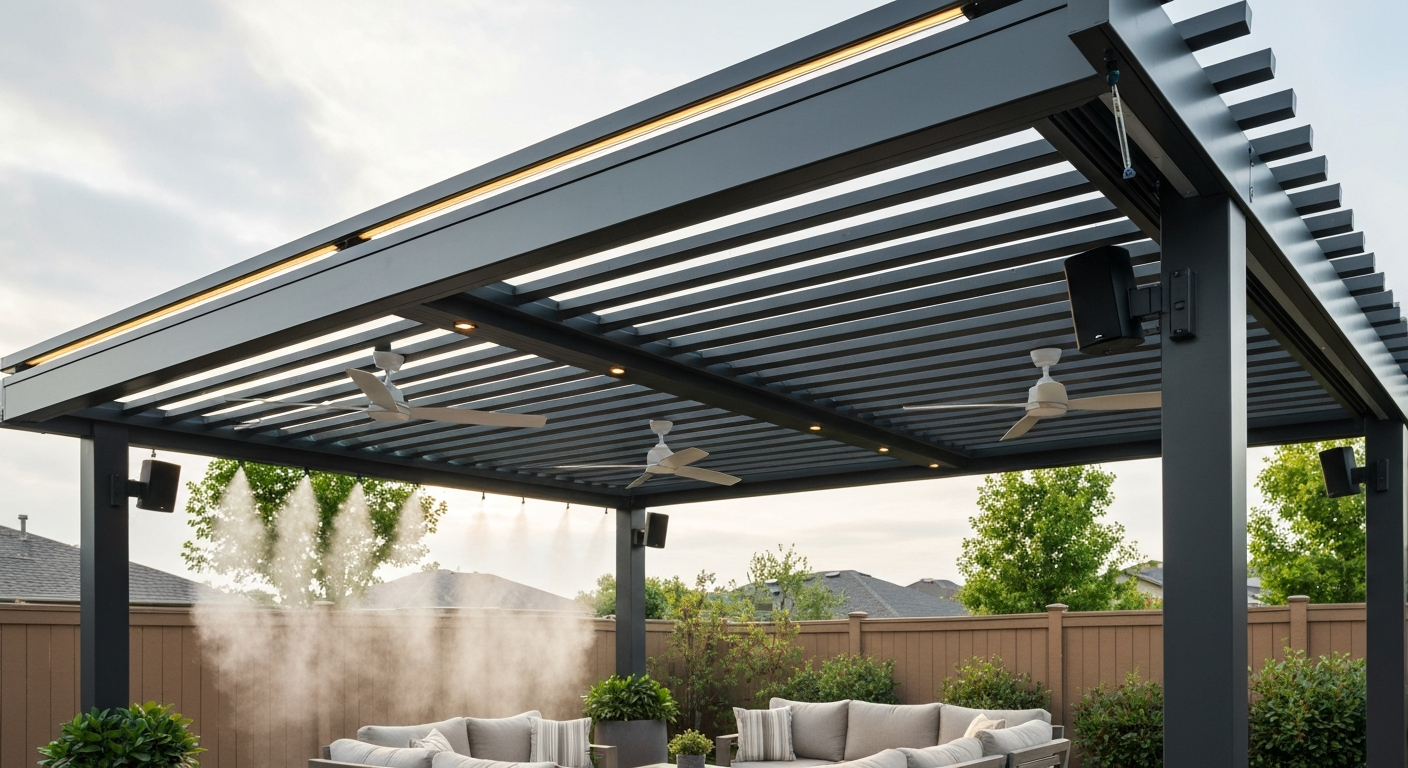
Motorized louvered pergolas sit at the premium end, typically $8,000 to $25,000 installed depending on size, materials, and integrated accessories (fans, heaters, LED strips, speakers). The adjustable aluminum louver slats let you dial in shade and ventilation independently, which is a genuine functional advantage over a fixed cover. The tradeoff is installation complexity: these structures typically require footing permits, structural engineering sign-off in many jurisdictions, and connection to a 120V or 240V circuit. IBC Appendix I covers structural provisions for patio covers and is the code framework most local building departments reference, Los Angeles County, for example, has specific plan-check procedures for attached patio covers, and Miami-Dade County requires product approval verification for hurricane-zone compliance. Budget extra time for permits: timelines range from a few days to several weeks depending on jurisdiction backlog and project complexity.
Wood pergolas with shade sails or fixed lattice roofs occupy the middle ground aesthetically and structurally. A DIY cedar or redwood pergola can be built for $2,000-$6,000 in materials, but requires basic carpentry skills, appropriate footings, and in many jurisdictions a permit for attached structures. Composite pergolas (cellular PVC or wood-polymer blends) eliminate the rot and repainting burden of wood while retaining the visual warmth, but typically cost 20-40% more than equivalent wood.
| Cover Type | Installed Cost Range | DIY Friendly | Climate Best Fit | Permit Typically Required | Lifespan |
|---|---|---|---|---|---|
| Manual retractable awning | $500–$1,500 | Yes (wall mount) | Mild climates, light rain | Rarely for freestanding; often for attached | 7–15 years (fabric) |
| Motorized retractable awning | $1,500–$3,500 | Partial (needs electrician) | Mild to moderate; retract in high wind | Sometimes | 10–20 years (motor/frame) |
| Fixed aluminum patio cover | $3,000–$8,000 | No (structural) | Hot, sunny, high UV | Yes — most jurisdictions | 25–40 years |
| Motorized louvered pergola | $8,000–$25,000 | No | All climates with accessories | Yes — structural + electrical | 20–30 years |
| Wood pergola (DIY) | $2,000–$6,000 materials | Yes (moderate skill) | Mild to moderate | Yes if attached | 10–20 years with maintenance |
| Composite pergola | $5,000–$14,000 installed | Partial | Humid climates (no rot) | Yes if attached | 25+ years |
Misting systems
A well-designed high-pressure misting system (operating at 800-1,000 psi) can drop the perceived temperature on a covered patio by 15 to 25 degrees Fahrenheit in dry climates like Arizona, Nevada, and inland California. In high-humidity markets like Houston or Miami, mid-pressure systems (150-250 psi) work better because they produce slightly larger droplets that evaporate faster in damp air without leaving surfaces wet. Low-pressure systems that connect to a standard garden hose (under 80 psi) are inexpensive ($30-$150) but produce droplets that soak surfaces and people, I would only recommend them for open, uncovered spaces. High-pressure residential kits from brands like Aero-Mist, MistAway, and Cool-Off range from $300 to $800 for a 10-12 nozzle setup; professional installation adds $200-$600 depending on complexity. Maintenance is straightforward: flush nozzles monthly, replace nozzle tips annually (or more frequently with hard water), and winterize the lines in freeze-prone climates.
Outdoor speakers
For covered patios, look for a minimum IP55 rating (protected against dust and low-pressure water jets per IEC 60529). IP65 is better if the speaker will be fully exposed to rain. Polk Audio's Atrium series has earned consistent high marks from outdoor audio reviewers and DIY installers alike: the Atrium 4, 5, and 6 models run $100-$200 per speaker with good mid-range clarity for music and speech at typical patio distances. Sonos and Bose outdoor speakers step up to $500-$1,200+ per pair and offer better soundstage and smart-speaker integration but require Wi-Fi reliability outdoors. For true stereo coverage on a large patio, plan for two pairs of bookshelf-style speakers or a dedicated in-ceiling/in-wall system under a solid cover. Speaker wire should be rated for direct burial or outdoor use (CL3 or CL2 rated) and routed in conduit if exposed.
Ceiling and tower fans
The single most important label to check on any outdoor ceiling fan is the UL listing: UL Damp is the minimum for covered patios protected from direct rain, and UL Wet is required for exposed or semi-exposed locations. Fans rated only for dry locations will corrode and can create an electrical hazard outdoors. Hunter, Minka Aire, and Big Ass Fans (Haiku outdoor series) all produce well-reviewed UL Wet-rated outdoor fans in the $150-$800 range. For very large covered patios (over 400 sq ft), a single fan is usually insufficient, plan for one fan per 75-150 square feet of covered area for meaningful air movement. Tower fans are a portable alternative for uncovered areas but are not a substitute for ceiling fans in a designed patio space: they are more vulnerable to wind disruption and have shorter outdoor lifespans.
Structural solutions: footings, posts, and attachments
The structural side of a patio project is where most DIY homeowners underestimate the complexity. Attached patio covers transfer lateral and vertical loads to the primary dwelling's framing, if the ledger board attachment is not engineered correctly, you face both safety risk and code violation. ASCE/SEI 7 is the standard designers use to calculate site-specific wind and snow loads; in practice, your local building department will require calculations (sometimes stamped by a structural engineer) for any attached cover above a certain size. Miami-Dade's product-approval requirement is the most rigorous in the country, but similar wind-zone considerations apply along the Gulf Coast and in mountain snow-load zones. Freestanding structures with proper footings (typically 12-18 inch diameter concrete piers, depth determined by frost line) are somewhat simpler from a code standpoint but still typically require permits for structures over 200 square feet or those with electrical connections. Always check your local jurisdiction before pouring concrete, permit fees for covered-patio work commonly run $150-$600, and the cost of building without a permit (remediation, resale disclosure, insurance implications) is far higher.
Materials comparison: aluminum, wood, composite, and outdoor fabrics
The material you choose for your patio cover and structure shapes everything downstream: maintenance burden, longevity, regional suitability, aesthetics, and total cost. Here is how the main options stack up, and where each one makes the most sense.
| Material | Typical Cost (installed per sq ft) | Durability | Maintenance | Best Climate Fit | Aesthetic |
|---|---|---|---|---|---|
| Aluminum | $15–$35 | 25–40 years; rust-free | Low — occasional wash, paint touch-up | Hot/humid, coastal, high UV | Modern/clean; powder coat color choices |
| Wood (cedar/redwood) | $20–$45 | 10–20 years with upkeep | High — annual seal or stain, check for rot | Mild, dry climates | Warm, natural; premium look |
| Composite (wood-polymer) | $25–$55 | 25+ years; no rot | Low — periodic cleaning only | Humid, coastal, freeze-thaw | Wood-like but less character |
| Outdoor fabric (awning/canopy) | $3–$12 per sq ft fabric only | 7–15 years (fabric life) | Medium — cleaning, retraction in storms | All climates (with proper spec) | Soft, residential; many colors/patterns |
| Vinyl / PVC (lattice, screens) | $10–$25 | 15–25 years | Low — hose-down cleaning | Hot and humid (good for screens) | Functional; limited aesthetic warmth |
Aluminum is the workhorse of the patio industry for good reason. It does not rot, it holds powder-coat finishes well in UV-heavy environments, and it is the standard structural material for louvered roofs, screen enclosures, and most manufactured patio covers. If you are in Florida, Arizona, or any coastal market, aluminum frames are almost always the right call. Wood brings warmth and customizability that aluminum cannot replicate, but it demands honest commitment to annual maintenance. I have seen gorgeous cedar pergolas turn grey and punky within five years in humid climates because the homeowner assumed it would 'take care of itself.' If you love wood, budget for a proper stain or sealant every 1-2 years and inspect for rot annually at post bases, that is where moisture damage starts. Composite materials are a reasonable middle ground in very humid or coastal environments where wood rot is a near-certainty but you want the visual warmth of grain texture.
For fabrics, the ASTM D4847 standard is the reference point for awning and canopy performance. That standard covers tensile strength, tear resistance, water repellency, colorfastness, and flammability. When a manufacturer references compliance testing against those criteria, it means the fabric has been independently evaluated, not just described in marketing language. Ask for the fabric specification sheet before purchasing any retractable awning or shade sail. Heavier solution-dyed acrylic fabrics (like Sunbrella) maintain color significantly longer than polyester alternatives in high-UV environments and are the standard recommendation for premium awning applications. In fire-risk zones (WUI zones in California and the Mountain West), look for fabrics with a California Title 19 or NFPA 701 fire-retardant rating, this is the core value proposition of TEC Patio FR's product line.
Climate control by region: matching your system to your weather
The best patio climate strategy in Phoenix is completely different from the right approach in Minneapolis or Charlotte. In the desert Southwest (Arizona, Nevada, inland California), shade and misting are the two highest-impact investments, a high-pressure misting system under a solid aluminum cover can make a patio genuinely usable from May through September when it would otherwise be uninhabitable. In humid Gulf Coast markets (Houston, New Orleans, Tampa), misting adds little benefit because the ambient humidity is already near saturation; ceiling fans, proper ventilation design, and screened enclosures to block mosquitoes and wind-driven rain are far more effective. In the Mountain West (Colorado, Utah, Montana), you are designing for both summer heat and early-season snow loads, ASCE 7 snow-load parameters for those zip codes should drive your structural specification, and retractable or motorized systems that can be closed in winter extend your usable season significantly. In the upper Midwest and Northeast, maximizing shoulder-season usability (April-May and September-October) means a focus on wind protection and infrared patio heaters rather than cooling systems. Regional contractor knowledge matters here, a patio installer who works regularly in your market will know the local permit norms and the weather loads your structure must handle.
Installation vs. DIY: what you can realistically do yourself
I am broadly pro-DIY for the components that are genuinely DIY-appropriate, but honest about where hiring out saves you money in the long run. Here is a practical breakdown.
| Task | DIY Realistic? | Why / Why Not | Typical Professional Cost |
|---|---|---|---|
| Wall-mounted retractable awning (manual) | Yes | Straightforward lag-bolt installation into blocking; no electrical | $200–$600 labor |
| Wall-mounted motorized awning | Partial | Mounting is DIY; motor wiring needs licensed electrician | $400–$900 labor + electrical |
| Freestanding pergola kit (wood or aluminum) | Yes (moderate skill) | Kit systems designed for DIY; footings require care | $800–$2,500 labor |
| Attached aluminum patio cover | No | Ledger attachment, structural loading, permit required | $1,500–$4,000 labor |
| Motorized louvered pergola | No | Structural, electrical, permit — multiple licensed trades | $3,000–$8,000+ labor |
| Misting system (high-pressure) | Partial | Line routing is DIY; pump installation benefits from plumber | $200–$600 labor |
| Outdoor ceiling fan | Yes (basic electrical) | Standard junction box swap; use UL Wet-rated fan and box | $100–$250 labor |
| Outdoor speaker wiring | Yes | Use CL3/CL2-rated wire; conduit in exposed runs | $150–$400 labor |
A note on permits: skipping a permit to save time or money is a short-term gain with long-term risk. Unpermitted structures can complicate home sales (requiring disclosure or demolition), may void homeowner's insurance coverage for damage claims, and create liability if someone is injured. Permit fees for a typical covered patio run $150-$600 depending on jurisdiction and project valuation. Plan-check timelines range from a few days for over-the-counter approvals of simple freestanding structures to several weeks for attached covers requiring engineering review. Both Los Angeles County and Miami-Dade County publish detailed guidance on patio cover permit requirements, and most jurisdictions have similar resources online. Los Angeles County publishes a Residential Code Manual with a dedicated Patio Covers guidance (definitions, permit triggers, and plan‑check procedures) titled RESIDENTIAL CODE MANUAL, Patio Covers, Los Angeles County Building & Safety (PDF) RESIDENTIAL CODE MANUAL — Patio Covers — Los Angeles County Building & Safety (PDF).
Maintenance schedules and warranty tips
Most patio cover problems I have seen are the result of deferred maintenance rather than product defects. A simple annual checklist prevents the majority of early failures.
- Spring opening (March-April): Inspect fabric for mildew, tears, or UV degradation; clean with mild soap and water; check all mounting hardware for corrosion or loosening; test motor operation on motorized systems and confirm remote/app pairing
- Mid-season (June-July): Clear debris from louvered channels and gutters; check misting nozzles for clogging (common with hard water); inspect speaker and fan mounting hardware
- Fall closing (October-November): Retract fabric awnings fully before first freeze; drain misting system lines completely; cover exposed motor housings if not IP65-rated; apply wood sealant on any timber elements
- Annual (any season): Lubricate awning arms per manufacturer spec (most specify a silicone-based lubricant); inspect footings for cracking or heave; check all electrical connections for moisture intrusion
On warranties: read the fine print before you buy. SunSetter's ten-year warranty, for example, is well-documented and transferable, but like most manufacturer warranties it is voided by failure to follow the published maintenance schedule or by using the awning in wind conditions above the specified limit. Somfy motor warranties typically cover parts replacement but require that installation was performed by a qualified installer, a DIY motor installation may void the coverage. Always register your product immediately after installation and keep the purchase receipt and installation documentation, since warranty claims without proof of purchase are routinely denied.
Buyer's checklist and decision flow
Before you spend a dollar, work through these questions in order. Your answers will eliminate options that do not fit your situation and focus your budget on what actually matters.
- What is your primary problem to solve: shade, rain protection, wind, heat, noise from neighbors, or aesthetics?
- What is your climate zone and what are the realistic worst-case wind and snow loads? (Check the ASCE 7 Hazard Tool for your zip code)
- Is the structure attached to the home or freestanding? Attached means permits and structural review in almost every jurisdiction
- What is your realistic total budget including installation, permits, and first-year accessories?
- Do you want a permanent structure or something retractable for seasonal use?
- Are you in a WUI fire zone, coastal hurricane zone, or high snow-load area? These drive material requirements
- How much maintenance are you willing to commit to annually? Wood is beautiful but demanding
- Do you want smart-home integration? If yes, confirm your Wi-Fi reaches the patio reliably before specifying smart components
- Are you buying product only or a product-plus-installer package? If the latter, verify contractor licensing before signing anything
Finding and vetting a local patio contractor
The contractor you hire matters as much as the product you choose. A well-made louvered pergola installed incorrectly by an unlicensed crew is both a safety hazard and a warranty liability. Here is the vetting process I recommend, drawn from contractor licensing board guidance.
- Verify the license: Every state has a contractor licensing board with a free public lookup. California's CSLB and Florida's DBPR both offer online license verification showing active status, license classification, bond status, and any disciplinary history. Check this before you take a quote seriously
- Confirm insurance: Ask for a certificate of general liability insurance and workers' compensation coverage. Request that you be named as an additional insured for the duration of the project
- Check their permit history: A contractor who regularly pulls permits in your jurisdiction knows the local code. Ask directly: 'Will you pull the permit for this project?' If they say that is your responsibility, be cautious
- Read review patterns, not averages: Look for recurring themes on BBB, Trustpilot, Google, and Yelp. A contractor with a 4.2-star average but ten complaints about abandoned projects is very different from one with a 4.2-star average and complaints about minor scheduling delays
- Get three itemized quotes: A quote that does not specify materials by brand, gauge, and finish is not a real quote. Make sure permit fees are included or explicitly excluded with an explanation
- Ask about post-installation support: Who do you call if a motor fails in year two? Does the contractor have a service department or do they refer you back to the manufacturer?
Service marketplaces like Angi and HomeGuide can surface local contractors quickly, but treat them as a starting point, not an endorsement. The vetting steps above apply regardless of how you found the contractor. US Patio Systems' installer network is one of the more structured approaches in the industry, installers are trained on the product line and nominally accountable to the brand, but independent verification of individual installer licensing is still your responsibility as the homeowner.
A final word on online reviews for patio products
Consumer reviews for patio products are genuinely useful when they are real, but the FTC has updated its advertising and endorsement guidance precisely because fake and incentivized reviews are widespread in the home improvement category. When I evaluate review patterns for a brand, I look for specificity (real reviews mention specific products, installation dates, and concrete problems), recency, and volume across multiple platforms. A brand with 200 five-star reviews on its own website and two-star patterns on third-party platforms is telling you something important. Trustpilot's verification tools help, but no platform eliminates the problem entirely. Read critically, weight independently verified reviews more heavily, and cross-check against BBB complaint records before you commit to any brand or installer. The same skepticism applies to any score in this guide, treat it as a starting point for your own research, not a final verdict.
FAQ
What high-level research goals should guide the review guide for fine patio design reviews?
Define scope (whole systems, components, materials, climate control, installation, costs, maintenance, regional suitability, contractor selection); identify audience segments (DIY, hiring homeowners); establish objective scoring criteria (performance, durability, ease of install, cost, warranty, service); collect primary source technical standards and codes; gather manufacturer specs, installer/pricing data, and independent consumer feedback; document permit/structural constraints and regional considerations.
Which technical standards and codes must be consulted and why?
Consult building codes and structural standards to ensure safety and permit accuracy: • Local/adopted building codes and county manuals (e.g., Los Angeles County Residential Code Manual, jurisdiction permit guides) for permit triggers, plan‑check procedures and timelines. • IBC/Appendix I (patio covers) for definitions and structural provisions. • ASCE/SEI 7 for site‑specific wind, snow and seismic design loads. • Miami‑Dade product approval listings for hurricane/impact approvals in coastal/high‑wind jurisdictions. These sources validate design limits, load requirements and permitting requirements cited to homeowners.
What product performance and safety standards should I research for motors, enclosures and fabrics?
Gather these standards to evaluate durability and suitability: • IEC 60529 (IP ratings) for water/dust resistance of motors and control enclosures. • UL motor testing/listings (UL 1004 series) for motor safety and performance. • ASTM textile/awning standards (e.g., ASTM D4847) for fabric strength, water resistance, colorfastness and flammability. Use manufacturer test reports and certification documents to substantiate claims.
What manufacturer and installer documents are essential to collect?
Collect owner/installation manuals, spec sheets, maintenance guides and warranty documents from manufacturers (e.g., Somfy, SunSetter) and major brands (Patio Magic, Smart Patio Plus, TEC Patio FR, US Patio Systems). These primary documents provide torque/power specs, installation complexity, required installer qualifications, recommended maintenance intervals, warranty durations and transferability clauses—key inputs for scoring and homeowner guidance.
What market and pricing data sources should be used to compile cost ranges and installed‑price estimates?
Use a mix of national cost aggregators, marketplaces and local installers: • HomeAdvisor, Angi, HomeGuide and RemodelingExpense for national installed price ranges and state‑by‑state variation. • Manufacturer suggested retail prices and distributor quotes for component costs. • Local contractor quotes and marketplace listings to validate regional installed costs and typical add‑ons (speakers, misting, electrical). Document date and geography for all price data.
How should consumer experience and reliability be researched?
Triangulate consumer feedback across multiple platforms: • Aggregators and complaint databases: Better Business Bureau, Trustpilot, Google Reviews, Yelp to identify recurring reliability or service issues. • Warranty claim patterns and service bulletins from manufacturers. • Installer feedback forums, trade groups and vetted social groups for field issues. Apply FTC guidance on evaluating authenticity and disclose limitations of review data.