
For most patios, the best ceiling fan is a wet-rated, 52-inch model with a DC motor, corrosion-resistant blades, and a remote control, and if your patio is under a solid roof or pergola cover with wiring already run, you can have one installed and running this weekend. The Hunter AirStack Outdoor (52") and the Big Ass Fans Haiku L Outdoor are two of the strongest all-around choices available right now, covering the mid-range and premium ends respectively. But 'best' is genuinely different depending on your patio size, your ceiling cover type, your climate, and whether you want an integrated light. Here's how to figure out exactly what fits your situation.
Best Patio Ceiling Fan Guide: Size, Ratings, and Lights

Elise Prescott
29 Apr 2026
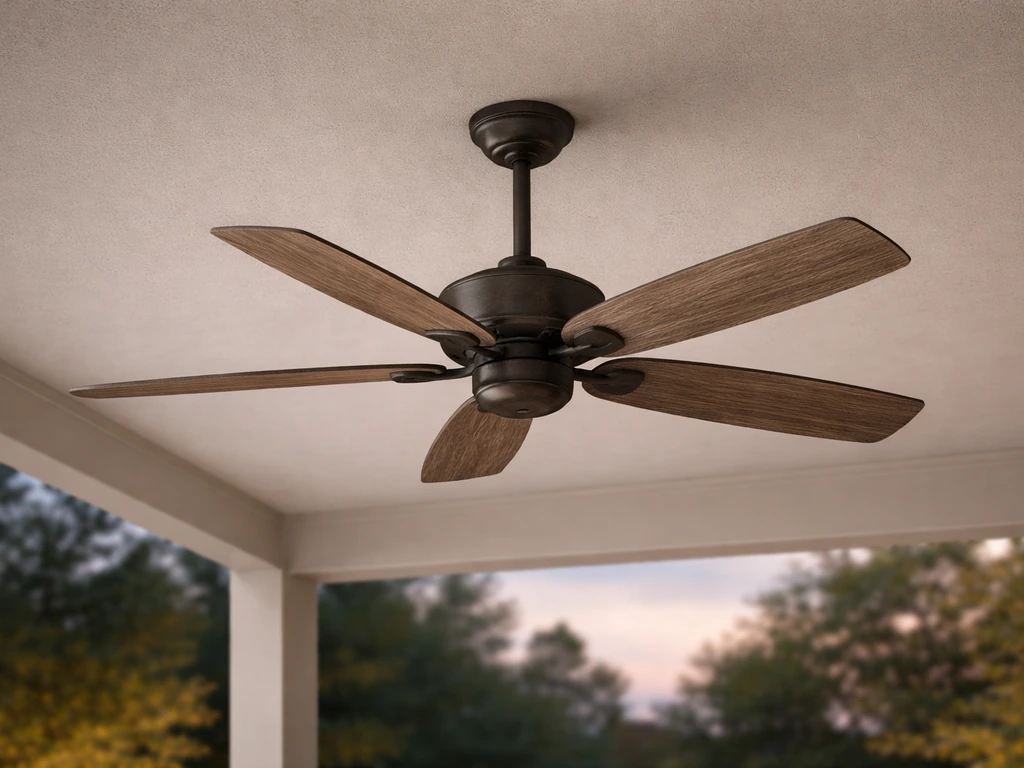
What 'best' actually means for a patio ceiling fan
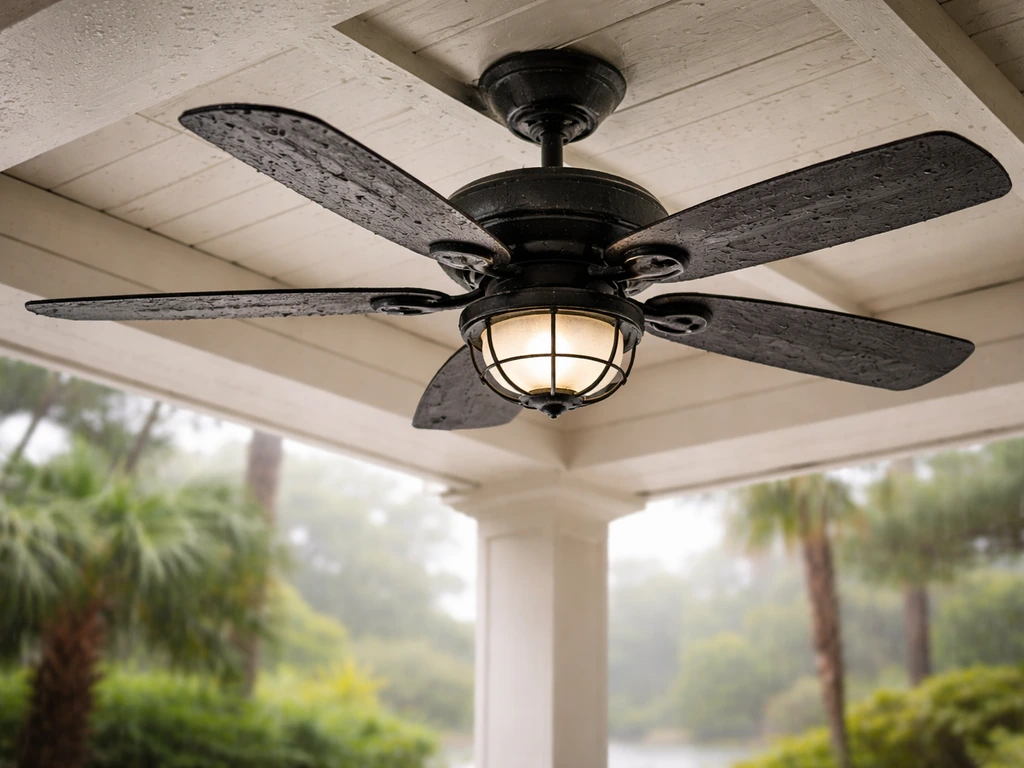
A patio ceiling fan isn't just an indoor fan that lives outside. The outdoor environment, humidity, rain splash, temperature swings, insects, and salt air in coastal regions, will destroy an unrated indoor fan within a season or two. So when someone says 'best,' the baseline has to start with outdoor certification, not style or price.
Beyond the basics, the best fan for your patio is the one that moves enough air for your specific square footage, mounts safely to your ceiling cover type, runs quietly enough that you can have a conversation under it, and doesn't corrode or discolor within a couple of years. If it has an integrated light and remote or app control, even better. Price matters, but a cheap fan that fails in year two costs more than a quality one bought once.
The factors worth weighing are: wet vs. damp rating, motor type (DC vs. AC), CFM airflow, blade material, mounting compatibility with your patio cover, control options, noise level, and warranty. We'll walk through each of these in order so you can build your own shortlist by the end.
Outdoor-safe specs: wet rating, materials, and corrosion resistance
This is the most important section for patio buyers, and it's where a lot of people make expensive mistakes. There are three location ratings for ceiling fans and light fixtures: dry, damp, and wet. UL defines a damp location as a partially protected area, think a covered porch, a patio under a solid pergola cover, or a screen room. A wet location is anywhere blank" rel="noopener noreferrer">water can drip, splash, or flow directly onto the fixture, like an exposed deck overhang, a pergola without a solid roof, or anywhere rain can blow in sideways.
Here's the practical rule: if your patio has a solid roof and the fan won't get rained on directly, a damp-rated fan is technically fine. But if there's any chance of rain contact, wind-driven moisture, or you live in a high-humidity coastal environment, buy a wet-rated fan. The peace of mind is worth the modest price difference, and manufacturers like Hunter specifically build their wet-rated WeatherMax fans for exactly this use case.
For coastal buyers, anywhere within a few miles of salt water, corrosion resistance becomes its own category. Big Ass Fans makes the Haiku Coastal specifically for this environment, using marine-grade 316 stainless steel hardware to resist salt, sun, and wind. Their i6 Outdoor uses aircraft-grade aluminum airfoils with corrosion-resistant components for covered outdoor environments. If you're in Florida, the Gulf Coast, or the Pacific Coast, don't skip this detail, standard aluminum or steel hardware will pit and rust fast.
| Rating | Where it applies | What to look for on the box |
|---|---|---|
| Dry | Fully indoor spaces only | Not appropriate for any patio use |
| Damp | Covered patios, screened porches, sheltered pergolas | UL damp location listing on label |
| Wet | Exposed patios, open pergolas, anywhere rain can reach the fan | "Suitable for Wet Locations" marking per UL |
Beyond the rating itself, look at the blade material. ABS plastic blades hold up well outdoors and resist warping and moisture. Aluminum blades are durable and work great in dry climates. Wood or MDF blades are generally not suited for wet-rated applications unless specifically treated and listed for it. Check the motor housing too, sealed motor housings prevent insects, debris, and moisture from getting inside, which extends motor life considerably in outdoor settings.
Choosing the right size and airflow for your patio
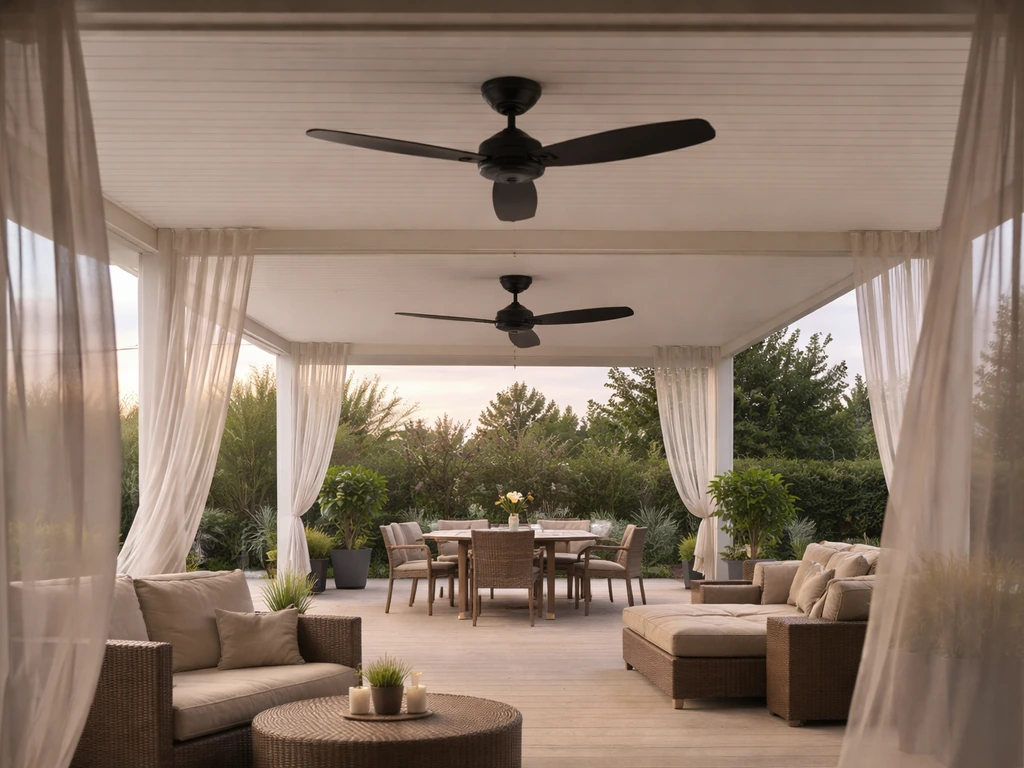
Fan diameter and CFM (cubic feet per minute) airflow are the two numbers that determine whether your patio actually feels cooler or just has a fan hanging on the ceiling. Sizing is more critical outdoors than indoors because you're working with an open or semi-open space, you can't trap the cooled air the way you would inside a room.
As a starting point, use these rough diameter guidelines based on your patio's longest dimension. Under 12 feet: a 42–44" fan is adequate. 12–18 feet: go with a 52" fan, which is also the most common size and gives you the most model options. Over 18 feet: consider a 60"+ fan or two 52" fans spaced evenly. For very large covered patios or commercial-style spaces, the Big Ass Fans i6 Outdoor posts up to 17,405 CFM, that's commercial-grade airflow for a very large area. For a typical 15x20 suburban patio, the Hunter AirStack's 6,628 CFM at high speed is more than enough.
- Patio under 150 sq ft: 42–44" fan, 3,000–5,000 CFM
- Patio 150–300 sq ft: 52" fan, 5,000–7,500 CFM
- Patio 300–500 sq ft: 60"+ fan or two 52" fans, 7,500–12,000+ CFM
- Large open or commercial patio: commercial-grade fan (i6 Outdoor class), 12,000–17,000+ CFM
Mounting height matters as much as diameter. The sweet spot is having the lowest point of the fan blades at least 7 feet above the floor, Big Ass Fans explicitly calls this out in their sizing guidance. If your patio ceiling is 8 feet, you'll want a flush-mount (hugger) style or a short downrod to keep clearance in the safe zone. For ceilings at 10 feet or higher, a longer downrod brings the fan down into the effective airflow zone for people sitting below. Keep at least 2 feet of clearance from the fan blades to the nearest wall or post.
One more thing on airflow: ENERGY STAR-certified fans report CFM/watt efficiency, which tells you how much air you're moving per unit of energy consumed. A DC motor fan typically blows an AC motor fan out of the water on this metric. Hunter's AirStack is Energy Star qualified, and the Haiku L is engineered specifically for efficiency. If you're running the fan 8+ hours a day all summer, that efficiency difference adds up on your electric bill.
Patio fan with light: what to actually think about
A lot of patio ceiling fans come with integrated LED lights or accept light kit add-ons, and for most people that's a huge bonus since it eliminates the need for a separate light fixture on the ceiling. But outdoor fan lights have a few specific things worth checking before you buy.
First, the light kit itself needs to be rated for the same location as the fan. A wet-rated fan with a dry-rated light kit defeats the purpose. Look for sealed or enclosed light kits specifically listed for outdoor/wet use when buying a wet-rated fan. Big Ass Fans' Haiku light kit, for example, is built as part of the sealed system with specs like 1,280 lumens output and color temperatures ranging from 2,700 K to 4,000 K depending on configuration.
On brightness and color temperature: 1,280 lumens is solid for ambient patio lighting, enough to see clearly but not so harsh it kills the mood. For a warm, inviting atmosphere (which most people want on a patio), look for 2,700 K to 3,000 K color temperature. The Haiku L Outdoor puts out light at 2,700 K, which is a warm, incandescent-like tone. Hunter's Sentinel with LED Light spec lists 3,000 K, a slightly crisper warm white. Both work well outdoors; 2,700 K feels cozier, 3,000 K reads as slightly brighter.
Dimming is worth having on a patio light. The Haiku L offers 16 levels of brightness control, and the Haiku fan light kit uses PWM-based dimming. Hunter's Sentinel uses a handheld remote that controls both fan speeds and LED dimming in one unit. If you're planning to use the patio for both entertaining and relaxed evenings, the ability to dial the light down without a separate switch is genuinely useful.
One wiring note: if your patio ceiling box is on a single-switch circuit, you may not be able to independently control the fan and light without adding a receiver or upgrading to a smart fan system. More on that in the next section.
Controls, noise, and day-to-day comfort
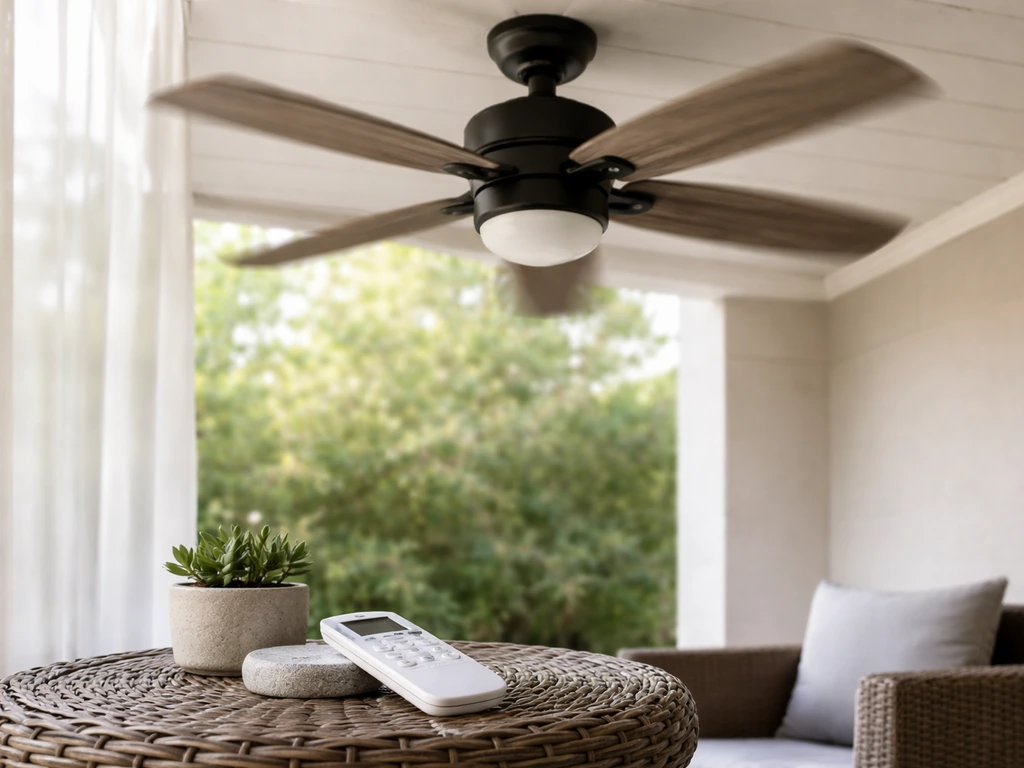
The control options available on patio ceiling fans have improved a lot in the past few years, and it's worth spending five minutes thinking about what you actually want before buying. Pull chains are fine for garages and utility spaces but feel out of place on a finished patio. A handheld remote is the minimum I'd recommend for patio use, it lets you adjust speed and light from your chair without standing up.
Many fans now come with remote receivers built directly into the fan housing at the factory, which simplifies installation considerably. Hunter fans with preinstalled receivers pair with handheld remotes and optional wall controls. For a more integrated setup, Big Ass Fans' Haiku Coastal and Haiku L both support app-based smart control through the Big Ass Fans app, which lets you set schedules, adjust speed by percentage, and even integrate with smart home systems. If you're building out a smarter patio, that level of control is genuinely useful, especially for automating the fan based on time of day or temperature.
Noise is a bigger deal on a patio than most people expect. Outdoor environments are quieter in the evenings, so a fan that hums or wobbles is more noticeable. DC motor fans run significantly quieter than AC motor fans because the motor operates at variable speeds rather than fixed poles. Big Ass Fans claims less than 35 dBA on both the i6 and the Haiku L at max speed, that's whisper-quiet in practice. Hunter's mid-range models are reasonably quiet but won't match a premium DC motor on this spec. If noise is a dealbreaker for you, prioritize DC motor fans.
| Control Type | Best for | Downside |
|---|---|---|
| Pull chain | Budget installs, utility patios | Not usable from seating area |
| Handheld remote | Most residential patios | Easy to lose the remote |
| Wall control | Fixed seating layouts, cleaner look | Requires wiring to wall location |
| App / smart control | Tech-forward setups, scheduling use | Higher cost, needs Wi-Fi |
Installation checklist for patio covers
Installing a ceiling fan on a patio is different from a standard indoor install in a few important ways, and getting these details right is what separates a fan that lasts 10 years from one that creates a safety hazard. Here's what to check before and during installation.
The outlet box
This is the single most overlooked part of a patio fan install. NEC rules are clear: if a ceiling fan relies on the outlet box for sole support, that box must be listed and marked for fan support. Big Ass Fans specifies that the outlet box should be rated for fan support up to a specific weight, for the i6, that's a 70 lb rating. Standard light-fixture boxes are not rated for fan support and can pull out of the ceiling over time, especially with the dynamic load of a spinning fan. If you're not sure what box you have, replace it before hanging any fan.
Mounting height and downrod selection
Aim for blade tips at least 7 feet above the finished floor, and at least 2 feet of clearance from blades to the nearest wall or structural post. For vaulted or angled ceilings on covered patios, check the fan's maximum slope tolerance before buying. The Haiku L, for example, allows mounting on ceiling slopes up to 33 degrees. Some fans require a specific angled canopy adapter for sloped ceilings, don't assume your chosen fan ships with one.
Electrical requirements for outdoor fans
Wet-rated fans installed in exposed outdoor locations require GFCI protection on the branch circuit, this is a code requirement, not optional. Big Ass Fans explicitly calls this out in the Haiku Coastal installation guide for exposed installations. Also, in exposed outdoor locations, the wiring cover above the fan must be permanently and fixedly covered so water cannot enter the wiring compartment. If your patio is covered (solid roof), you have more flexibility, but GFCI protection is still strongly recommended for any outdoor circuit.
DIY vs. hiring a pro
If you have a wired ceiling box already in place and are comfortable with basic electrical work, swapping in a new fan is a reasonable DIY project. If you're running new wire, adding a GFCI circuit, or working with a complex patio cover structure (like a wood pergola with structural members), hire a licensed electrician. The cost of a professional install is typically $150–$350 depending on your market, and it's worth it for anything that involves new wiring or uncertain junction box situations. Permit requirements vary by jurisdiction but are common for new circuits, check with your local building department before starting.
- Confirm outlet box is rated for fan support (check for fan-rated marking or replace it)
- Verify the circuit is GFCI-protected, especially for wet-rated fans
- Measure ceiling height and choose the correct downrod length to hit 7 ft clearance
- Check ceiling slope if applicable — confirm the fan's max slope tolerance
- For fans with remote receivers, decide if receiver will be built-in or canopy-mounted
- Turn off power at the breaker before starting any wiring work
- For smart fans, ensure Wi-Fi reaches the patio before purchasing an app-connected model
How to compare models and pick the right fan today
Here's a practical framework for shortlisting. First, filter by wet vs. damp rating based on your specific patio setup. Then filter by blade span using the sizing guide above. Then check CFM at high speed against your square footage, for most patios, 5,000–7,500 CFM from a 52" fan is the target. Finally, layer in control preferences, light requirements, and budget.
| Fan | Size | CFM (High) | Noise | Location Rating | Controls | Best for |
|---|---|---|---|---|---|---|
| Hunter AirStack Outdoor | 52" | 6,628 CFM | Moderate | Wet-rated | Remote included | Mid-budget, most patios |
| Hunter Sentinel with LED | 52" | Not published | Moderate | Damp-rated | Remote + dimmer | Covered patio with light priority |
| Big Ass Fans Haiku L Outdoor | 52" | High (varies by speed) | <35 dBA | Wet-rated | App + remote | Premium, quiet operation |
| Big Ass Fans Haiku Coastal | 52" | High (varies by speed) | <35 dBA | Wet-rated (marine grade) | App + remote | Coastal/salt-air environments |
| Big Ass Fans i6 Outdoor | 84"–96" | Up to 17,405 CFM | <35 dBA | Wet-rated | App + BACnet options | Large patios, commercial spaces |
For most homeowners with a standard 200–350 sq ft covered patio, the Hunter AirStack Outdoor 52" is the practical pick: Energy Star certified, 6,628 CFM at high speed, wet-rated, and it comes with a remote. It's widely available at Home Depot and Lowe's, making returns and support easy. If you want premium quiet performance and smart home integration, the Haiku L Outdoor is worth the jump in price, 16 brightness levels, 2,700 K warm light, app control, and near-silent DC motor operation at under 35 dBA. For coastal homes, don't compromise on the Haiku Coastal's marine-grade hardware.
One thing to keep in mind: ceiling fans are the right solution for permanent comfort on a covered patio, but if you're also dealing with a very hot, partially exposed space, you might want to consider supplementing with a patio cooling fan or misting system to handle peak summer heat. If you want airflow from the ground instead of from the ceiling, the best floor fan for patio can be a practical way to target hot spots. If you need extra relief during peak heat, the best patio cooling fan can complement your ceiling fan with targeted airflow. For a quick fix, the best blower for patio can also provide focused airflow where your ceiling fan does not reach. Ceiling fans move air effectively but don't lower ambient temperature on their own, they create a wind-chill effect for people in the space. For open or partially exposed patios where ceiling mounting isn't practical, a floor fan or pedestal option is a separate decision worth thinking through. For more guidance on the best style of patio fan setup, see the recommendations on what type of fan is best for an outdoor patio what type of fan is best for outdoor patio.
Bottom line: measure your space, confirm your ceiling cover type and wiring situation, pick a wet or damp rating accordingly, match the blade span to your square footage, and decide whether you want a light kit and smart controls. Do those five things and you'll have a short list of two or three fans that are genuinely the best options for your specific patio, not just the most marketed ones.
FAQ
If my patio is covered, when should I still buy a wet-rated patio ceiling fan instead of a damp-rated one?
Choose wet-rated if there is any possibility of direct rain splash, wind-driven water, or water pooling near the fan, even under a pergola. Also go wet-rated if the ceiling cover is open on the sides or the fan is near an overhang edge where rain can blow in.
Do I need to run ceiling fans on separate switches if I want independent control of the fan and the integrated light?
Not always, but often. If your ceiling box is on a single-switch circuit, fan and light may only turn on together. For independent control, you may need a compatible controller/receiver setup, a second switch, or a smart fan system that supports separate fan and light commands.
What happens if the fan blades are too low or too close to a wall or post?
Too-low blade tips reduce safety clearance and can interfere with seating or foot traffic, and fans can also wobble if mounting or airflow is constrained. Too-close clearance can increase blade strike risk and reduce effective airflow, making the fan feel weaker even when CFM is high.
How important is CFM compared to fan diameter for a patio?
Diameter affects the airflow footprint, but CFM determines how much air actually moves. For patios, a 52-inch fan is often the practical sweet spot, but if your CFM is far below what the square footage needs, you will feel only light circulation rather than true cooling wind.
My patio has a sloped or vaulted ceiling, how do I confirm the fan will mount correctly?
Check the fan’s maximum slope tolerance and whether it includes the correct angled canopy or downrod adapter. If the listed slope limit is exceeded, you can end up with poor blade clearance, airflow aimed incorrectly, or an unsafe tilt that causes wobble.
Can I use a patio ceiling fan outdoors with a ceiling box that is not specifically rated for ceiling-fan support?
No. Ceiling-fan installs must use a listed fan-support outlet box, not a standard light fixture box. If you cannot confirm fan-rated weight capacity, replace the box before installing to avoid long-term pull-out and wiring strain.
Do outdoor patio ceiling fans need GFCI protection even if the fan is under a solid roof?
Wet installations require GFCI protection by code. Even when a fan is under a solid roof, using GFCI protection is still strongly recommended for outdoor circuits because moisture exposure and splash risk can still occur, especially around electrical penetrations.
What’s the safest way to reduce patio fan wobble or noise after installation?
Verify the ceiling outlet box is fan-rated and properly secured, confirm blades are fully tightened, and ensure the fan is balanced by using the manufacturer’s balancing kit if provided. Also make sure the downrod length and canopy fit the listed installation instructions, incorrect alignment is a common wobble cause.
Are wood or MDF blades ever acceptable for an outdoor patio ceiling fan?
Only if they are specifically listed for wet-rated outdoor use. General-purpose wood or MDF blades can warp, swell, or degrade outdoors. If the fan is wet-rated, use blades intended for that environment, materials like ABS or corrosion-resistant metal are typically the safest choices.
How do I decide between remote control and app control for a patio ceiling fan?
If you mainly want to adjust speed and light from the seating area, a handheld remote is usually the simplest and most reliable. Choose app control if you want scheduling, automation, or temperature and time routines, but confirm Wi-Fi reliability where the fan is installed and check whether the app requires a compatible controller.
How should I choose the color temperature of the outdoor light kit for a patio?
For a warmer, mood-friendly glow, look around 2,700 K to 3,000 K. If your patio is used for tasks like grilling or reading, slightly higher color temperatures often provide better visibility. Also check whether the light kit supports dimming, dimming lets you keep ambiance without turning the space harshly bright.
If I run the patio fan many hours per day in summer, what feature affects electricity costs the most?
Motor efficiency, often reflected in CFM per watt or Energy Star classification. DC motor fans generally deliver better efficiency at typical operating speeds. Even if price is higher, the long daily runtime can make efficiency savings noticeable on utility bills.
Should I add a cooling fan or misting system instead of relying on a ceiling fan alone?
Consider supplementation if your patio is very hot and partially exposed, because ceiling fans mainly create comfort via wind-chill rather than lowering ambient air temperature. Misting can increase perceived cooling, but use equipment rated for the outdoor environment and avoid adding moisture near electrical components without proper clearance and safety design.
How can I sanity-check airflow expectations for my patio before buying?
Measure your patio’s usable square footage and verify your target fan size and CFM at high speed. If you typically run the fan on low to medium, check whether the low/medium airflow still meets your comfort needs, high-only numbers can overestimate how strong it will feel during normal use.